

5.11 - Catalysis
Overview
A catalyst is a substance that speeds up a reaction without being used up overall. Catalysts are everywhere: enzymes speed up most of the reactions in your cells, and the catalytic converter in a car cleans up its exhaust. This topic explains how a catalyst works at the particle level. It changes the mechanism, giving the reaction a new path with a lower activation energy or more effective collisions. Catalysts do this in three main ways: by binding to reactants, by acid-base catalysis, and by surface catalysis.
How a catalyst speeds up a reaction
For a catalyst to increase the rate, adding it has to increase the number of effective collisions (collisions that lead to products), provide a reaction path with a lower activation energy, or both.
A catalyst doesn't just lower the barrier on the original path. It opens a different path, a new mechanism with new elementary steps and new intermediates. The energy profile shows the difference:
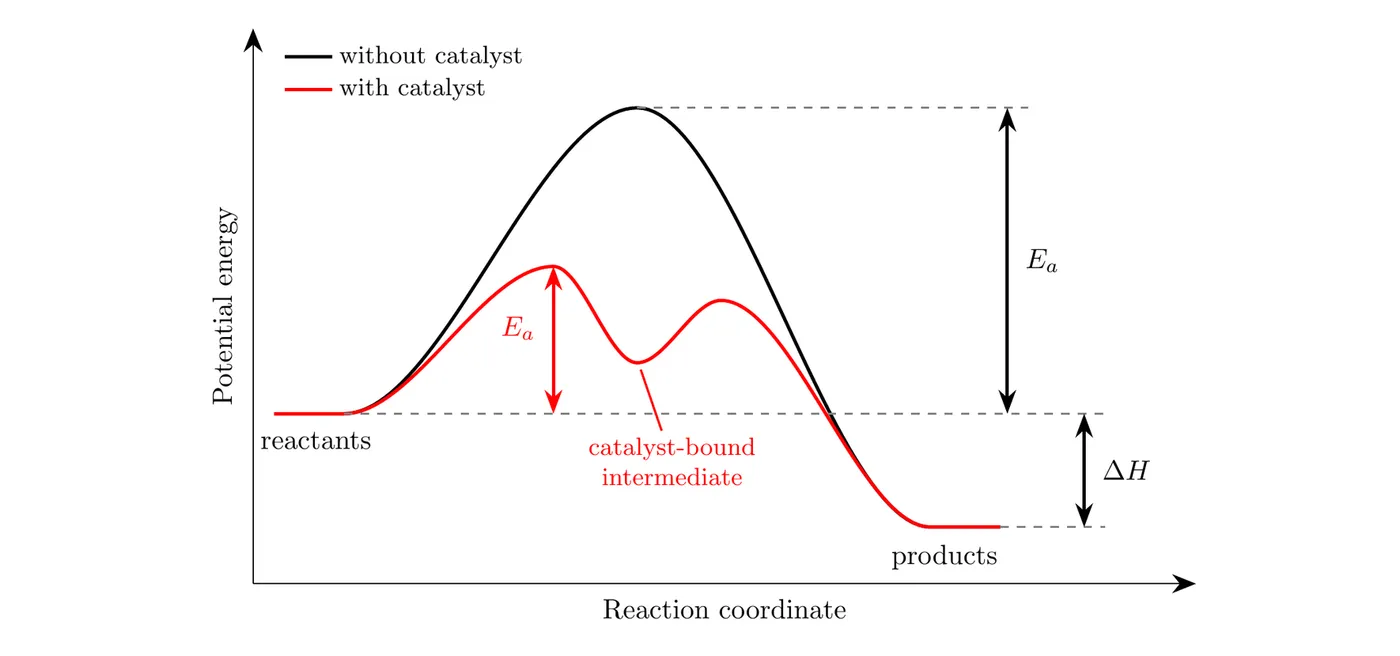
- The catalyzed path has lower peaks. Its highest point is well below the uncatalyzed peak, so its activation energy is smaller.
- It often has more steps. Here the catalyzed path has two humps, with an intermediate in which the catalyst is bound to a reactant.
- The start and end levels don't change. The reactants and products are the same substances, so is the same with or without a catalyst.
- Both directions speed up. The barrier is lower for the reverse reaction too, so a catalyst doesn't change where an equilibrium ends up. It only gets there faster (more on this in Unit 7).
Why a lower activation energy means a faster rate
Recall the Maxwell-Boltzmann distribution from Topic 5.5. At a given temperature, only collisions with energy at or above can react. A catalyst doesn't change the temperature, so the distribution of particle energies stays exactly the same. What changes is the cutoff:
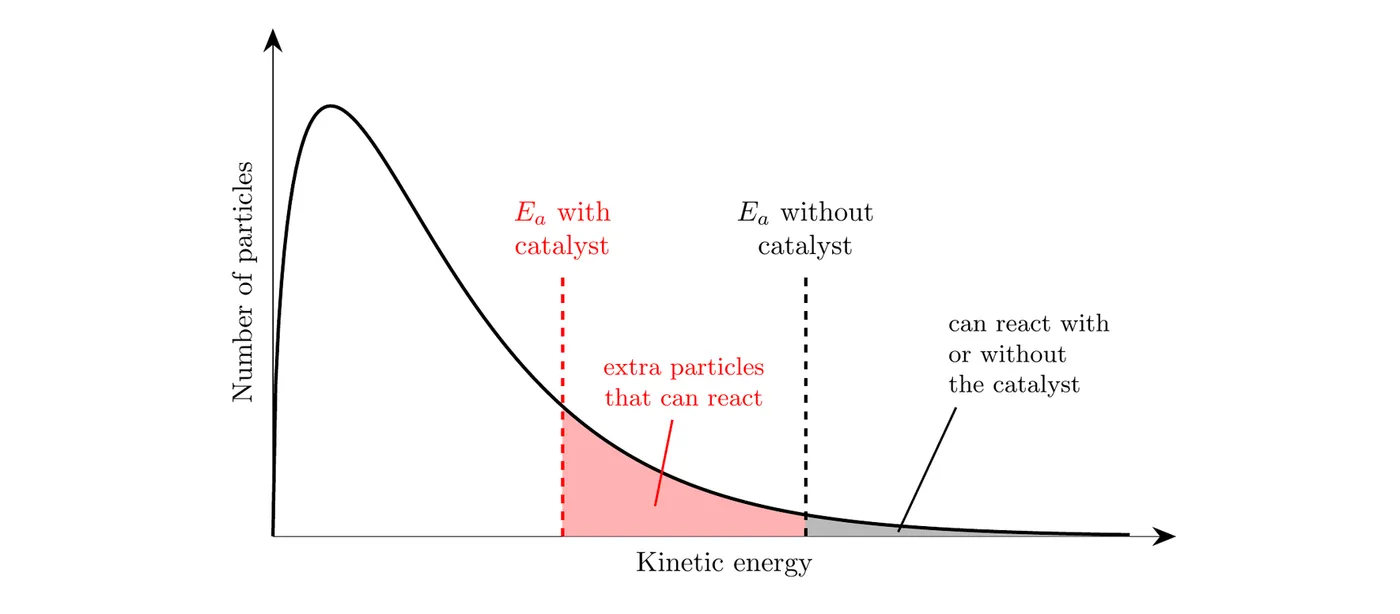
With the lower , the red region is added to the gray one, so a much larger fraction of collisions has enough energy to react. More effective collisions per second means a faster reaction. Small drops in make big differences: at 25 °C, lowering by just 10 kJ/mol speeds up a reaction by a factor of more than 50, if nothing else changes. (That number comes from the Arrhenius equation, and calculations like it are not assessed on the AP exam.)
Compare this with raising the temperature, which speeds up a reaction in a different way. Heating spreads the curve out to higher energies, so more particles pass the same cutoff. A catalyst keeps the curve and moves the cutoff.
Catalysts in a mechanism
In a mechanism with a catalyst, the net concentration of the catalyst stays constant: whatever is used up in one step is made again in a later step. Very often the catalyst is used up in the rate-determining step and regenerated in a step after it. That means the catalyst shows up in the rate law even though it isn't in the overall equation.
Two terms are useful here. A homogeneous catalyst is in the same phase as the reactants (for example, dissolved ions in a solution). A heterogeneous catalyst is in a different phase, usually a solid with gas or liquid reactants.
Example 1: A catalyst in the rate-determining step
Iodide ions catalyze the decomposition of hydrogen peroxide. The proposed mechanism is:
(a) Write the overall equation. (b) Identify the catalyst and the intermediate. (c) Write the rate law. (d) What happens to the rate if is doubled?
(a) Add the steps. and each appear once on each side and cancel:
(b) is used in step 1 and made again in step 2, so it's the catalyst. Everything is dissolved in water, so it's a homogeneous catalyst. is made in step 1 and used in step 2, so it's the intermediate.
(c) Step 1 is slow and bimolecular:
(d) The rate is first order in , so doubling doubles the rate. More catalyst means more and collisions in the slow step each second.
Catalysts that bind to reactants
Some catalysts work by binding to the reactants. Once bound, the reactants are either held in a better orientation for reacting (more of their collisions are effective) or they react with a lower activation energy (for example, because binding stretches the bonds that need to break). This usually creates a new intermediate in which the catalyst is bound to the reactant.
Enzymes work this way. An enzyme is a protein catalyst. The reactant, called the substrate (S), binds to a pocket on the enzyme (E) called the active site, forming an enzyme-substrate complex (ES). The complex reacts, and the product leaves, freeing the enzyme to bind another substrate:
ES is the new intermediate, and the enzyme is regenerated at the end, as a catalyst must be. Because the active site has a specific shape, each enzyme works on only one substrate or a small set of similar ones. For example, the enzyme catalase speeds up the same decomposition of shown in Example 1, protecting cells from this reactive compound.
Acid-base catalysis
Some catalysts form a covalent bond with a reactant. In acid-base catalysis, a reactant or an intermediate gains or loses a proton (). Adding or removing that proton creates a new intermediate and new elementary steps that wouldn't happen otherwise.
Example 2: Acid-catalyzed decomposition of formic acid
In concentrated sulfuric acid, formic acid (HCOOH) breaks down into carbon monoxide and water. The acid's acts as the catalyst in this mechanism:
Identify the catalyst and the intermediates, and explain why this counts as acid-base catalysis.
Answer: Adding the steps gives . is used in step 1 and made again in step 3, so it's the catalyst. and are made and then used, so they're intermediates. This is acid-base catalysis because the reactant gains a proton in step 1 (forming a new bond to ), and an intermediate loses a proton in step 3. With the extra proton attached, the group can leave as a water molecule, which is much easier than breaking the molecule apart without the acid.
Surface catalysis
In surface catalysis, a reactant or intermediate binds to, or forms a covalent bond with, the surface of a solid catalyst, usually a metal. This introduces new elementary steps involving these bound intermediates. A classic example is adding hydrogen to ethene on the surface of a metal such as nickel or platinum:
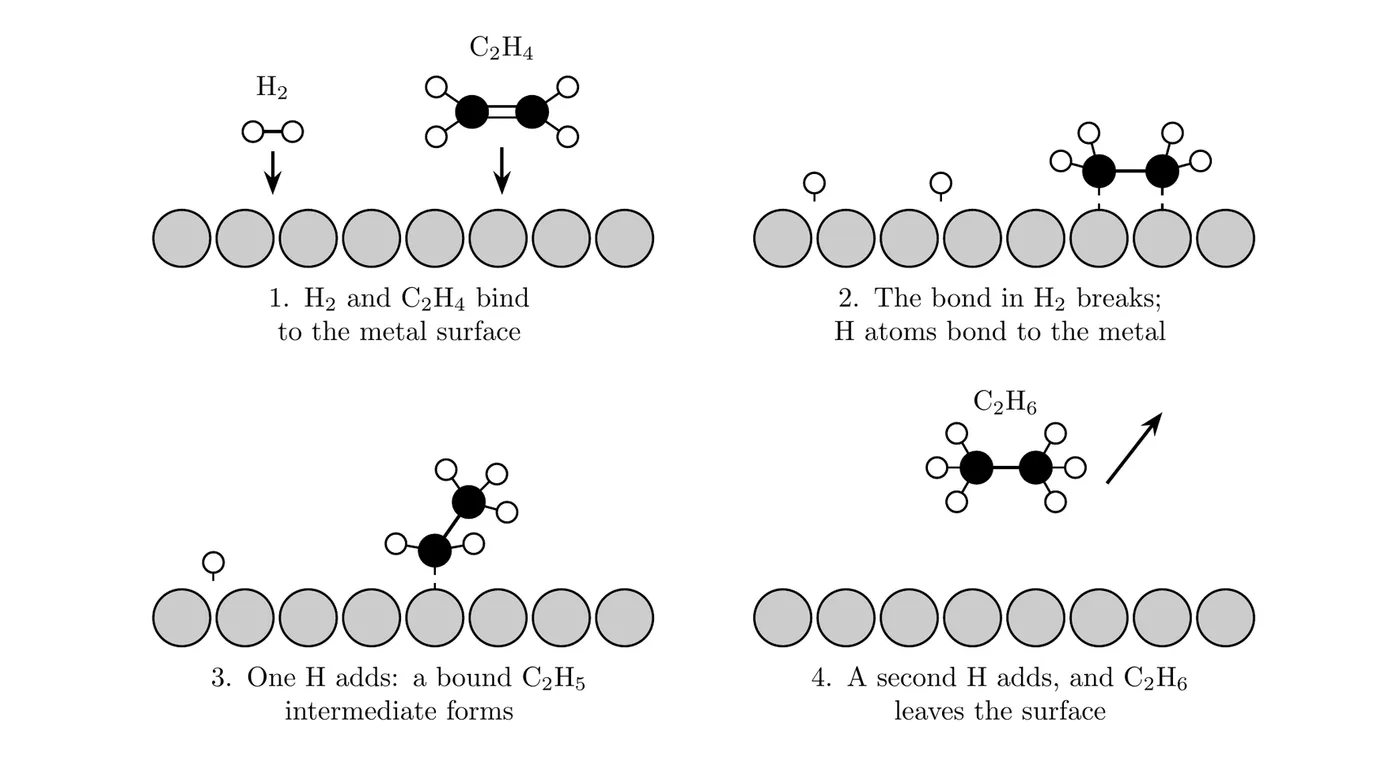
- and bind to the metal surface.
- The bond in breaks, and each H atom forms a bond to the metal. Breaking this bond on its own takes a lot of energy, but the new metal-hydrogen bonds make up much of the cost.
- One H atom moves over and bonds to a carbon atom, forming a bound intermediate.
- A second H atom adds, and the finished molecule leaves the surface. The surface is free to catalyze again.
Because the reaction happens on the surface, catalysts like this are made as fine powders or thin coatings to expose as much surface area as possible. The catalytic converter in a car works the same way: metals such as platinum, palladium, and rhodium bind CO, NO, and unburned fuel on their surfaces and convert them to , , and .
Example 3: Explaining a catalyst at the particle level (AP-style)
A student adds a few drops of potassium iodide solution to a beaker of hydrogen peroxide at room temperature, and oxygen gas bubbles out much faster. A classmate claims, "The catalyst makes the molecules move faster, so they collide harder." Evaluate the claim, and explain the faster rate in terms of collisions and activation energy.
Answer: The claim is incorrect. The temperature didn't change, so the average kinetic energy of the particles and their Maxwell-Boltzmann distribution are the same as before. Instead, the iodide ions provide a new reaction pathway (the two-step mechanism in Example 1) with a lower activation energy. With a lower , a larger fraction of collisions has enough energy to react, so there are more effective collisions per second and forms faster. The is regenerated in step 2, so it isn't used up, and for the reaction is unchanged.
Common mistakes
- Saying the catalyst gives particles more energy. It doesn't change the temperature or the energy distribution. It lowers the energy needed.
- Saying a catalyst changes . Reactants and products are the same, so is the same. The best AP wording is "provides an alternate pathway (mechanism) with a lower activation energy."
- Saying a catalyst is never used up. It is used up in one step, then regenerated in a later step, so its net amount doesn't change.
- Leaving the catalyst out of the rate law. If it reacts in the rate-determining step, it belongs there, even though it's not in the overall equation.
- Thinking a catalyst only speeds up the forward reaction. It lowers the barrier for both directions.