

7.1 - Introduction to Equilibrium
Overview
Many processes in chemistry can run forward and backward. When a reversible process happens in a closed container, it eventually reaches equilibrium: a state where nothing you can observe changes anymore, even though the forward and reverse processes keep going. This topic covers which processes are reversible, what equilibrium looks like in the lab, why it is called dynamic, and how to spot it on a graph. The rest of Unit 7 and most of Unit 8 build on these ideas.
Reversible processes
A reversible process can go in either direction: the products can turn back into the reactants. We show this with a double arrow, . The process read left to right is the forward reaction, and right to left is the reverse reaction. These five kinds come up all through Units 7 to 9, and you should recognize all of them:
Kind of process | Example | Forward / reverse |
Evaporation and condensation (physical) | Liquid evaporates / vapor condenses | |
Absorption and desorption of a gas (physical) | in a sealed soda | Gas dissolves into the liquid / gas escapes from it |
Dissolution and precipitation of a salt (physical) | Solid dissolves / ions rejoin the solid | |
Proton transfer (acid-base) | moves to water / moves back to acetate | |
Electron transfer (redox) | Electrons move from Ag to / from back to |
In principle any reaction can run backward, but for some the reverse reaction is so slight that we treat them as one-way, like burning methane. Topic 7.5 explains this with the size of K.
What equilibrium looks like
Picture some water in a bottle that you seal right away. At first there is very little water vapor above the liquid, so molecules evaporate much faster than they condense, and the amount of vapor grows. The more vapor there is, the more often vapor molecules hit the surface and stick, so condensation speeds up. Eventually condensation catches up with evaporation. From then on, the amount of vapor (and its pressure) stays constant.
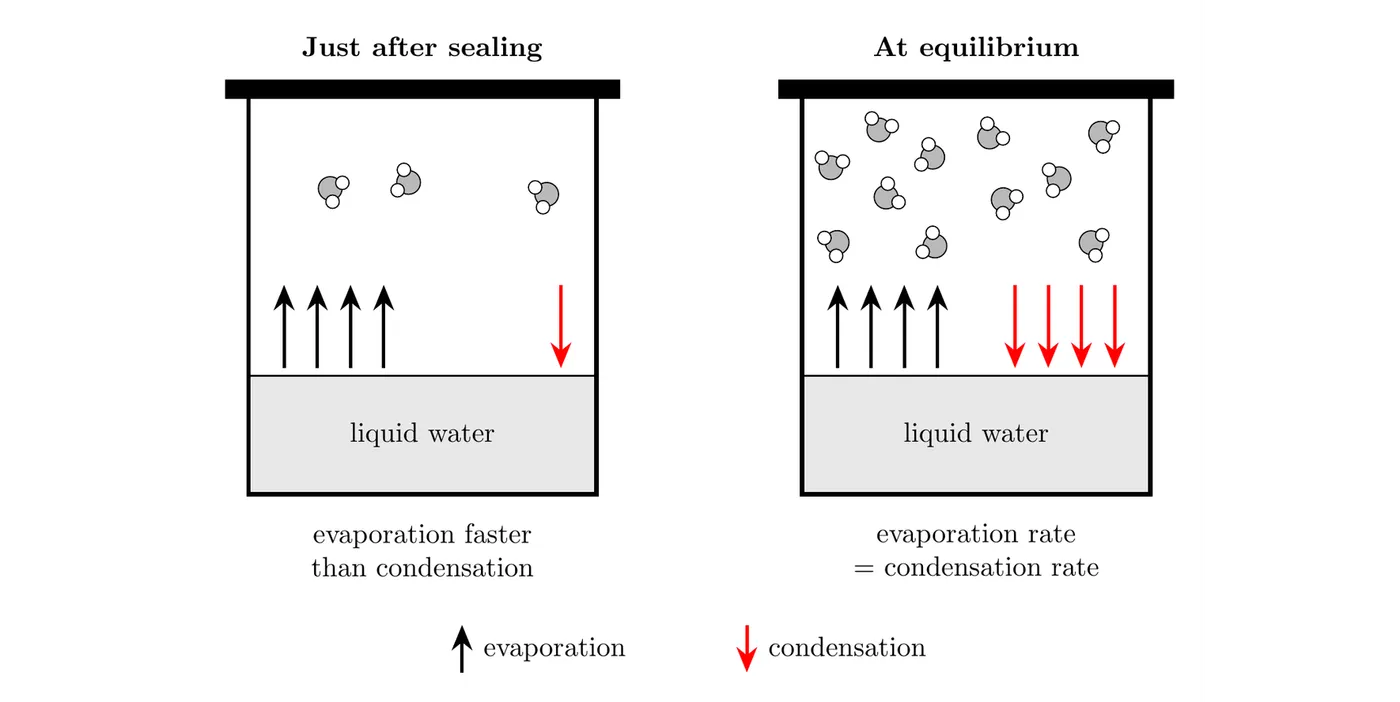
That final state is equilibrium. Every system at equilibrium has these features:
- No observable changes. Color, pressure, temperature, pH, and the amount of any solid all stay constant.
- Reactants and products are both present. The process doesn't run to completion. In the bottle, there is always liquid water and water vapor.
- The concentrations or partial pressures of all species stay constant. Constant does not mean equal. At equilibrium the amounts can be very different from each other.
Equilibrium needs a closed system, where nothing can enter or leave. In an open pot, the vapor drifts away, condensation never catches up, and the water eventually evaporates completely.
Example 1: Vapor in a sealed flask (AP-style)
A student adds 1.00 mL of liquid water (about 1.00 g) to an evacuated 1.00 L flask at 25 °C and seals it. The pressure inside rises and then levels off at 0.0313 atm, the vapor pressure of water at 25 °C. (a) Explain, in terms of rates, why the pressure rises and then stops changing. (b) Calculate the mass of water in the vapor once the pressure is constant. (c) Use your answer to (b) to support the claim that reactants and products are both present at equilibrium.
(a) At first there is no vapor, so evaporation happens but condensation doesn't. The amount of vapor grows and the pressure rises. As the vapor builds up, condensation speeds up. When the condensation rate equals the evaporation rate, the amount of vapor stops changing, so the pressure stays constant.
(b) Use the ideal gas law for the vapor, with K (the liquid takes up only 0.001 L of the flask):
(c) Only 0.0231 g of the 1.00 g evaporated, so about 97.7% of the water is still liquid. Liquid (the reactant) and vapor (the product) are both present, and both amounts stay constant at equilibrium.
Equilibrium is dynamic
Equilibrium is not a stopped reaction. The forward and reverse processes keep happening at the particle level, but at equal rates, so there is no net change. Think of a store where people walk in and out at the same rate: the number of shoppers inside stays the same, but the individual shoppers keep changing.
A classic experiment shows this. Start with a saturated solution of sodium iodide sitting on top of some undissolved solid, already at equilibrium:
Now add a little solid NaI made with radioactive iodide ions. The amount of solid at the bottom doesn't change, and the concentration of the solution doesn't change. But after a while, radioactive iodide shows up dissolved in the solution, and ordinary iodide shows up in the solid. That can only happen if solid keeps dissolving and ions keep rejoining the solid, at the same rate.
Graphs of equilibrium being established
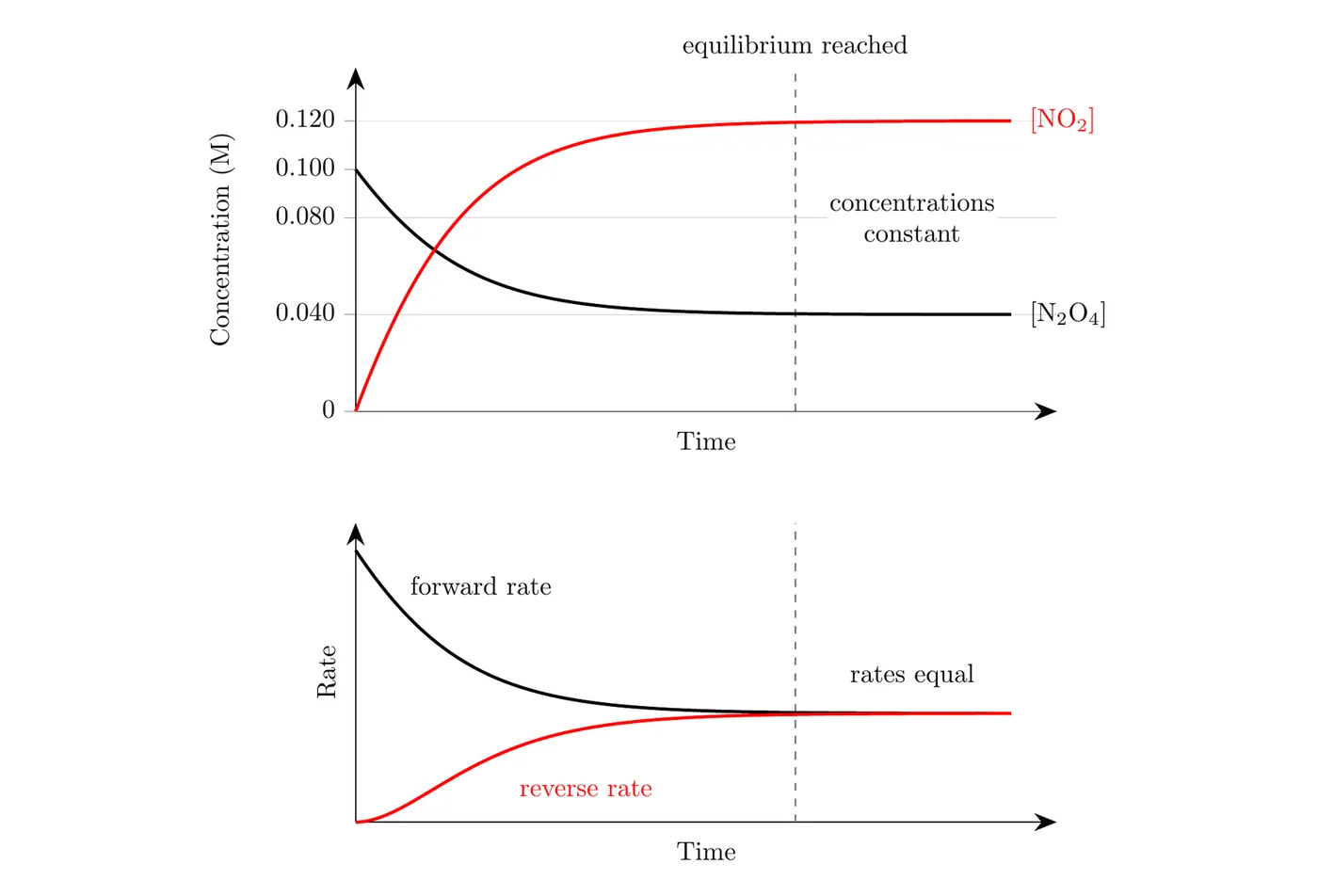
Graphs of concentration, partial pressure, or rate against time show a reaction settling into equilibrium. Take , a colorless gas, which breaks apart into brown :
A sealed flask starts with M and no , at constant temperature. The top graph shows the concentrations, and the bottom graph shows the rates of the forward and reverse reactions over the same time.
How to read these graphs:
- Concentrations level off together. falls and rises, and both flatten out at the same moment. From then on the system is at equilibrium, and the brown color stops getting darker.
- The changes follow the coefficients. drops by M while rises by M, a 1 : 2 ratio, just like the balanced equation. At every moment, the curve rises twice as fast as the curve falls.
- The equilibrium concentrations are not equal. Here they settle at M and M.
- The rates meet and stay equal. At the start the forward rate is at its highest (the most ) and the reverse rate is zero (no yet). As is used up, the forward rate drops. As builds up, the reverse rate rises. Once they're equal, the concentrations stop changing. The rates level off at the same value; they don't drop to zero.
- Partial pressure graphs look the same. At constant temperature, a gas's partial pressure is proportional to its concentration, so a graph of partial pressure against time has the same shape.
A common trap: the point where the two concentration curves cross is not equilibrium. It's just the moment the two concentrations happen to be equal. Equilibrium starts where the curves go flat.
Example 2: Deciding when equilibrium is reached
A student seals and in a flask at 430 °C, starting with M and M. Every 10 minutes they measure (from its violet color) and .
Time (min) | (M) | (M) |
0 | 0 | |
10 | 0.0171 | |
20 | 0.0179 | |
30 | 0.0180 | |
40 | 0.0180 | |
50 | 0.0180 | |
60 | 0.0180 |
(a) By what time had the system reached equilibrium? Justify your answer. (b) Show that the data fit the balanced equation. (c) The student says, "After 40 minutes, the reaction stopped." Explain why this is wrong.
(a) From 40 minutes on, both concentrations stay constant: M and M. At 30 minutes, was still a little higher ( M), so the system was still changing. Equilibrium was reached sometime between 30 and 40 minutes. Check every column: alone already looked constant at 30 minutes.
(b) From the start to equilibrium, fell by
and rose by M. The ratio is , which matches the 1 : 2 ratio of to in the balanced equation.
(c) Constant concentrations don't mean the reaction stopped. and keep forming , and keeps breaking down into and . After 40 minutes the two reactions run at equal rates, so there is no net change. Equilibrium is dynamic.
Common mistakes
- Thinking equilibrium means equal concentrations. It means constant concentrations.
- Thinking the reaction stops at equilibrium. Both reactions keep going at equal rates.
- Saying the rates are zero at equilibrium. They're equal, not zero.
- Marking equilibrium where two concentration curves cross. Equilibrium starts where the curves go flat.
- Sketching curves that ignore the coefficients. For , the curve must change twice as much as the curve.
- Forgetting the system has to be closed. If a product can escape, the reverse process can't keep up, and equilibrium is never reached.