

2.10 - Circular Motion
Centripetal Acceleration
Centripetal acceleration points inward, toward the center of the circular path.
Magnitude:
where:
- = centripetal acceleration (m/s²)
- = linear speed, tangent to the circle (m/s)
- = radius of the circular path (m)
It always points toward the center of the circle, perpendicular to the velocity vector.
The AP equation sheet lists this as . The second form uses angular speed (in rad/s), which you’ll use in Unit 5.
Centripetal Force
Centripetal force is the net force that produces centripetal acceleration:
Here’s the critical idea: centripetal force is not a separate force you draw on a free body diagram. It’s the net result of real forces (tension, friction, gravity, normal force, and so on) that happen to point toward the center of the circle.
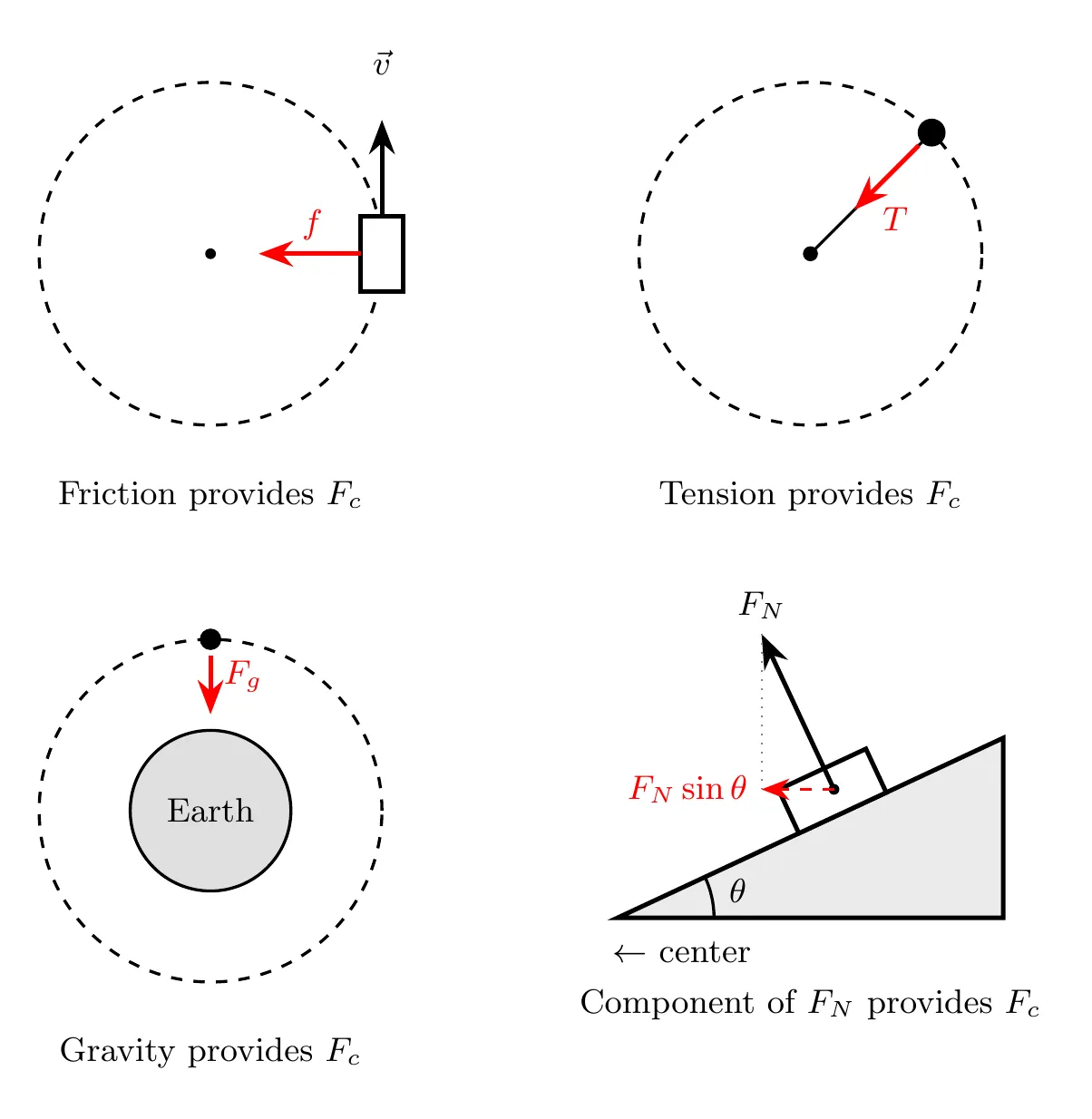
What actually provides it. Different situations use different real forces:
Situation | Force providing centripetal force |
Car turning on a flat road | Friction |
Object on a string (horizontal circle) | Tension |
Satellite orbiting Earth | Gravity |
Car on a banked curve | Component of normal force (plus friction if present) |
Ball in a vertical circle on a string | Tension and/or gravity components |
Problem-Solving Strategy: Circular vs. Non-Circular Directions
For circular motion, sort the forces into two columns instead of the x-y chart you’d use for linear motion:
Non-Circular Direction (perpendicular to motion) | Circular Direction (toward center) |
(equilibrium) | (centripetal force) |
The non-circular direction holds the forces perpendicular to the motion (usually vertical for a horizontal circle), and these are typically in equilibrium, so . The circular direction holds the forces pointing toward the center, and these are not in equilibrium, so .
Banked Curves
A banked curve is a tilted surface that helps vehicles get around a turn. The tilt lets the normal force have a component pointing toward the center of the circle.
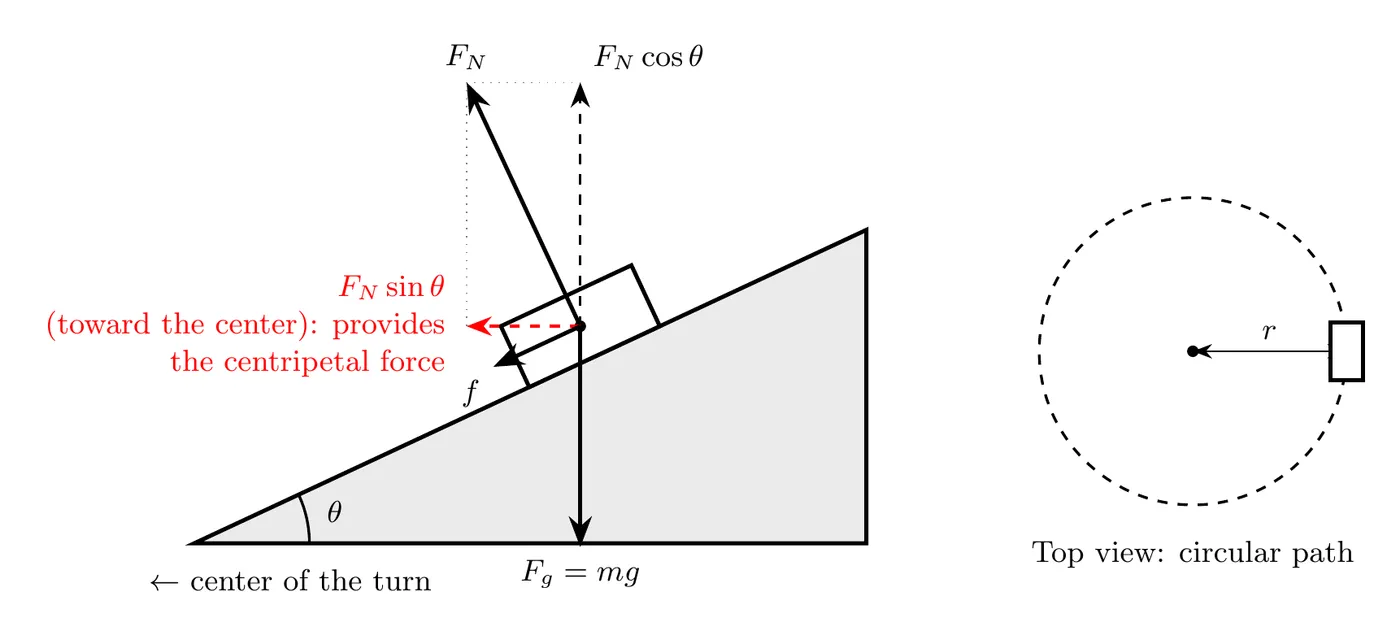
Free body diagram for a car on a banked curve: the weight (downward), the normal force (perpendicular to the surface), and friction (parallel to the surface, which can point up or down the bank).
Breaking those into components: in the non-circular (vertical) direction, and balance , while in the circular (horizontal) direction, and provide the centripetal force.
Example: Designing a Banked Curve
Problem: a highway curve has a radius of 120 m and is banked at 37°. (a) At what speed can a car take the curve with no friction needed? (b) If between the tires and the road, what’s the fastest the car can go without sliding up the bank? Use m/s², , and .
(a) With no friction, the vertical part of the normal force holds the car up and the horizontal part provides the centripetal force:
Divide the second equation by the first:
(b) Going faster, the car tends to slide up the bank, so static friction points down the slope at its maximum, . Now both and have parts in each direction:
Divide again and solve for the speed:
Answer: 30 m/s with no friction, and at most 38 m/s with friction. Below 30 m/s the car tends to slide down the bank instead, so friction points up the slope. Run the same steps with friction flipped and you get a minimum speed of about 22 m/s.
Tangential Acceleration
In AP Physics C, objects in circular motion can also speed up or slow down as they go, which brings in tangential acceleration.
Tangential acceleration () is parallel to the velocity and changes the speed: positive speeds the object up, negative slows it down, and zero means constant speed (uniform circular motion). Centripetal acceleration (), on the other hand, is perpendicular to the velocity and changes the direction.
Net acceleration. When both are present, the net acceleration is their vector sum:
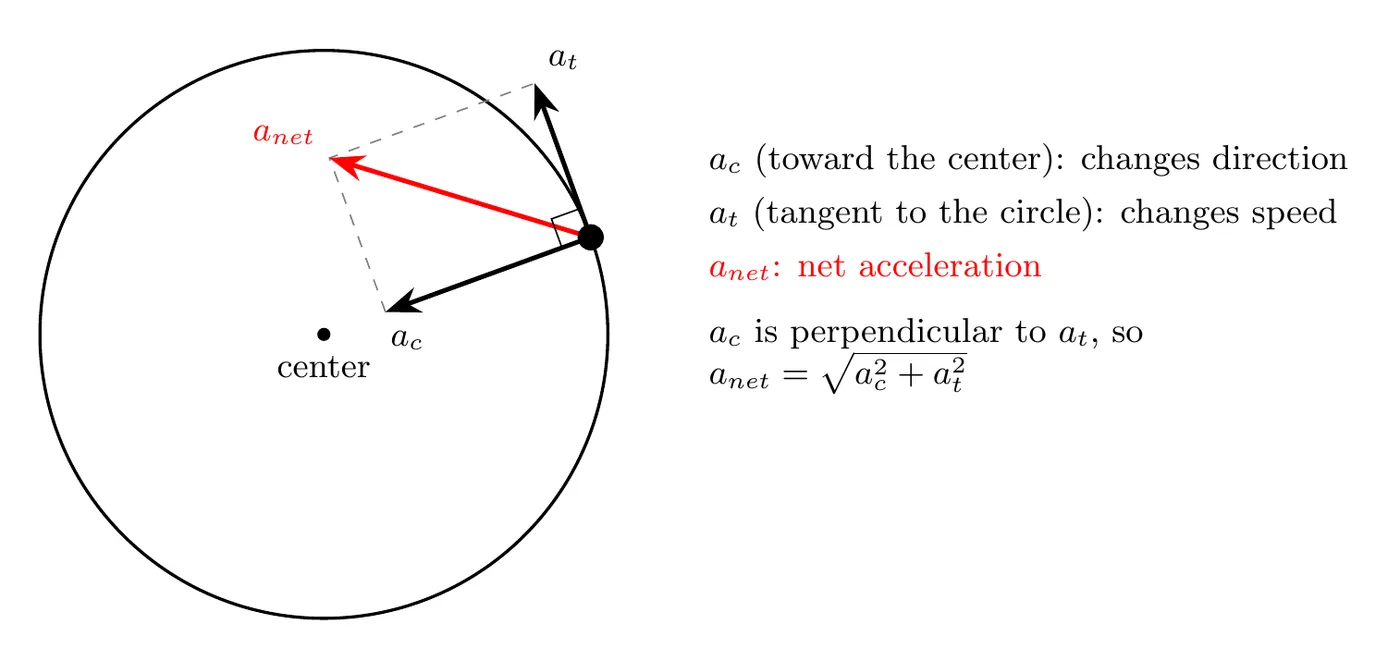
The net acceleration points at an angle given by:
where is the angle between the net acceleration and the radial (center-pointing) direction.
Vertical Circles
In a vertical circle (a ball on a string, a roller coaster loop), gravity is one of the forces, so the net force toward the center changes around the loop.
At the top, both gravity and the string’s tension (or a track’s normal force) point down, toward the center:
The slower the object goes, the less tension it needs. The minimum speed is when the tension drops all the way to zero and gravity alone provides the centripetal force:
Any slower and gravity pulls the object inward more than circular motion needs, so it falls off the circle (the string goes slack, or the coaster car leaves the track).
At the bottom, tension points up (toward the center) and gravity points down (away from it):
Example: Ball on a String
Problem: a 0.50 kg ball whirls in a vertical circle of radius 0.50 m on a light string. Its speed is 4.0 m/s at the top and 6.0 m/s at the bottom. Use m/s².
- What’s the minimum speed the ball could have at the top?
- Find the tension at the top and at the bottom.
- When the string is horizontal, the ball’s speed is 5.1 m/s. Find the magnitude of its acceleration there.
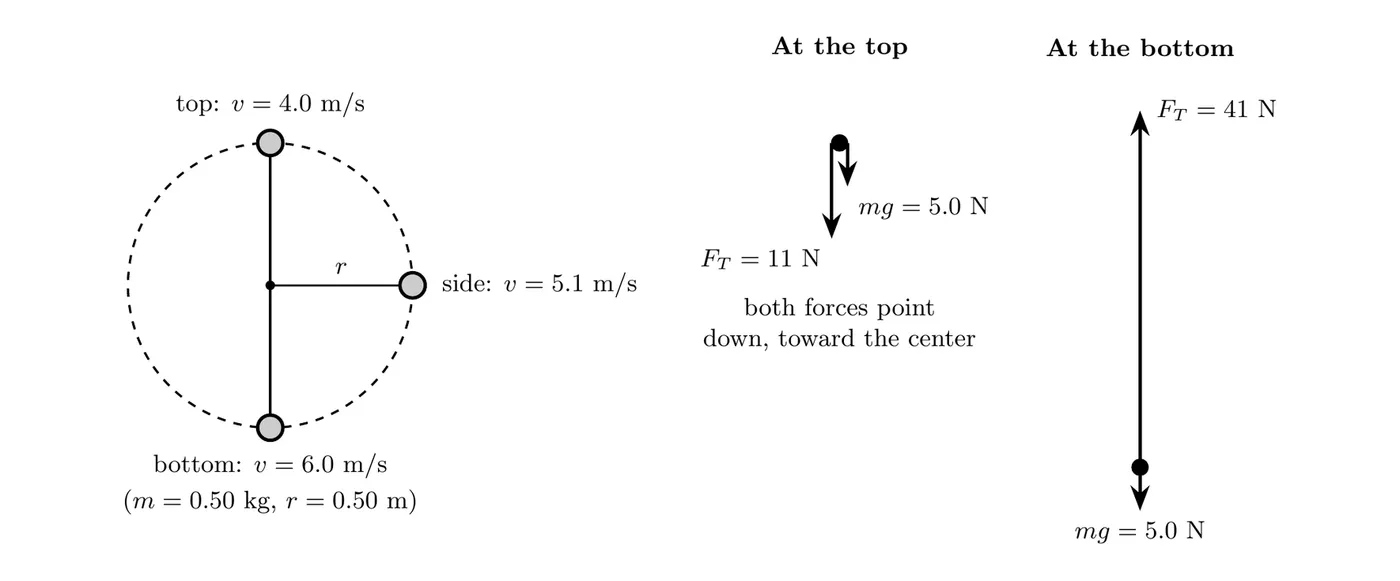
(a) m/s. At 4.0 m/s the ball is well above that, so the string stays tight.
(b) At the top:
At the bottom:
The string pulls almost four times harder at the bottom, which is where a string like this is most likely to snap.
(c) With the string horizontal, tension is the only force toward the center, and gravity (straight down) is tangent to the circle:
The net acceleration points mostly toward the center, tipped about 11° downward. (The three speeds fit together the way energy conservation predicts, which you can check in Unit 3.)
Period and Frequency
For circular motion at constant speed, you can describe things with period and frequency.
Period () is the time for one full revolution:
measured in seconds.
Frequency () is the number of revolutions per unit time:
measured in hertz (Hz) or s⁻¹.
Link to linear speed:
The shows up because it’s the circumference, the distance covered in one full revolution.
Period isn’t only for circles. The time for one full rotation of a spinning object, or for one full back-and-forth cycle of an oscillation (Unit 7), is also called the period, and works for all of them.
Conical Pendulum
A conical pendulum is a mass on a string swinging in a horizontal circle, with the string sweeping out a cone.
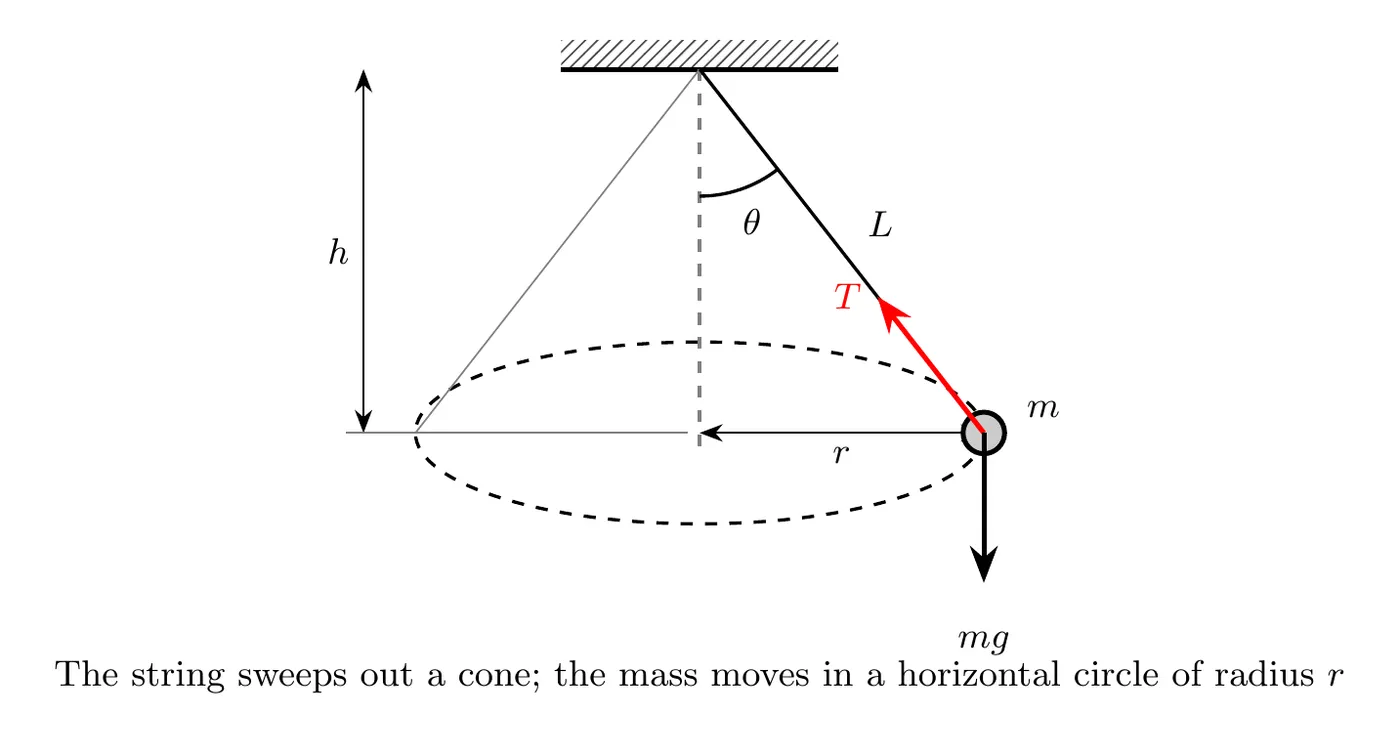
Free body diagram: tension along the string, and weight downward.
Breaking into components: vertically (non-circular), ; horizontally (circular), .
Example Problem: Conical Pendulum
A small ball of mass 0.20 kg is on a string 0.60 m long and swings in a horizontal circle of radius 0.48 m. Use m/s².
- Draw a free body diagram of the forces on the ball.
- Find the tension in the string.
- Find the magnitude of the ball’s centripetal acceleration.
- Find the period (time for one revolution).
Solution
Step 1: Set up the geometry.
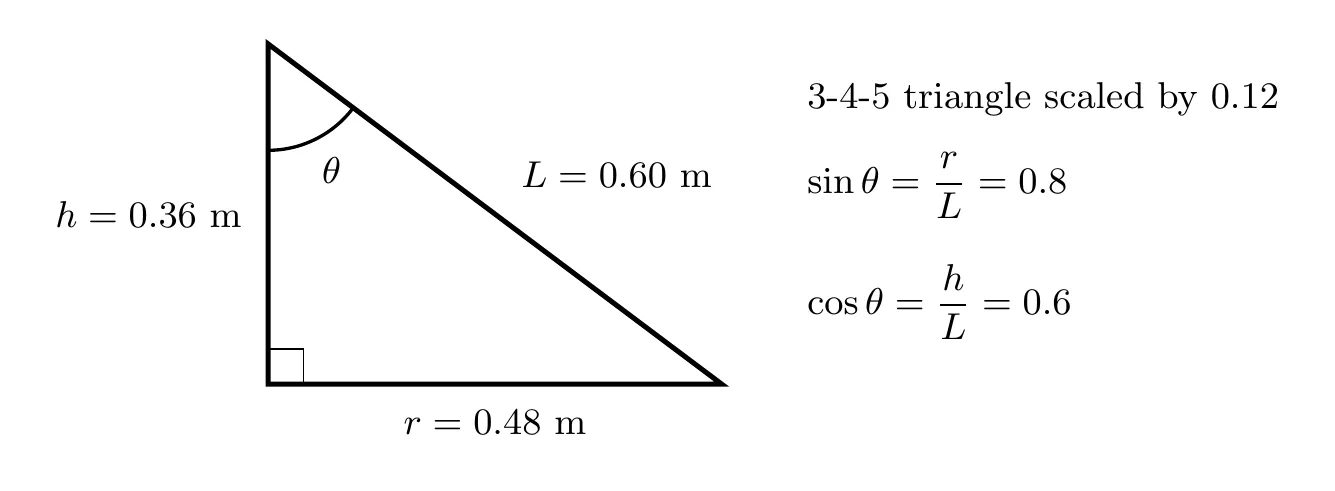
From the geometry:
That’s a 3-4-5 right triangle scaled by 0.12.
Part (a): Free body diagram.
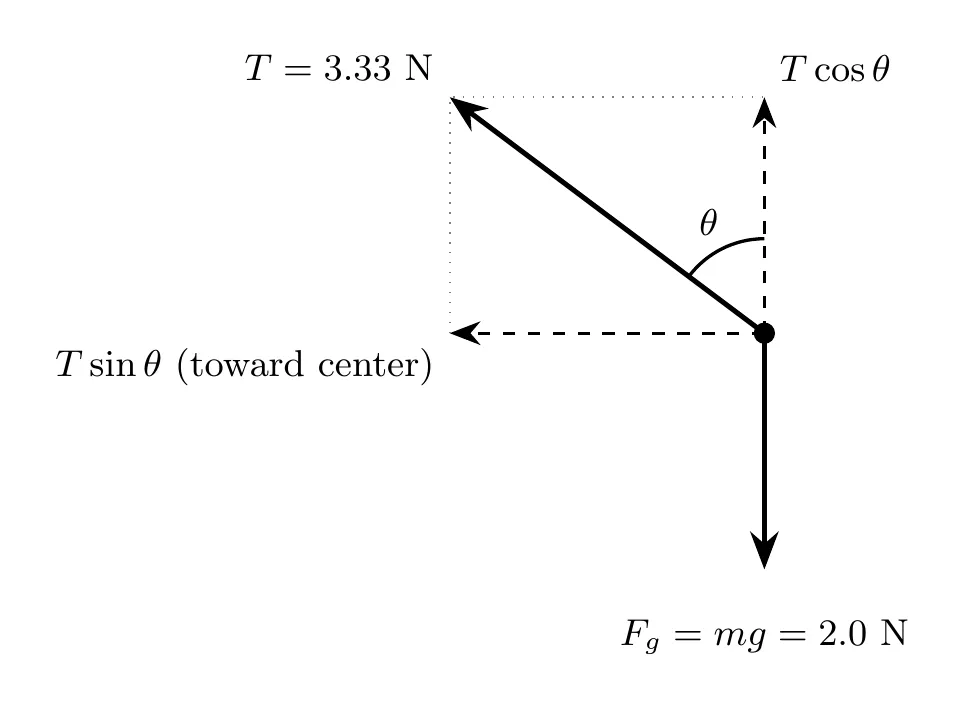
The forces on the ball are the tension along the string and the weight downward.
Part (b): Finding tension. In the non-circular (vertical) direction, :
The tension is 3.33 N (exactly N).
Part (c): Finding centripetal acceleration. In the circular (horizontal) direction, :
The centripetal acceleration is 13.3 m/s².
Part (d): Finding the period. Get the speed from :
Then the period:
The period is about 1.2 seconds. You can also get there directly with:
Circular Orbits and Kepler’s Third Law
For a satellite in a circular orbit around a much heavier central body (a moon around a planet, a planet around a star), gravity is the only force on the satellite, so gravity alone provides the centripetal force. With orbital radius and central mass :
The satellite covers one circumference per period, so . Substitute and solve for :
This is Kepler’s third law for circular orbits: the square of the period is proportional to the cube of the orbital radius. The satellite’s own mass cancels out, and the constant depends only on the central body’s mass.
- Predicting changes: if a satellite moves to an orbit with 4 times the radius, grows by , so the period grows by a factor of 8.
- Weighing the central body: rearranged, , so measuring and for anything orbiting a body gives you its mass. The Moon’s orbit ( m, days s) gives Earth’s mass as about kg, close to the accepted kg.
In this course you only need Kepler’s third law (for circular orbits), not his first or second laws.
Common Mistakes
- Drawing centripetal force as its own force on the FBD. It’s not a new force. It’s the net result of real forces (tension, friction, normal, gravity) pointing toward the center. Never label a force “F_c” on your diagram.
- Confusing centripetal and centrifugal. Centrifugal force is a fictitious force that shows up in rotating reference frames. In an inertial frame (the right frame for these problems), only centripetal forces exist.
- Guessing the friction direction on banked curves. Friction can point up or down the bank depending on whether the car is going too fast or too slow for the banking angle. Analyze it rather than assume.
- Forgetting that circular motion needs a net force. Objects in circular motion are not in equilibrium, even at constant speed. There has to be a net force toward the center.
- Mixing up tangential and centripetal acceleration. Centripetal () changes direction, tangential () changes speed, and they’re perpendicular.
- Using diameter instead of radius. The formulas use . If you’re given diameter, halve it first.
- Wrong trig function for components. When the angle is measured from the vertical (common in conical pendulums), the horizontal component uses sine and the vertical uses cosine. Check which angle you have.
- Setting the circular direction to zero. The circular equation is , not . It’s the non-circular direction that usually equals zero.
- Missing force components. On banked curves, both the normal force and friction can have components in the circular direction. Include both when they’re present.
- Wrong period formula. It’s , not or . Don’t drop the .
- Not spotting 3-4-5 triangles. Many problems use 3-4-5 right triangles (or multiples like 6-8-10) to keep the numbers clean. Recognizing them saves time.
- Assuming constant speed when it isn’t. If there’s tangential acceleration, the speed is changing, so you can’t use .
- Using linear kinematics for circular motion. Equations like apply to linear motion or tangential components, not to centripetal acceleration.
- Confusing period and frequency. Period is time per revolution (seconds), frequency is revolutions per time (Hz). They’re reciprocals: .
- Sign errors in component equations. Stay consistent with your coordinate system. If you pick inward as positive for the circular direction, every force toward the center is positive.