

2.8 - Spring Forces
Ideal Springs
An ideal spring has these traits:
- Negligible mass (basically massless).
- A force that’s proportional to how much its length changes.
Those simplifications let us focus on the spring’s mechanics without worrying about its own weight or inertia.
Hooke’s Law
The force from a spring follows Hooke’s Law:
where:
- = spring force (N).
- = spring constant (N/m).
- = change in the spring’s length from its relaxed (natural) length (m).
Understanding the Spring Constant
The spring constant (also called the force constant) is , measured in newtons per meter (N/m).
What it means: the spring constant tells you how much force it takes to stretch or squeeze the spring by one meter.
Reading k values:
- Low k (easy to stretch): slinkies, rubber bands, floppy springs.
- Example: N/m means just 5 N stretches it a meter.
- High k (hard to stretch): car suspension springs, garage door springs, stiff springs.
- Example: N/m means it takes 5000 N to stretch it a meter.
The spring constant is a property of the spring itself. Stiffer springs have higher k values.
The Negative Sign: Restoring Force
That negative sign in Hooke’s Law really matters:
The negative sign means the spring force is a restoring force. It always points back toward the equilibrium position.
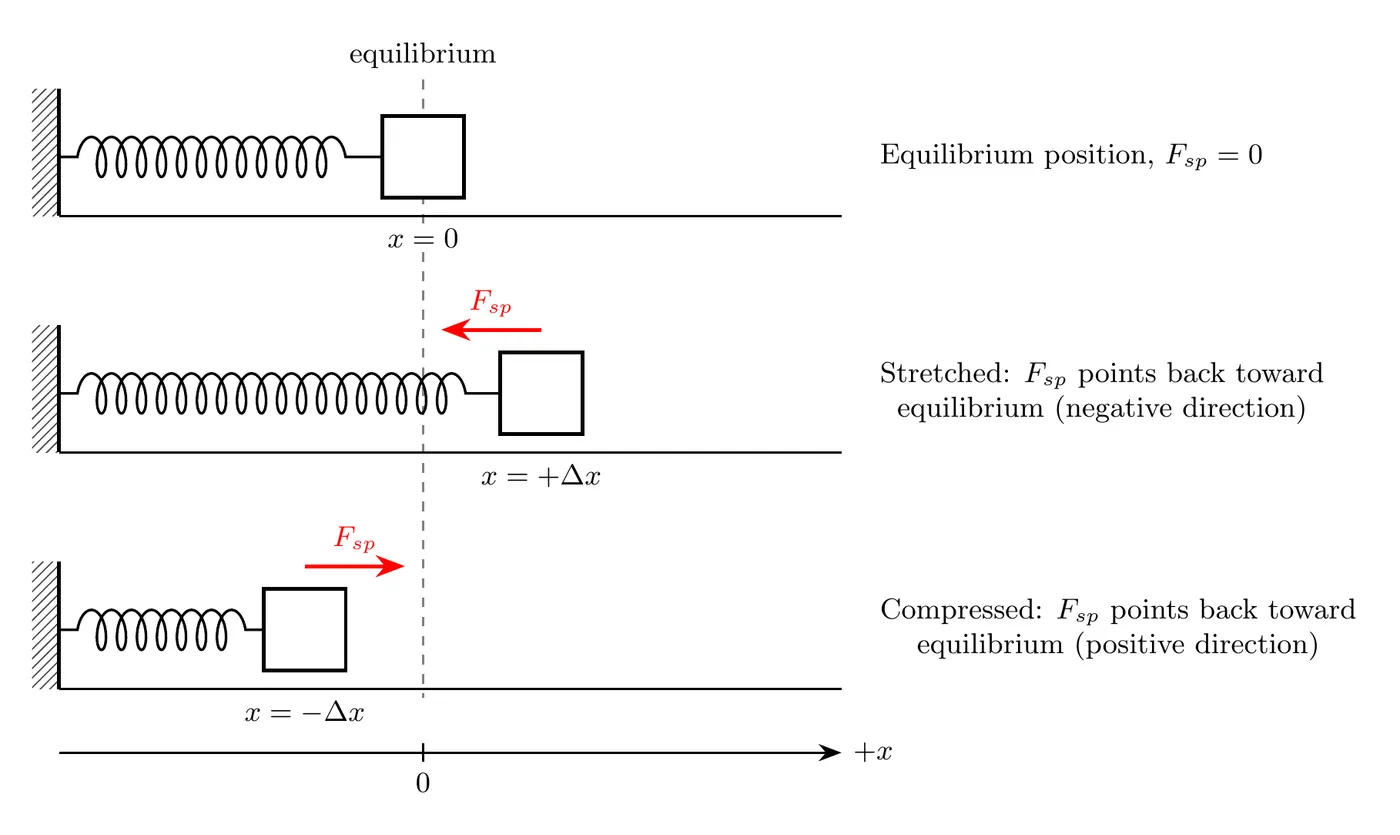
The core idea:
- Stretch the spring and the force pulls back.
- Compress the spring and the force pushes back.
- At equilibrium there’s no spring force.
Which equilibrium? For a spring lying flat, the object’s equilibrium position is right where the spring is relaxed, so the spring force always points back toward that spot. For a mass hanging from a spring, the equilibrium position is lower, where the spring has stretched just enough to hold up the weight (). The spring force by itself still points toward the spring’s relaxed length, but the net force on the mass (spring plus gravity) points toward the hanging equilibrium position, and it equals times the mass’s displacement from that position.
Springs on Vertical vs. Horizontal Surfaces
The diagrams often show hanging springs (vertical), but the same rules apply to springs lying on a horizontal surface.
Vertical springs: you have to bring gravity into the equilibrium.
Horizontal springs: gravity is perpendicular to the motion, so it’s often ignored in the analysis.
Either way, they both follow Hooke’s Law: .
Springs in Series
Springs in series are hooked up end to end.
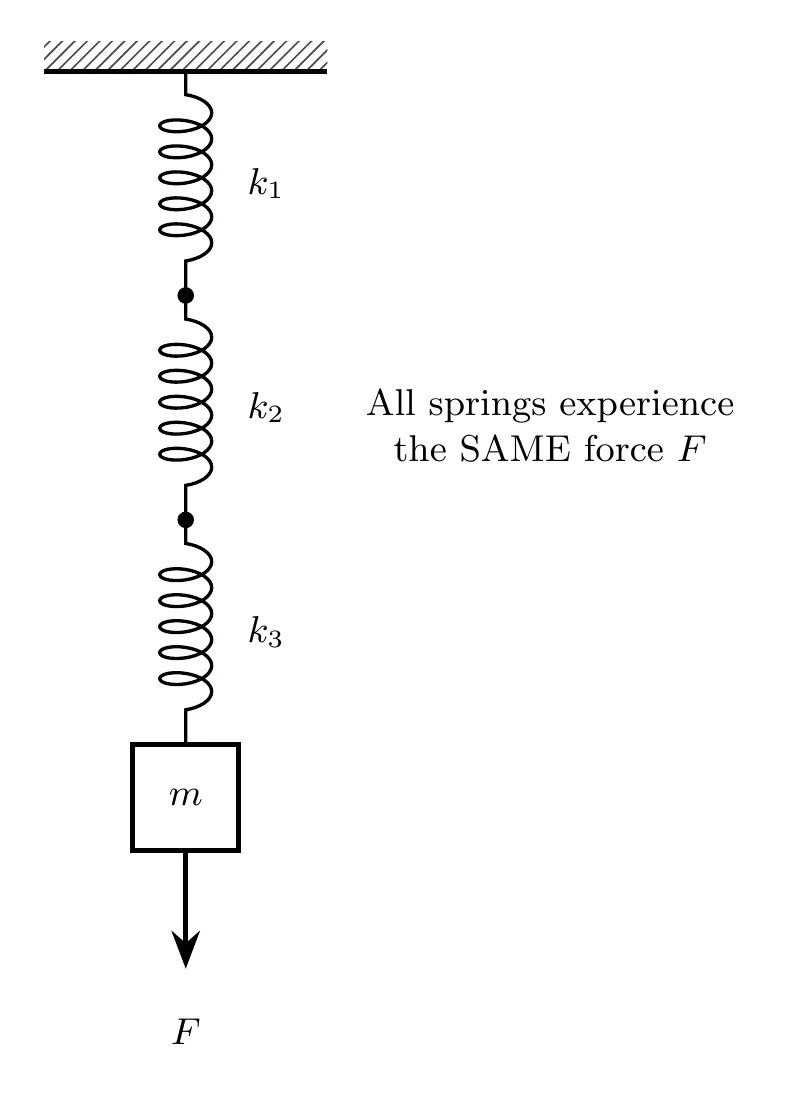
Key property: every spring in series feels the same force.
What changes: each spring stretches a different amount depending on its own spring constant.
Finding the Effective Spring Constant for Series
For springs in series, you get the effective spring constant from:
It’s a reciprocal sum (like resistors in parallel in a circuit).
The result: the effective spring constant for a series ends up smaller than the smallest single spring constant. The system gets floppier.
Finding Individual Displacements in Series
Since every spring feels the same force :
Total displacement:
Springs in Parallel
Springs in parallel sit side by side, all attached to the same mass.
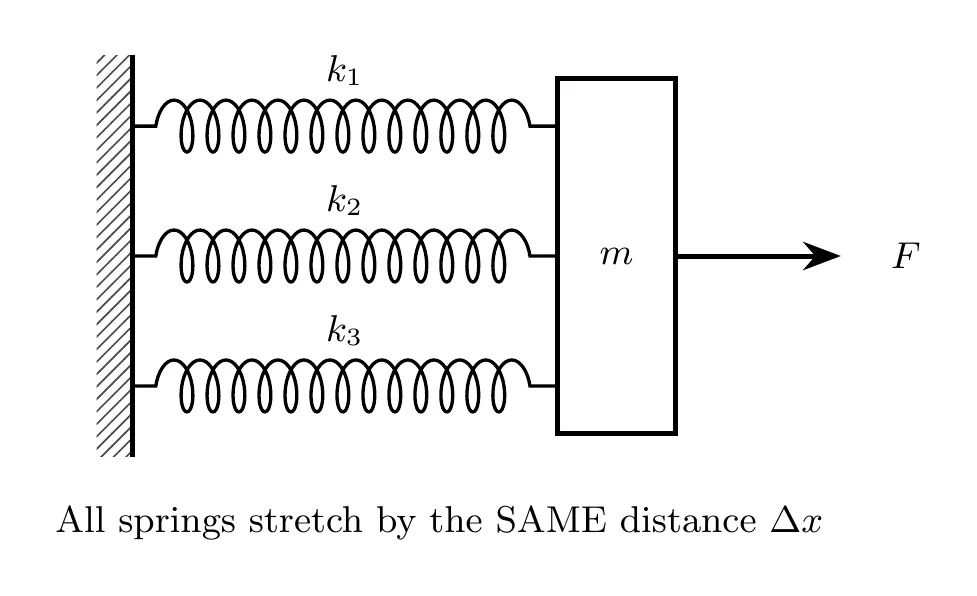
Key property: every spring in parallel stretches the same distance .
What changes: each spring puts out a different force depending on its spring constant.
Finding the Effective Spring Constant for Parallel
For springs in parallel, the effective spring constant is:
It’s a straight sum.
The result: the effective spring constant for a parallel setup is bigger than the largest single spring constant. The system gets stiffer.
Why That Works
Each spring chips in its own force:
Total force:
Example: Same Two Springs, Two Arrangements
Problem: you have two ideal springs, N/m and N/m, and a 3.0 kg mass. How far does the mass hang below where it would be with relaxed springs (a) with the springs in series and (b) with them in parallel? Use m/s².
Either way, the springs together hold up the weight, N.
(a) Series: both springs carry the full 30 N, and their stretches add: . Dividing by gives the series rule:
Check: spring 1 stretches m and spring 2 stretches m, which add to 0.25 m. ✓ And 120 N/m is less than 200 N/m, the smaller of the two, just as the series rule says.
(b) Parallel: both springs stretch the same amount, and their forces add:
Spring 1 pulls up with N and spring 2 with N, which add to 30 N. ✓
Answer: 0.25 m in series and 0.060 m in parallel. The parallel setup is about four times stiffer. On the AP exam you’ll only see springs that are all in series or all in parallel, not mixtures of both.
Summary Table: Series vs. Parallel
Property | Series | Parallel |
What’s the same | Force (F) | Displacement (Δx) |
What differs | Displacement | Force |
Effective k | ||
Result | More flexible (smaller k) | Stiffer (larger k) |
Example Problem: Two Springs in Series with Two Masses
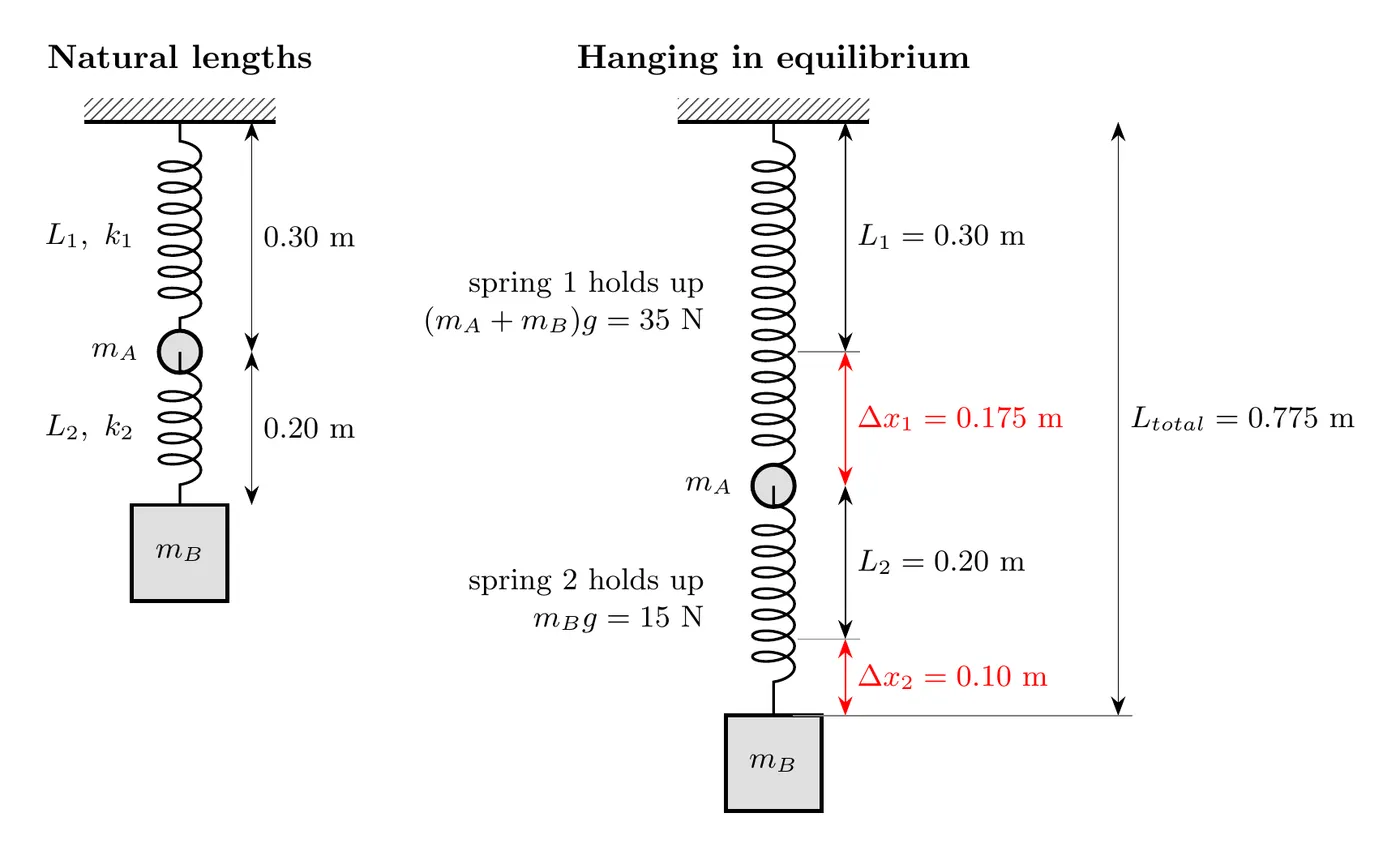
Problem: a vertical spring system has two ideal springs in series. The upper spring has equilibrium length m and spring constant N/m. The lower spring has equilibrium length m and spring constant N/m.
A mass kg is attached at the connection point between the two springs. A second mass kg hangs from the bottom of the lower spring.
Find the total length of the system when it’s hanging in equilibrium. Use m/s².
Solution
Step 1: Look at the forces on each spring
Upper spring: it holds up both masses, and .
Lower spring: it only holds up .
Step 2: Find the stretch of the upper spring
From Hooke’s Law, :
Step 3: Find the stretch of the lower spring
Step 4: Add up the total length
Answer: the total length in equilibrium is 0.775 m, or 77.5 cm.
What it tells you: the upper spring stretches more (17.5 cm) than the lower one (10 cm) because it’s carrying more weight. The total length is both natural lengths plus both stretches.
Non-Ideal Springs Consideration
For non-ideal springs that actually have some mass, you have to account for the weight of the springs themselves:
- Springs higher up in a series hold not just the attached masses but also the weight of the springs hanging below them.
- That makes the force bookkeeping trickier.
- Each segment has to include the cumulative weight below it.
For most problems, just assume ideal springs unless the problem says otherwise.
A spring can also be nonideal because its force isn’t proportional to its stretch. Stretch a real spring too far (past its elastic limit), or pull on a rubber band, and a graph of force versus stretch stops being a straight line. Hooke’s law only applies on the straight part.
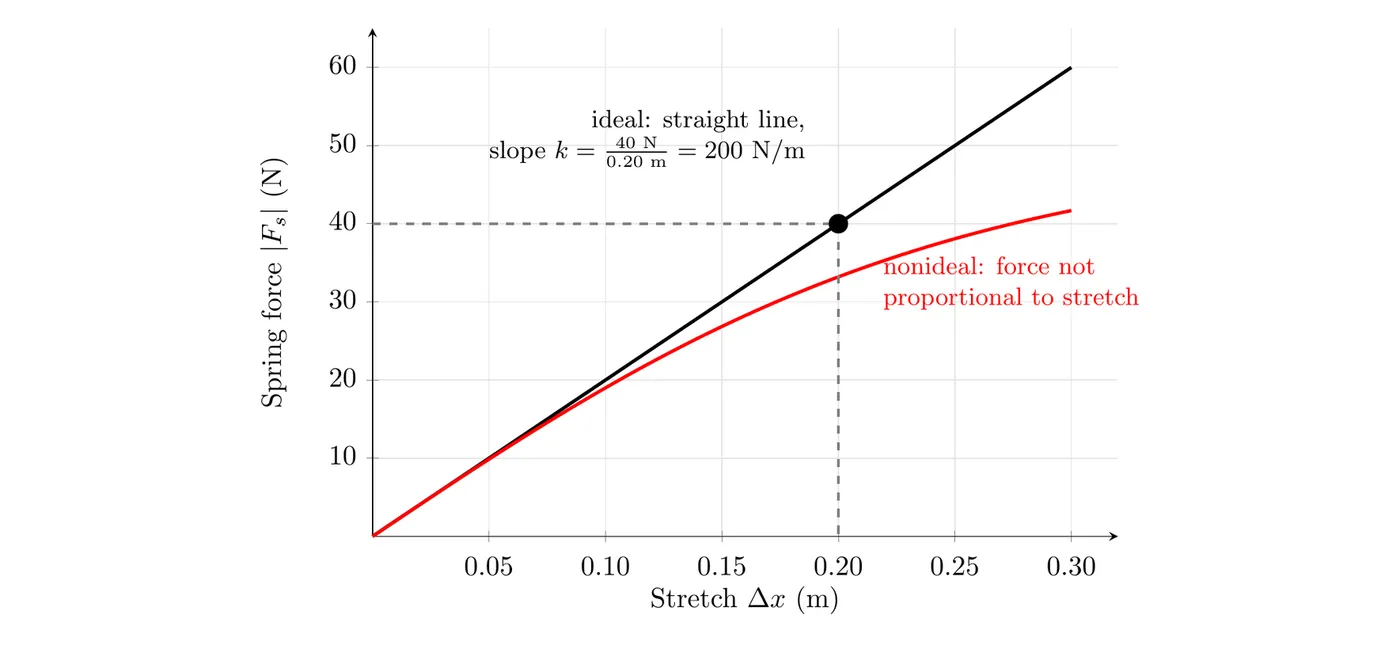
Reading k from a graph: for an ideal spring, the graph of spring force magnitude versus stretch is a straight line through the origin, and its slope is . In the graph above, the ideal spring’s line passes through (0.20 m, 40 N), so N/m.
Common Mistakes
- Dropping the negative sign in Hooke’s Law. The negative sign is what carries the direction. It’s , not .
- Swapping the series and parallel formulas. Series uses the reciprocal sum (like parallel resistors), parallel uses the straight sum (like series resistors). Keep them straight.
- Measuring Δx from the wrong spot. In Hooke’s law, is how far the spring’s length has changed from its natural (relaxed) length. For a hanging spring, that’s not the same as the mass’s displacement from its hanging equilibrium position.
- Assuming series springs stretch equally. In series, the force is shared equally, but the stretches differ based on each spring constant. Stiffer springs (higher k) stretch less.
- Adding displacements in parallel. In parallel, all the springs share the same displacement. They don’t each stretch differently and add up.
- Using the wrong effective-k formula. Series: . Parallel: . Series makes it floppier, parallel makes it stiffer.
- Not counting every mass in vertical series systems. When masses hang at the connection points, upper springs have to support everything below them, not just the bottom mass.
- Confusing equilibrium position with natural length. For a hanging spring, the equilibrium position is where the spring force balances the weight, which is NOT the natural unstretched length.
- Wrong units for the spring constant. It’s in N/m, not just N. If you’re given something like N/cm, convert first.
- Thinking stiffer springs have lower k. It’s the other way around. Higher k means a stiffer spring that’s harder to stretch.
- Forgetting the natural lengths in total-length problems. Total length is the sum of the natural lengths plus the sum of all the extensions. Don’t leave out the original lengths.
- Misusing the force formula in equilibrium. In equilibrium, the spring force magnitude equals the weight it holds: . Leave the negative sign out when you’re just setting up a magnitude equation.