

2.5 - Newton’s Second Law
Unbalanced Forces
Unbalanced forces happen when the forces add up to something other than zero:
When the forces are unbalanced, the object accelerates, and that’s Newton’s Second Law territory.
Side by side:
- First Law: balanced forces () means no acceleration.
- Second Law: unbalanced forces () means acceleration.
Newton’s Second Law Statement
Newton’s Second Law of Motion: the acceleration of a system’s center of mass has a magnitude proportional to the net force on the system and points in the same direction as that force. Acceleration is also inversely proportional to the system’s mass.
What that actually means
- Directly proportional to force: more net force means more acceleration.
- Same direction as the force: the acceleration vector points the same way as the net force vector.
- Inversely proportional to mass: more mass means less acceleration for the same force.
Mathematical Form: Redefining Acceleration
Newton’s Second Law gives you a fresh definition of acceleration:
Though it’s more often written as:
The AP equation sheet writes it as
The “sys” is a reminder that this is the acceleration of a system’s center of mass, and the sum includes only the external forces on that system.
or broken into components:
This is the go-to equation for motion when the forces are unbalanced.
Connection to Newton’s First Law
Newton’s First Law is really just a special case of the Second Law.
When the forces are balanced:
then:
That’s the First Law: zero net force means zero acceleration, which means constant velocity.
Proportionality Relationships
Getting a feel for the proportionalities helps a lot with conceptual questions.
Force and Acceleration (mass held constant)
- Double the force and the acceleration doubles.
- Triple the force and the acceleration triples.
- Halve the force and the acceleration is cut in half.
Force and Mass (acceleration held constant)
- Double the mass and you have to double the force to keep the same acceleration.
- Triple the mass and you have to triple the force.
Mass and Acceleration (force held constant)
- Double the mass and the acceleration halves.
- Triple the mass and the acceleration drops to a third.
- Halve the mass and the acceleration doubles.
Visual Representation of Proportionalities
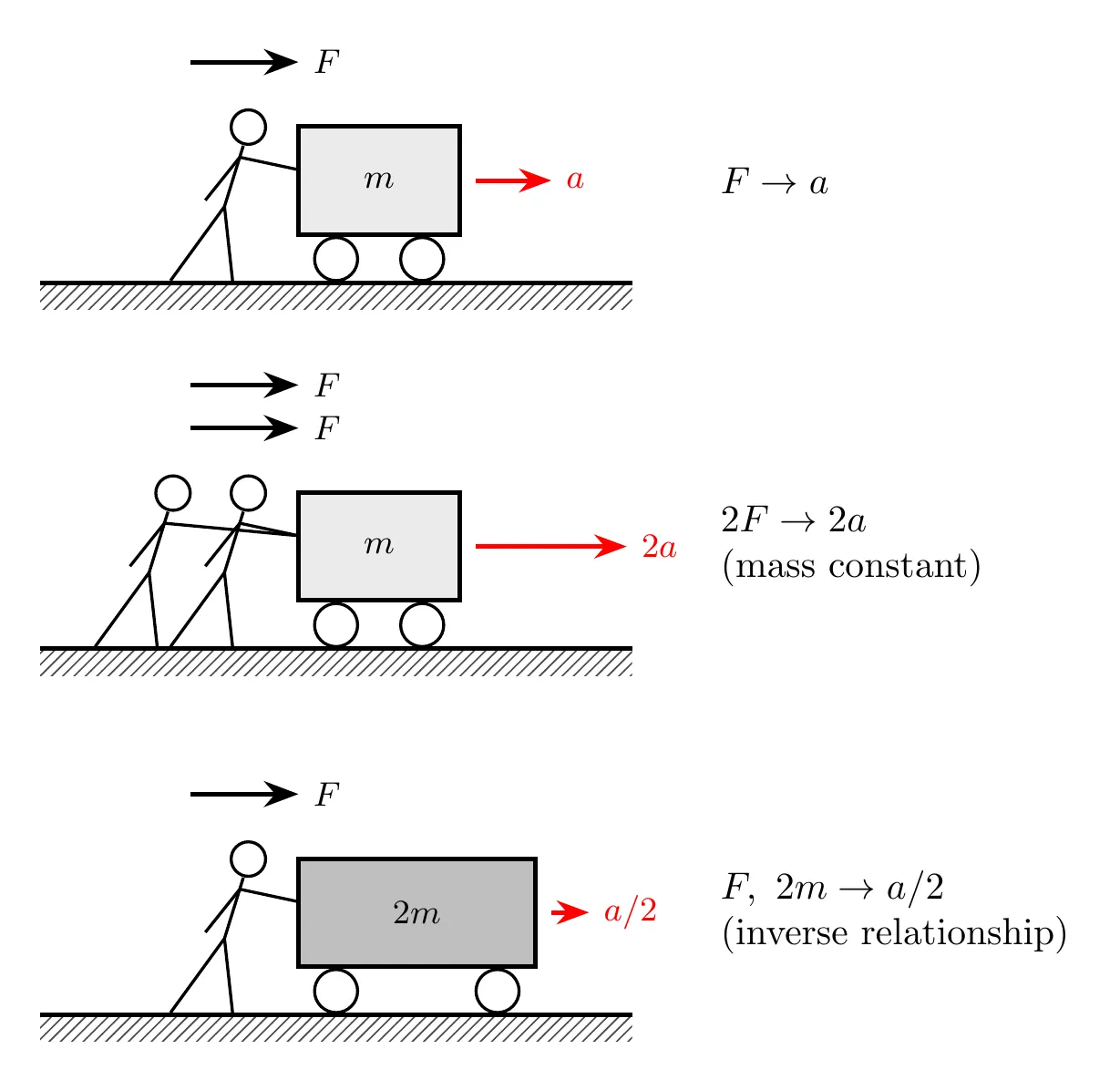
Testing the Second Law With Data
A classic lab: pull a cart along a level, low-friction track with a force sensor, measure its acceleration with a motion sensor, and repeat with different pulling forces while the cart’s mass stays the same. The second law predicts , so a graph of versus should be a straight line through the origin with a slope of .
Net force (N) | Acceleration (m/s²) |
0.20 | 0.39 |
0.40 | 0.82 |
0.60 | 1.18 |
0.80 | 1.61 |
1.00 | 2.02 |
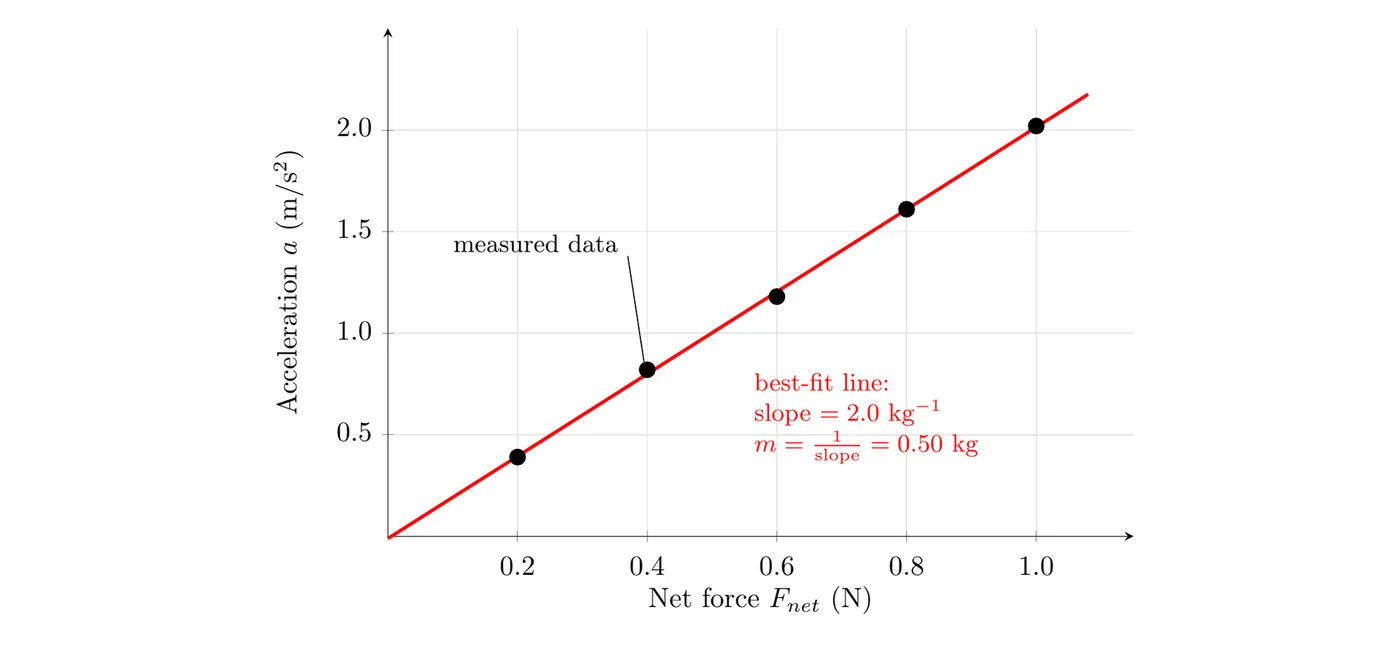
Reading the graph: the best-fit line has a slope of about 2.0 kg⁻¹ (the units of (m/s²)/N work out to 1/kg). So the cart’s mass is kg. If the line crossed the force axis to the right of the origin instead, that would point to friction you didn’t account for: part of the pull goes into balancing friction before the cart speeds up.
To test how acceleration depends on mass, keep the force the same and change the mass. A graph of versus curves, so graph versus instead: it should be a straight line with a slope equal to .
Center of Mass and External Forces
Here’s the key principle: a system’s center of mass only changes its velocity if there’s a nonzero net external force on the system.
Internal forces (forces between objects inside the system) don’t move the center of mass at all. Only external forces do that.
Example: a 1.5 kg cart and a 2.5 kg cart sit on a frictionless track with a compressed spring between them. You push the back cart forward with a steady 8.0 N force while the spring pushes the carts apart. The spring forces are internal, so no matter what the spring does to each cart, the center of mass of the two-cart system accelerates at
Newton’s Second Law and Calculus
Newton’s Second Law ties into kinematics through calculus. Since acceleration is the derivative of velocity:
you can write the Second Law as:
This form comes in handy when:
- Force depends on velocity: .
- Force depends on time: .
- You’re solving differential equations of motion.
Problem-Solving Strategy Review
DRAW: make a free body diagram showing every force.
SUM: apply in each direction.
SOLVE: solve the equations for whatever you’re after.
Example Problem: Velocity-Dependent Force with Calculus
Problem: a particle of mass 8 kg starts from rest at time and moves in a straight line. Its velocity as a function of time is:
where is in m/s and is in seconds.
What’s the instantaneous net force on the particle at seconds?
Solution
Step 1: Sort out what we’ve got
We want force from Newton’s Second Law:
We’re given:
- Mass: kg.
- Velocity function: .
- The time we care about: s.
We aren’t handed the acceleration directly, but we can pull it out of the velocity.
Step 2: Find the acceleration function
Acceleration is the time derivative of velocity:
Apply the power rule:
So the acceleration function is m/s².
Step 3: Find the acceleration at t = 3 seconds
Step 4: Apply Newton’s Second Law
Answer: the instantaneous net force at seconds is 216 N.
Alternative Approach: Force as a Function of Time
You can also write force as a function of time before plugging in a specific time.
Start with Newton’s Second Law:
Substitute the acceleration function:
Evaluate at t = 3 seconds:
✓
Both routes land on the same answer. The second one gives you force as a function of time, which is useful if you want to see how the force changes as time goes on.
When to Use Calculus with Newton’s Second Law
Reach for calculus when:
- You have velocity and need acceleration: .
- You have position and need acceleration: , then .
- Force depends on velocity: gives you differential equations like .
- Force depends on position: gives you differential equations too.
- You’re going backwards from force to motion: integrate to get velocity, then integrate again to get position.
Key Relationships Summary
Given | To Find | Use |
Common Mistakes
- Forgetting to differentiate. If you’re given velocity and asked for force, you first have to get acceleration from . You can’t just use .
- Flipping the proportionality directions. Keep it straight: (direct) but (inverse). Doubling the mass halves the acceleration, it doesn’t double it.
- Writing the Second Law wrong. is standard. Writing is fine too, but never write .
- Not summing forces first. The Second Law uses the net force (the sum of everything), not one individual force. Add them up before you apply it.
- Mismatched units. Force in newtons (N), mass in kilograms (kg), acceleration in m/s². If they don’t match, convert first.
- Pointing the force the wrong way. The acceleration vector points the same way as the net force vector. Keep your signs consistent with your coordinate system.
- Forgetting F = ma is a vector equation. That means and each have to hold on their own.
- Assuming acceleration is constant. In calculus-based physics, acceleration can change with time. Don’t reach for the constant-acceleration kinematics equations unless you’ve checked that really is constant.
- Power rule slip-ups. Remember . The derivative of is , not or just .
- Evaluating at the wrong time. After you get or , don’t forget to plug in the specific time the problem asked about.
- Including internal forces in a system analysis. When you treat a system as a whole, only external forces count toward the net force that accelerates the center of mass.
- Confusing velocity with acceleration. A big velocity doesn’t mean a big acceleration. A car cruising at a steady 100 km/h has zero acceleration.