

2.6 - Gravitational Force
Newton’s Law of Universal Gravitation
Newton’s Law of Universal Gravitation tells you the gravitational force between two objects.
The gravitational force between two objects is:
- Directly proportional to each of their masses.
- Inversely proportional to the square of the distance between their centers.
One thing to always remember: gravity is always attractive. Objects pull toward each other and never push apart.
The Formula
where:
- = gravitational force (in newtons).
- = the universal gravitational constant = N·m²/kg².
- = the masses of the two objects (in kg).
- = the distance between the centers of the two objects (in meters).
Important: that distance is measured between the centers of the objects, not their surfaces.
Direction: the gravitational force on each object points along the line connecting the two centers of mass, toward the other object. And when you work out how a system moves, you can treat the gravitational force on it as acting at its center of mass.
Proportionality Relationships
Here’s how changes in mass and distance play out in the gravitational force.
Effect of Mass (direct proportionality)
- Double one mass and the force doubles.
- Double both masses and the force quadruples.
- Halve one mass and the force halves.
Effect of Distance (inverse square)
- Double the distance and the force drops to .
- Triple the distance and the force drops to .
- Halve the distance and the force grows 4 times bigger.
This is what “inverse square law” means: the force weakens by the square of however much the distance changes.
Gravitational Field
A field is a way to model a non-contact force acting on objects at different spots in space. Gravity is a field force.
Gravitational Field Strength
The gravitational field strength (a vector) is defined as:
where:
- = gravitational field strength (units: N/kg).
- = gravitational force.
- = mass of the object feeling the force.
Near Earth’s surface: N/kg.
We usually call m/s² the “acceleration due to gravity,” but written as a vector it’s the gravitational field strength, with units of N/kg.
What it means: every kilogram of mass near Earth’s surface feels 9.8 N of gravitational pull.
The field at any distance: dividing Newton’s law of gravitation by the test mass gives the field that a mass creates at a distance from its center:
The field points toward the center of , and it doesn’t depend on the test mass at all. It’s a property of the location.
Field strength vs. acceleration: if gravity is the only force on an object, its acceleration in m/s² equals the field strength in N/kg at that spot (). A ball dropped near the surface (ignoring air resistance) accelerates at 9.8 m/s². A book resting on a table sits in the same 9.8 N/kg field, but its acceleration is zero because the normal force cancels gravity.
The value of g: the measured field strength near Earth’s surface is 9.8 N/kg, the value on the equation sheet. AP Physics C rounds it to N/kg, and that’s the value to use in calculations (the full rule for the exam is in Topic 1.3).
Connecting Gravitational Force to Surface Gravity
At or near a planet’s surface, the gravitational force on an object is:
But you can also write that force with the universal law of gravitation:
where:
- = mass of the planet.
- = mass of the object.
- = radius of the planet.
Set the two equal:
This lets you find the surface gravity of any planet as long as you know its mass and radius.
When Can You Treat Gravity as Constant?
Since depends on , gravity is never perfectly constant. But if the distance from Earth’s center barely changes during the motion, the change in the force is too small to matter, and you can treat as constant the whole way.
- Climbing a 100 m building: goes from m to m, so drops by a factor of . That’s a 0.003% change. Treat it as constant.
- Rising to the International Space Station, about 400 km up: the factor is , so is about 11% smaller. Now you need with the right .
Rule of thumb: if the change in height is tiny compared with the planet’s radius, gravity is constant.
Apparent Weight
Apparent weight is the force an object seems to press on a scale or support with, and it can be different from the real gravitational force when the whole system is accelerating.
The classic example is an elevator.
When the Elevator Accelerates Upward
The normal force (your apparent weight) goes up. You feel heavier.
When the Elevator Accelerates Downward
The normal force (your apparent weight) goes down. You feel lighter.
Notation
Sometimes apparent weight gets written as (F-g-prime):
- Use when accelerating upward.
- Use when accelerating downward.
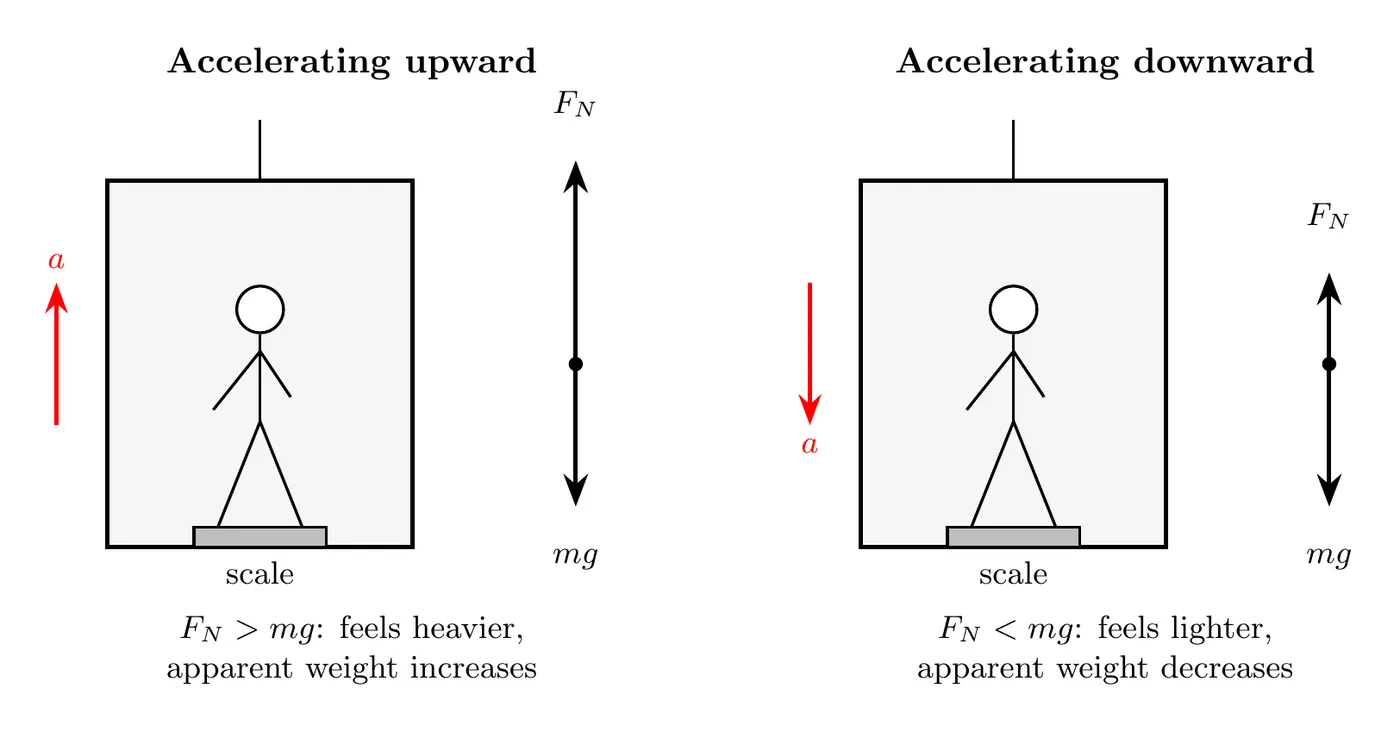
What you actually feel: that shift in apparent weight is the sensation you get when an elevator starts moving. You feel pressed into the floor (heavier) when it accelerates upward, and lighter when it accelerates downward.
Apparent weight is the normal force. A scale doesn’t measure gravity directly. It measures how hard it has to push up on you, which is the normal force. So the magnitude of your apparent weight is defined as the magnitude of the normal force on you. It equals only when you aren’t accelerating up or down.
Feeling Weightless
You appear weightless when nothing is pushing up on you, which happens in two situations:
- No forces act on you at all, like an astronaut drifting in deep space far from any planet.
- Gravity is the only force on you, which means you’re in free fall. If an elevator’s cable snapped, you and the elevator would both accelerate down at , so and the scale would read zero.
Astronauts on the International Space Station are in the second situation. Gravity up there is still close to 90% as strong as on the ground (see the example above), but the station and everyone in it are falling around Earth together, so nothing presses on anyone. They’re weightless, not gravity-free.
The Equivalence Principle
Picture yourself in a closed elevator with no windows. If it sits at rest on Earth, a scale under you reads . If it’s in deep space, far from any planet, accelerating upward at 10 m/s², the floor has to push you with , so the scale reads the same thing, and a dropped ball “falls” to the floor the same way. No experiment inside the elevator can tell the two apart.
That’s the equivalence principle: an observer in a noninertial (accelerating) frame can’t tell an apparent weight caused by the frame’s acceleration apart from a real gravitational force from a gravitational field. Einstein used this idea as a starting point for general relativity.
Inertial Mass vs. Gravitational Mass
Mass shows up in two different laws, playing two different roles:
- Inertial mass is the in . It measures how much an object resists changes to its motion, its inertia.
- Gravitational mass is the in . It measures how strongly an object attracts, and is attracted by, other masses.
Nothing in Newton’s laws says these have to be the same number. But experiments have checked again and again, and they agree to better than one part in a trillion, so physics treats them as equal. That’s why every object falls with the same acceleration (ignoring air resistance): a bowling ball feels more gravitational force than a marble, but it has exactly that much more inertia, so no matter what the falling object’s mass is.
Newton’s Shell Theorem
Newton’s Shell Theorem describes the gravitational force from a uniform spherical shell of mass (basically a hollow sphere).
Two Key Results
1. For objects outside the shell:
The shell pulls on you as if all of its mass were packed at the center.
where is the distance from the center of the shell.
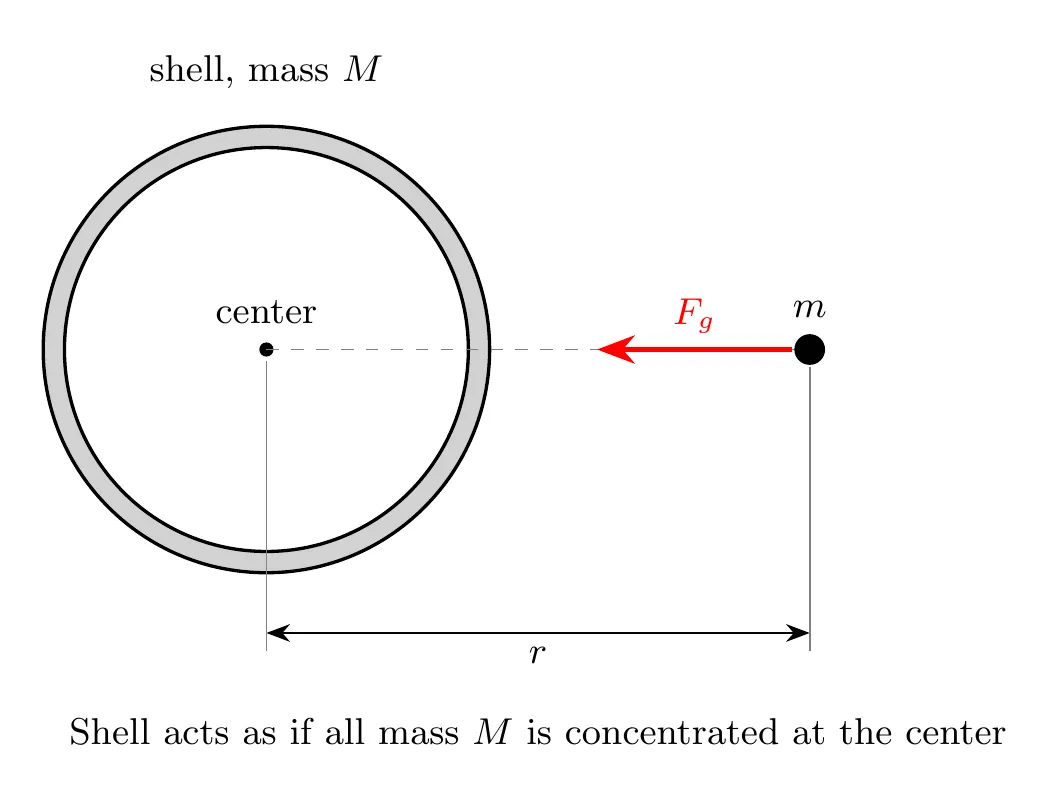
2. For objects inside the shell:
The gravitational field inside a uniform spherical shell is zero.
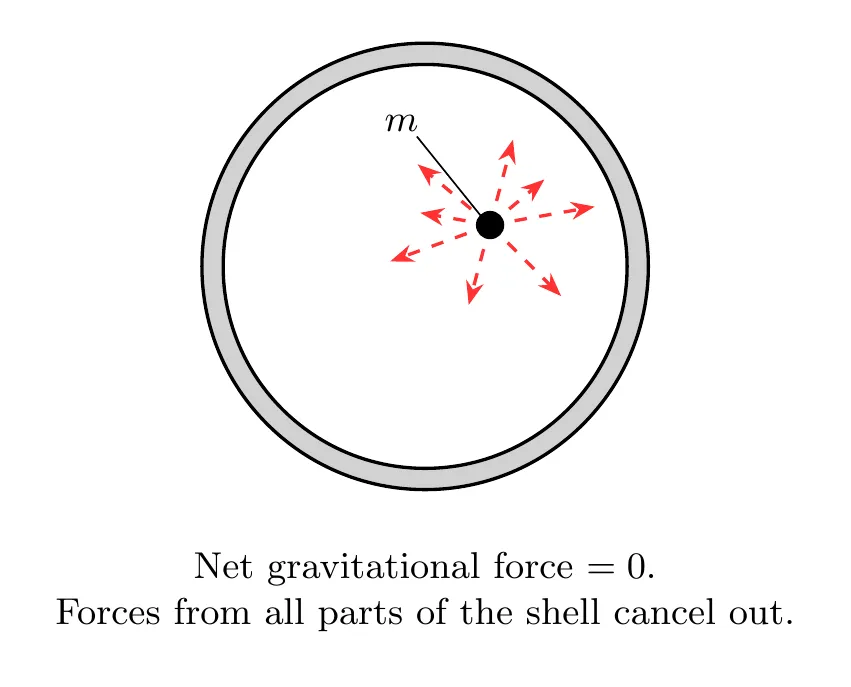
Why it matters: this theorem is the reason we can treat planets as point masses when we work out gravitational forces on objects outside them. Earth can be treated as if all its mass sits at its center, both for satellites and for stuff on the surface.
Note: on the AP exam, you’re expected to recognize and use this theorem conceptually, not derive it with math.
Where the shell theorem comes from: a sphere’s pull on an object is really the sum of the pulls from every tiny piece of mass in the sphere, each with its own distance and direction. Adding all of them up takes calculus, and the shell theorem is the result. You don’t have to derive it, but you do need to use it.
Inside a Uniform Solid Sphere
Now put an object inside a solid sphere of uniform density , at a distance from the center ( less than the sphere’s radius ). Think of the sphere as a ball of radius plus a set of shells outside it:
- The shells outside the object pull on it with zero net force (shell theorem, result 2).
- The ball of radius underneath the object acts like a point mass at the center (shell theorem, result 1).
So only the partial mass within radius counts:
(The second form uses .) Plug that into Newton’s law of gravitation:
Everything multiplying is constant, so the force is proportional to the distance from the center. With a minus sign to show it points toward the center:
The field grows in a straight line from zero at the center to its surface value at , then falls off as outside. (This force has the same form as a spring force, which comes back in Unit 7.)
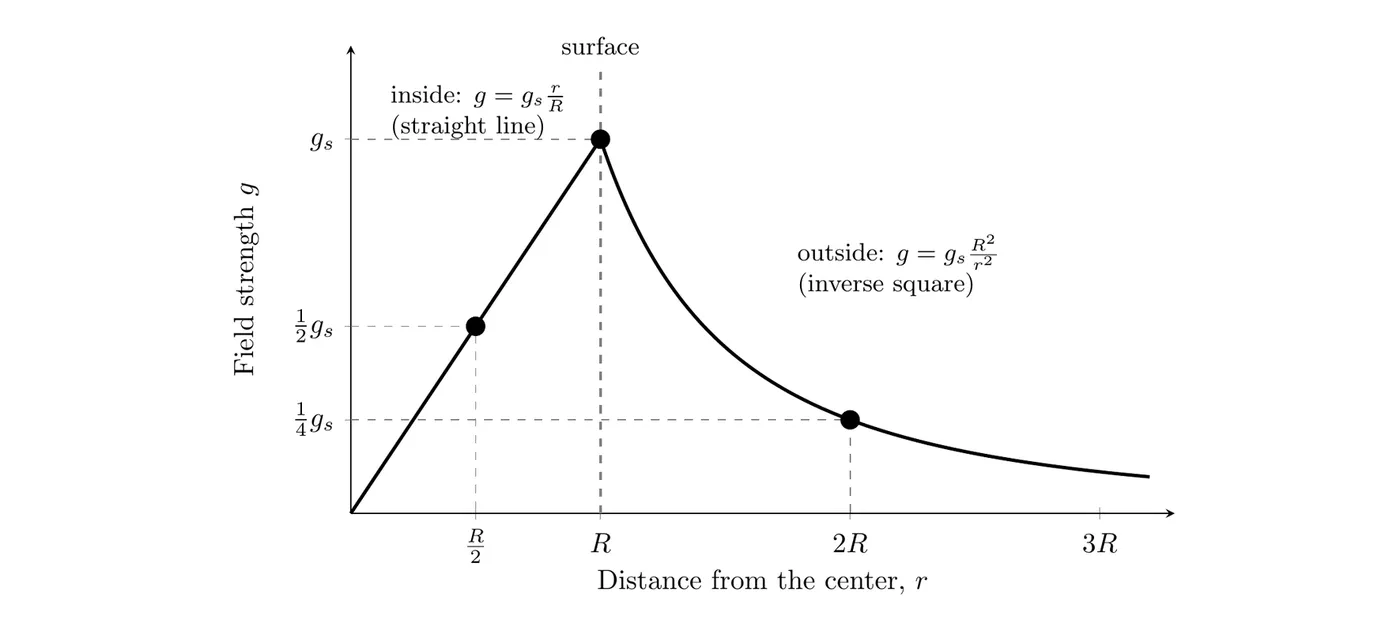
Example: model a planet as a uniform sphere with a surface field of 10 N/kg. What’s the gravitational force on a 2.0 kg probe halfway to the center? Inside, the field is proportional to , so at it’s half the surface value:
That’s half the 20 N the probe would feel at the surface. (Real Earth isn’t uniform: its core is much denser than its crust, so treating it as uniform is a model, not a measurement.)
Superposition of Gravitational Forces
When several masses pull on one object, the net gravitational force is the vector sum of all the individual pulls.
This is the principle of superposition.
Example Problem: Three Masses in a Line
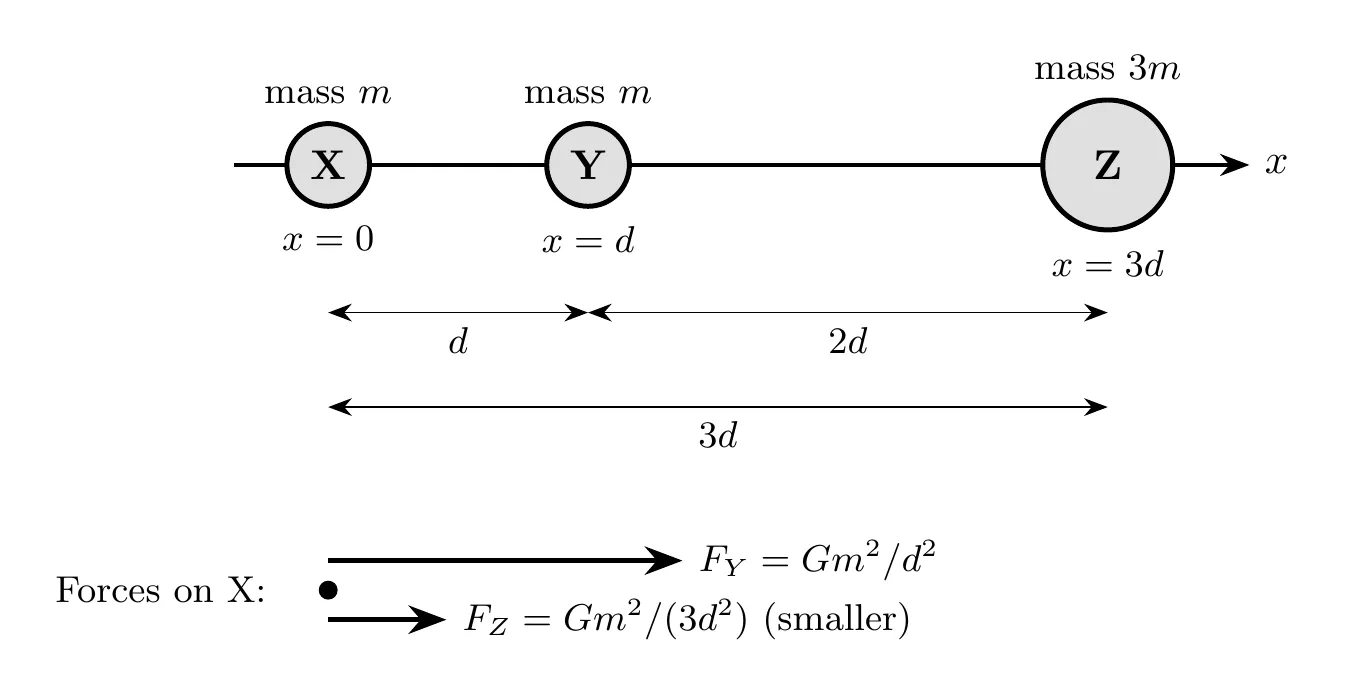
Problem: three uniform spheres X, Y, and Z sit along a straight line. Sphere X has mass at position . Sphere Y has mass at position . Sphere Z has mass at position .
Find the magnitude of the net gravitational force on sphere X from spheres Y and Z. Give your answer in terms of , , and .
Solution
Step 1: Find the force on X from Y
X and Y are a distance apart.
Direction: Y pulls X to the right (the positive direction).
Step 2: Find the force on X from Z
X and Z are a distance apart.
Direction: Z also pulls X to the right.
Step 3: Find the net force (both point the same way)
Since both forces point the same direction, add them:
Get a common denominator:
Answer: the net gravitational force on sphere X is , pointing to the right.
If the Forces Pointed Opposite Ways
If the layout were different and the two forces pointed in opposite directions, you’d subtract the smaller from the larger:
Always watch the geometry and the directions of the gravitational pulls.
Finding Acceleration from Gravitational Force
Once you’ve got the net gravitational force, you can find the acceleration with Newton’s Second Law:
Example: for sphere X above:
Important Formulas Summary
Relationship | Formula | Notes |
Universal Gravitation | Between any two masses | |
Surface gravity | At a planet’s surface | |
Weight | Near the surface | |
Gravitational field | Field strength | |
Apparent weight | In an accelerating frame |
Common Mistakes
- Using the surface distance instead of center-to-center. The in is between centers, not surfaces. For a satellite orbiting Earth, is Earth’s radius plus the altitude.
- Forgetting the inverse square. Doubling the distance makes the force one-quarter, not one-half. Tripling it makes the force one-ninth, not one-third.
- Botching superposition. When several forces act, you have to track direction. Same-direction forces add, opposite-direction forces subtract.
- Mixing up G and g. Capital N·m²/kg² is the universal constant. Lowercase m/s² (or N/kg) is Earth’s surface gravity.
- Wrong apparent-weight formula. In an elevator accelerating upward, use , not . The normal force goes up, not down.
- Forgetting gravity is always attractive. Never draw gravitational forces pushing things apart. They always pull toward each other.
- Misusing the Shell Theorem. It applies to uniform spherical shells. It doesn’t work for irregular shapes or non-uniform densities without extra work.
- Not squaring the distance change right. If the distance triples, the denominator becomes , not .
- Wrong units for G. The universal gravitational constant has those messy units, N·m²/kg². Make sure everything (mass in kg, distance in m) is in SI units.
- Assuming g is the same everywhere. The value m/s² only holds near Earth’s surface. At other altitudes or on other planets, you get a different from .
- Using the wrong mass for acceleration. When you want the acceleration of object 1 from a gravitational force, use , not the mass of object 2.
- Forgetting the common denominator. When you add fractions like , you need a common denominator () before you add.