

2.3 - Newton’s Third Law
Newton’s Three Laws of Motion
Isaac Newton came up with three fundamental laws describing how forces affect motion. We’ll focus on the third law here, but it’s worth noting all three:
- First Law: objects with zero acceleration (equilibrium).
- Second Law: objects with non-zero acceleration ().
- Third Law: action-reaction force pairs.
The third law is conceptually simple, but it gets misunderstood a lot.
Newton’s Third Law: Action-Reaction Pairs
Newton’s Third Law describes the interaction between two systems in terms of the paired forces they each exert on the other.
The Math
In words: for every action force, there’s an equal and opposite reaction force.
Key Features of Action-Reaction Pairs
- Equal magnitude: .
- Opposite direction: the forces point opposite ways.
- Act on different objects: one force acts on object A, the other on object B.
- Same type of force: both are the same type (both contact, both gravitational, and so on).
- Occur simultaneously: you can’t have one without the other.
Important Principle: Internal Forces and the Center of Mass
Interactions between objects within a system don’t affect the system’s center of mass. Action-reaction pairs inside a system cancel out when you analyze the system as a whole, but they can still make individual objects accelerate in different directions.
Why internal forces cancel: each internal force comes with a third law partner that’s also inside the system, equal in size and opposite in direction. Add them all up and they cancel in pairs, so only external forces are left to accelerate the center of mass.
Example: two ice skaters, Ana (60 kg) and Ben (40 kg), stand together and push off each other with a force of 120 N. Ana’s acceleration is m/s² one way, and Ben’s is m/s² the other way. They speed off in opposite directions, but the center of mass of the two-skater system doesn’t accelerate at all (this formula comes from taking two time derivatives of the center of mass formula):
The ice is close to frictionless and the vertical forces balance, so there’s no net external force, and the center of mass stays right where it was.
Tension Forces
Tension is the large-scale result of the forces that tiny segments of a string, cable, or chain exert on each other in response to outside forces.
Properties of Ideal Strings
An ideal string has:
- Negligible mass (massless).
- No stretch (inextensible).
For ideal strings:
- The tension is the same at every point along the string.
- The tension always points toward the point of attachment.
Properties of Non-Ideal Strings
For strings with non-negligible mass:
- The tension can vary from point to point.
- You have to account for the string’s weight.
Example: a heavy rope. A uniform rope 3.0 m long with a mass of 0.60 kg hangs from the ceiling, and a 4.0 kg block hangs from its bottom end. Find the tension at the bottom, middle, and top of the rope. Use m/s².
Each piece of rope has to hold up the block plus all the rope below it. The rope’s linear mass density is kg/m, so at a height above the bottom end, the tension is
- Bottom (): N, just the block’s weight.
- Middle ( m): N.
- Top ( m): N, the block plus the whole rope.
The tension grows steadily from bottom to top. With an ideal (massless) rope, all three answers would be 40 N.
Ideal Pulleys
We usually assume ideal pulleys, which have:
- Negligible mass.
- Frictionless rotation about an axis through the center of mass.
An ideal pulley only changes the direction of the string. Because it has no mass and no friction, the string doesn’t have to pull harder on one side to get it turning, so the tension is the same on both sides. (In Unit 5 you’ll see that a pulley with mass needs different tensions on its two sides to spin up.)
Common Tension Problems
1. Atwood Machine
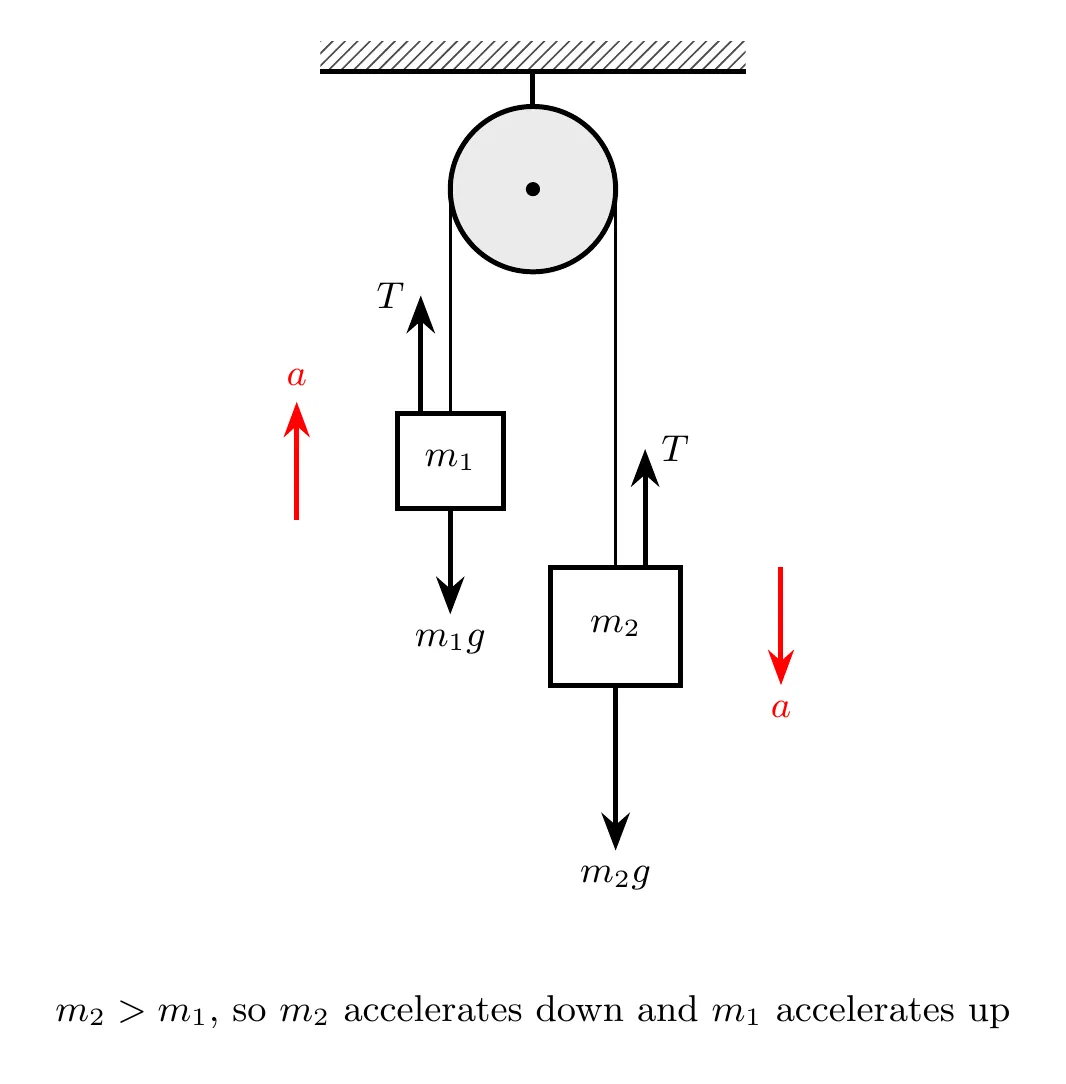
An Atwood machine is two masses connected by a string over a pulley, hanging vertically on either side.
Example: an Atwood machine holds a 2.0 kg block on one side and a 3.0 kg block on the other, connected by an ideal string over an ideal pulley. Find the acceleration and the tension. Use m/s².
System first: treat both blocks and the string as one system that moves along the string. The heavier block’s weight pulls the system one way and the lighter block’s weight pulls it the other way. The tension is internal, so it drops out:
Then isolate one block: the 2.0 kg block accelerates upward, so
Check with the 3.0 kg block, which accelerates downward: gives N. ✓ Because the string and pulley are ideal, the same 24 N pulls up on both blocks.
2. Half Atwood Machine (Modified Atwood Machine)
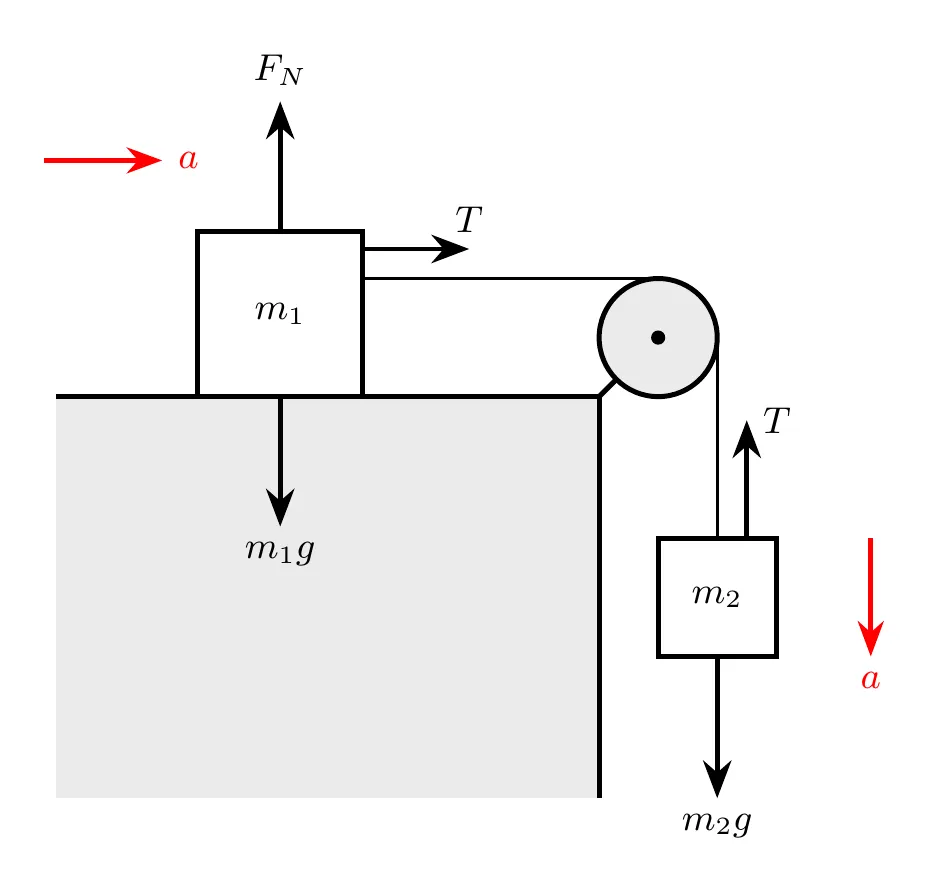
A half Atwood machine has one mass on a horizontal surface and another hanging vertically, connected by a string over a pulley.
3. Connected Objects (Horizontal)
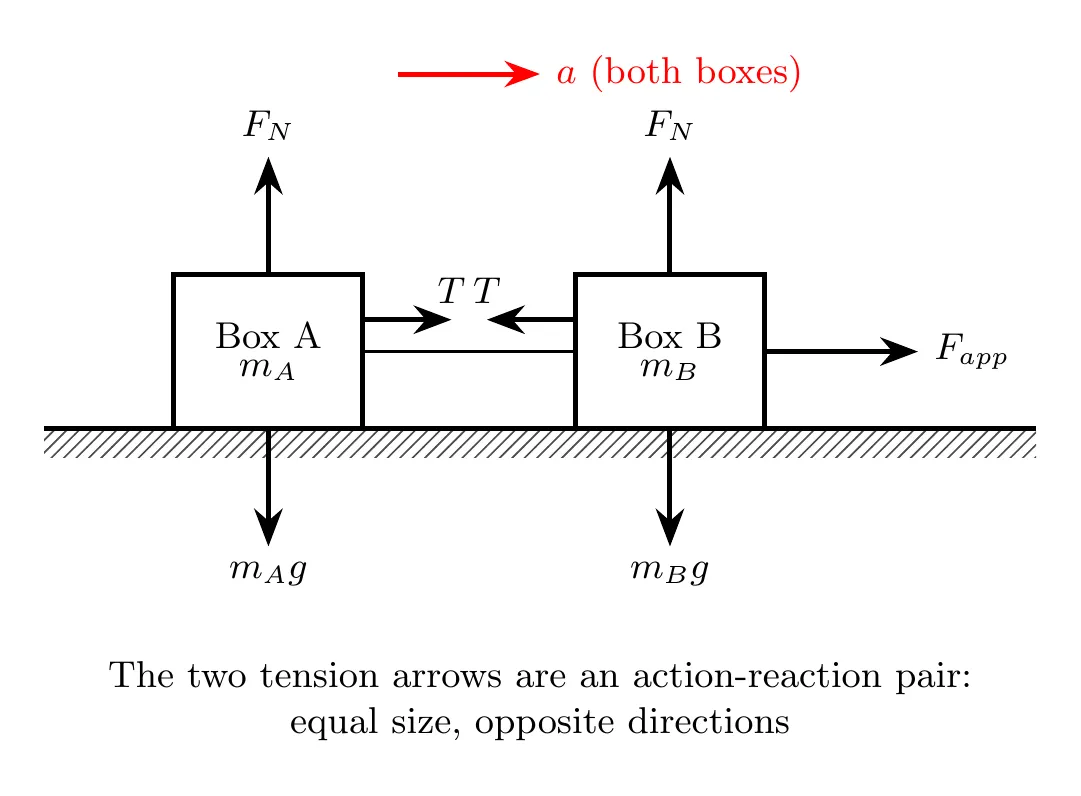
Connected objects are two or more objects linked by strings or ropes, often pulled by an external force.
Problem-Solving Strategy for Multi-Object Systems
Step 1: Treat the system as a whole to find the acceleration.
When multiple objects are connected and move together, they share the same acceleration. Analyze the whole system to find that common acceleration.
Step 2: Isolate individual objects to find the internal forces.
Once you know the acceleration, draw separate free body diagrams for the individual objects to find the tensions or other internal forces.
Example Problem: Connected Boxes
Problem: Two boxes are connected by a light string on a frictionless horizontal surface. Box P has a mass of 4 kg and Box Q has a mass of 6 kg. A horizontal force of 15 N pulls Box Q to the right.
- What is the acceleration of the system?
- What is the tension in the string connecting the boxes?
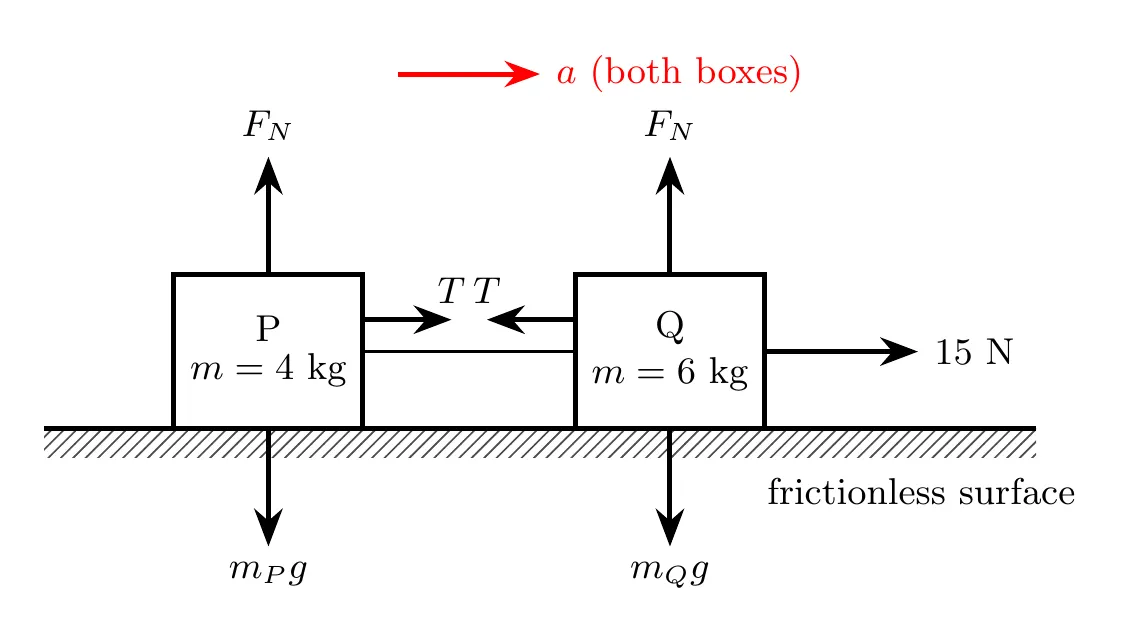
Part (a): Finding the System Acceleration
Treat both boxes as a single system.
Apply Newton’s Second Law to the whole system:
The forces in the x-direction on the system:
- Applied force: 15 N to the right (positive).
- No friction.
Total mass:
Apply Newton’s Second Law:
Answer: the system accelerates at 1.5 m/s² to the right.
Part (b): Finding the Tension in the String
Now isolate one of the boxes. Pick the simpler one. Box P has fewer forces.
Free body diagram for Box P:
- Tension pointing right (the only horizontal force).
Apply Newton’s Second Law to Box P:
Answer: the tension in the string is 6 N.
Verification Using Box Q
Check this by analyzing Box Q instead.
Free body diagram for Box Q:
- Applied force: 15 N to the right (+).
- Tension: to the left ().
Apply Newton’s Second Law to Box Q:
That confirms the answer. The tension is 6 N no matter which box you analyze.
Why Both Methods Give the Same Answer
By Newton’s Third Law, the tension the string exerts on Box P (to the right) and the tension the string exerts on Box Q (to the left) are an action-reaction pair. They have equal magnitude:
Both have magnitude 6 N, just pointing opposite ways.
Choosing Which Object to Analyze
The strategy: pick the object with fewer forces in the direction you’re analyzing.
In our example:
- Box P: only tension in the x-direction, so a simpler calculation.
- Box Q: both the applied force and tension in the x-direction, so a bit more complex.
Both methods work, but one takes less algebra.
Newton’s Second Law: The Foundation
Newton’s Second Law is the math tool you use alongside free body diagrams:
or, in component form:
This law says the net force on an object equals its mass times its acceleration.
Common Mistakes
- Confusing action-reaction pairs with balanced forces. Action-reaction pairs act on different objects. Balanced forces act on the same object and give zero acceleration.
- Including tension in system analysis. When you analyze the whole system, internal tensions are internal forces and shouldn’t go into . Only external forces affect the system’s acceleration.
- Assuming the tension equals the applied force. Tension does not equal the applied force unless the object being pulled is massless or has zero acceleration.
- Drawing tension pointing away from both objects. Tension points toward the point of attachment. On two connected boxes, tension points right on the left box and left on the right box.
- Using different accelerations for connected objects. Objects connected by an inextensible string have the same magnitude of acceleration (though possibly different directions in an Atwood machine).
- Forgetting that action-reaction pairs are the same type of force. If one is gravitational, both are. If one is tension, both are. You can’t pair a tension force with a gravitational force.
- Applying action-reaction pairs to the same object. Newton’s Third Law pairs always act on different objects. Never draw both forces of an action-reaction pair on the same free body diagram.
- Not knowing when to use the system approach. When you need the acceleration, analyze the whole system. When you need internal forces (like tension), analyze individual objects.
- Miscounting the total mass. When finding the system acceleration, include all the masses:
- Confusing which way tension acts. Tension in a rope pulling an object always pulls toward the connection point, never away from the object into empty space.