

2.4 - Newton’s First Law
Net Force
Before we get into Newton’s First Law, we need the idea of net force.
Net force is the vector sum of all the forces acting on a system:
The net force is what decides how an object’s motion changes. To find it, you just add up all the force vectors acting on the object.
Translational Equilibrium
Translational equilibrium is when the forces line up so that the net force on a system comes out to zero:
You can also write that as:
Since forces are vectors, equilibrium has to hold in each dimension on its own:
T-Chart Method for Organization
A handy way to keep things organized is the T-chart method:
X-Direction (Horizontal) | Y-Direction (Vertical) |
Forces → | Forces ↑ |
Forces ← | Forces ↓ |
This lays out the forces by direction so you don’t accidentally leave one out when you apply Newton’s laws.
Newton’s First Law Statement
Newton’s First Law: if the net force on a system is zero, that system’s velocity stays constant.
In plainer words
An object at rest stays at rest, and an object in motion keeps moving at constant velocity, until a net external force acts on it.
The key word is EXTERNAL. To change a system’s motion, the force has to come from outside the system. Internal forces within a system don’t do anything to the motion of its center of mass.
Important Consideration: Dimensional Independence
Forces can be balanced in one dimension but unbalanced in another, and that’s a big deal when you’re analyzing motion:
- An object can be in equilibrium vertically () while still accelerating horizontally ().
- Always look at each dimension separately.
The velocity only changes in the direction of the unbalanced force. A hockey puck gliding east on frictionless ice that gets a steady push toward the north keeps its eastward velocity exactly the same while it picks up northward velocity.
Example: Pulling a Sled
Problem: a 5.0 kg sled sits on frictionless ice. You pull it with a rope at 20 N, angled 37° above the horizontal. Find the normal force and the sled’s acceleration. Use m/s², , and .
Vertical (balanced): the sled doesn’t leave the ice, so :
Horizontal (unbalanced): nothing opposes the rope’s horizontal pull:
Answer: N and m/s² forward. The forces balance up and down, so the vertical velocity stays zero, while the unbalanced horizontal force changes the horizontal velocity. The normal force is less than the 50 N weight because the rope helps hold the sled up.
Law of Inertia
Newton’s First Law also goes by the name Law of Inertia.
Inertia is how much an object resists changes to its state of motion. The quantity that measures inertia is mass, in kilograms (kg).
- More mass means more inertia, which makes the motion harder to change.
- Less mass means less inertia, which makes the motion easier to change.
Classic Example: Bus Passenger
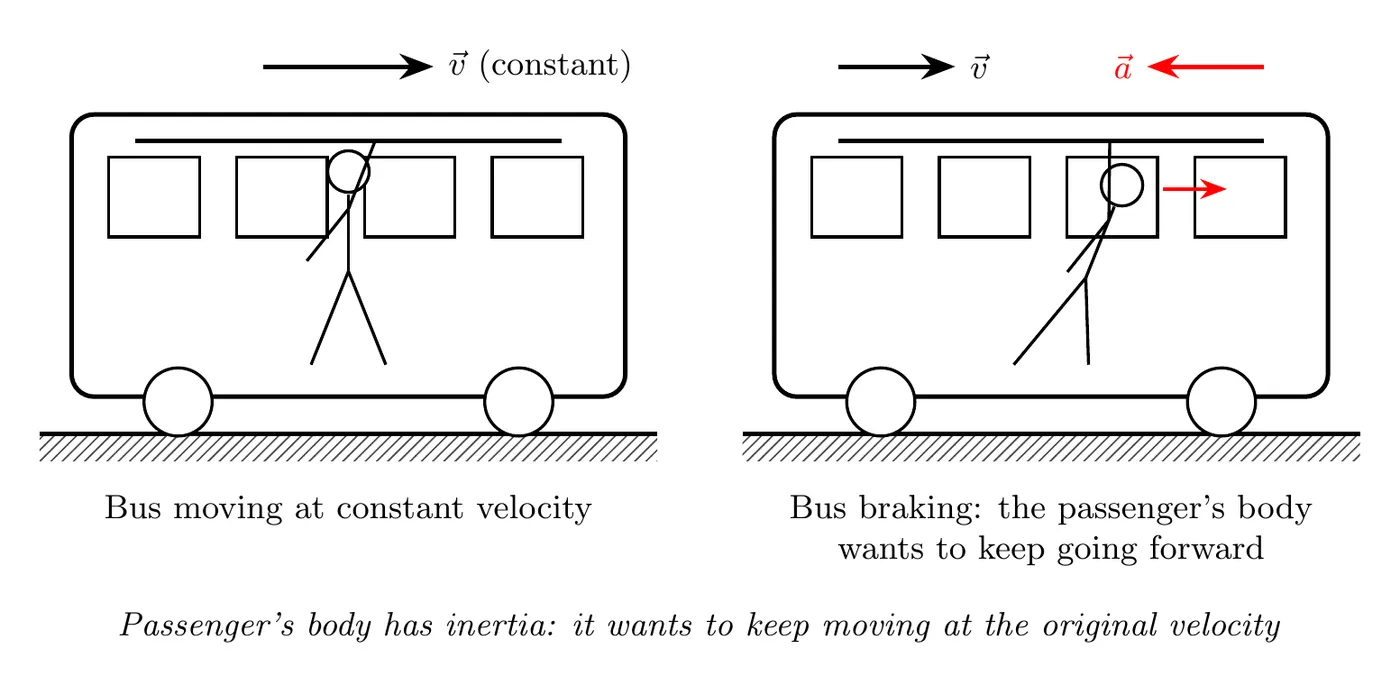
The setup: you’re standing on a moving bus holding a handrail.
So what happens when the bus brakes?
- The bus and the floor slow down.
- Your body wants to keep going forward at the original speed, thanks to inertia.
- You feel yourself lurching forward.
- The handrail gives you the external force you need to slow your body down along with the bus.
That’s inertia in action: your body resists the change in motion.
Inertial Reference Frames
Back in 1.4, an inertial reference frame was one that isn’t accelerating. Newton’s first law gives the real test: an inertial reference frame is one where an observer would see the first law work, so an object with zero net force on it really does sit still or move at constant velocity. Newton’s laws only hold in inertial frames.
- Accelerating frames are noninertial. On the braking bus, a ball on the floor rolls forward even though nothing pushes it forward. To someone on the bus, it looks like the first law failed. To someone on the sidewalk (an inertial frame), the ball just keeps moving at the bus’s old speed while the bus slows down under it.
- The ground counts as inertial for AP problems. Earth’s spin gives points on the equator a small acceleration (about 0.03 m/s², well under 1% of ), so it’s ignored.
Equilibrium/Tension Problems
One classic use of Newton’s First Law is objects hanging from a couple of cables or wires at angles.
Key Setup
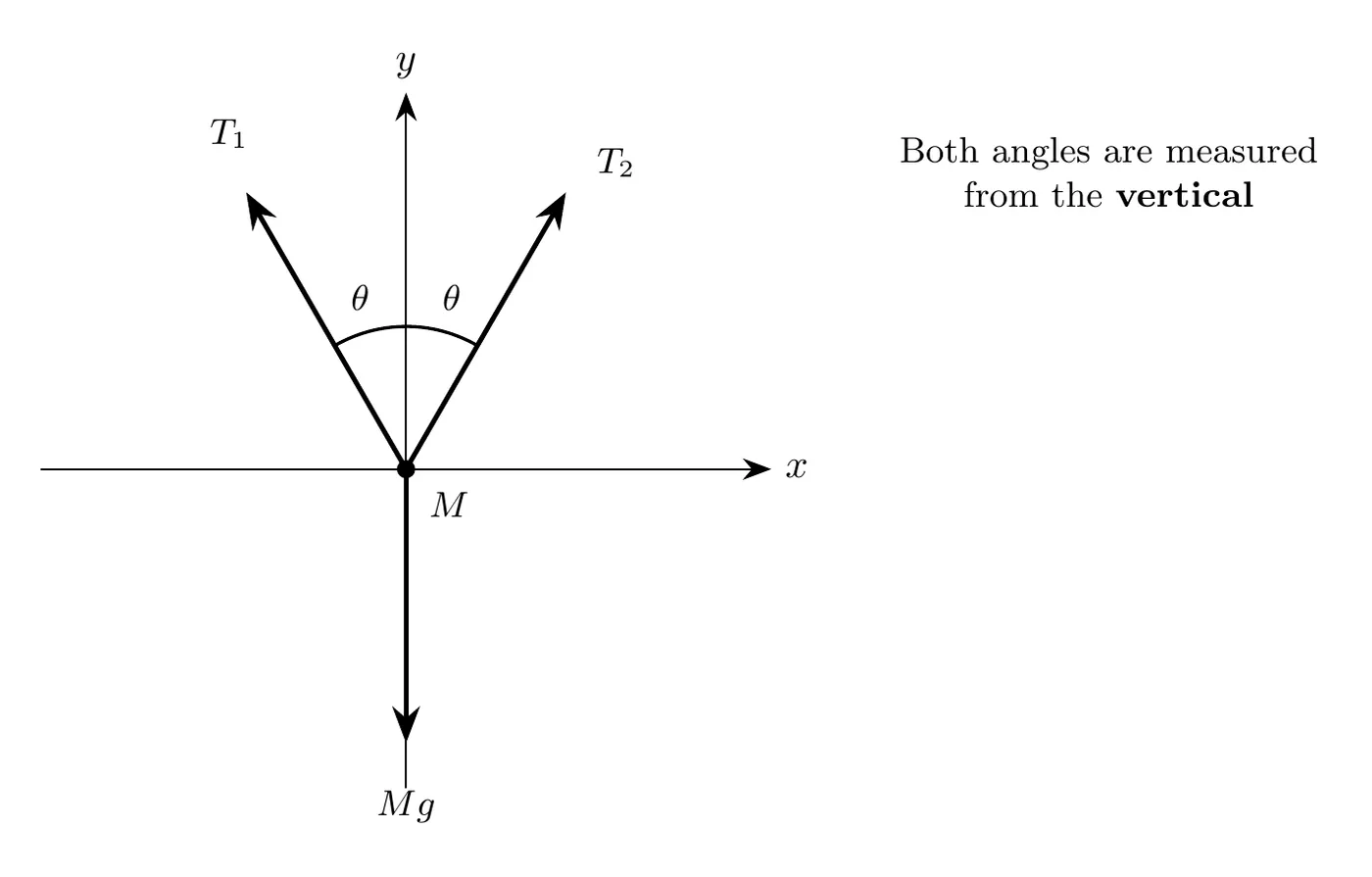
For tension problems:
1. Draw the free body diagram at the point where the cables meet.
2. Break the tension forces into components.
3. Apply the equilibrium conditions in each direction.
Important: Angle Reference Matters
When the angle is measured from the VERTICAL:
- the x-component uses sine:
- the y-component uses cosine:
When the angle is measured from the HORIZONTAL:
- the x-component uses cosine:
- the y-component uses sine:
Always check the problem to see which reference, vertical or horizontal, it’s using.
Example Problem: Suspended Traffic Light
Problem: a traffic light with mass hangs at rest from two support cables. Each cable makes an angle with the vertical, and the system is in equilibrium. What’s the tension in each cable?
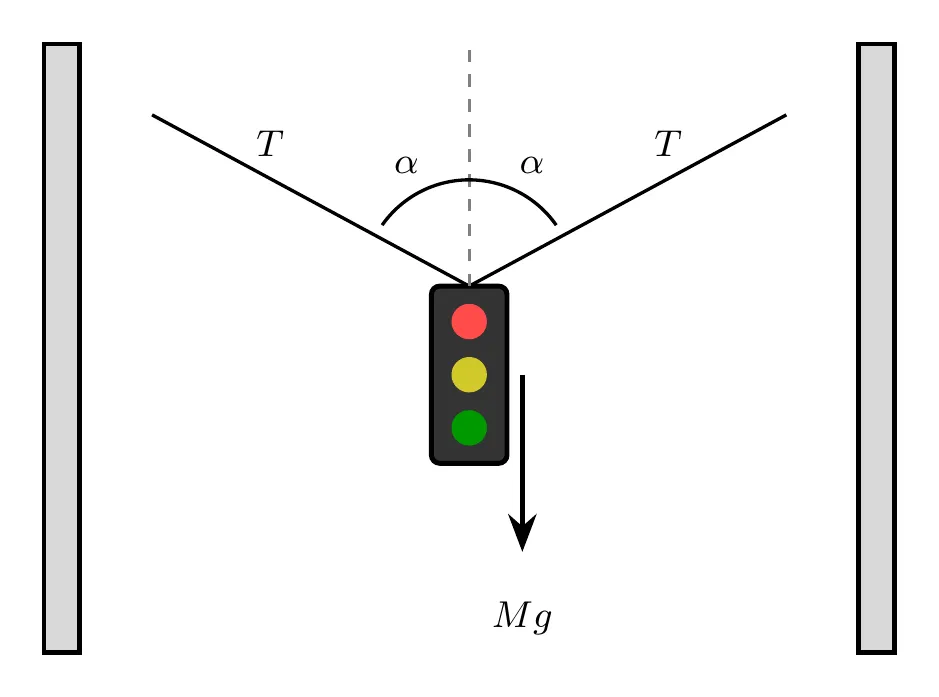
Solution
Step 1: Draw the free body diagram
At the point where the cables meet the traffic light, three forces are acting:
- Tension in the left cable (up and to the left).
- Tension in the right cable (up and to the right).
- Weight (straight down).
By symmetry, .
Step 2: Set up the T-chart
X-Direction | Y-Direction |
(left, negative) | (left, up) |
(right, positive) | (right, up) |
(down, negative) | |
Step 3: Apply equilibrium in the x-direction
That just confirms the horizontal components cancel, which makes sense since the tensions are equal.
Step 4: Apply equilibrium in the y-direction
Step 5: Solve for the tension
Answer: each cable has tension .
What it’s telling you:
- As gets bigger (cables more horizontal), shrinks, so the tension climbs.
- When (cables straight up), , the smallest possible tension.
- As (cables horizontal), , which is why you physically can’t hold it up that way.
Problem-Solving Strategy for First Law Problems
DRAW:
1. Draw a free body diagram.
2. Pick a coordinate system.
3. Break the angled forces into components.
SUM:
1. Apply in the x-direction.
2. Apply in the y-direction.
3. Write an equation for each direction.
SOLVE:
1. Solve the system of equations.
2. Check that the answer actually makes sense.
Common Mistakes
- Thinking equilibrium means “at rest.” Equilibrium just means , which covers objects cruising at constant velocity, not only ones sitting still.
- Grabbing the wrong trig function. Always check whether the angle comes from the vertical or the horizontal, because that’s what tells you whether each component uses sine or cosine.
- Forgetting equilibrium applies to each dimension on its own. You need AND separately.
- Tossing internal forces into a system analysis. Only external forces decide whether a system is in equilibrium. Internal forces between parts of the system come in action-reaction pairs that cancel out.
- Assuming symmetric tensions are always equal. Tensions are only equal when the geometry is symmetric (equal angles, equal masses, and so on). Check for symmetry before you assume it.
- Not seeing that constant velocity means equilibrium. If the velocity is constant (zero counts), then acceleration is zero, so the object is in equilibrium ().
- Swapping sine and cosine. Here’s a quick check: the component along the axis closest to the force uses the smaller angle, which gives the larger trig value. If is small from the vertical, the y-component should be big (cosine of a small angle is close to 1).
- Dropping the factor of 2. When two symmetric supports share the load, account for both: , not .
- Skipping the limiting cases. Always sanity-check the answer in the extremes (like or ).
- Mixing up inertia with momentum or force. Inertia is NOT a force. It’s a property (measured by mass) describing how much something resists changes in motion. Don’t draw “inertia” as a force on your free body diagram.