

2.7 - Kinetic and Static Friction
Kinetic Friction
Kinetic friction shows up when two surfaces in contact are sliding past each other.
The main things to know:
- It involves motion, one surface sliding over another.
- It fights against the direction of motion.
- If an object slides to the right, kinetic friction pushes to the left.
Relative to what? Kinetic friction on a surface points opposite to that surface’s motion relative to the other surface, not relative to the ground. Picture a box sliding backward along the bed of a pickup truck that’s speeding up. Relative to the bed, the box slides backward, so kinetic friction on the box points forward, which is the same way the box is moving relative to the road. By Newton’s third law, the box’s friction on the truck bed points backward.
Kinetic Friction Formula
where:
- = kinetic friction force (N).
- = coefficient of kinetic friction (no units).
- = normal force (N).
The AP equation sheet combines kinetic friction and maximum static friction into one line, . The “equals” part is kinetic friction (or static friction at its max), and the “less than” part is static friction that hasn’t maxed out yet.
Normal force and friction are two parts of one contact force. When a surface pushes on an object, the part of that push perpendicular to the surface is the normal force (it always points away from the surface), and the part along the surface is friction.
Important: surface area does NOT factor into friction. Friction only depends on the coefficient and the normal force.
Coefficient of Friction
The coefficient of friction () is basically a measure of how slippery a surface is.
A few properties:
- It’s a dimensionless number (no units).
- It’s usually between 0 and 1, though it can go above 1 for really rough surfaces.
- It depends on the two surfaces in contact (tire on road, wood on carpet, and so on).
- Lower values mean more slippery.
- Higher values mean more grip and more resistance.
For kinetic friction: is on the lower side, since it’s easier to keep something moving than to get it going.
Static Friction
Static friction acts between surfaces that aren’t sliding relative to each other yet.
The big difference from kinetic friction:
- Kinetic friction is the force needed to keep something moving.
- Static friction is the force you have to overcome to get it moving in the first place.
Static Friction Inequality
Unlike kinetic friction, static friction is written as an inequality:
Static friction:
- Adjusts itself to match whatever force you apply, up to a limit.
- Takes on the size and direction it needs to stop things from slipping.
- Can be anything from 0 up to .
Maximum static friction:
What this means: if your applied force is below , the object won’t budge and static friction just matches your push. Once your applied force passes , the object breaks loose and starts moving, and kinetic friction takes over.
Slipping and sliding both mean the two surfaces are moving relative to each other. Static friction is the force that prevents slipping, and it points whichever way it has to. When you walk, your shoe pushes backward on the ground, so static friction on your shoe points forward, the direction you’re going. The same goes for a car’s tires when the car speeds up. The bottom of the shoe (or tire) isn’t slipping, so it’s static friction, not kinetic.
Static vs. Kinetic Friction Graph
A classic experiment is to pull a block with a slowly growing force while you watch the friction force.
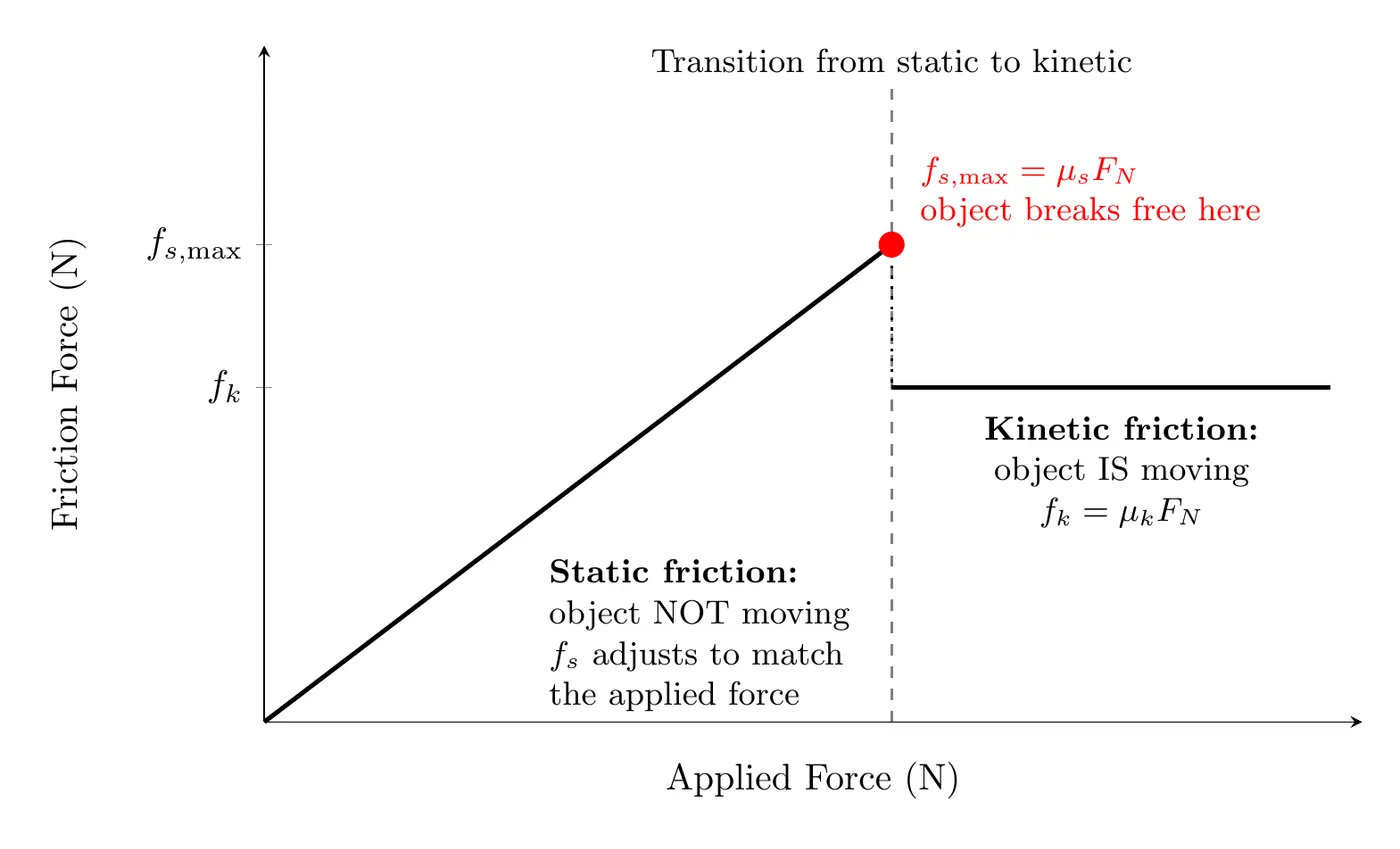
What the graph is showing:
- Linear region (static): as you push harder, static friction rises right along with you to keep the object still. Nothing moves.
- Peak (maximum static friction): the high point is . That’s the breakaway force.
- Drop to the plateau (kinetic): the moment it starts moving, friction drops down to the lower kinetic value and levels off.
- Horizontal plateau (kinetic): while it’s sliding at constant velocity, kinetic friction stays steady at .
Relationship Between Static and Kinetic Coefficients
For any given pair of surfaces:
The static coefficient is usually bigger than the kinetic one.
What that means physically: it’s harder to get something moving than to keep it moving.
One important catch: when you compare different surface pairs, this relationship might not hold, because they’re different materials. For instance:
- Tire on dry road: , .
- Tire on ice: , .
- Wood on sandpaper: , .
Each pair has within itself, but comparing across pairs doesn’t tell you anything useful.
Example Problem: Block Against Vertical Wall
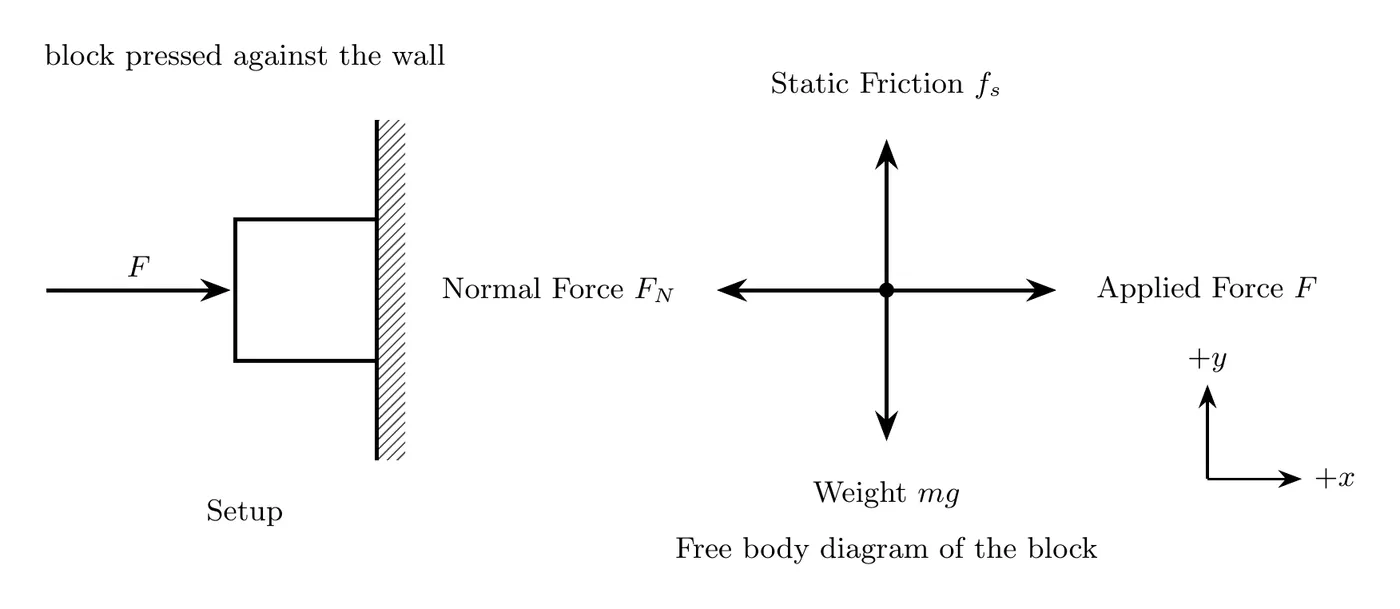
Problem: a horizontal force presses a block of mass against a vertical wall. The coefficient of static friction between the block and the wall is . What’s the smallest that keeps the block from sliding down?
Solution
Step 1: DRAW the free body diagram
Four forces act on the block:
- Applied force pointing right (pushing the block into the wall).
- Normal force pointing left (the wall pushing back).
- Weight pointing down.
- Static friction pointing up (holding the block up so it doesn’t slide down).
Worth noticing: here the normal force and the applied force are horizontal, while the weight and friction are vertical. That’s flipped from your usual flat-surface problem.
Step 2: SUM by applying equilibrium
Set up and :
X-direction (horizontal):
So the normal force equals the applied force.
Y-direction (vertical):
Static friction has to equal the weight to keep the block from slipping.
Step 3: SOLVE using the friction relationship
For static friction:
At the minimum force that just barely prevents slipping, we’re at maximum static friction:
Plug in what we found:
Solve for :
Answer: the minimum horizontal force is .
What it tells you:
- More mass means you need more force.
- A bigger friction coefficient means you need less force (better grip).
- If is tiny (super slippery), blows up to something huge.
Example Problem: Block on an Adjustable Ramp
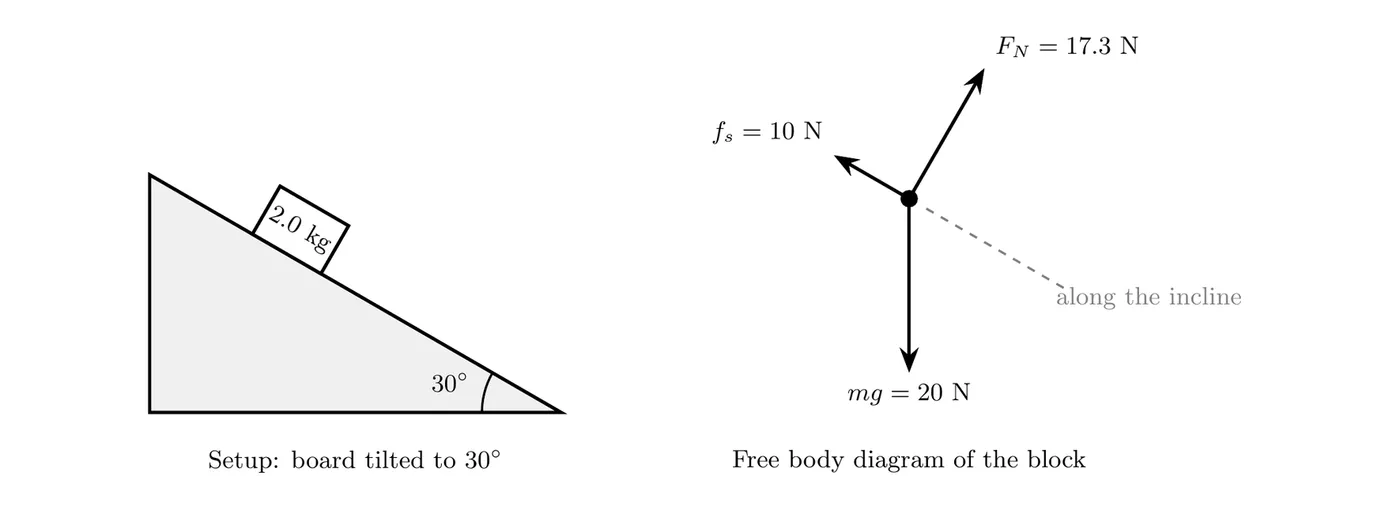
Problem: a 2.0 kg block rests on a board. The coefficients of friction between them are and . Use m/s².
- The board is tilted to 30°. Does the block slide? What’s the friction force?
- Slowly raise the board. At what angle does the block start to slip?
- Right after it starts to slip at that angle, what’s its acceleration?
Solution
Part (a): DRAW. Three forces act on the block: its weight N straight down, the normal force perpendicular to the board, and static friction up the board (without it, the block would slide down). Tilt the axes so runs along the incline.
SUM. Perpendicular to the board, N. Along the board, if the block stays put, static friction has to balance the downhill part of gravity:
SOLVE. Is that allowed? The most static friction can give is
Since 10 N is less than 13 N, static friction can do the job. The block stays put, and friction is 10 N up the board, not 13 N. Static friction only supplies what’s needed.
Part (b): the block is about to slip when static friction hits its max, . The mass and cancel:
This is also a simple lab method for measuring : tilt a board slowly, record the angle where the block first slips, and take its tangent.
Part (c): once it slides, kinetic friction takes over, . Along the incline (down is positive):
Answer: (a) no, friction is 10 N up the board; (b) 37°; (c) 2.0 m/s² down the incline. The block lurches into motion right away because is smaller than .
Problem-Solving Strategy for Friction Problems
DRAW:
1. Draw the free body diagram.
2. Decide whether the friction is static or kinetic.
3. Figure out which way friction points (it opposes motion, or the motion that’s about to happen).
SUM:
1. Apply and .
2. Use the friction equation: or .
3. Remember the normal force is perpendicular to the contact surface.
SOLVE:
1. Solve the system of equations.
2. Check that the answer makes physical sense.
Common Mistakes
- Assuming the normal force always equals the weight. Normal force only equals on a horizontal surface with no other vertical forces. On inclines, vertical walls, or with extra vertical forces, .
- Mixing up static and kinetic friction. Static friction keeps things from moving (at rest or not slipping). Kinetic friction fights against something that’s already sliding.
- Using the wrong inequality for static friction. It’s , not . The equals sign only kicks in at the maximum, right before motion starts.
- Thinking surface area matters. Friction depends only on the normal force and the coefficient, NOT on the contact area.
- Wrong friction direction on vertical surfaces. In the vertical wall problem, friction acts up or down, not sideways. Always set the direction based on the motion or the motion that’s about to happen.
- Comparing coefficients across different material pairs. Don’t hold up the of one pair against the of a different pair. The rule only works within one surface pair.
- Forgetting static friction adjusts. Static friction isn’t always maxed out. It takes on whatever value it needs (up to the max) to stop motion.
- Using the kinetic formula when nothing’s moving. If an object is sitting still or just about to move, use static friction. Kinetic friction only applies while surfaces are actually sliding.
- Mixing up which force makes the normal force. The normal force is always perpendicular to the contact surface. On a vertical wall, it’s the horizontal applied force that creates it, not gravity.
- Assuming friction always opposes the applied force. Friction opposes motion or the motion about to happen, which isn’t always the same direction as your push. In the wall problem, friction is vertical even though the push is horizontal.
- Not catching when the object breaks free. On the friction graph, motion starts at the peak (maximum static friction), not before. Below that threshold the object stays put no matter how hard you push.
- Treating friction as constant in every situation. Kinetic friction is constant while sliding, but static friction ranges from zero up to its maximum depending on the applied forces.