

2.5 - Mutually Exclusive Events
Overview
Some events can happen together, and some can't. This topic covers the joint probability of two events, which is the probability that both happen, and mutually exclusive (or disjoint) events, which can never happen together. On the AP exam, you'll be asked to justify whether two events are mutually exclusive, and the justification always comes down to one number: .
Joint probability: the probability of A and B
The joint probability of events and is the probability that both events happen on the same trial of a random process (the same roll, the same flip, the same randomly chosen person).
The outcomes that are in both and make up the intersection of and , written . So the joint probability is written and read "the probability of intersect ," or just "the probability of and ." The symbol means and: an outcome counts only if it's in and also in .
Seeing it in a Venn diagram
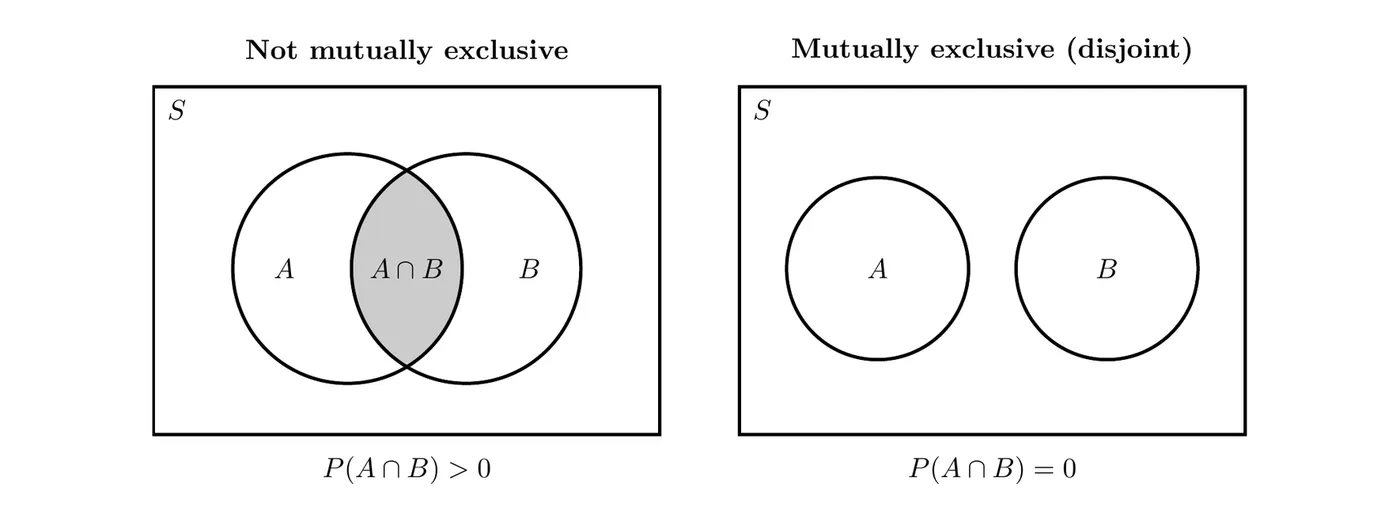
A Venn diagram draws the sample space as a rectangle and each event as a circle inside it. The region where the circles overlap is . When two events can't happen together, their circles don't overlap at all.
Finding a joint probability
- Equally likely outcomes: count the outcomes that are in both events and divide by the total number of outcomes in the sample space (Topic 2.4).
- Two-way table: divide the count in the cell where the two events meet by the grand total of the table. This is the joint relative frequency from Topic 2.2.
- Given probabilities: sometimes the problem just tells you , for example "12% of students do both."
Example 1: Joint probability from a die roll
Roll a fair six-sided die. Let = "the roll is even" and = "the roll is greater than 3." Find .
Step 1: List the outcomes in each event.
Step 2: Find the outcomes that are in both events.
Step 3: All 6 outcomes are equally likely, so divide by 6.
Answer: The probability that one roll is both even and greater than 3 is , about .
Example 2: Joint probability from a two-way table
A high school asked all 400 of its seniors whether they have a driver's license and whether they have a part-time job.
Job | No job | Total | |
License | 126 | 114 | 240 |
No license | 34 | 126 | 160 |
Total | 160 | 240 | 400 |
One senior is chosen at random. Let = "has a license" and = "has a job." Find .
Step 1: Find the cell where the License row meets the Job column. There are 126 seniors with both.
Step 2: Divide by the grand total.
Answer: The probability that a randomly chosen senior has both a driver's license and a part-time job is . In other words, 31.5% of the seniors have both.
Mutually exclusive (disjoint) events
Two events are mutually exclusive, or disjoint, if they can't happen at the same time. No outcome is in both events, so the intersection is empty and the joint probability is zero:
On a Venn diagram, mutually exclusive events are circles that don't overlap, like the right side of the figure above.
- Roll one die. "Roll a 2" and "roll an odd number" are mutually exclusive. No single roll is both.
- Choose one student. "Is a junior" and "is a senior" are mutually exclusive. Each student is in exactly one grade.
- Choose one senior from Example 2. "Has a license" and "has a job" are not mutually exclusive, because 126 seniors have both, so .
Categories of one variable never overlap
Each individual falls into exactly one category of a categorical variable (one grade level, one blood type, one favorite season). So events built from different categories of the same variable are always mutually exclusive. Events built from two different variables, like license and job, can overlap, so you have to check the joint probability.
Mutually exclusive is about one trial
Disjoint means the events can't both happen on the same trial. Flip a coin twice. "The first flip is heads" and "the second flip is heads" are not mutually exclusive, because the outcome HH makes both of them happen.
Justifying mutually exclusive on the AP exam
AP questions ask you to justify whether two events are mutually exclusive using the joint probability. A full justification has three parts:
- Name the two events in context.
- Find and show where the number comes from (a cell of a table, a list of outcomes, or a given probability).
- Compare it to 0 and state the conclusion in context.
For example: " and are not mutually exclusive, because , which is not 0. A senior can have both a driver's license and a part-time job." Just saying "they can happen at the same time" with no number is a weak justification.
Example 3: Justifying with a two-way table (AP-style)
A summer camp has 180 campers. Each camper is in one age group and picks exactly one morning activity.
Swimming | Archery | Climbing | Total | |
Ages 8 to 10 | 34 | 26 | 0 | 60 |
Ages 11 to 13 | 22 | 18 | 24 | 64 |
Ages 14 to 16 | 18 | 14 | 24 | 56 |
Total | 74 | 58 | 48 | 180 |
One camper is chosen at random. For each pair of events, decide whether the events are mutually exclusive, and justify your answer.
(a) "Is 8 to 10 years old" and "chose climbing"
The joint probability is 0, so the events are mutually exclusive. No camper aged 8 to 10 chose climbing, so a camper chosen from this camp can't be in both groups.
(b) "Is 14 to 16 years old" and "chose swimming"
Since , the events are not mutually exclusive. There are 18 campers who are 14 to 16 and chose swimming.
(c) "Chose swimming" and "chose archery"
Each camper picks exactly one activity, so no camper is in both groups. The events are mutually exclusive, because they are two categories of the same variable.
Mutually exclusive is not the same as independent
Students often mix these two ideas up. Mutually exclusive asks: can the events happen together? Independent (Topic 2.7) asks: does knowing one event happened change the probability of the other? Two mutually exclusive events that each have a positive probability can't be independent. If you know happened, then definitely didn't, so knowing changed the probability of to 0.
Common mistakes
- Thinking "different" means "disjoint." "Even" and "greater than 3" are different events, but a roll of 4 is in both.
- Dividing by the wrong total. A joint probability from a table uses the grand total, not a row or column total. Dividing by a row or column total gives a conditional probability (Topic 2.6).
- Justifying without a number. Show , say whether it equals 0, and explain what that means in context.
- Mixing up trials. Events about different trials, like the first and second flips of a coin, can both happen, so they aren't disjoint.
- Treating mutually exclusive as independent. Disjoint events with positive probabilities are always dependent.