

2.7 - Independent Events and Unions of Events
Overview
Two events are independent when knowing whether one happened tells you nothing about the other. Independence makes "and" probabilities simple: you just multiply. This topic also covers "or" probabilities, the probability that happens, happens, or both, using the general addition rule from the AP formula sheet.
Independent events
Events and are independent if knowing whether has occurred (or will occur) does not change the probability that occurs. If knowing does change it, the events are dependent.
When and are independent, all three of these are true:
For events with positive probabilities, the three statements go together: if one is true, all three are. So to check independence, you only need to check one. If it fails, the events are dependent.
Where independence comes from
- Separate physical trials. Coin flips, die rolls, and spinner spins don't remember earlier results.
- Random selection with replacement. Putting the item back resets the probabilities for the next pick.
- Choosing a few individuals from a very large population. This is close enough to independent even without replacement. Later units make this precise with the 10% condition.
- The problem says so. AP questions often state that trials are independent. Use it, and say that you're using it.
- Otherwise, check. With a two-way table or given probabilities, compare with , or with .
Example 1: Checking independence with a two-way table
A coffee shop recorded 200 orders by temperature and size.
Small | Large | Total | |
Iced | 42 | 28 | 70 |
Hot | 78 | 52 | 130 |
Total | 120 | 80 | 200 |
An order is chosen at random. Let = "iced" and = "large." Are and independent?
Step 1: Find the probability of a large drink overall.
Step 2: Find the probability of a large drink given that the order is iced. Restrict to the Iced row.
Step 3: Compare: .
Answer: Yes, and are independent. Knowing that an order is iced doesn't change the probability that it's large: 40% of iced orders are large, and 40% of all orders are large. (Hot orders match too: .)
Example 2: Checking independence with probabilities
At a large high school, 40% of students play a school sport, 25% are in a music ensemble, and 12% do both. A student is chosen at random. Let = "plays a sport" and = "is in a music ensemble." Are and independent?
Method 1: Compare with .
Method 2: Compare with .
Answer: and are not independent. Students who play a sport are more likely to be in a music ensemble (30%) than students overall (25%). Either method alone is a complete justification.
Probability questions vs. sample data
In a probability question, the table or probabilities you're given are treated as exact, so independence means equal. If is close to but not equal, the events are dependent. With data from a sample, small differences can come from chance alone. In topics 3.14 and 3.15, you'll learn the chi-square test for deciding whether a difference in sample data is big enough to be evidence of an association.
The multiplication rule for independent events
If and are independent, the general multiplication rule from Topic 2.6 simplifies, because :
This extends to more than two independent events: multiply all of their probabilities. Only use it when independence is stated or justified. For dependent events, go back to .
"At least one" problems
"At least one" means one or more, which can happen in many different ways. It's much faster to use the complement, because the opposite of "at least one" is "none":
Example 3: Free throws (AP-style)
A basketball player makes 75% of her free throws. Assume her shots are independent. She takes 4 free throws in a game.
(a) Find the probability that she makes all 4.
(b) Find the probability that she misses at least one. "Misses at least one" is the complement of "makes all 4."
(c) Find the probability that she makes at least one. The complement is "misses all 4," and each miss has probability .
Answer: The probability is about that she makes all 4, that she misses at least one, and that she makes at least one. These multiplications only work because the shots are independent. If a miss made her more nervous on the next shot, you couldn't just multiply.
Independent vs. mutually exclusive
These two ideas sound alike but answer different questions.
Mutually exclusive (disjoint) | Independent | |
Question it answers | Can and happen on the same trial? | Does knowing happened change the probability of ? |
Test | , or | |
Example (one die roll) | "Roll a 2" and "roll an odd number" | "Roll an even number" and "roll a 1 or 2": |
Here's the key link: if and are mutually exclusive and both have positive probability, they cannot be independent. Knowing that you rolled a 2 makes the probability of an odd number drop from to 0. That's a change, so the events are dependent.
Unions: the probability of A or B
The union of and , written , is the event that happens, happens, or both happen. Its probability is . In statistics, "or" always includes "both."
The general addition rule
From the AP formula sheet:
Why subtract? includes the outcomes that are in both events, and so does . Adding them counts the overlap twice, so you subtract it once.
Special case: mutually exclusive events
If and are mutually exclusive, then , and the rule becomes
Only use this shortcut when the events really are disjoint.
"Neither" is the complement of "or"
"Neither nor " is everything outside both circles, so .
Example 4: Union with a Venn diagram
Go back to the high school in Example 2: (plays a sport), (music ensemble), and . A student is chosen at random.
(a) Find the probability that the student plays a sport or is in a music ensemble.
(b) Find the probability that the student does neither.
(c) Find the probability that the student plays a sport but is not in a music ensemble.
A Venn diagram with the probability of each region shows all of these at once. The four regions add to 1: .
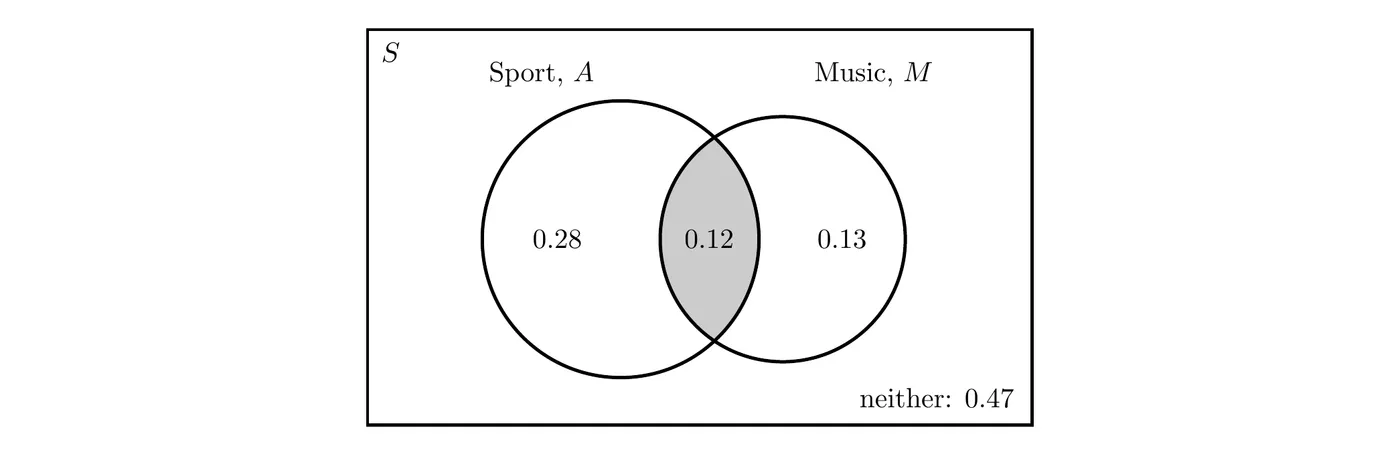
Answer: 53% of students do at least one of the two activities, 47% do neither, and 28% play a sport without being in a music ensemble.
Example 5: Union of independent events (AP-style)
Maya takes a train and then a bus to work. The train is late on 15% of days, and the bus is late on 20% of days. Assume the train and the bus are late independently of each other. Find the probability that at least one of them is late on a randomly chosen day.
Method 1: General addition rule. Let = "train is late" and = "bus is late." Independence gives the joint probability.
Method 2: Complement. "At least one is late" is the complement of "neither is late."
Answer: The probability that the train, the bus, or both are late is . Both methods agree, which is a good check. Just adding would be wrong, because it counts the days when both are late twice.
Common mistakes
- Assuming independence without a reason. Multiply only when independence is given or you've checked it.
- Confusing independent with mutually exclusive. Disjoint events with positive probabilities are always dependent.
- Forgetting to subtract the overlap. alone double counts the outcomes in both events. If your answer for is bigger than 1, this is usually why.
- Adding cases for "at least one." Use instead of trying to add up every case.
- Calling events independent because the numbers are close. In a probability question, has to equal exactly.