

5.10 - Multistep Reaction Energy Profile
Overview
In Topic 5.6 you drew the energy profile for one elementary step: a single hump from reactants, over a transition state, down to products. A mechanism with several steps gets one hump for each step, and the valleys between the humps are the intermediates. This topic is about building and reading these multistep energy profiles: where each activation energy is, where the overall energy change is, and how to spot the slow step.
Building the profile from the mechanism
Knowing the energetics of each elementary step lets you build the profile for the whole reaction, one step at a time.
- Each step has its own transition state. That's one peak per step.
- Each intermediate sits in a valley between two peaks. It's a real species at a local energy minimum, so it lasts a little while before the next step uses it up.
- Each level is the energy of the whole system, meaning every species present at that point, not just the one that changed.
- Each step has its own energy change, the valley after its peak minus the valley before it. A step can be uphill (endothermic) even when the overall reaction is downhill.
- The overall energy change is products minus reactants. It equals the sum of the steps' energy changes.
Here's a two-step mechanism with a slow first step:
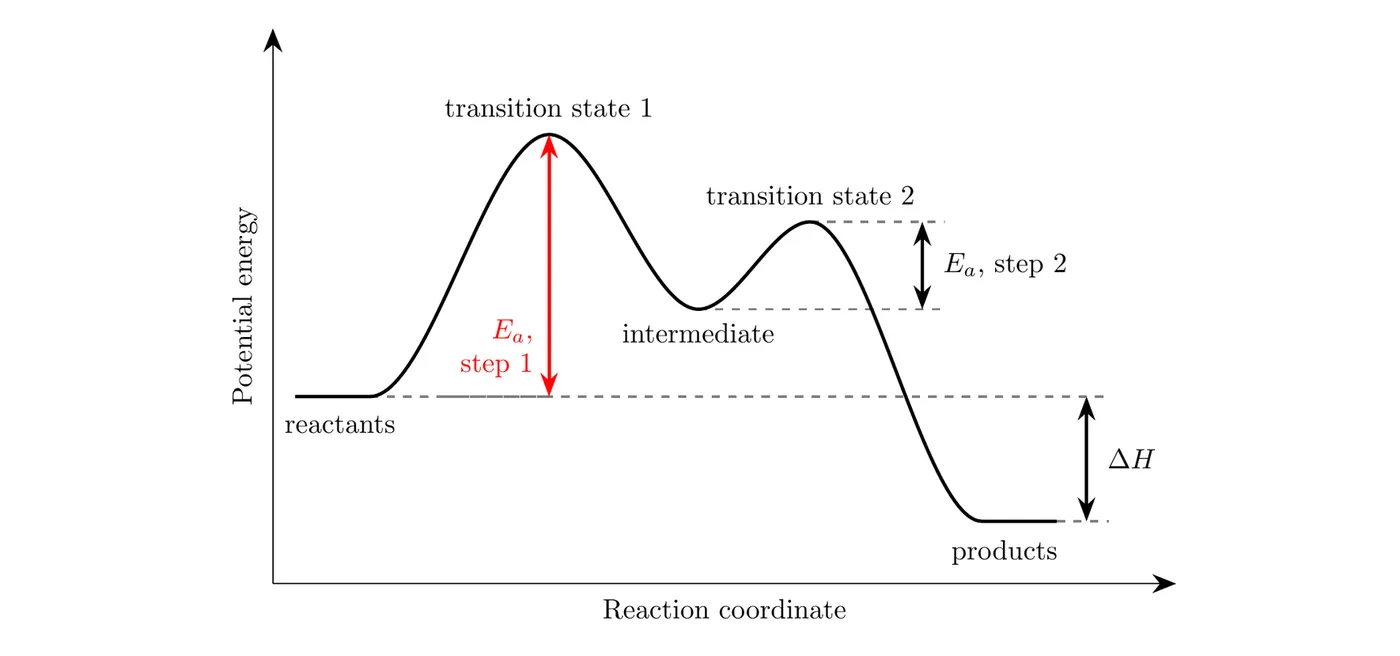
Read it from left to right. The reactants climb over transition state 1, the top of step 1, and drop into the valley of the intermediate. The intermediate climbs over transition state 2 and falls to the products. In this example step 1 is uphill (the intermediate is higher in energy than the reactants), but the overall reaction is exothermic because the products end up lower than the reactants.
Feature on the profile | What it means |
Number of peaks | Number of elementary steps |
Valleys between peaks | Intermediates (a simple sequence of steps has one fewer intermediate than steps) |
Each peak | A transition state (activated complex), never an intermediate |
Products level minus reactants level | for the overall reaction |
Reading activation energies
- for a step runs from the valley just before that peak up to the top of that peak. For step 1 that's the reactant level. For step 2 it's the intermediate's valley, not the original reactants.
- for the reverse of a step runs from the valley after the peak up to the same peak.
- The slow (rate-determining) step is the step with the largest activation energy, measured from that step's own starting point: the biggest climb from the valley just before its peak. Fewer collisions have enough energy to make that climb, so that step is slowest. On the profiles you'll see on the AP exam, its peak is also the highest one, so when you sketch a profile, give the slow step both the biggest climb and the highest peak. In the profile above, step 1 is the slow step.
- A fast, reversible step (a pre-equilibrium, Topic 5.9) has a small barrier in both directions, so the system crosses it back and forth easily.
- The highest peak compared with the reactants shows the most energy the system has to reach on its way to products.
Here's how to check that a profile matches a mechanism:
- Count the peaks. There should be one per step.
- Find the biggest climb. It should be the step the mechanism calls slow.
- Check the valleys. Each one is an intermediate, and its level should be higher or lower than the one before it according to whether that step is endothermic or exothermic.
- Compare the start and end levels. Products should be lower for an exothermic reaction and higher for an endothermic one.
Example 1: Reading a multistep energy profile
Use the energy profile below to answer the questions.
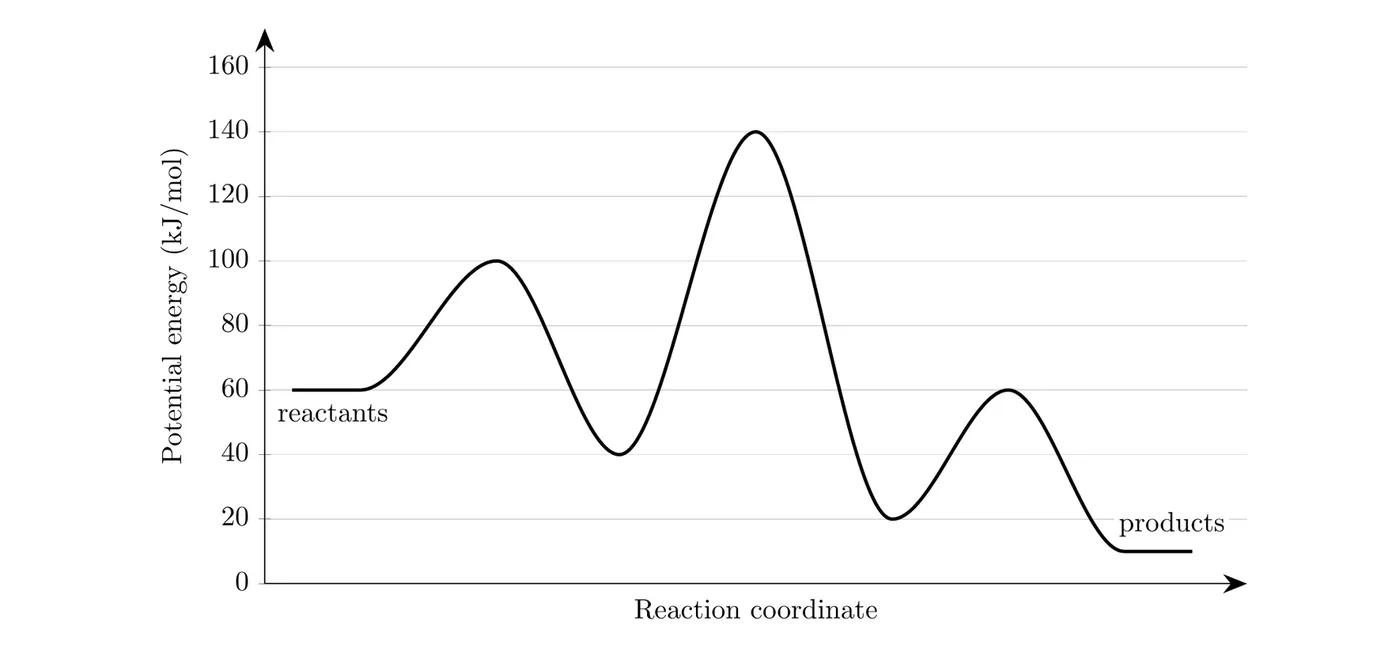
(a) How many elementary steps and intermediates does the mechanism have?
There are 3 peaks, so there are 3 steps. There are 2 valleys between the peaks, so there are 2 intermediates.
(b) Find the activation energy of each step. Which step is rate determining?
Read each climb from the valley just before the peak:
Step 2 has the largest activation energy (100 kJ/mol), so step 2 is the rate-determining step. Watch out: the activation energy of step 2 is not kJ/mol. Step 2 starts from the first intermediate at 40 kJ/mol, not from the reactants.
(c) What is for the overall reaction? Is it exothermic or endothermic?
The products are lower than the reactants, so the reaction is exothermic. As a check, the three steps' energy changes are , , and kJ/mol, which add up to kJ/mol.
(d) What is the activation energy for the reverse of step 2?
Answer: 3 steps and 2 intermediates; = 40, 100, and 40 kJ/mol, with step 2 rate determining; kJ/mol (exothermic); the reverse of step 2 has kJ/mol.
Example 2: Sketching a profile from a mechanism (AP-style)
The mechanism from Topic 5.9 for the reaction of nitrogen monoxide with hydrogen is shown below. Step 1 is slightly exothermic, and steps 2 and 3 are both strongly exothermic. Sketch the energy profile, and label the reactants, intermediates, and products.
Count the peaks. Three steps means three peaks. Two intermediates, and , means two valleys between them.
First hump. Step 1 is fast and slightly exothermic: a small hump, ending just below the reactants.
Second hump. Step 2 is slow, so it gets the largest climb from its valley. It's strongly exothermic, so it ends far below where it started.
Third hump. Step 3 is fast (a smaller climb) and strongly exothermic, ending at the products, the lowest level.
Labels. Label each level with everything present at that point. After step 1, the system is plus the 2 that haven't reacted yet. After step 2, it's .
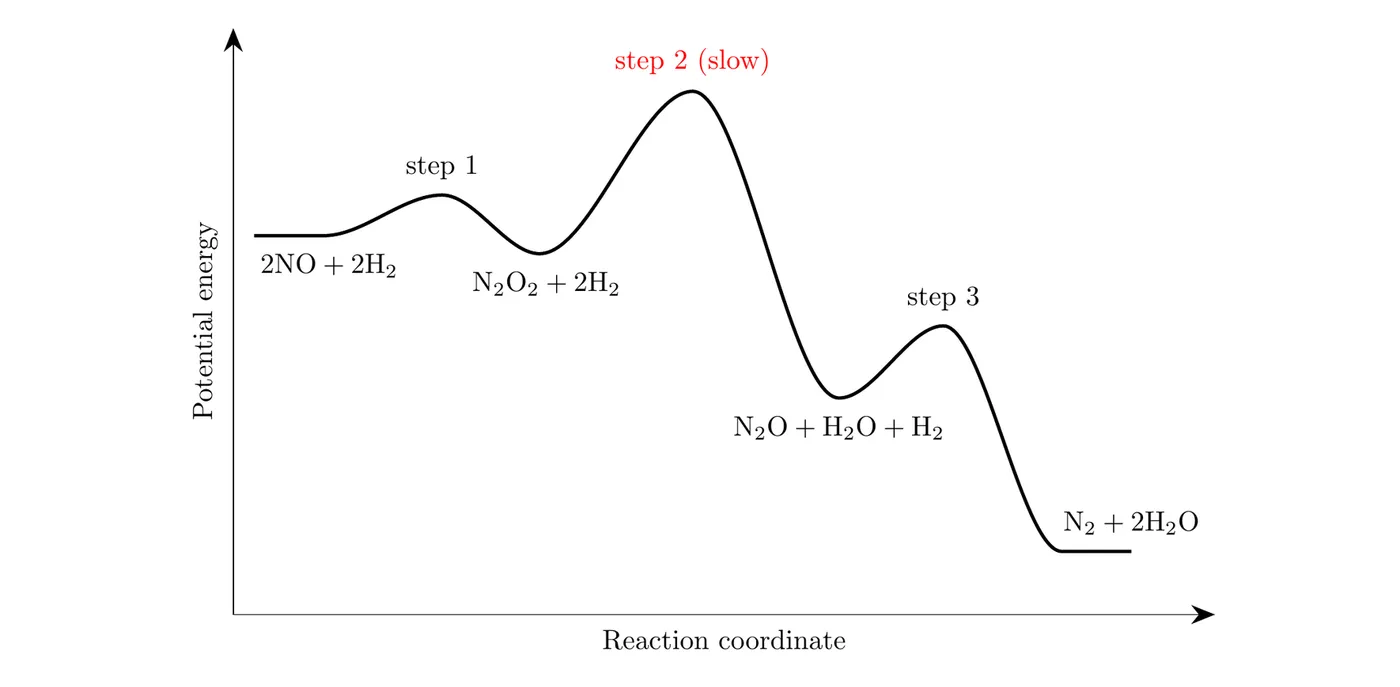
Answer: The sketch above. The heights aren't to scale, but the features that matter are: three peaks, the biggest climb at step 2, a first valley just below the reactants, and products far below the reactants.
Common mistakes
- Measuring every step's from the original reactants. Each step's climb starts from the valley right before its peak.
- Swapping intermediates and transition states. Intermediates are valleys. Transition states are peaks.
- Drawing the wrong number of humps. One peak per elementary step, including fast steps.
- Giving the slow step a small barrier. The rate-determining step must have the largest activation energy on the diagram.
- Getting backward. It's products minus reactants. Exothermic means the products end lower.
- Labeling only the species that changed. Each level is the whole system, so include species still waiting to react.