

5.5 - Collision Model
Overview
Why does a reaction go at the speed it does? The collision model answers this at the particle level: particles have to collide, and only collisions with enough energy and the right orientation make products. Together with the Maxwell-Boltzmann distribution of particle energies, it explains why most collisions fail and why heating a reaction speeds it up so much.
Reactions need collisions
For an elementary reaction to make products, the reactant particles have to collide. Bonds can only break and new ones form when the atoms involved get close enough to interact. No collision, no reaction.
Particles collide a lot. In a gas at room temperature and pressure, each molecule hits other molecules billions of times per second. If every collision made products, almost every reaction would be over in a fraction of a second. Most reactions are much slower than that, so in most reactions only a small fraction of collisions leads to a reaction. A collision that does is a successful (or effective) collision, and it needs two things:
- Enough energy. The collision has to carry at least the activation energy, . Below that, the particles just bounce apart.
- The right orientation. The particles have to hit in a way that lets the bonds rearrange, so the atoms that need to bond actually meet.
Energy: the activation energy
When particles collide, some of their kinetic energy goes into stretching and breaking bonds. The activation energy is the minimum collision energy needed to push the atoms into the arrangement partway between reactants and products (the transition state, Topic 5.6). A gentle collision doesn't supply enough energy, and the particles separate unchanged.
Orientation
Energy alone isn't enough. Consider the elementary reaction between a chlorine atom and nitrosyl chloride:
To form , the incoming Cl atom has to hit the Cl end of NOCl. If it hits the O end, no bond between the two Cl atoms can form, and the particles bounce apart no matter how hard they hit.
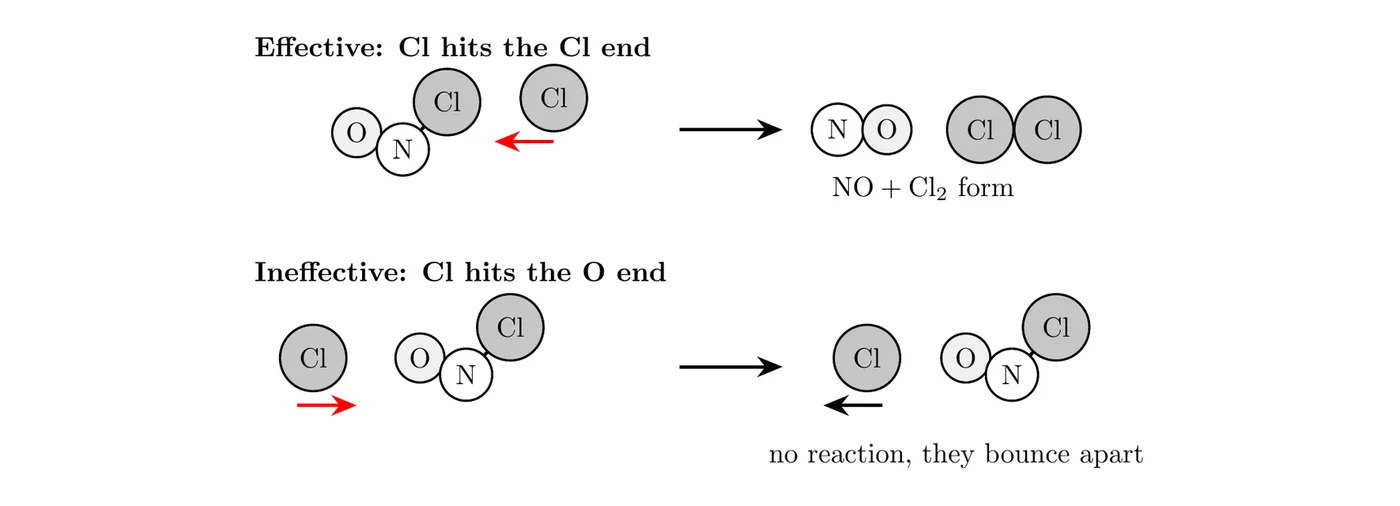
Larger molecules have even more ways to hit wrong, which is one reason reactions between large molecules can be slow.
The Maxwell-Boltzmann distribution
The particles in a sample don't all have the same kinetic energy. A few move slowly, most move at medium speeds, and a few move very fast. The Maxwell-Boltzmann distribution shows how many particles have each kinetic energy (you met it for gases in Topic 3.5).
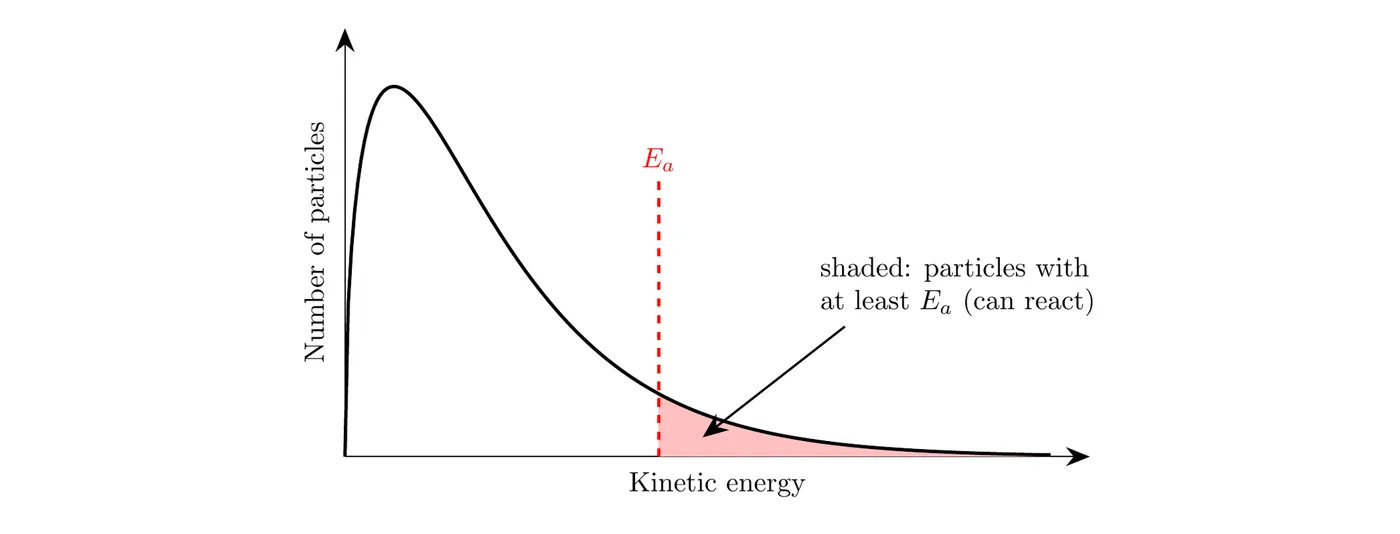
How to read it:
- The curve starts at zero, rises to a peak (the most common energy), and has a long tail to the right (a few particles with high energy).
- The total area under the curve stands for all of the particles.
- The area to the right of stands for the particles with at least the activation energy. Its share of the total area is a rough estimate of the fraction of collisions energetic enough to react.
For a typical reaction, sits out in the tail, so the shaded fraction is small. That's the energy reason most collisions fail.
Higher temperature
Raising the temperature raises the average kinetic energy of the particles. The distribution changes in a specific way:
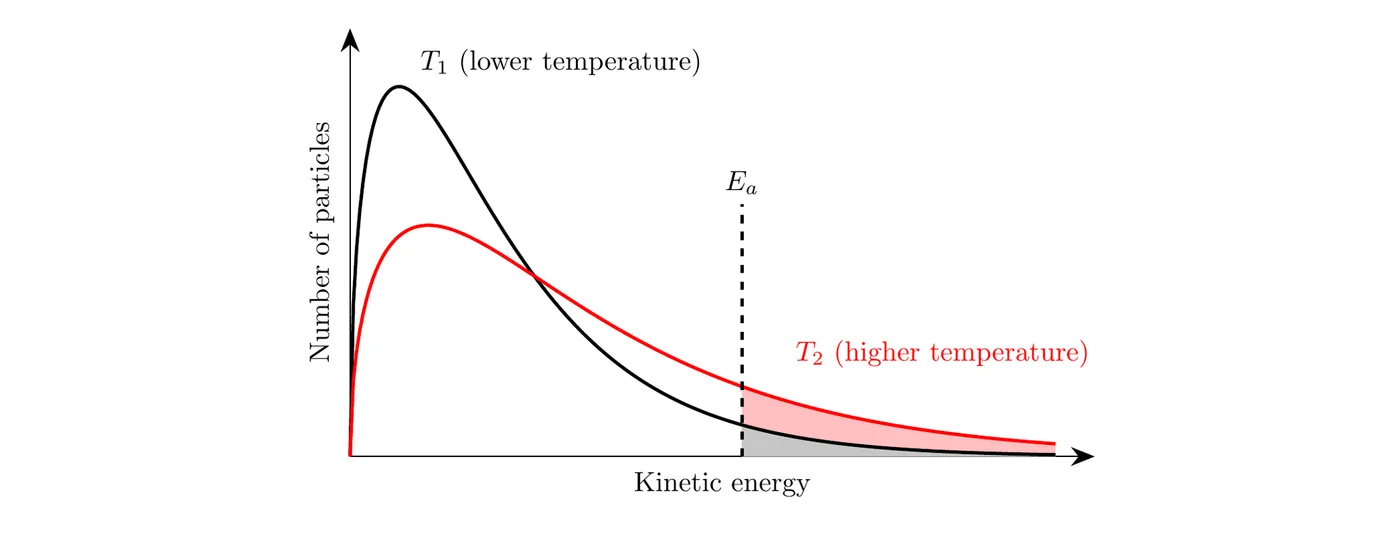
- At the higher temperature, , the peak moves right (to higher energy) and gets lower, and the curve spreads out.
- The area under both curves is the same, because the number of particles didn't change.
- The area to the right of is much larger at (red and gray together) than at (gray only). A much larger fraction of collisions have enough energy to react.
So temperature affects the rate in two ways: particles move faster and collide more often, and a larger fraction of collisions have at least . The second effect is by far the bigger one, as Example 2 shows.
Putting the collision model to work
Change | Collisions per second | Fraction of collisions with at least | Rate |
Raise a reactant's concentration | Increases | No change | Faster |
Grind a solid into smaller pieces | Increases | No change | Faster |
Raise the temperature | Increases a little | Increases a lot | Faster |
Add a catalyst | No change | Increases (lower , Topic 5.11) | Faster |
Example 1: Which collision works?
For the elementary step , two collisions have the same energy, more than . In collision X, the N atom of NO hits an O atom at one end of . In collision Y, the O atom of NO hits . Which collision can produce products? Explain.
Collision X. In the product , nitrogen is bonded to two oxygen atoms, so the new bond forms between N and an O atom taken from . Only a collision that brings the N atom right up to an end O atom of lets that bond form while a bond in breaks. In collision Y, the N atom faces away from , so the new bond can't form and the molecules bounce apart. Both collisions had enough energy, so orientation decides.
Example 2: Why heating doubles the rate (AP-style)
A student finds that the rate of a reaction nearly doubles when the temperature goes from 25 °C to 35 °C. The student claims: "At 35 °C the molecules collide twice as often, so the rate doubles." (a) Use the fact that the average speed of the molecules is proportional to the square root of the kelvin temperature to evaluate the claim. (b) Explain the increase in rate using the Maxwell-Boltzmann distribution.
(a) At the same concentration, collisions per second go up in proportion to the average speed:
The molecules collide only about 1.7% more often, not twice as often, so the claim is wrong. More frequent collisions can't explain a rate that nearly doubles.
(b) At 35 °C the Maxwell-Boltzmann distribution shifts toward higher energies and spreads out, so the area to the right of grows. A larger fraction of collisions have at least the activation energy, so more collisions per second are successful. That larger fraction, not the small rise in collision frequency, is what nearly doubles the rate. (For a reaction with kJ/mol, the fraction goes up by a factor of about 1.9. That number comes from the Arrhenius equation in Topic 5.6, and calculations like it are not assessed on the AP exam.)
Example 3: Number vs. fraction of successful collisions
Two separate changes are made to a reaction mixture: (1) the concentration of a reactant is doubled, and (2) the temperature is raised. Both speed up the reaction. Which change increases the fraction of collisions that are successful?
Only raising the temperature. Doubling a concentration doubles the number of collisions per second, so the number of successful collisions per second goes up, but the fraction that succeed stays the same: the particles have the same energy distribution and the same . Raising the temperature moves more of the distribution past , so a larger fraction of collisions succeed.
Common mistakes
- Thinking every collision causes a reaction. Only collisions with at least and the right orientation succeed, and in most reactions that's a small fraction.
- Saying heat works mainly through more collisions. The main effect is a larger fraction of collisions with at least .
- Drawing the higher-temperature curve taller. It's lower and wider, peaks farther right, and has the same area.
- Mixing up number and fraction. More concentration means more successful collisions per second, but the same fraction. Higher temperature raises the fraction.
- Moving when the temperature changes. Temperature changes the curve, not the activation energy. A catalyst is what lowers .