

5.8 - Reaction Mechanism and Rate Law
Overview
A proposed mechanism makes a prediction you can test: the rate law. If the rate law the mechanism predicts matches the one measured in the lab, the mechanism is consistent with the data. If it doesn't match, the mechanism is out. This topic covers the most common case on the AP exam, where the first step is the slow one (or every step goes only forward), so the rate law comes straight from the slowest step.
The rate-determining step
The steps in a mechanism usually run at very different speeds. The slowest step is called the rate-determining step (or rate-limiting step). The overall reaction can't go faster than its slowest step, so that step sets the overall rate.
Think of a cafeteria line where the servers are fast but there's one slow cashier. The number of students who get through each minute depends only on the cashier. Adding more servers doesn't help. Steps that come after the slow step are like that: they use up what the slow step makes almost as soon as it's made, so speeding them up doesn't change the overall rate.
Writing the rate law from a mechanism
Recall from Topic 5.4 that the rate law of an elementary step comes straight from its coefficients. For a step :
This works only for elementary steps, because their coefficients count the particles that actually collide. It doesn't work for an overall equation.
When each step is irreversible, or when the first step is the rate-limiting step, the rate law of the whole reaction is set by the molecularity of the slowest step. To find it:
- Find the slow step.
- Write its rate law from its coefficients.
- Check that the rate law contains only species you can control and measure: reactants, and sometimes a catalyst. If it contains an intermediate, you're not done. Topic 5.9 shows how to replace it.
- Compare the result with the experimental rate law.
Fast steps after the rate-determining step don't appear in the rate law. A reactant that enters only in a fast later step is zero order: changing its concentration doesn't change the rate, even though it's used up in the reaction.
Example 1: Rate law from a slow first step
Write the rate law predicted by this mechanism, and compare it with the experimental rate law, .
Find the slow step. It's step 1, which is bimolecular: two molecules collide.
Write its rate law from the coefficients:
Check for intermediates. Only appears, and it's a reactant.
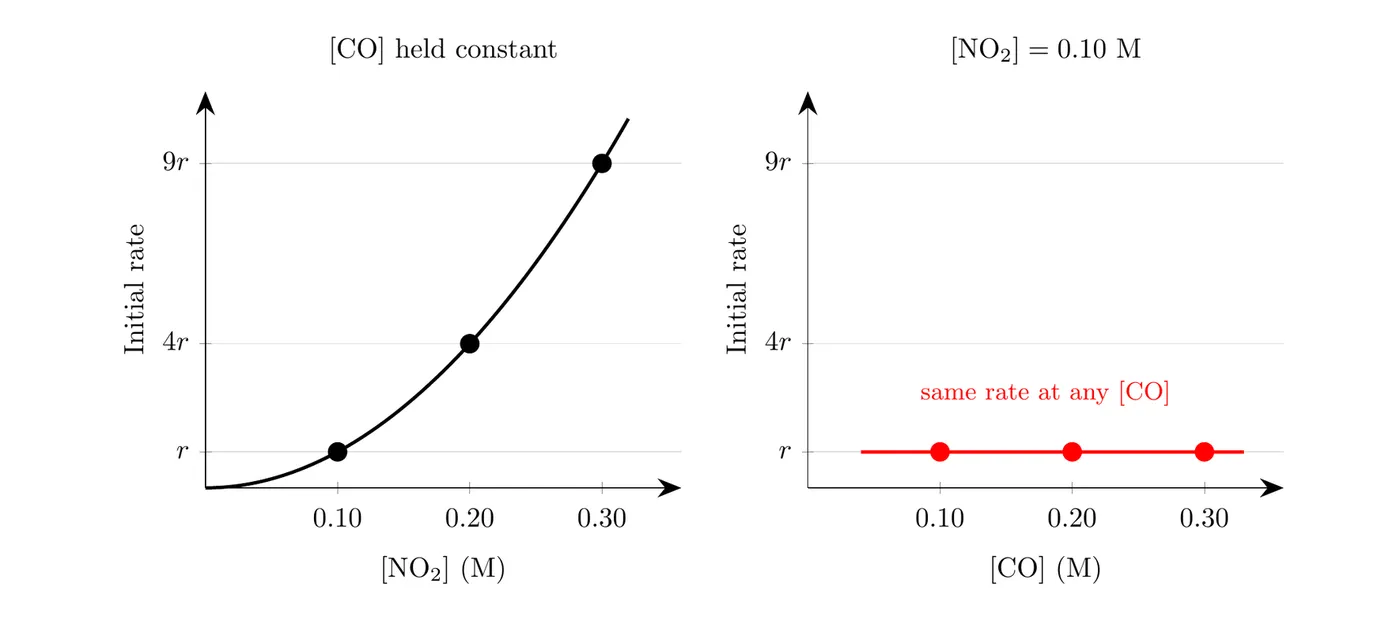
Answer: The mechanism predicts , which matches the experiment (at temperatures below about 225 °C). The reaction is second order in and zero order in CO. CO only reacts in step 2, which waits on the that step 1 makes, so adding more CO doesn't speed anything up.
If you had written a rate law from the overall equation, you would have gotten , which is wrong. The graphs below show what the correct rate law means for initial-rate experiments: doubling multiplies the rate by 4 and tripling it multiplies the rate by 9, while changing does nothing.
Example 2: Which step is rate determining?
Nitryl chloride decomposes by the mechanism below. The experimental rate law is . Which step is rate determining?
Try step 1 as the slow step. Step 1 is unimolecular, so its rate law is . That matches the experiment.
Try step 2 as the slow step. Its rate law would be , which includes the intermediate Cl. That can't be a final rate law, and when you replace [Cl] using the method in Topic 5.9, you get , which doesn't match.
Answer: Step 1 is the rate-determining step. A slow first step gives a rate law that depends only on , to the first power, just as observed.
Example 3: Choosing between mechanisms with rate data (AP-style)
Hydrogen reacts with iodine monochloride:
A student measures the initial rate in three trials at the same temperature. (The data are made up, but the rate law they lead to is the real one for this reaction.)
Trial | (M) | (M) | Initial rate (M/s) |
1 | 0.020 | 0.040 | |
2 | 0.060 | 0.040 | |
3 | 0.020 | 0.080 |
(a) Determine the rate law. (b) Calculate , with units. (c) Two mechanisms are proposed. Which one is consistent with the data?
- Mechanism I: Step 1 (slow), . Step 2 (fast), .
- Mechanism II: one step, .
(a) From trial 1 to trial 2, triples with held constant, and the rate triples:
From trial 1 to trial 3, doubles with held constant, and the rate doubles:
The reaction is first order in each reactant and second order overall.
(b) Use any trial. Trial 1:
The data have two significant figures, so . The units fit a second-order rate law. (Trials 2 and 3 give the same value, which is a good check.)
(c) Mechanism I's slow step is , which predicts . That matches. Mechanism II is a single elementary step, so its rate law would come from its coefficients: . That predicts the rate would go up by a factor of 4 from trial 1 to trial 3, but it only doubled.
Answer: , with . Mechanism I is consistent with the data, and mechanism II is not. Mechanism II also needs a termolecular collision, which is unlikely in the first place. In mechanism I, HI is the intermediate.
Catalysts can show up in the rate law
A catalyst isn't in the overall equation, but if it's a reactant in the slow step, it is in the rate law. For example, iodide ions speed up the decomposition of hydrogen peroxide, and the slow step of the mechanism is . So , and doubling the amount of catalyst doubles the rate. Topic 5.11 works through the whole mechanism.
What a matching rate law tells you
- A mismatch rules a mechanism out. If the predicted rate law disagrees with experiment, that mechanism (with that slow step) can't be right.
- A match only means "consistent." Two different mechanisms can predict the same rate law (you'll see one in Topic 5.9). Chemists combine the rate law with other evidence, such as detecting an intermediate (Topic 5.7), to decide between them.
- Use the right wording on the AP exam: "The mechanism is consistent with the rate law because the rate-determining step, step 1, involves one and one ." Say which step is slow and connect its particles to the orders.
Common mistakes
- Writing a rate law from the overall equation. Coefficients give orders only for an elementary step.
- Using a fast step's rate law. Only the slow step sets the rate.
- Leaving an intermediate in the rate law. If the slow step contains one, use Topic 5.9 to replace it.
- Thinking a zero-order reactant isn't used up. CO is consumed in the reaction even though the rate doesn't depend on [CO].
- Leaving out a catalyst. If the catalyst reacts in the slow step, it belongs in the rate law.