

5.2 - Introduction to Rate Law
Overview
A rate law is an equation that tells you how the rate of a reaction depends on the concentrations of the reactants. Rate laws come from experiments, not from the balanced equation, and on the AP exam you'll often find them from tables of initial rates. This topic covers what each part of a rate law means, how to find the orders and the rate constant from data, and how to get the units of right.
Measuring how fast a reaction goes
Kinetics experiments monitor the amount of a reactant or product over time, then turn those measurements into rates. A common tool is the spectrophotometer. If a reactant or product is colored, its absorbance is proportional to its concentration (, Topic 3.13), so recording absorbance every few seconds is the same as recording concentration.
In the AP lab that finds the rate law for the fading of crystal violet, for example, purple crystal violet () reacts with hydroxide ions to form a colorless product. As the solution fades, the absorbance drops, and the data show how changes with time. Topic 5.3 analyzes data like this.
To compare different starting concentrations, chemists measure the initial rate: the rate right after mixing, the slope of the concentration vs. time curve at . At that moment, the concentrations are the known starting values, so each initial rate goes with one exact set of concentrations.
The rate law
For a reaction with reactants A and B, the rate law has this form:
- is the rate constant.
- is the order with respect to A, and is the order with respect to B.
- , the sum of the powers, is the overall order of the reaction.
The rate is proportional to each reactant's concentration raised to a power, and the powers are found by experiment. They are not the coefficients from the balanced equation (the one exception is an elementary reaction, Topic 5.4). Two real examples:
Overall reaction | Experimental rate law | Orders |
rate | First order in ; first order overall | |
(below about 225 °C) | rate | Second order in , zero order in CO; second order overall |
In the second reaction, CO is a reactant, but changing doesn't change the rate. It's zero order in CO (), so CO doesn't appear in the rate law. A rate law can also include a catalyst, which isn't in the balanced equation at all (Example 2 has one).
What the orders mean
The order tells you how the rate responds when that concentration changes. If a concentration is multiplied by a factor , the rate is multiplied by :
Order in A | Term in the rate law | doubled | tripled |
0 | rate (no change) | rate (no change) | |
1 | rate | rate | |
2 | rate | rate |
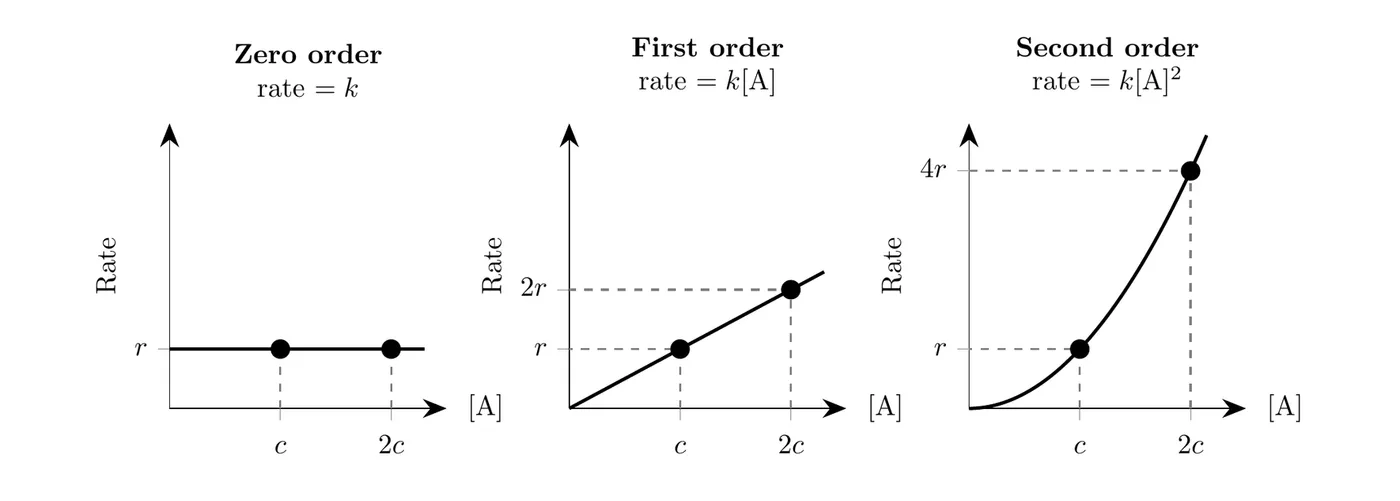
On the AP exam, orders are almost always 0, 1, or 2. (Fractional orders exist, but you'll rarely see them.)
Example 1: Predicting a rate change
A reaction has the rate law rate . At the same temperature, is tripled and is cut in half. By what factor does the rate change? What happens to ?
Multiply the effects of the two changes:
The rate becomes 4.5 times as fast. The rate constant doesn't change: depends on the temperature (and on whether a catalyst is present), not on the concentrations.
The rate constant, k
The rate constant is the proportionality constant in the rate law. Three facts to know:
- At a given temperature, is constant. Changing a concentration changes the rate, not .
- depends on temperature. For almost every reaction, gets larger as the temperature rises, which is why heating speeds reactions up (Topics 5.5 and 5.6). A catalyst also changes .
- The units of depend on the overall order. A rate always has units of M/s, so needs whatever units make the right side of the rate law come out in M/s.
To find the units, solve the rate law for . For an overall order of :
Overall order | Example rate law | Units of |
0 | rate | (the same as M/s) |
1 | rate | |
2 | rate or | |
3 | rate |
This works backward too: a rate constant in means a first-order reaction, and one in means second order overall.
Finding a rate law from initial rates
The method of initial rates compares trials that start with different concentrations:
- Find two trials where only one reactant's concentration changes. Everything else, including the temperature, must stay the same.
- Divide the two rates. Set the rate ratio equal to (concentration ratio) and solve for the order.
- Repeat for each reactant.
- Write the rate law. Then plug the data from any one trial into it and solve for , with units.
When a concentration doubles, the rate ratio is 1, 2, or 4 for orders 0, 1, or 2. When the numbers aren't that clean, solve with logarithms: .
The reactions in the two examples below are real, and so are their rate laws, but the concentrations and rates are made up to keep the math clean.
Example 2: Iodination of acetone
Acetone reacts with iodine in acidic solution. is a catalyst: it speeds up the reaction but isn't used up, so it isn't in the balanced equation.
Initial rates were measured by following the fading color of . Find the rate law and the value of .
Trial | (M) | (M) | (M) | Initial rate (M/s) |
1 | 0.400 | 0.00200 | 0.100 | |
2 | 0.800 | 0.00200 | 0.100 | |
3 | 0.400 | 0.00400 | 0.100 | |
4 | 0.400 | 0.00200 | 0.200 |
Acetone (Trials 1 and 2): doubles and the rate doubles.
Iodine (Trials 1 and 3): doubles and the rate doesn't change, so the reaction is zero order in ().
Catalyst (Trials 1 and 4): doubles and the rate doubles, so the reaction is first order in .
The overall order is . Use Trial 1 to find :
Notice the two surprises. Iodine is a reactant, but it isn't in the rate law. isn't in the balanced equation, but it is in the rate law. That's why you can't read a rate law off an overall equation.
Example 3: Nitrogen monoxide and hydrogen (AP-style)
At a high temperature, nitrogen monoxide reacts with hydrogen:
Trial | (M) | (M) | Initial rate of formation of (M/s) |
1 | 0.0100 | 0.0100 | |
2 | 0.0150 | 0.0100 | |
3 | 0.0100 | 0.0250 |
(a) Determine the order with respect to NO and with respect to . Justify your answers. (b) Write the rate law and give the overall order. (c) Calculate , with units. (d) Predict the initial rate when M and M. (e) A student says the rate law should be rate because both coefficients are 2. Explain why the student is wrong.
(a) In Trials 1 and 2, stays the same and is multiplied by . The rate is multiplied by:
So the reaction is second order in NO. In Trials 1 and 3, stays the same and is multiplied by :
So the reaction is first order in .
(b) rate , third order overall ().
(c) Use Trial 1:
(d) Plug the new concentrations into the rate law:
Check against Trial 1: doubling multiplies the rate by 4 and doubling multiplies it by 2, so the rate should be M/s. It matches.
(e) Orders come from experimental data, not from coefficients. Multiplying by 2.50 multiplied the rate by 2.50, not by , so the order in is 1. Coefficients match the orders only for an elementary reaction (Topic 5.4), and this reaction happens in several steps.
Common mistakes
- Using coefficients as orders. Orders come from data. Only for an elementary step do they match the coefficients.
- Comparing trials where two concentrations change. Pick trials where only one concentration changes. If no such pair exists, first undo the effect of the reactant whose order you already know.
- Thinking changes with concentration. Concentrations change the rate. Only temperature (or a catalyst) changes .
- Wrong or missing units on . Work them out from the overall order : .
- Keeping a zero-order reactant in the rate law. If the rate doesn't change when a concentration changes, that reactant's order is 0 and it drops out of the rate law.