

5.4 - Elementary Reactions
Overview
Most reactions don't happen in one step. The balanced equation shows the overall change, but the particles actually react through a series of simple collisions or breakups called elementary reactions. For an elementary reaction, and only for one, you can write the rate law straight from the equation. This topic shows how, and why steps that need three particles to collide at once are rare.
What an elementary reaction is
An elementary reaction (or elementary step) describes one event at the particle level, exactly as written. is elementary: one NO molecule collides with one molecule, and in that single collision an oxygen atom moves from to NO.
The number of reactant particles in an elementary reaction is its molecularity:
Molecularity | What happens | General form | Example |
Unimolecular | One particle breaks apart or rearranges | ||
Bimolecular | Two particles collide | or | |
Termolecular | Three particles collide at the same instant | Rare (see below) |
Most overall reactions, like , are not elementary. They're the sum of several elementary steps, called a reaction mechanism (Topic 5.7). An overall equation tells you what you start and end with. An elementary equation tells you what actually collides.
Rate laws for elementary reactions
For an elementary reaction, the rate law comes from the equation: the exponent on each reactant is its coefficient in that step. The rate of an elementary reaction is proportional to how often the right particles collide (or, for a unimolecular step, to how many particles there are to break apart), and that depends on the concentrations in exactly this way.
Elementary step | Molecularity | Rate law |
Unimolecular | rate | |
Bimolecular | rate | |
Bimolecular | rate | |
Termolecular | rate |
Why the collision count matches the rate law
Picture a box of A and B particles. Each A can collide with each B, so the number of possible A with B collisions is (number of A) times (number of B).
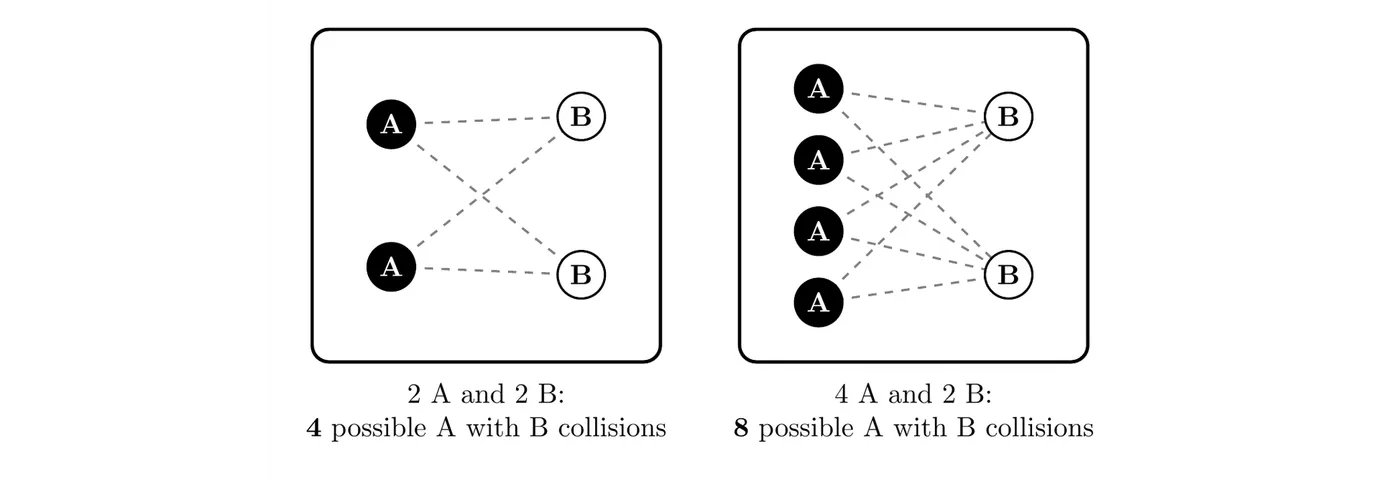
Doubling the number of A particles doubles the possible collisions, from 4 to 8. Doubling both A and B would give , four times as many. That's exactly what rate predicts. For a step like , both colliding particles are A, so the collision frequency goes as .
Overall reactions are different
You can write a rate law from coefficients only when you know the reaction is elementary. For an overall reaction, the rate law has to come from experiments. The reaction looks like one simple collision, but below about 225 °C its experimental rate law is rate , not . So it can't be a single elementary step. (It happens in two steps, starting with .)
Why termolecular steps are rare
For a termolecular step, three particles have to hit at the same instant, with enough energy and in the right orientation. Two-particle collisions happen all the time, but the chance that a third particle arrives at exactly that moment is tiny. So elementary reactions involving three or more particles colliding at once are rare, and four-particle collisions essentially never happen.
That helps when you judge a proposed mechanism: steps should be unimolecular or bimolecular, with a termolecular step only when there's a good reason for it. A few termolecular steps do occur. In the upper atmosphere, ozone forms when an O atom and an molecule collide while a third molecule (written M, often ) carries away the extra energy:
Example 1: Writing rate laws for elementary steps
Each equation below is an elementary step. Give its molecularity and rate law.
Elementary step | Molecularity | Rate law |
Unimolecular | rate | |
Bimolecular | rate | |
Bimolecular | rate | |
Termolecular | rate |
Notice that is the same as : two of the same particle colliding gives a squared term.
Example 2: Writing the step from its rate law
An elementary step has the rate law rate and forms and . Write a balanced equation for the step and give its molecularity.
The rate law says one and one CO collide, so those are the reactants. Add the products and check the atoms:
Each side has 1 N, 1 C, and 4 O, so it's balanced. Two particles collide, so the step is bimolecular. (This is the second step of the reaction above.)
Example 3: Elementary or not? (AP-style)
(a) Write the rate law for the elementary step . (b) If is tripled, by what factor does the rate of this step change? Explain at the particle level. (c) The overall reaction has the experimental rate law rate . Explain why this reaction can't happen as a single elementary step.
(a) The step is elementary, so the exponent is the number of particles colliding: rate .
(b) The rate is multiplied by . Tripling puts three times as many molecules in the same volume, and each one has three times as many other molecules to hit. So the number of with collisions per second goes up by about .
(c) Two reasons. First, if it were elementary, its rate law would come from the coefficients: rate . That doesn't match the experimental rate law, which is first order in . Second, as a single step it would need four molecules (two NO and two ) to collide at the same instant, which essentially never happens. The reaction must go through a mechanism of simpler steps.
Common mistakes
- Writing rate laws from overall equations. Coefficients give the orders only for elementary steps. For an overall reaction, use data.
- Forgetting that 2A gives a squared term. and both have rate .
- Calling a reaction elementary because it looks simple. looks like one collision, but its rate law shows it isn't.
- Proposing steps with three or more particles. Termolecular steps are rare, and four-particle steps don't happen. Build mechanisms from unimolecular and bimolecular steps.