

5.7 - Introduction to Reaction Mechanisms
Overview
A balanced equation tells you where a reaction starts and where it ends, but not how it gets there. Most reactions don't happen in one collision. They happen as a series of simple steps, and that series is called the reaction mechanism. This topic is about reading a mechanism: naming its parts, checking that the steps add up to the overall equation, and weighing evidence for one mechanism over another.
What a reaction mechanism is
A reaction mechanism is a series of elementary reactions, or steps, that happen in sequence. Recall from Topic 5.4 that an elementary step is a single event: one particle breaking apart, or two particles colliding. Each step is written exactly as the particles meet, so its coefficients tell you how many particles take part.
Each step also has a molecularity (Topic 5.4): almost every step is unimolecular or bimolecular, because termolecular steps are rare.
Here's a classic example. The reaction between nitrogen dioxide and carbon monoxide has this overall equation:
It looks like one collision between and . But at temperatures below about 225 °C, the evidence shows it happens in two steps:
In step 1, two molecules collide and an oxygen atom moves from one to the other. In step 2, the made in step 1 hands an oxygen atom to . Neither step is the overall equation, but together they produce it. (The labels "slow" and "fast" become important in Topic 5.8.)
The parts of a mechanism
Every species in a mechanism plays one of four roles. You can tell which by looking at where it shows up first.
Role | How it appears in the steps | In the overall equation? |
Reactant | Used up (on the left side) and not fully made back | Yes, on the left |
Product | Made (on the right side) and not used up later | Yes, on the right |
Intermediate | Made in an earlier step, then used up in a later step | No |
Catalyst | Used up in an earlier step, then made again in a later step | No |
A quick way to remember the last two: an intermediate is made, then used. A catalyst is used, then made. Both cancel out of the overall equation, which is why neither one appears in it.
In the and mechanism, is an intermediate: step 1 makes it and step 2 uses it. Notice that shows up on both sides too, but it isn't a catalyst. Step 1 uses two molecules and step 2 makes back only one, so overall one is used up. That makes it a reactant.
Adding the steps to get the overall equation
The elementary steps of a valid mechanism must add up to the balanced overall equation. To check:
- Add the steps like equations: everything on a left side goes on the left, everything on a right side goes on the right.
- Cancel any species that appears on both sides, in the same amount. If the amounts differ, cancel only the smaller amount.
- What's left should be the overall balanced equation. If it isn't, either the mechanism is wrong or one of the steps has to happen more than once (multiply that step first).
For the and mechanism:
The cancels completely. Only one of the two molecules on the left cancels, because only one shows up on the right. The result matches the overall equation, so this mechanism passes the first test.
Example 1: Identifying the parts of a mechanism
High in the atmosphere, chlorine atoms (from CFCs) destroy ozone. One proposed mechanism is:
Write the overall equation, and identify the intermediate and the catalyst.
Add the steps and cancel:
Classify the species that canceled. is made in step 1 and used in step 2, so it's an intermediate. is used in step 1 and made again in step 2, so it's a catalyst.
Answer: Overall, . The intermediate is , and the catalyst is . Because each Cl atom comes back at the end, a single Cl atom can go around this cycle again and again, destroying many thousands of ozone molecules before it's removed.
Example 2: Finding a missing step (AP-style)
Nitryl chloride decomposes by a two-step mechanism. The overall equation and the first step are given:
(a) Write step 2. (b) Identify the intermediate. (c) Give the molecularity of each step.
(a) Step 2 supplies whatever the overall equation needs that step 1 doesn't. It uses the second , makes the second and the , and uses up the Cl atom from step 1:
Check by adding: . The Cl cancels, leaving the overall equation.
(b) Cl is made in step 1 and used in step 2, so Cl is the intermediate.
(c) Step 1 has one reactant particle, so it's unimolecular. Step 2 has two, so it's bimolecular.
Example 3: A step that happens twice
Sometimes one step has to happen twice for every one time the overall reaction happens. Dinitrogen pentoxide decomposes as , by this mechanism:
Adding the steps once each gives 1 on the left, but the overall equation has 2. Steps 2 and 3 together use two , so step 1 must happen twice. Multiply step 1 by 2, then add:
Answer: With step 1 counted twice, the steps add up to the overall equation. The intermediates are and .
Intermediates exist only during the reaction
A reaction intermediate is produced by some elementary steps and consumed by others. So it isn't there at the start (nothing has made it yet), and it isn't there at the end (it's all been used up). It exists only while the reaction is happening.
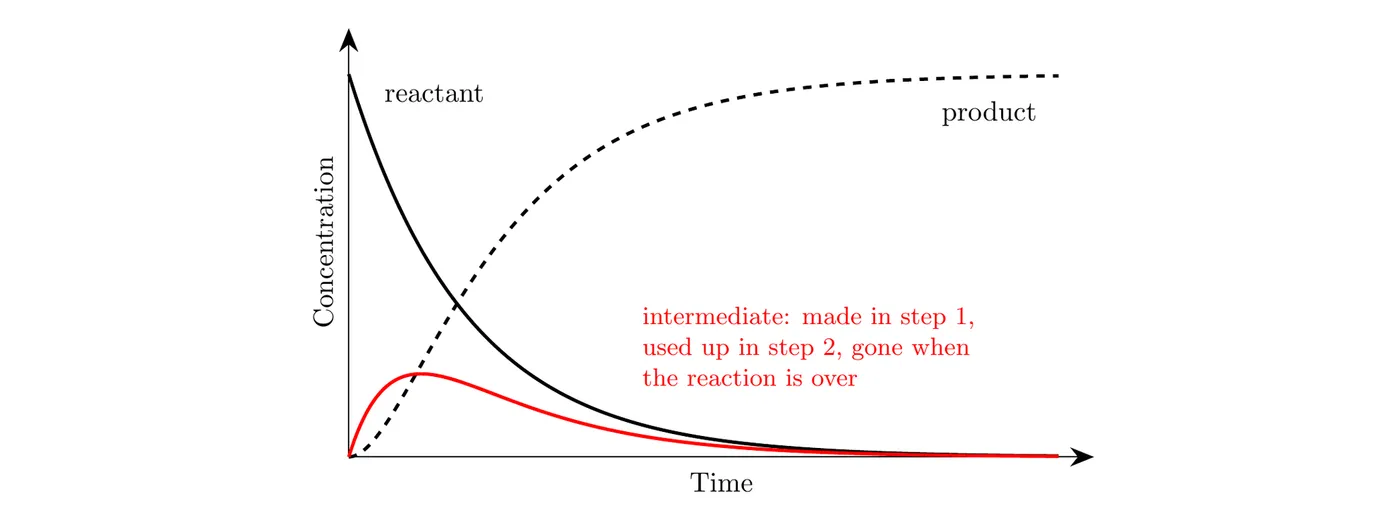
The graph shows a two-step reaction, reactant to intermediate to product. The intermediate's concentration starts at zero, rises while step 1 makes it, and falls back to zero as step 2 uses it up. Many intermediates are so reactive that their concentration stays tiny the whole time.
Intermediates vs. transition states
They both sit between reactants and products, but they're different things:
Intermediate | Transition state (activated complex) | |
What it is | A real species, with its own formula | The highest-energy arrangement of atoms during one step, with bonds partly broken and partly formed |
On an energy profile | A valley between two peaks | The top of a peak |
Can it be detected? | In principle, while the reaction runs | No; it lasts about one molecular vibration |
You'll see both on multistep energy profiles in Topic 5.10.
Evidence for a mechanism
Nobody can watch individual collisions, so a mechanism is a model: a proposal about what the particles are doing. Evidence can support a mechanism, but it can't prove one. A proposed mechanism is acceptable when:
- The steps add up to the balanced overall equation.
- Each step is reasonable. Steps should be unimolecular or bimolecular. A termolecular step is possible but unlikely.
- It agrees with experiments, especially the experimentally measured rate law (Topics 5.8 and 5.9).
Detecting an intermediate is a common way to build evidence. If one proposed mechanism includes a certain intermediate and another doesn't, then finding that intermediate in the reaction mixture while the reaction runs supports the first mechanism over the second. Failing to find an intermediate doesn't rule a mechanism out, though, because some intermediates react too fast to catch.
The AP exam won't ask you how the data on detecting an intermediate are collected. It can ask you to use the fact that an intermediate was detected to argue for one mechanism over another.
Example 4: Using a detected intermediate (AP-style)
Two mechanisms are proposed for .
- Mechanism I: one bimolecular step, .
- Mechanism II: the two steps shown earlier on this page, with made in step 1 and used in step 2.
Suppose an experiment detects small amounts of while the reaction is running, but none after the reaction is complete. Which mechanism does this support? Justify your answer.
Answer: It supports mechanism II. shows up only while the reaction runs, which is how an intermediate behaves. Mechanism II has as an intermediate (made in step 1, used in step 2), but mechanism I involves no species besides the reactants and products. Topic 5.8 shows that the measured rate law points to mechanism II as well.
Common mistakes
- Mixing up intermediates and catalysts. Look at the order: an intermediate is made first and used later; a catalyst is used first and made again later.
- Calling anything that appears on both sides a catalyst. Count first: above is a reactant.
- Leaving intermediates or catalysts in the overall equation. They cancel when you add the steps.
- Canceling too much. Cancel only the amount that appears on both sides.
- Saying evidence proves a mechanism. Evidence supports or is consistent with a mechanism. It never proves one.