

5.6 - Reaction Energy Profile
Overview
A reaction energy profile is a graph of energy as reactants turn into products. It shows the energy barrier the particles have to get over (the activation energy) and whether the reaction releases or absorbs energy overall. You'll draw, label, and read these diagrams on the AP exam, and use them to explain why heating speeds a reaction up.
Breaking and forming bonds
Elementary reactions typically involve breaking some bonds and forming new ones. Take a simple atom transfer, where atom B moves from A to C:
The old bond can't vanish at the same instant the new one appears. As C moves in, the bond between A and B stretches and weakens while a bond between B and C starts to form. Partway through, B is partly bonded to both, , where the dots are partial bonds. This arrangement has more energy than either the reactants or the products, because the old bond is mostly broken and the new one isn't fully formed yet.
Reading a reaction energy profile
Here's the energy profile for that reaction, with each part labeled:
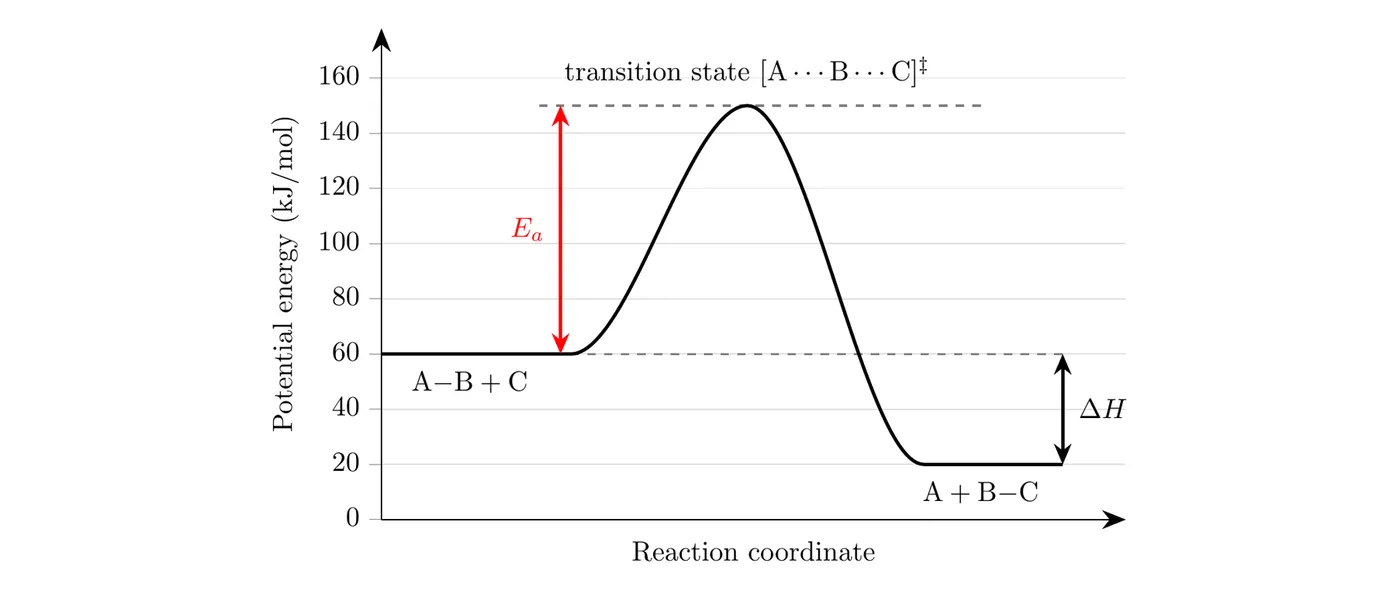
- Reaction coordinate (-axis): the progress of the reaction, from reactants to products. It's the axis along which all the complicated motions of the atoms rearranging are plotted. It isn't time, and it has no units.
- Potential energy (-axis): the energy stored in the arrangement of the atoms, in their bonds and in the attractions and repulsions between particles.
- Reactants (the plateau on the left) and products (the plateau on the right).
- Transition state (the peak): the highest-energy arrangement along the path, also called the activated complex. It has partial bonds, lasts only an instant, and can't be isolated. It's marked with a double dagger, .
A profile usually runs from reactants, through a transition state, to products. Two energy differences matter:
- Activation energy, : the energy difference between the reactants and the transition state. This is the activation energy for the forward reaction.
- Overall energy change, : products minus reactants. If the products are lower, is negative and the reaction is exothermic (it releases energy). If they're higher, is positive and the reaction is endothermic (Unit 6 covers these in detail).
The reverse reaction crosses the same peak from the other side, so its activation energy is measured from the products:
Example 1: Reading values from a profile
Use the profile above for . Find for the forward reaction, , and for the reverse reaction. Is the reaction exothermic or endothermic?
Read the three levels: the reactants are at 60 kJ/mol, the transition state at 150 kJ/mol, and the products at 20 kJ/mol.
is negative, so the reaction is exothermic. Check: kJ/mol.
Temperature and the rate of an elementary reaction
To react, colliding particles need enough energy to reach the transition state. The fraction of collisions that do depends on the temperature (the Maxwell-Boltzmann distribution, Topic 5.5). Heat the sample and many more collisions have at least , so the rate goes up. The barrier itself doesn't change with temperature. What changes is how many particles can get over it.
The Arrhenius equation puts this relationship into math:
- is the rate constant, is the temperature in kelvins, and .
- is roughly the fraction of collisions with at least . It gets bigger as rises and smaller as rises.
- , the frequency factor, accounts for how often particles collide and how often they're oriented correctly.
What to take from it, in words:
- Higher temperature means a larger and a faster reaction.
- A larger means a smaller and a slower reaction (at the same temperature, with a similar ).
- Reactions with a larger are more sensitive to temperature. The same temperature rise multiplies their rate constant by a bigger factor.
The Arrhenius equation isn't on the AP reference sheet, and calculations with it are not assessed on the AP exam. You do need to explain the relationships above.
Example 2: Sketching an endothermic profile (AP-style)
An elementary reaction has a forward activation energy of 52 kJ/mol and kJ/mol. (a) Sketch and label a reaction energy profile. (b) Calculate the activation energy of the reverse reaction. (c) At the same temperature, does a larger fraction of collisions have enough energy to react in the forward or the reverse direction? Justify your answer. (d) Explain why raising the temperature increases the rate of the forward reaction.
(a) Put the reactants at 0 kJ/mol. The products sit 34 kJ/mol higher (endothermic), and the transition state is 52 kJ/mol above the reactants:
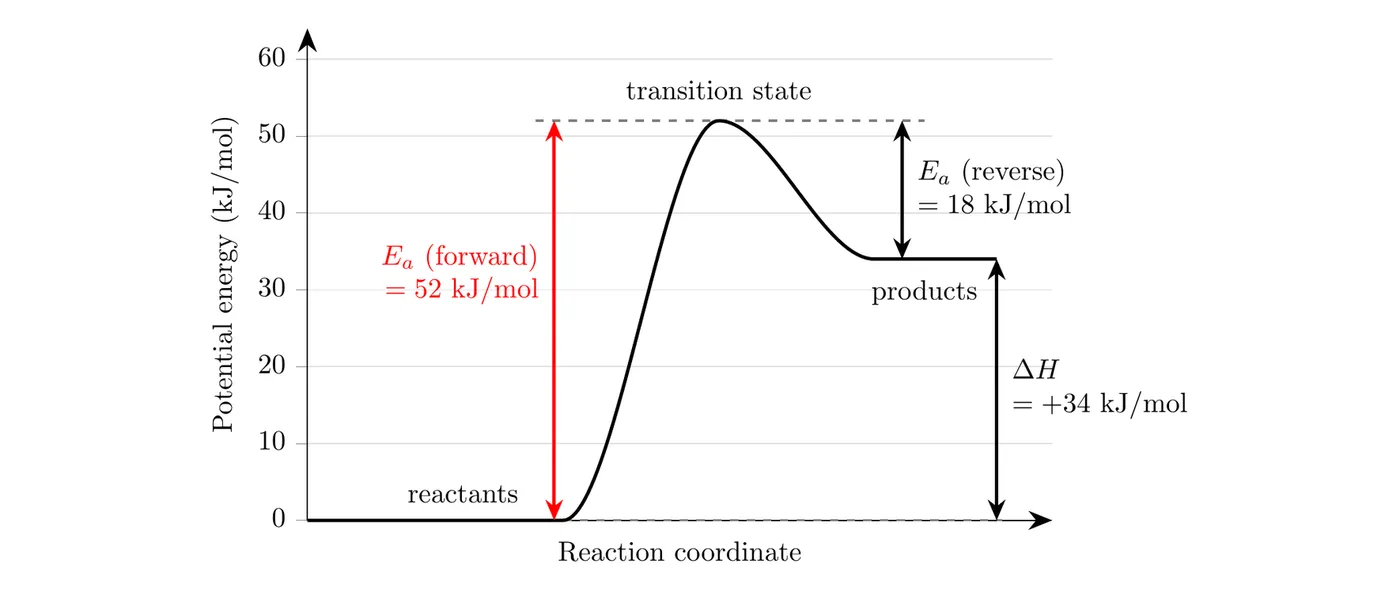
(b)
(c) The reverse direction. Its barrier (18 kJ/mol) is much lower than the forward barrier (52 kJ/mol), so at the same temperature a much larger fraction of collisions between product particles have enough energy to reach the transition state.
(d) At a higher temperature, the Maxwell-Boltzmann distribution shifts toward higher energies, so a larger fraction of collisions have at least 52 kJ/mol, enough to reach the transition state. More collisions per second succeed, and the rate increases. The barrier itself stays 52 kJ/mol.
Example 3: Which reaction is more sensitive to temperature?
Reaction 1 has kJ/mol and Reaction 2 has kJ/mol, and they have the same frequency factor . (a) At 25 °C, which has the larger rate constant? (b) If both are heated from 25 °C to 35 °C, whose rate constant goes up by a larger factor?
(a) Reaction 1. Its lower barrier means a larger fraction of collisions have enough energy, so its is larger.
(b) Reaction 2. With a high barrier, only particles far out in the tail of the Maxwell-Boltzmann distribution can react, and that's the part of the curve that grows the most, relatively, when the temperature rises. For these numbers, the 10 °C rise multiplies by about 1.7 for Reaction 1 and about 2.9 for Reaction 2. These factors come from the Arrhenius equation, so calculating them is not assessed on the AP exam. You only need to predict which one is bigger.
Common mistakes
- Measuring from the wrong place. runs from the reactants up to the peak, not from the bottom of the graph, and not from the products (that's the reverse ).
- Getting the sign of backward. It's products minus reactants. Products below reactants means negative, exothermic.
- Thinking a more negative means a faster reaction. How far downhill a reaction goes doesn't set its speed. The height of the barrier does.
- Treating the reaction coordinate as time. It shows the progress of the atoms rearranging, not a clock.