

5.9 - Pre-Equilibrium Approximation
Overview
In Topic 5.8 the slow step came first, so its rate law was the answer. But when the slow step comes later, it usually involves an intermediate, and a rate law can't contain an intermediate. The pre-equilibrium approximation fixes this: it uses a fast, reversible step before the slow step to write the intermediate's concentration in terms of reactants. This is how you get a rate law from a mechanism whose first step is not rate limiting.
Why a later slow step causes a problem
Take this reaction and its proposed mechanism:
The slow step is step 2, so the rate law starts as . But is an intermediate. You can't add it to the flask or measure it easily, and its concentration is tiny. A rate law has to be written in terms of species you control, like the reactants. So you need a way to express using and .
The pre-equilibrium idea
Look at what the intermediate does after step 1 makes it. It can go back to reactants (the reverse of step 1), or forward to products (step 2). Going back is fast. Going forward is slow. So almost every molecule falls apart back into and long before it gets the chance to react in step 2.
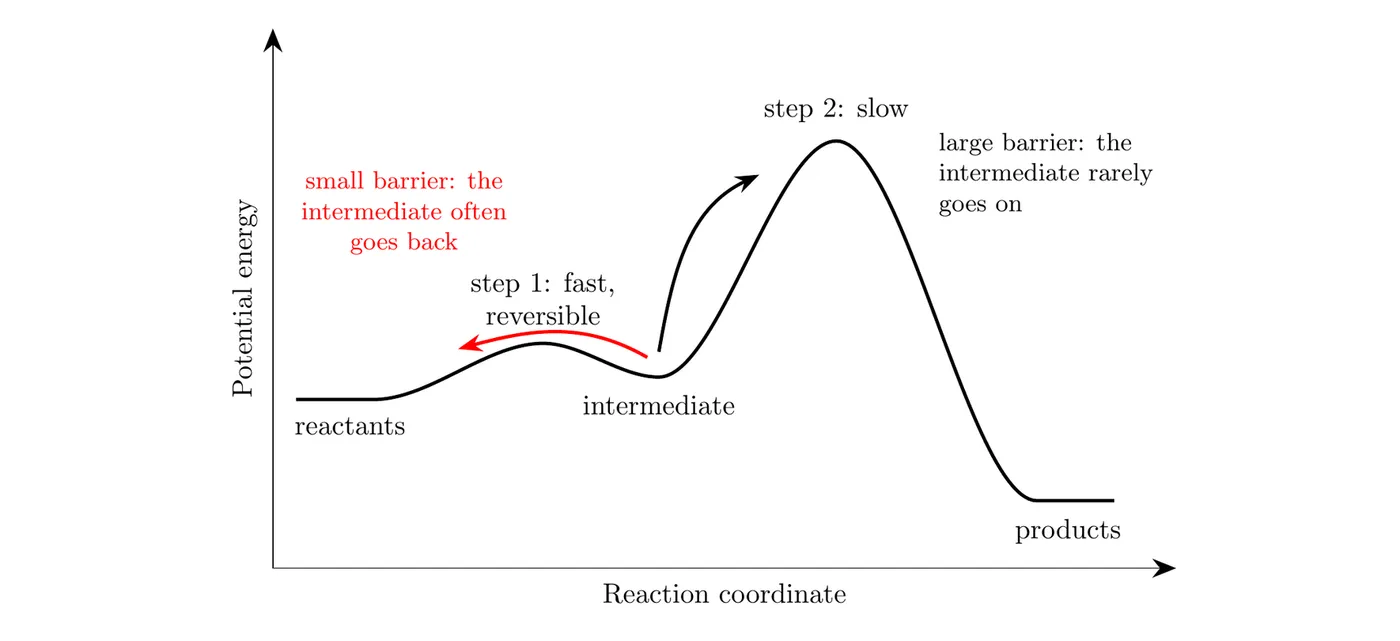
As a result, step 1 runs forward and backward many times while step 2 slowly drains off a little intermediate. Step 1 reaches equilibrium, and step 2 is too slow to disturb it much. That's the pre-equilibrium approximation: treat the fast step before the slow step as being at equilibrium.
At equilibrium, the forward rate of step 1 equals its reverse rate. Using for the forward rate constant and for the reverse:
Solve for the intermediate:
The ratio is the equilibrium constant for step 1, . (You'll study equilibrium constants in Unit 7. Here you only need the fact that at equilibrium the forward and reverse rates are equal.)
The method, step by step
- Write the rate law of the slow step from its coefficients.
- Find the intermediate in that rate law.
- For the fast, reversible step that makes the intermediate, set forward rate equal to reverse rate, and solve for the intermediate's concentration.
- Substitute into the slow step's rate law, and combine all the constants into a single .
- Check the final rate law: no intermediates allowed. Reactants, and sometimes products or catalysts, are fine.
Example 1: A third-order rate law from bimolecular steps
Use the mechanism above to find the rate law for .
Rate law of the slow step (step 2):
Find the intermediate. It's .
Use the fast equilibrium (step 1), as shown above:
Substitute and combine the constants:
Answer: , which matches the experimental rate law. The reaction is third order overall, yet no step needs three particles to collide at once. That's why a third-order rate law doesn't mean there's a termolecular step.
Follow-up: If is doubled and is cut in half, the rate changes by a factor of . The rate doubles.
Example 2: A product in the rate law
Ozone decomposes by this mechanism:
Rate law of the slow step: . The O atom is the intermediate.
Use the fast equilibrium. Set the forward rate of step 1 equal to its reverse rate:
Substitute:
Answer: The reaction is second order in and negative first order in , a product. Adding pushes the fast equilibrium back toward , which lowers the concentration of O atoms and slows the slow step. If doubles, the rate is cut in half. A product showing up in the denominator of a rate law is a strong sign of a pre-equilibrium.
Example 3: Two mechanisms, one rate law (AP-style)
For the reaction below, the experimental rate law is .
Two mechanisms are proposed.
- Mechanism I: Step 1 (slow), . Step 2 (fast), .
- Mechanism II: the three steps below.
(a) Show that mechanism II is consistent with the rate law. (b) Is mechanism I also consistent? Which mechanism is more likely, and why? (c) By what factor does the rate change if is doubled and is tripled?
(a) The slow step is step 2: . is an intermediate, so use the fast equilibrium in step 1:
This matches the experiment. The steps also add up to the overall equation ( and cancel), so mechanism II is consistent.
(b) Mechanism I's slow first step gives directly, so it's consistent with the rate law too. But that step is termolecular: two NO molecules and one molecule would have to collide at the same instant, which is very unlikely. Mechanism II gets the same rate law using only unimolecular and bimolecular steps, so mechanism II is more likely. Detecting the intermediate would support it further.
(c) The rate is second order in NO and first order in :
Answer: The rate increases by a factor of 12.
When to use pre-equilibrium on the AP exam
- Use it when the mechanism has a fast, reversible step (written with ) before the slow step, and the slow step's rate law contains an intermediate.
- If the first step is slow, you don't need it. Use the slow step's rate law directly (Topic 5.8).
- College courses also use another method, the steady-state approximation, for these mechanisms. On the AP exam, use the pre-equilibrium approximation.
Common mistakes
- Leaving the intermediate in the final rate law. The whole point of this topic is to replace it.
- Setting up the equilibrium upside down. Write forward rate = reverse rate, with the step's reactants on the forward side, then solve for the intermediate.
- Using the overall equation's coefficients. Even when the final rate law happens to match the overall coefficients (as for ), that's a result of the mechanism, not a shortcut you can count on.
- Assuming a third-order rate law means a termolecular step. A fast equilibrium followed by a bimolecular slow step gives third order too, and it's far more likely.
- Dropping a product from the rate law. If the fast step makes a product along with the intermediate, that product ends up in the denominator.