

8.10 - Buffer Capacity
Overview
Every buffer has a limit. Buffer capacity is how much strong acid or strong base a buffer can neutralize before its pH starts to change a lot. Two buffers can have exactly the same pH and very different capacities, because pH depends on the ratio of the components while capacity depends on how much of each is actually there. This topic covers the two things that control capacity: the concentration of the components and which component there is more of.
What sets the capacity
A buffer has one component for each job. The conjugate base handles added acid, and the weak acid handles added base:
Each reaction uses up one buffer component. While both components are present in reasonable amounts, the ratio changes slowly and so does the pH. Once one component is nearly gone, the next bit of acid or base has nothing to react with, and the pH changes sharply.
That gives a quick way to compare buffers:
- The most strong acid a buffer can neutralize equals the moles of it contains.
- The most strong base a buffer can neutralize equals the moles of HA it contains.
The pH starts to drift a bit before those limits (once the ratio passes about 10 to 1 either way, Topic 8.9), but comparing the moles of each component is the fastest way to decide which buffer can handle more.
Concentration: same pH, more capacity
If you raise the concentrations of both components and keep their ratio the same, the pH stays the same but the capacity goes up. The Henderson-Hasselbalch equation depends only on the ratio, so it gives the same pH. But the more concentrated buffer has more moles of HA and in every milliliter, so it can neutralize more added acid or base.
The same idea works in reverse: diluting a buffer with water keeps its pH but lowers its capacity.
The graph compares two acetic acid buffers (HA = , = ) as 1.00 M is added to 100.0 mL of each.
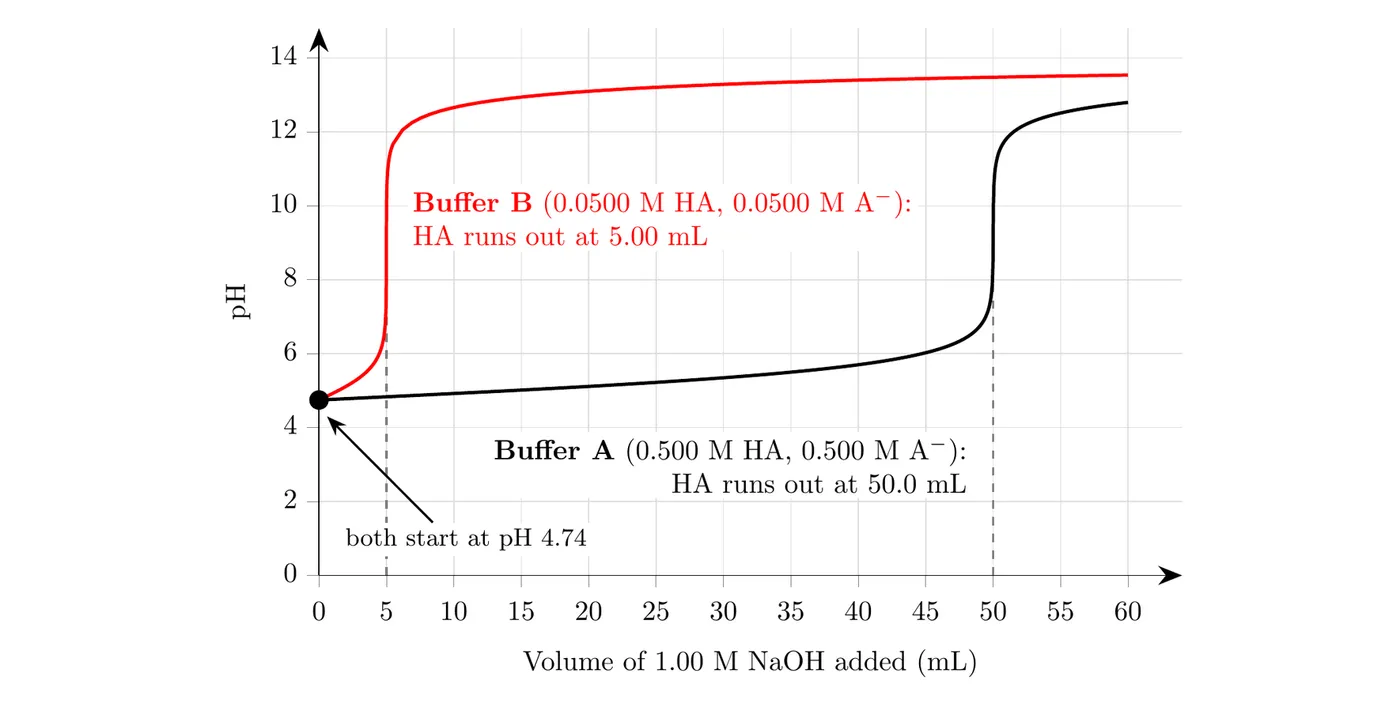
Both start at pH 4.74, since both have a 1 to 1 ratio. Buffer B's pH shoots up after only 5.00 mL of base, when its HA runs out. Buffer A, ten times more concentrated, holds its pH until about 50.0 mL. Adding strong acid instead would give the mirror image: the pH would drop sharply once ran out.
Example 1: Comparing two buffers
Buffer A is 100.0 mL of 0.500 M and 0.500 M . Buffer B is 100.0 mL of 0.0500 M and 0.0500 M .
(a) Compare their pH values. Both have , so both have pH = p = 4.74. They have the same pH.
(b) What is the most HCl each buffer can neutralize? Each mole of acetate neutralizes one mole of :
Buffer A can neutralize ten times as much acid. It has the greater buffer capacity.
(c) 10.0 mL of 1.00 M (0.0100 mol) is added to each. Which one still works as a buffer? Buffer A goes from 0.0500 mol of each component to 0.0400 mol HA and 0.0600 mol . Both are still present, so it's still a buffer, and its pH only rises to 4.92. Buffer B has just 0.00500 mol of HA. All of it reacts, and 0.0050 mol of is left over in 110.0 mL. Buffer B is no longer a buffer, and the excess sets the pH (Topic 8.4):
(The extra digit in 0.0455 M is carried into the log. The pH gets two decimal places, for the two significant figures in 0.0050 mol.) You can see both results on the graph at 10 mL.
The ratio decides which direction
A buffer with more conjugate acid than base has a greater capacity for added base than for added acid. A buffer with more conjugate base than acid has a greater capacity for added acid than for added base. It follows from the jobs above: HA neutralizes base, so more HA means more room for base, and neutralizes acid, so more means more room for acid.
Buffer | pH compared with p | Capacity for added acid | Capacity for added base |
More HA than | pH < p | smaller | larger |
Equal amounts | pH = p | the same both ways | the same both ways |
More than HA | pH > p | larger | smaller |
For a set total amount of HA and , equal amounts give the best all-around buffer, because it can handle acid and base equally well. That's another reason to pick an acid with a p close to the pH you need.
Example 2: Capacity in each direction
A buffer is 1.00 L of solution containing 0.40 mol and 0.10 mol .
(a) Find the pH.
(b) Is this buffer better at handling added acid or added base? Added base. It can neutralize up to 0.40 mol of (all the acetic acid) but only up to 0.10 mol of (all the acetate). Its capacity for base is four times its capacity for acid. This matches its pH of 4.14, below the p: the acid form is in excess.
Example 3: Particle diagrams (AP-style)
The boxes represent three buffer solutions made from the same weak acid, HA, and its conjugate base, . Each box shows the same volume.
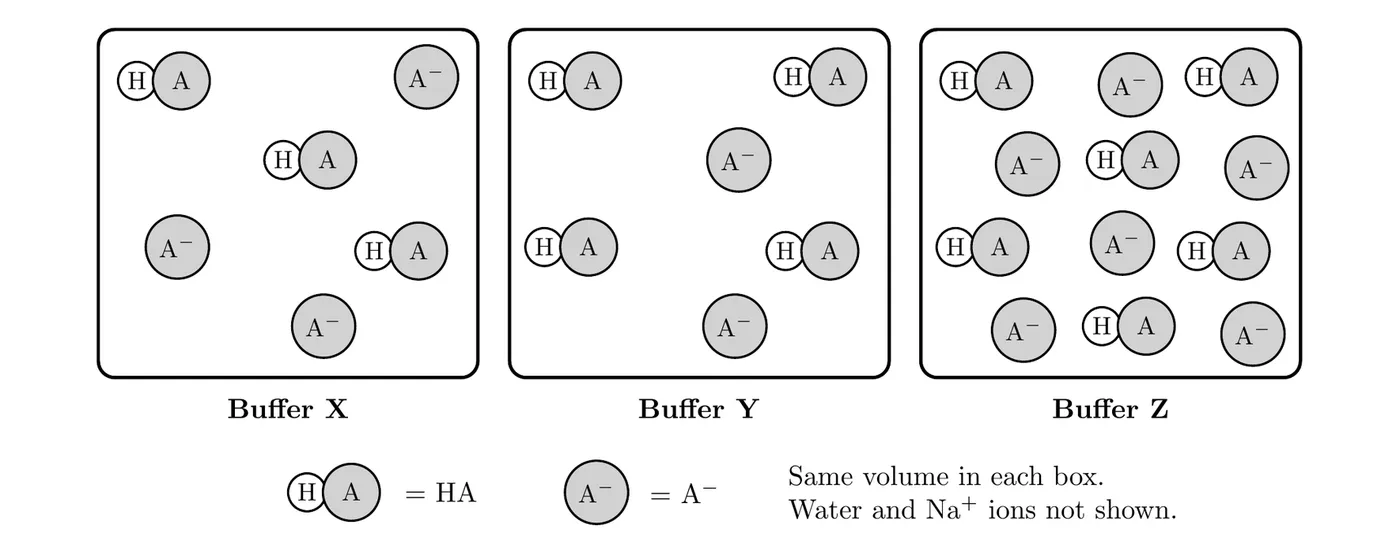
(a) Rank the buffers by pH. Buffers X (3 HA, 3 ) and Z (6 HA, 6 ) both have a 1 to 1 ratio, so both have pH = p. Buffer Y (4 HA, 2 ) has more acid than base, so its pH is below the p. From lowest to highest: Y < X = Z.
(b) Which buffer has the greatest capacity for added acid? Buffer Z. It has the most (6), and is what neutralizes added acid.
(c) Which buffer can neutralize more added base than added acid? Buffer Y. It has 4 HA to react with base but only 2 to react with acid.
(d) Three ions are added to Buffer Y and to Buffer Z. In which one does the pH change much more? Explain. Buffer Y. Its 2 ions neutralize only 2 of the ions, so one is left over with nothing to react with, and the pH drops sharply. Buffer Z neutralizes all three and is left with 9 HA and 3 . Both components are still present, so it's still a buffer, and its pH drops far less.
Buffer capacity in the lab
In the AP lab on buffers, you prepare a buffer, check its pH, and test its capacity. A typical procedure:
- Choose a weak acid with a p close to the target pH, and use the Henderson-Hasselbalch equation to find the ratio of base to acid you need.
- Measure the components (weigh the solid salt, measure the acid solution with a pipet or buret), dissolve, and dilute to the mark in a volumetric flask.
- Calibrate the pH meter with standard buffers, then measure your buffer's pH and compare it with the prediction.
- Test the capacity: add a strong acid or base of known concentration from a buret in small portions, recording the pH after each one, until the pH has changed by a set amount (often 1 unit). The more volume it takes, the greater the capacity.
AP questions describe a mistake and ask how it changes the results. Think about what the mistake does to the moles of HA and , then apply the two rules: pH follows the ratio, capacity follows the amounts.
Mistake | Effect on the buffer's pH | Effect on the measured capacity |
Weighed a hydrated salt but calculated with the anhydrous molar mass | lower than planned (less than planned) | smaller for added acid; unchanged for added base |
Filled the volumetric flask past the mark | about the same (the ratio doesn't change) | smaller (fewer moles in each sample tested) |
Rinsed the buret with water but not with the NaOH titrant | no effect on the buffer itself | looks larger (the titrant was diluted, so more mL were needed) |
pH meter not calibrated (every reading 0.20 too high) | reads 0.20 too high | little effect if you measure the change in pH |
Example 4: A mix-up with sodium acetate (AP-style)
A student plans a buffer with 0.0500 mol of and 0.0500 mol of in 250.0 mL, which should have pH = p = 4.74. She measures 50.0 mL of 1.00 M into a volumetric flask and adds 4.10 g of sodium acetate, the mass she calculated with the anhydrous molar mass, 82.03 g/mol. Then she dilutes to 250.0 mL. The bottle she used actually held sodium acetate trihydrate, ( = 136.08 g/mol).
(a) How many moles of acetate did she actually add?
(b) What pH will she measure?
The pH is 4.52, lower than the 4.74 she planned, because the buffer has less base than acid.
(c) How does the mistake affect the buffer's capacity? Its capacity for added acid is smaller: only 0.0301 mol of acetate is there to neutralize acid, instead of 0.0500 mol. Its capacity for added base is unchanged, because the 0.0500 mol of acetic acid is still there.
(d) How should she fix it? Remake the buffer using the trihydrate's molar mass: of .
Common mistakes
- Thinking a more concentrated buffer has a different pH. pH depends only on the ratio. Concentration changes the capacity.
- Thinking water ruins a buffer's pH. Dilution keeps the ratio, so the pH stays about the same. It lowers the capacity.
- Mixing up the jobs. neutralizes added acid. HA neutralizes added base. A buffer runs out of protection against acid when it runs out of .
- Comparing capacity by looking at the pH. A higher pH doesn't mean more capacity. Compare the moles of each component.
- Forgetting that capacity depends on amount, not just concentration. 1.00 L of a 0.0500 M buffer holds the same moles as 100.0 mL of a 0.500 M buffer, so the two can neutralize the same amount of acid or base.