

8.11 - pH and Solubility
Overview
Some salts dissolve much better in acid than in water, and some don't care about pH at all. The difference is whether one of the salt's ions reacts with or . If it does, changing the pH pulls that ion out of solution, and Le Châtelier's principle says more solid dissolves to replace it. This topic is qualitative: the AP exam asks you to predict and explain the direction of the change, not to calculate solubility at a given pH.
The idea: remove an ion, and more solid dissolves
A slightly soluble salt in water reaches an equilibrium with its ions (Topic 7.11). For calcium fluoride:
- Anything that lowers the concentration of one of the ions makes , so more solid dissolves until again. The salt is more soluble.
- Anything that raises the concentration of one of the ions (a common ion, Topic 7.12) makes , so solid forms. The salt is less soluble.
itself doesn't change with pH; only temperature changes it. What changes is the solubility, how much solid has to dissolve before the ion concentrations satisfy .
Three kinds of ions make a salt's solubility depend on pH: the hydroxide ion, an ion that's a weak base, and an ion that's a weak acid.
Salts that contain hydroxide
Metal hydroxides such as and release when they dissolve:
- Add acid (lower the pH): reacts with , which lowers . Now , so more dissolves. The overall reaction is:
- Add base (raise the pH): extra is a common ion. , so the solubility goes down.
This is how milk of magnesia works. It's a suspension of , which barely dissolves in water but dissolves in stomach acid and neutralizes it.
Example 1: A saturated solution of magnesium hydroxide
A beaker holds a saturated solution of with extra solid on the bottom. Predict what happens to the amount of solid when each of these is added, and explain.
(a) A few drops of 6 M . The solid decreases. reacts with , lowering . That makes smaller than , so more dissolves until again.
(b) A few drops of 6 M . The solid increases. The added makes , so precipitates until .
(c) Does change in either case? No. The temperature didn't change, so stays the same. Only the solubility changes.
Salts with an anion that's a weak base
The conjugate base of a weak acid is a weak base. Anions like , , , and all react with . For calcium fluoride in acid:
This reaction removes , so and more dissolves. The effect gets large once the pH drops below the p of HF (about 3.2), because then most of the dissolved fluoride is in the HF form (Topic 8.7).
Carbonates go one step further. The carbonic acid that forms breaks down into carbon dioxide, which bubbles out of the solution:
Since the escapes, the reaction can't run backward, and a carbonate keeps dissolving as long as there's acid.
Adding base to these salts has little effect. doesn't react with or .
Anions that don't react
, , , and are conjugate bases of strong acids. They're such weak bases that they don't react with (Topic 8.6). So adding acid doesn't change the solubility of salts like , , or .
Example 2: Telling two silver salts apart (AP-style)
A student has two unlabeled powders. One is and the other is . She adds 6 M to a small sample of each. Sample 1 fizzes and the solid dissolves. Sample 2 shows no visible change.
(a) Identify each sample and justify your answer with an equation. Sample 1 is . Carbonate is a weak base, so it reacts with the acid and leaves as gas (the fizzing):
Sample 2 is . is the conjugate base of a strong acid and doesn't react with , so the acid doesn't change its solubility.
(b) Why is a poor choice of acid for this test? adds . Sample 1 would still fizz, but the it released would immediately precipitate as , so both test tubes would end up with a solid in them. avoids this because all nitrate salts are soluble.
Salts with an ion that's a weak acid
If one of the salt's ions can donate a proton, raising the pH removes it: turns it into its conjugate base. So these salts become more soluble as the pH goes up. Cream of tartar, potassium hydrogen tartrate (), is only slightly soluble in water. Its anion is a weak acid:
Adding base removes , so and more solid dissolves. Nothing new precipitates, since potassium salts are soluble. ( is amphiprotic, so a strongly acidic solution also dissolves more of it, by turning it into tartaric acid, .)
Summary
Ion in the salt | Examples | Adding acid (lower pH) | Adding base (higher pH) |
Hydroxide, | , | more soluble | less soluble (common ion) |
Anion that's a weak base | , , | more soluble | little change |
Ion that's a weak acid | little change, unless the ion is also a weak base | more soluble | |
Anion of a strong acid | , , | no change | no change, unless the metal ion forms a hydroxide precipitate |
To explain any of these on the AP exam, give three things: the reaction that removes (or adds) an ion, the effect on compared with (or the direction of the shift), and the result for solubility.
Example 3: Predicting the effect of acid
Which of these salts are more soluble in 1 M than in pure water: , , , ? Justify each answer.
- : more soluble. is a weak base. It reacts with to form HF, which lowers , so and more dissolves.
- : no change. is the conjugate base of a strong acid, HBr, so it doesn't react with .
- : more soluble. reacts with to form water, which lowers , so and more dissolves.
- : more soluble. reacts with and leaves as gas, so the solid keeps dissolving as long as acid is present.
Reading solubility data
The graph shows the molar solubility of three salts in solutions held at different pH values. The values were calculated from and data, and the log scale lets all three fit on one graph. You won't have to do these calculations, but you should be able to read and explain a graph like this one.
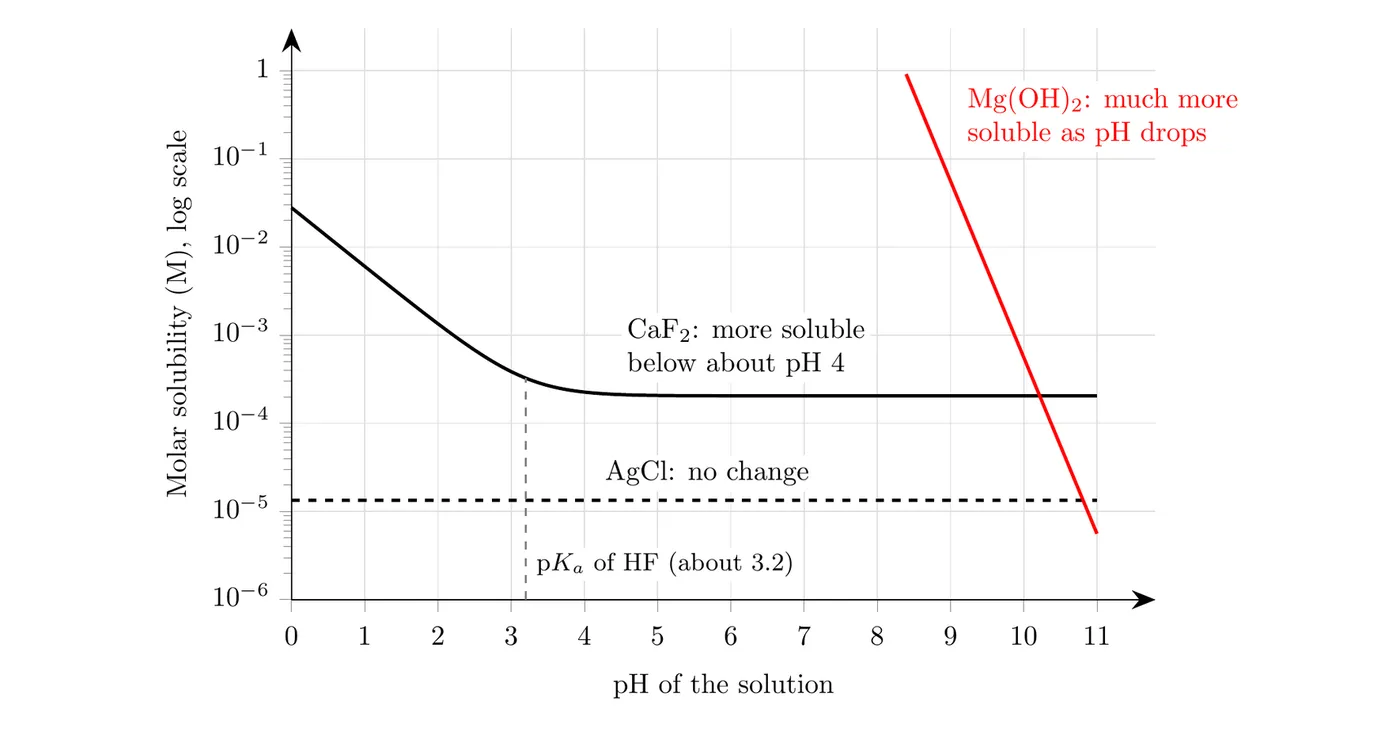
- (dashed line): flat. doesn't react with , so pH has no effect.
- : flat above about pH 4, then rising as the pH drops. In acid, more and more becomes HF.
- (red line): falls steeply as the pH rises. is one of the salt's own ions, so every increase in pushes the dissolving equilibrium back hard. Below about pH 8.4 its solubility would be above 1 M, so the line runs off the top of the graph.
Example 4: Reading the graph
Use the solubility graph above.
(a) Roughly how many times more soluble is at pH 2 than at pH 7? At pH 7 the curve sits at about M. At pH 2 it's a little above M. So is roughly 7 times more soluble at pH 2.
(b) Explain why 's solubility doesn't change between pH 5 and pH 11. In that range the pH is well above the p of HF, so almost all the dissolved fluoride stays as . Nothing removes it, so the solubility is the same as in pure water.
(c) A student wants to dissolve as much as possible. Should she use a solution at pH 5 or pH 10? Explain. pH 5. The lower at pH 5 keeps below until far more has dissolved. At pH 10, the high acts as a common ion and keeps the solubility low.
Where you see this
- Teeth. Tooth enamel is mostly hydroxyapatite, . Both and react with acid, so the acids that mouth bacteria make from sugar slowly dissolve enamel. Fluoride replaces some to form fluorapatite, . is a much weaker base than , so fluorapatite holds up better in acid.
- Stone and shells. Limestone, marble, and seashells are mostly , which dissolves in acid. Acid rain slowly erodes marble statues, and more acidic seawater makes it harder for shellfish to build their shells.
Common mistakes
- Saying acid makes every salt more soluble. It only matters if one of the ions reacts with : hydroxide or the conjugate base of a weak acid. doesn't care.
- Saying changes with pH. is constant at a given temperature. The solubility changes.
- Writing "the acid dissolves it" and stopping. Name the ion that reacts, write the reaction, then explain the shift (, so more solid dissolves).
- Getting hydroxides backward in base. Adding to a metal hydroxide makes it less soluble (common-ion effect).
- Testing silver or lead salts with . The precipitates the metal ion. Use .
- Calculating when you only need to explain. The AP exam doesn't ask for solubility at a given pH. It asks for the direction and the reason.