

8.7 - pH and pKa
Overview
Topic 8.5 showed that pH = p at the half-equivalence point, where . This topic extends that idea to any pH. By comparing the pH of a solution with the p of an acid, you can tell which form of the acid, protonated or deprotonated, is present in the larger amount. The same comparison explains how acid-base indicators change color and how to pick the right indicator for a titration.
Comparing pH with p
Rearrange the expression to compare the base form with the acid form:
Taking the log of both sides (remember that p means ) gives a simple result:
So the protonation state of a weak acid depends only on how the pH of the solution compares with the acid's p:
Solution pH | Which form is present in larger amount | Example: acetic acid (p = 4.74) |
pH < p | The acid form: | At pH 3.00, mostly |
pH = p | Equal amounts: | At pH 4.74, half and half |
pH > p | The base form: | At pH 7.00, mostly |
Why it makes sense: a low pH means lots of , and by Le Châtelier's principle that pushes to the left, so the proton stays on the acid. A high pH means few ions, so the acid gives its proton up.
Each pH unit away from the p changes the ratio by a factor of 10:
pH p | Percent in the base form | |
1/100 | 0.99% | |
1/10 | 9.1% | |
1 | 50% | |
10 | 91% | |
100 | 99% |
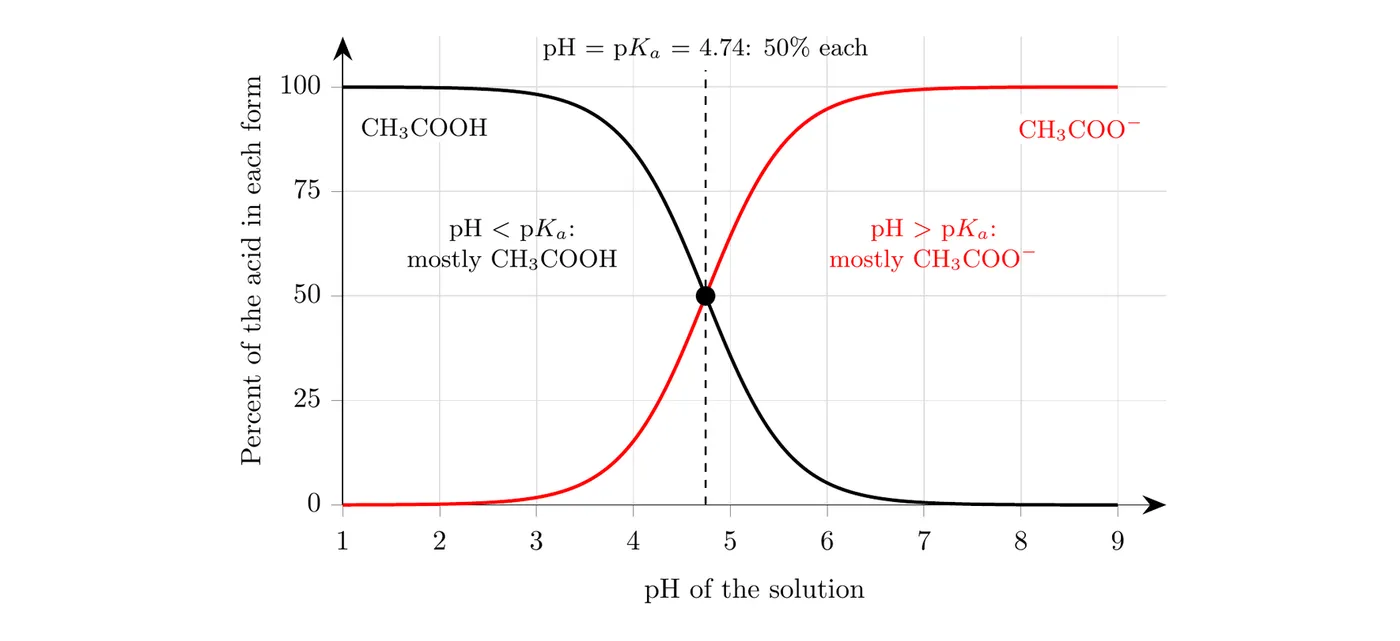
The graph shows the same thing for acetic acid. The two curves cross at pH = p = 4.74, where each form is 50%. Within about one pH unit of the p, both forms are present in large amounts, which is exactly what a buffer needs (Topic 8.8).
Weak bases and polyprotic acids
For a weak base B, compare the pH with the p of its conjugate acid, . At 25 °C, p = 14.00 p. Ammonia has p = 4.74, so the p of is 9.26. Below pH 9.26, is the main form. Above it, is.
A polyprotic acid has a p for each proton, so compare the pH with each one. Phosphoric acid has p values of 2.12, 7.21, and 12.38. At pH 10, the first two protons are gone (the pH is above 2.12 and 7.21) but the third is still on (the pH is below 12.38), so the main form is .
Example 1: Predominant forms
(a) Which form of acetic acid (p = 4.74) predominates at pH 3.00? (b) What is the ratio at pH 7.00? (c) Which form of ammonia predominates at pH 10.00, and by what ratio?
(a) pH 3.00 is below the p, so predominates:
That's about 55 molecules of for every ion.
(b)
At pH 7.00, acetic acid is almost all acetate. That's why carboxylic acids in the body, where the pH is about 7.4, exist mostly as their carboxylate ions.
(c) Compare the pH with the p of , 9.26. pH 10.00 is above it, so the base form, , predominates:
Example 2: Particle diagrams and pH (AP-style)
Formic acid, , has p = 3.74. The diagrams represent three formic acid solutions whose pH values are 3.26, 3.74, and 4.22, not in that order.
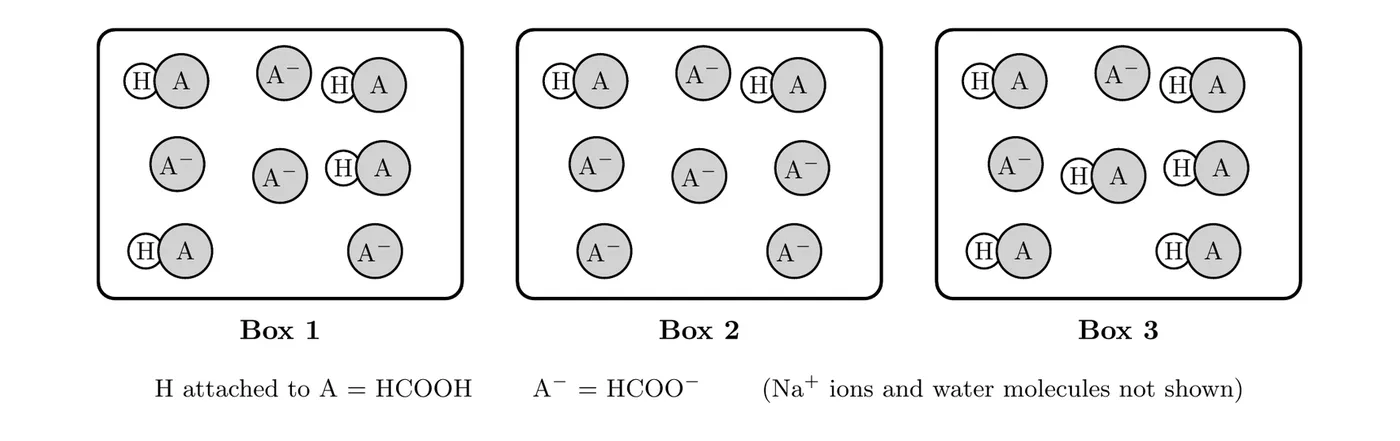
(a) Match each box to its pH, and justify your answer. (b) Show that the ratio in the box for pH 4.22 is consistent with the p.
(a) Box 1 has equal numbers of and (4 and 4), so its pH equals the p: pH 3.74. Box 3 has more than (6 to 2), so its pH is below the p: pH 3.26. Box 2 has more (6 to 2), so its pH is above the p: pH 4.22.
(b)
Box 2 shows 6 for every 2 , a ratio of 3, which matches.
Acid-base indicators
An acid-base indicator is a weak acid, written HIn, whose protonated and deprotonated forms have different colors:
An indicator follows the same pH and p rule as any weak acid. When the pH is well below the indicator's p, HIn predominates and you see the acid color. When the pH is well above it, predominates and you see the base color. Your eye picks up the change over a range of roughly p to p , where one form goes from 10 times the other to one-tenth of it.
Phenolphthalein is a good example. Its HIn form is colorless and its form is pink, and its p is about 9.4, so it turns from colorless to pink between about pH 8.3 and 10.0. Only a few drops are used, so the indicator doesn't change the pH of the solution. It just reports it.
Indicator | Acid color | Base color | Approximate p | Color change range (pH) |
Methyl orange | red | yellow | 3.4 | 3.1 to 4.4 |
Bromocresol green | yellow | blue | 4.7 | 3.8 to 5.4 |
Methyl red | red | yellow | 5.0 | 4.4 to 6.2 |
Bromothymol blue | yellow | blue | 7.1 | 6.0 to 7.6 |
Phenolphthalein | colorless | pink | 9.4 | 8.3 to 10.0 |
Reported p values and color ranges vary a little from one source to another.
Choosing an indicator for a titration
The color change of an indicator marks the endpoint of a titration. For accurate results the endpoint has to land on the equivalence point, so choose an indicator whose p is close to the pH at the equivalence point. Then the color changes in the steep jump, where one drop of titrant moves the pH by several units.
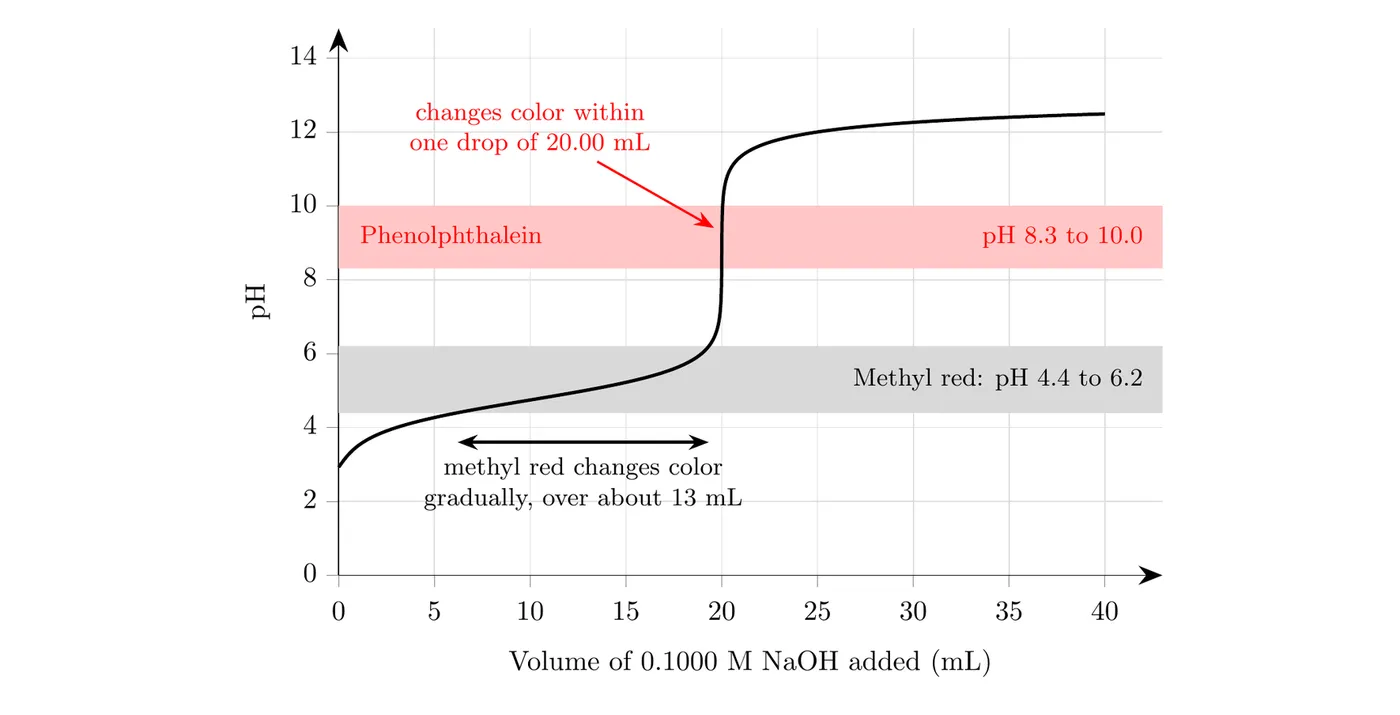
This is the acetic acid titration from Topic 8.5, with its equivalence point at 20.00 mL and pH 8.70. Phenolphthalein changes color while the curve is nearly vertical, all within one drop of 20.00 mL. Methyl red would start changing at about 6 mL and finish at about 19 mL, in the buffer region. Its color would drift slowly instead of flipping, and the student would stop too early.
Titration | pH at equivalence | A good indicator |
Strong acid with strong base | 7.00 | Bromothymol blue (the jump is so large that phenolphthalein and methyl red also work) |
Weak acid with strong base | Above 7 | Phenolphthalein |
Weak base with strong acid | Below 7 | Methyl red |
Lab error link: if the indicator changes color before the equivalence point, the recorded volume of titrant is too small, so the calculated amount of analyte is too low. If it changes after, the result is too high.
Example 3: Choosing indicators (AP-style)
Use the indicator table above. (a) Choose the best indicator for titrating 25.00 mL of 0.0800 M with 0.1000 M HCl. The equivalence point is at pH 5.30 (Topic 8.5). (b) Choose the best indicator for titrating HCl with NaOH. (c) A student titrates acetic acid with NaOH but uses methyl red. Will the calculated concentration of acetic acid be too high, too low, or correct? Explain.
(a) Methyl red. Its p (about 5.0) is the closest to the equivalence pH of 5.30. Bromocresol green (4.7) is farther away.
(b) Bromothymol blue. A strong acid and a strong base reach equivalence at pH 7.00, and bromothymol blue's p of about 7.1 is the closest.
(c) Too low. Methyl red changes color between pH 4.4 and 6.2, which this titration passes through well before the equivalence point at pH 8.70. The student stops adding NaOH too soon, records too small a volume, and so calculates too few moles of acetic acid.
Common mistakes
- Flipping the rule. When pH < p, the protonated (acid) form predominates. When pH > p, the base form does.
- Using p for a base. Compare the pH with the p of the conjugate acid, 14.00 p at 25 °C.
- Thinking pH = p means pH = 7. It only means the two forms are equal. That can happen at any pH.
- Choosing an indicator by matching pH 7 every time. Match the indicator's p to the pH at the equivalence point of that titration.
- Thinking an indicator finds the equivalence point on its own. It changes color near its own p. It only marks the equivalence point if you choose it well.