

8.6 - Molecular Structure of Acids and Bases
Overview
Why is HCl a strong acid while HF is weak? Why does acetic acid, , give up only one of its four hydrogen atoms? The answers come from molecular structure. This topic shows how to look at a molecule or ion and predict which protons are acidic and how strong the acid or base will be. On the AP exam you'll be asked to justify claims like these with structure, not just recall them.
Which hydrogens are acidic?
Not every H atom in an acid can be given away. The protons that take part in acid-base reactions in water are almost always bonded to a highly electronegative atom, usually O (or a halogen, as in HCl). Two things make these protons acidic:
- The bond is very polar, so the H atom already carries a partial positive charge.
- When the proton leaves, the bonding electrons stay behind on an electronegative atom that can hold a negative charge.
H atoms bonded to carbon are not acidic in water. A C-H bond is nearly nonpolar, and carbon holds a negative charge poorly.
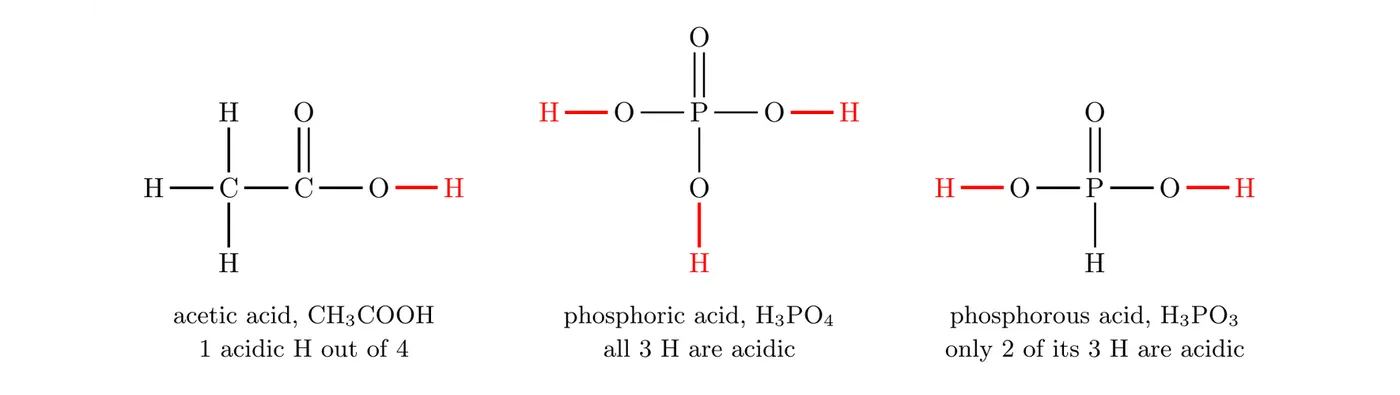
Acetic acid has four H atoms, but only the one on oxygen is acidic, so acetic acid is monoprotic. That's why some books and AP questions write it , with the acidic H out front (these notes use ). Phosphoric acid has three O-H groups, so it's triprotic. Phosphorous acid, , looks like it should be triprotic too, but one of its H atoms is bonded directly to P, so it's only diprotic. The formula alone can fool you. The structure tells you.
Acid strength comes from the conjugate base
When an acid ionizes, it leaves behind its conjugate base:
The more stable is (the better it can hold its negative charge), the further this equilibrium lies to the right, and the larger is. A stable conjugate base is also a weak base, because it has little pull on a proton. That's the rule from Topic 4.8 seen from the structure side: the stronger the acid, the weaker its conjugate base. Three features of structure make a conjugate base more stable, and so make an acid stronger: electronegativity, inductive effects, and resonance.
Electronegativity
Electronegative atoms hold negative charge well, so they stabilize the conjugate base relative to the acid. Across a period, the acid strength of the binary hydrides rises with the electronegativity of the atom bonded to H:
Carbon (electronegativity 2.55) holds the charge of so poorly that isn't acidic at all. Fluorine (3.98) holds the charge of well, so HF is a real acid, though a weak one.
Going down a group works differently. HF is weak, but HCl, HBr, and HI are all strong, even though Cl, Br, and I are less electronegative than F. Down a group the anion gets much larger, so its charge is spread over more space, and the longer H-X bond is weaker and easier to break. For binary acids in the same group, size wins over electronegativity.
For oxoacids, where the acidic H sits on an O atom bonded to a central atom, electronegativity works the normal way. A more electronegative central atom pulls electron density away from the O-H bond and helps hold the negative charge of the conjugate base:
Acid | Structure | Electronegativity of the halogen | |
HOCl | H-O-Cl | 3.16 | |
HOBr | H-O-Br | 2.96 | |
HOI | H-O-I | 2.66 |
Inductive effects
An inductive effect is the pull of electron density through a chain of bonds toward an electronegative atom. Electronegative atoms near the acidic O-H pull electron density away from it, which makes the O-H bond more polar and spreads the negative charge of the conjugate base over more atoms.
Adding O atoms to the central atom of an oxoacid has a big inductive effect. Each extra O pulls more electron density away from the O-H bond, and the extra O atoms also share the negative charge of the conjugate base:
Acid | O atoms on Cl | |
HOCl | 1 (the O in O-H) | |
2 | ||
3 | strong | |
4 | strong |
Chloric acid, , also ionizes almost completely, but the strong acids the AP exam expects you to know are the six from Topic 8.2.
Carbon chains show the same effect. Replacing the H atoms on the group of acetic acid with Cl atoms makes the acid stronger with each Cl:
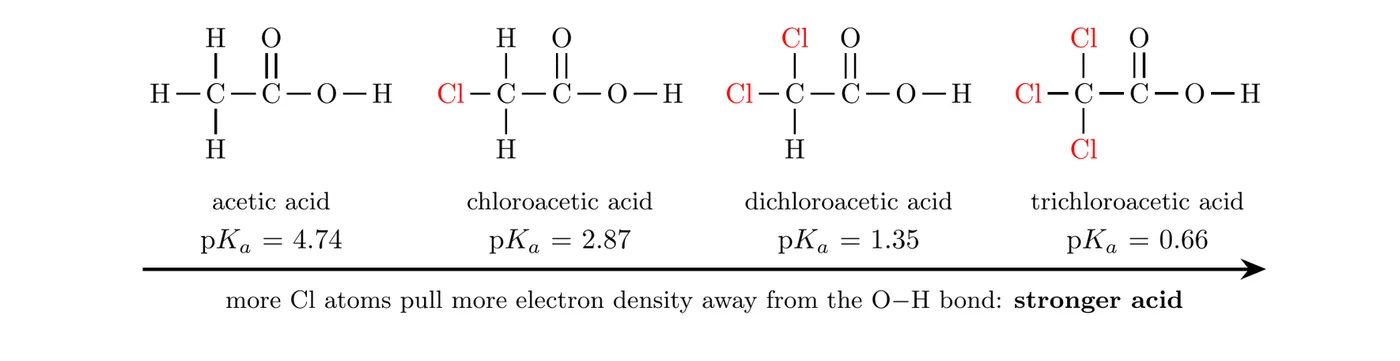
The Cl atoms aren't bonded to the acidic O-H, but they still pull electron density toward themselves through the C-C and C-O bonds. The effect fades quickly with distance, so an electronegative atom matters most when it's close to the O-H group.
Example 1: Ranking oxoacids
Rank HOBr, , and HOCl from weakest to strongest acid, and justify the ranking with structure.
HOBr < HOCl < . HOBr and HOCl have the same structure, but Cl (3.16) is more electronegative than Br (2.96). Cl pulls more electron density from the O-H bond and better stabilizes the conjugate base, . has a second O atom on Cl, which pulls even more electron density away from the O-H bond and lets two O atoms share the negative charge of . The values agree: , , and .
Example 2: Comparing acetic acid and chloroacetic acid (AP-style)
A student measures the pH of 0.20 M solutions of two acids at 25 °C. Acetic acid, , has a pH of 2.72, and chloroacetic acid, , has a pH of 1.80. (a) Which acid has the larger ? Justify your answer with the data. (b) Calculate the percent ionization of each acid. (c) Explain the difference in strength in terms of molecular structure. (d) Which is the stronger base, or ? Explain.
(a) Chloroacetic acid. At the same concentration, its lower pH means a higher , so a larger fraction of its molecules ionized.
(b) Percent ionization is at equilibrium divided by the starting concentration:
(c) Chlorine is very electronegative. Through the C-C bond it pulls electron density away from the COOH group (an inductive effect). That makes the O-H bond more polar and stabilizes the negative charge on . A more stable conjugate base means a stronger acid.
(d) . The weaker acid has the stronger conjugate base. With no Cl atom pulling on it, the charge in acetate is less stabilized, so acetate holds on to a proton more strongly.
Resonance
Resonance spreads the negative charge of a conjugate base over more than one atom, and a spread-out charge is more stable than one stuck on a single atom. This is why carboxylic acids, compounds with a COOH group, are the most common class of weak acids. Acetic acid, formic acid (), benzoic acid, citric acid, and lactic acid are all carboxylic acids.
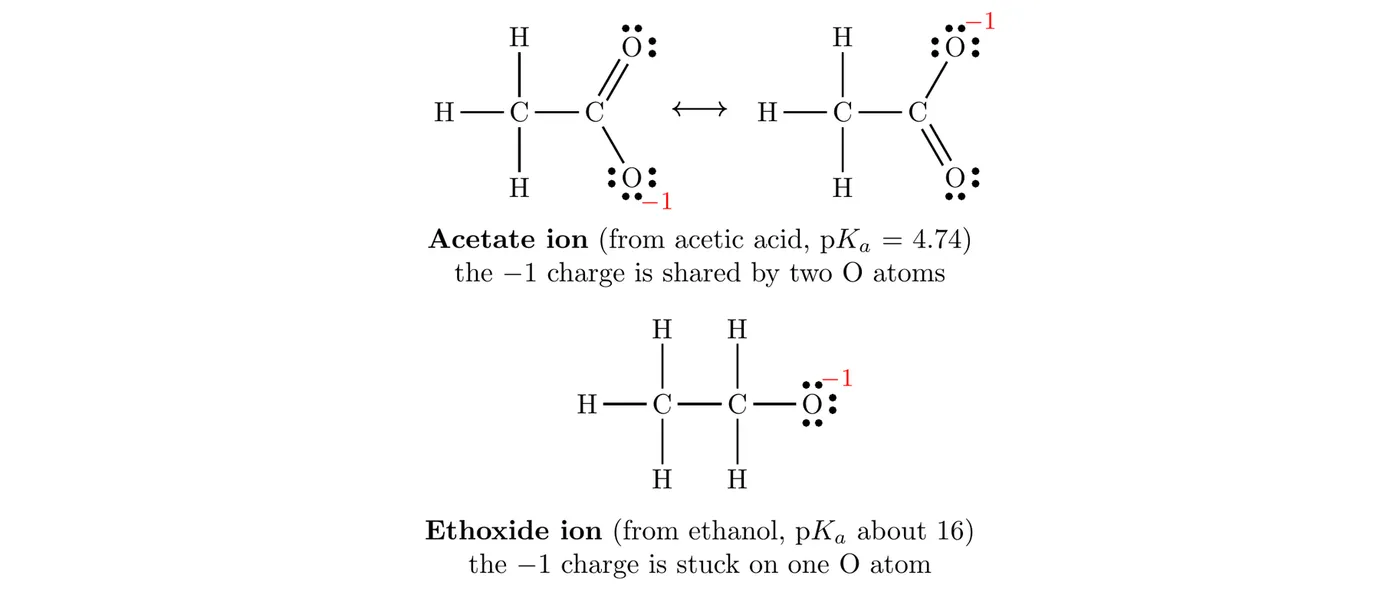
Ethanol, , also has an O-H group, but its p is about 16, so it doesn't act as an acid in water. Compare the conjugate bases. In ethoxide the negative charge sits on one O atom, while in acetate it's shared equally by two O atoms. Acetate is far more stable, so acetic acid is about times stronger than ethanol.
Example 3: Finding the acidic hydrogen
Lactic acid, , builds up in muscles during hard exercise. It has six H atoms, and two of them are on O atoms. (a) Which H atom ionizes in water? Explain. (b) Write the equation for its reaction with water.
(a) The H on the COOH group. When it leaves, the negative charge is shared by two O atoms through resonance, just as in acetate. The other O-H is like the one in ethanol: losing that H would leave the charge on one O with no resonance, so it doesn't ionize in water. The four H atoms bonded to C aren't acidic. Lactic acid is monoprotic, with .
(b)
Strong acids have very weak conjugate bases
The strong acids you need to know all have conjugate bases that are extremely stable, which makes them extremely weak bases:
Strong acid | Conjugate base | What stabilizes the conjugate base |
HCl, HBr, HI | , , | Large ions that spread the charge over a big volume |
Resonance over three electronegative O atoms | ||
Resonance over four O atoms, plus their inductive pull | ||
Resonance and the inductive pull of the O atoms on S |
These conjugate bases are so weak that they don't take protons from water to any measurable extent. They are spectator ions, so salts like NaCl and make neutral solutions. Only the first proton of is strong; is itself a weak acid.
Strong and weak bases
Strong bases are the group 1 and group 2 hydroxides, like NaOH, KOH, , and . These ionic compounds dissociate completely, and the base is the hydroxide ion itself. Its conjugate acid, water, is a very weak acid, and the metal cations (, ) are spectators that don't affect the pH.
Weak bases need a lone pair that can accept a proton. Two kinds are common. Nitrogenous bases, like ammonia and amines (such as methylamine, ), use the lone pair on N to take a proton from water:
Carboxylate ions, the conjugate bases of carboxylic acids, are weak bases too, because their parent acids are weak:
Acetate's is (Topic 8.3), so a sodium acetate solution is slightly basic.
Common mistakes
- Counting every H as acidic. Only H atoms on electronegative atoms (usually O) ionize. Acetic acid is monoprotic.
- Using electronegativity alone down a group. HF is weak and HI is strong. Down a group, the larger anion and weaker bond win.
- Getting the oxoacid trend backward. More O atoms on the central atom means a stronger acid.
- Saying a strong acid has a strong conjugate base. It's the reverse. , , and are so weak that they're spectator ions.
- Explaining with the acid instead of the conjugate base. A strong justification says why is stable: electronegativity, inductive effects, or resonance.