

8.4 - Acid-Base Reactions and Buffers
Overview
When you mix an acid with a base, they react first, and only then does an equilibrium decide the pH. This topic is about the four kinds of mixtures (strong or weak acid with strong or weak base), which species are left after the reaction, and how those species decide which pH method to use. It's also where buffers come from: they form when a weak acid is only partly neutralized.
The game plan: react first, then find the pH
Any reaction involving a strong acid or a strong base goes essentially to completion. Chemists say it happens quantitatively. You can see why from the equilibrium constants:
Reaction | |
With constants that large, whichever reactant runs out first is used up completely. So every mixing problem follows the same steps:
- Find the moles of each reactant (). Millimoles are fine: mL times mol/L gives mmol.
- Write the net ionic equation and do the stoichiometry in a before-change-after table, in moles. Don't use equilibrium here; the reaction goes to completion.
- List what's left (the major species), then pick the method: excess strong acid or base, a buffer, or a weak acid or base alone.
- If you need concentrations, divide by the total volume of the mixture.
(If you mix two acids instead, nothing gets neutralized. A strong acid sets the pH, and its pushes a weak acid's ionization back even further.)
Strong acid with strong base
A strong acid and a strong base react quantitatively:
(You'll also see it written , which means the same thing.) The cation of the base and the anion of the acid, like and , are spectators that don't change the pH. So the pH depends only on which reactant is in excess: divide the leftover moles of or by the total volume. If the moles are exactly equal, only water and spectator ions remain, and the pH is 7.00 at 25 °C.
Example 1: Mixing HCl with barium hydroxide
A student mixes 30.0 mL of 0.150 M HCl with 20.0 mL of 0.100 M . What is the pH of the mixture at 25 °C?
Step 1: Find millimoles. Remember that gives two (Topic 8.2).
Step 2: React them.
(mmol) | ||
Before | 4.50 | 4.00 |
Change | ||
After | 0.50 | 0 |
Step 3: The leftover is in 30.0 + 20.0 = 50.0 mL of solution.
Answer: pH = 2.00. The subtraction leaves only two significant figures (0.50 mmol), so the pH has two decimal places.
Weak acid with strong base
A strong base takes the proton from a weak acid, and this reaction also goes to completion:
What's left depends on which reactant was in excess, and each case uses a different method:
After the reaction | Major species | How to find the pH |
Weak acid in excess | HA and : a buffer | Henderson-Hasselbalch: pH = p + log([]/[HA]) |
Equal moles | only (a weak base) | , then solve like Topic 8.3 (slightly basic) |
Strong base in excess | and | moles of excess over total volume |
In the equal-moles case, the conjugate base reacts with water and makes the solution slightly basic:
When strong base is in excess, the solution contains too, but the it adds is tiny next to the excess strong base, so you can ignore it.
Buffers and the Henderson-Hasselbalch equation
A buffer is a solution with large amounts of both members of a conjugate acid-base pair, like and . Buffers resist changes in pH, because the weak acid can neutralize added base and the conjugate base can neutralize added acid (Topics 8.8 to 8.10 go deeper). You can make one two ways: dissolve the weak acid and a salt of its conjugate base together, or partly neutralize a weak acid with a strong base, which is what happens in this case.
The pH of a buffer comes from the Henderson-Hasselbalch equation (Topic 8.9):
Both members of the pair are in the same volume, so you can use their mole ratio in place of the concentration ratio. You don't even need the total volume.
Example 2: Three mixtures of acetic acid and NaOH (AP-style)
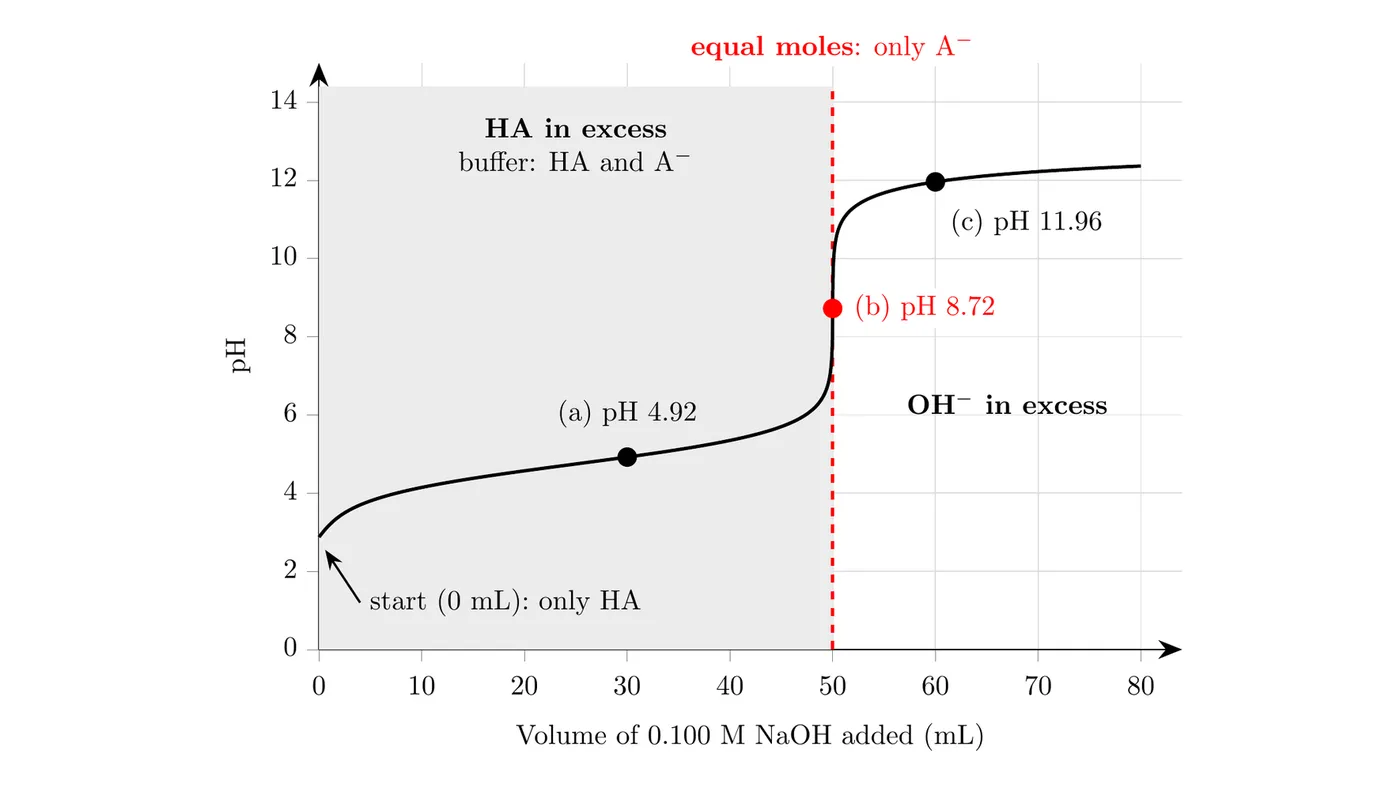
A student adds 0.100 M NaOH to 50.0 mL of 0.100 M () at 25 °C. Identify the major species and calculate the pH after adding (a) 30.0 mL, (b) 50.0 mL, and (c) 60.0 mL of NaOH.
The acid starts with (50.0 mL)(0.100 M) = 5.00 mmol. The NaOH adds 3.00, 5.00, and 6.00 mmol of .
(mmol) | |||
(a) 30.0 mL: before | 5.00 | 3.00 | 0 |
(a) after | 2.00 | 0 | 3.00 |
(b) 50.0 mL: after | 0 | 0 | 5.00 |
(c) 60.0 mL: after | 0 | 1.00 | 5.00 |
(a) Acetic acid is in excess, so the mixture is a buffer of and .
There's more than , so the pH is a little above the p.
(b) Equal moles: only acetate is left, 5.00 mmol in 50.0 + 50.0 = 100.0 mL, so M. Acetate is a weak base, with .
The solution is basic even though the acid and base were mixed in exactly equal amounts.
(c) 1.00 mmol of is left over in 50.0 + 60.0 = 110.0 mL.
Answer: (a) pH 4.92, a buffer of and . (b) pH 8.72, mostly . (c) pH 11.96, excess plus . Plotting the pH as more base is added gives the curve below. Each part of this example sits in a different region of it (titration curves are Topic 8.5).
Weak base with strong acid
This is the mirror image. A strong acid gives its proton to a weak base, quantitatively:
After the reaction | Major species | How to find the pH |
Weak base in excess | B and : a buffer | Henderson-Hasselbalch with p of : pH = p + log([B]/[]) |
Equal moles | only (a weak acid) | , then solve like Topic 8.3 (slightly acidic) |
Strong acid in excess | and | moles of excess over total volume |
In the equal-moles case, the conjugate acid gives a proton to water and makes the solution slightly acidic:
Example 3: Ammonia with hydrochloric acid
A student starts with 40.0 mL of 0.200 M (). Find the pH at 25 °C after adding (a) 15.0 mL and (b) 40.0 mL of 0.200 M HCl.
The ammonia is (40.0 mL)(0.200 M) = 8.00 mmol. For the conjugate acid, , and p = 14.00 4.74 = 9.26.
(a) The HCl adds 3.00 mmol of , which turns 3.00 mmol of into . That leaves 5.00 mmol and 3.00 mmol : ammonia is in excess, so it's a buffer.
(b) The HCl adds 8.00 mmol, exactly enough to convert all the ammonia. Only is left: 8.00 mmol in 80.0 mL, or 0.100 M. It's a weak acid.
Answer: (a) pH 9.48 (a buffer of and ). (b) pH 5.13. Mixing equal moles of a weak base and a strong acid gives a slightly acidic solution.
Weak acid with weak base
When both partners are weak, the reaction doesn't necessarily go to completion. It reaches an equilibrium:
Its equilibrium constant compares the two acids on opposite sides, HA and :
If HA is the stronger acid, and products are favored. This is the Topic 4.8 rule in numbers: an acid-base equilibrium favors the side with the weaker acid and weaker base.
Example 4: Which side is favored?
Calculate and decide which side is favored. (a) Acetic acid with ammonia. (b) Acetic acid with fluoride ion.
(a)
, so products are favored. Acetic acid is a much stronger acid than .
(b)
, so reactants are favored. The left side has the weaker acid (acetic acid) and the weaker base (, ), so most of the stays unreacted.
Common mistakes
- Doing equilibrium before stoichiometry. React the strong acid or base completely first, in moles. Only then think about equilibrium.
- Forgetting the total volume. After mixing, divide by the combined volume, not the volume of one solution.
- Assuming equal moles means pH 7. That's true only for strong acid with strong base. Weak acid with strong base ends basic; weak base with strong acid ends acidic.
- Using Henderson-Hasselbalch in the wrong place. It needs both HA and present in large amounts. Don't use it at the equal-moles point or when strong base is in excess.
- Treating weak acid plus strong base as an equilibrium. It goes to completion ().
- Forgetting the 2 in group 2 hydroxides. 1 mol of neutralizes 2 mol of .