

8.1 - Introduction to Acids and Bases
Overview
Acid-base chemistry comes down to two ions: hydronium, , and hydroxide, . This topic gives you the tools to measure them: the pH and pOH scales, and the equilibrium constant for water itself, . Every calculation in Unit 8 starts with these conversions, so practice them until they're automatic.
pH and pOH
In water solutions, can be anywhere from about 1 M down to M. Numbers that span 14 powers of ten are awkward to compare, so chemists use a logarithmic scale:
The "p" means "take the negative log of." Because of the minus sign, more means a lower pH. Because it's a log, each change of 1 pH unit is a tenfold change in . A solution at pH 3 has 10 times the hydronium concentration of one at pH 4, and 100 times that of one at pH 5.
To go backward, undo the log:
Hydrogen ion or hydronium ion? The terms "hydrogen ion" and "hydronium ion", and the symbols and , all mean the same aqueous ion here. A bare proton never floats free in water (Topic 4.8), so is preferred, but the AP exam accepts too.
Significant figures with logs
When you take a log, the digits after the decimal point in pH (or pOH) match the significant figures in the concentration. For example, M has two significant figures, so its pH is 2.33, with two decimal places. The 2 in front of the decimal only tells you the power of ten. Going backward works the same way: a pH with two decimal places gives a concentration with two significant figures.
Example 1: Converting between concentration and pH
(a) A solution has M. Find its pH.
(b) A solution has pOH = 4.15. Find .
(c) How many times greater is in a solution with pH 3.0 than in one with pH 5.0?
Answer: (a) pH = 2.33. (b) M. (c) The pH 3.0 solution has 100 times more . A difference of 2 pH units is a factor of , not a factor of 2.
On a calculator, put the whole concentration in parentheses, like
-log(4.7E-3), and use 10^(-4.15) to go backward.Water's autoionization and
Even perfectly pure water contains a few ions, because water molecules pass protons to each other (Topic 4.8 introduced this autoionization):
Like any equilibrium (Unit 7), this one has an equilibrium constant. Liquid water is left out of the expression, so the constant, written , is just the product of the two ion concentrations:
is tiny, so the reaction barely happens. In pure water at 25 °C, only about 2 of every billion water molecules are ionized at any moment.
applies to every aqueous solution, not only pure water. That links the two ions like a seesaw: add acid and goes up, so must go down to keep the product at . An acidic solution still contains some , and a basic solution still contains some .
Taking the negative log of both sides turns the product into a sum:
So if you know any one of , , pH, or pOH, you can find the other three.
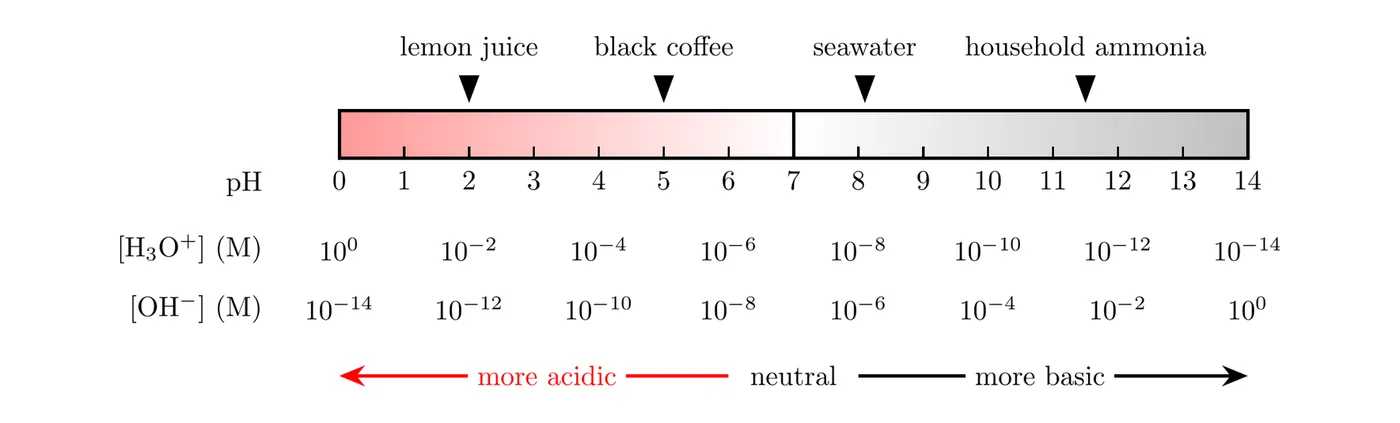
Reading the scale: pH and move in opposite directions, and and always multiply to . The everyday markers are typical values (lemon juice about 2, black coffee about 5, seawater about 8.1, household ammonia about 11.5), and real samples vary.
Example 2: The pH of seawater
Seawater has a pH of 8.10 at 25 °C. Find its pOH, , and . Is seawater acidic or basic?
Step 1: Use pH + pOH = 14.00.
Step 2: Undo each log.
Step 3: Check with : . It works.
Answer: pOH = 5.90, M, and M. Seawater is slightly basic, because is greater than .
Neutral solutions
A solution is neutral when = . Pure water is neutral, because autoionization makes one of each ion every time it happens. Setting the two equal at 25 °C:
At 25 °C | Ion concentrations | pH | pOH |
Acidic | > | below 7.00 | above 7.00 |
Neutral | = | 7.00 | 7.00 |
Basic | > | above 7.00 | below 7.00 |
changes with temperature
is an equilibrium constant, and every equilibrium constant depends on temperature. Autoionization is endothermic (), so heating water shifts the equilibrium toward the ions, and gets larger.
Temperature | p | pH of pure water | |
0 °C | 14.95 | 7.47 | |
25 °C | 14.00 | 7.00 | |
37 °C (approximate) | 13.62 | 6.81 | |
50 °C | 13.26 | 6.63 | |
100 °C | 12.25 | 6.13 |
In pure water, = = . A larger means more of both ions, so the pH of pure water drops as it warms. At 50 °C it's 6.63, and the water is still perfectly neutral, because went up by exactly the same amount. That's why the pH of pure, neutral water is 7.00 only at 25 °C.
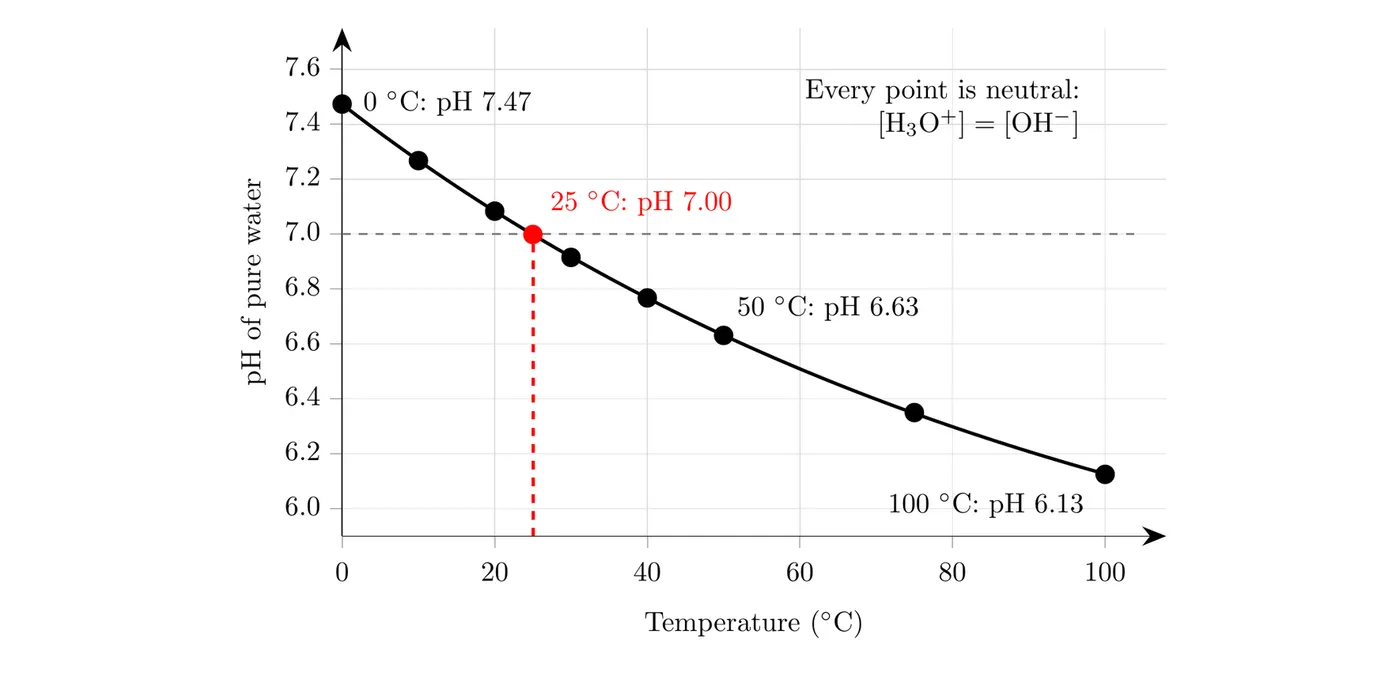
The data points come from the CRC Handbook of Chemistry and Physics and from Bandura and Lvov (2006). The 37 °C row is read from a smooth curve through those points, so it's approximate. Two takeaways: neutral means = , not "pH 7". And pH + pOH = 14.00 only at 25 °C. At other temperatures, pH + pOH = p for that temperature. Unless a problem says otherwise, assume 25 °C.
Example 3: Water at 50 °C (AP-style)
At 50 °C, . (a) Calculate and the pH of pure water at 50 °C. (b) A student says this water is acidic because its pH is below 7. Do you agree? (c) Is the autoionization of water endothermic or exothermic? Justify your answer. (d) A different solution at 50 °C has pH 7.00. Is it acidic, basic, or neutral?
(a) In pure water the two ions are equal, so :
(Two significant figures in gives M; keep the extra digit until you've taken the log.)
(b) No. The water is neutral, because = = M. A pH below 7 means acidic only at 25 °C.
(c) Endothermic. is larger at 50 °C () than at 25 °C (). Raising the temperature shifts an endothermic reaction toward products, which increases .
(d) At 50 °C, p, so:
The pOH is lower than the pH, so is greater than . At 50 °C, a pH of 7.00 is slightly basic.
Common mistakes
- Saying pH 7 always means neutral. Neutral means = . That's pH 7.00 only at 25 °C.
- Using 14.00 at the wrong temperature. pH + pOH = p, which equals 14.00 only at 25 °C.
- Treating pH as linear. pH 2 and pH 4 differ by a factor of 100 in , not a factor of 2.
- Thinking an acidic solution has no . means both ions are always present. Acidic just means there's more than .
- Wrong decimal places. The decimals in pH match the significant figures in the concentration.
- Calculator slips. Forgetting the parentheses in
-log(4.7E-3)or the negative sign in10^(-4.15).