

8.3 - Weak Acid and Base Equilibria
Overview
Most acids and bases are weak: only a small fraction of their molecules react with water. That makes their solutions equilibrium systems, so Unit 7's tools (equilibrium expressions, ICE tables, and the small- approximation) are exactly what you need here. This topic covers and , how to get the pH of a weak acid or base, percent ionization, and how an acid's strength connects to its conjugate base's.
Weak acids ionize only a little
A weak acid reacts with water to make hydronium ions, but only a small percentage of its molecules do it at any moment, so the reaction gets an equilibrium arrow:
Because so few molecules ionize, is much less than the starting concentration of the acid, and the vast majority of the acid stays as intact HA molecules. In a weak acid solution, the major species are HA and . and are minor species, present in equal, small amounts.
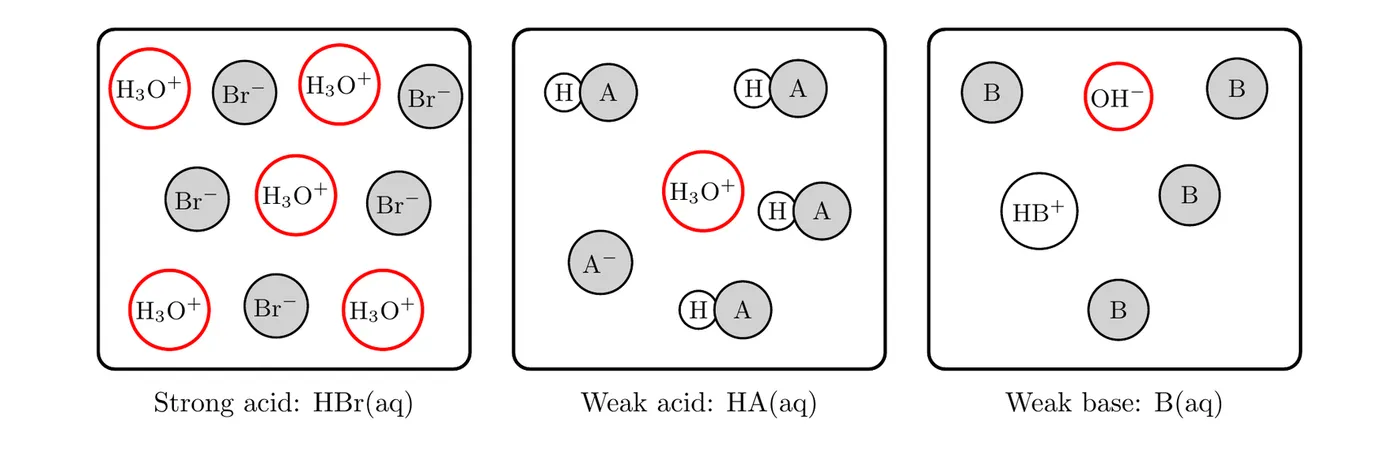
Each box started with 5 solute particles (water isn't shown). In the strong acid, every HBr has ionized. In the weak acid, only 1 of 5 HA molecules has given up its proton. In the weak base, only 1 of 5 B molecules has taken a proton from water, making one and one . Real weak acids and bases are usually even less ionized than this (often 1% or less), but then the ions would be too rare to draw.
The acid ionization constant,
The equilibrium constant for a weak acid ionizing is called , the acid ionization constant. Water is the solvent, so it's left out:
A smaller means a weaker acid: less ionization, fewer ions at equilibrium. Because of the minus sign, a weaker acid has a larger p. Values at 25 °C for some common weak acids:
Acid | Formula | p | |
hydrofluoric acid | HF | 3.20 | |
nitrous acid | 3.35 | ||
acetic acid | 4.74 | ||
hypochlorous acid | HOCl | 7.52 | |
hydrocyanic acid | HCN | 9.31 |
To find the pH of a weak acid from its starting concentration and (or p; use ), set up an ICE table, write the expression, and solve for = .
The small- approximation and the 5% check
Because a weak acid barely ionizes, is usually tiny compared with the starting concentration , so . That turns the equation into a simple square root:
Always check the approximation afterward: if is less than 5% of , it's fine. If not, solve the full quadratic, . AP questions are usually built so the approximation works, but you're expected to know when it does. A quick test before you start: the approximation works whenever is greater than 400.
Example 1: The pH of vinegar
Vinegar is about 0.83 M acetic acid, (). Find the pH of vinegar and the concentrations of all the species in it at 25 °C.
Step 1: Write the reaction and an ICE table. The from water ( M) is negligible, so start it at 0.
(M) | (M) | (M) | |
Initial | 0.83 | 0 | 0 |
Change | |||
Equilibrium |
Step 2: Write and use the small- approximation.
Step 3: Check the approximation.
Step 4: Find the pH and the remaining species.
Answer: pH = 2.41. M (essentially unchanged), M, and M. Fewer than 1 in 200 acetic acid molecules are ionized. That's what "weak" means.
Example 2: Finding from a measured pH
A student uses a calibrated pH meter to measure a 0.100 M solution of an unknown monoprotic acid at 25 °C and reads pH = 2.19. Calculate and identify the acid from the table above.
Step 1: Convert pH to . Keep an extra digit until the end.
Step 2: Each came with one from one HA, so M and M.
Step 3: Substitute into . You already know , so there's no reason to approximate.
Answer: , which matches nitrous acid, . Here the acid is 6.5% ionized, so dropping the subtraction (dividing by 0.100) would have given , a noticeably different value.
Weak bases and
A weak base reacts with water by taking a proton from it, which makes hydroxide ions. Again, only a small percentage of the base molecules react at any moment:
So is much less than the starting concentration of the base, and most of the base stays as B. The equilibrium constant is , the base ionization constant:
The most common weak bases are nitrogen compounds like ammonia () and the amines, plus the conjugate bases of weak acids (like acetate, ). The method is the same as for a weak acid, except that is , so you find pOH first and then pH = 14.00 pOH.
Example 3: The pH of an ammonia solution
Find the pH of 0.20 M at 25 °C. For ammonia, p = 4.74.
Step 1: Convert p to : .
Step 2: With and M:
Step 3: Check: , under 5%. Then convert.
Answer: pH = 11.28. The major species are and . The minor species are and ( M each) and ( M).
Percent ionization
Percent ionization tells you what fraction of a weak acid (or base) has reacted with water:
You can get it two ways. From p and the initial concentration, solve for as in Example 1. Or, from the initial concentration and the measured equilibrium concentration of any species, as in Example 2: or gives directly, and the leftover HA gives . For a weak base, use or over the starting concentration of B. The 5% check from earlier is the same thing as asking whether the percent ionization is under 5%.
Percent ionization depends on concentration: diluting a weak acid increases its percent ionization. Adding water lowers every concentration by the same factor. The top of the expression has two concentrations multiplied together, and the bottom has one, so diluting tenfold makes ten times smaller than . To get back to equilibrium, more HA ionizes. (Le Châtelier's principle says the same thing: the side with more dissolved particles is favored on dilution.)
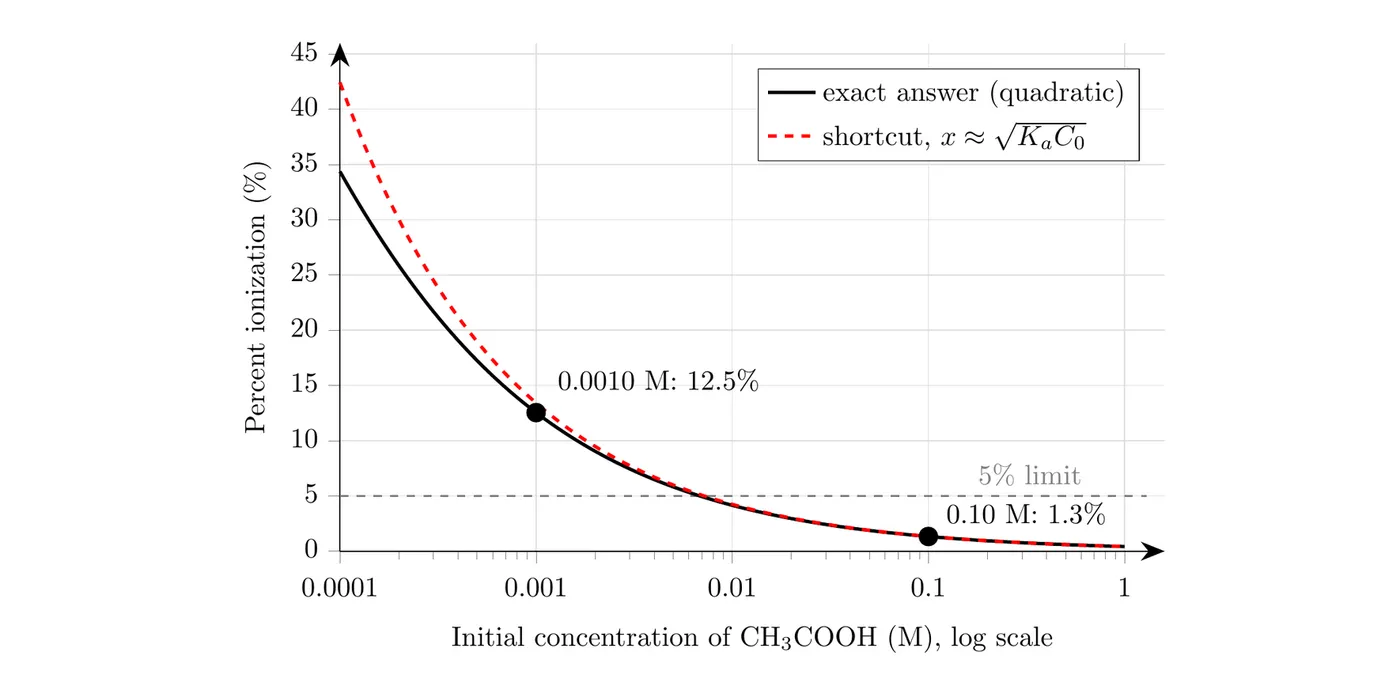
For acetic acid, a 0.10 M solution is 1.3% ionized, but a 0.0010 M solution is 12.5% ionized. Below about 0.0072 M, the small- shortcut gives more than 5%, and the more dilute the solution, the further the red dashed curve drifts above the exact one. Even though a larger fraction ionizes, the diluted solution still has a lower , so its pH is higher.
How and are related
Every weak acid HA has a conjugate base , and that base reacts with water too. Add the two reactions and you get the autoionization of water:
When you add reactions, you multiply their equilibrium constants (Unit 7). So for any conjugate acid-base pair:
This puts a number on a rule from Topic 4.8: the weaker the acid, the stronger its conjugate base. Since is fixed, a small forces a large .
Acid | Conjugate base | ||
HF | |||
HOCl | |||
HCN |
It works in the other direction too. For ammonia, , so its conjugate acid, , has . Constants rounded to two significant figures can make the last digit of a p disagree by 1: , but 14.00 4.74 = 9.26. That's rounding, not an error. Carry one extra digit through the steps and both routes give 9.255. These notes use 9.26.
Example 4: A bleach solution (AP-style)
Sodium hypochlorite, NaOCl, is the active ingredient in household bleach. A student prepares 0.20 M NaOCl at 25 °C. For HOCl, . (a) Calculate for . Is a stronger or weaker base than ? (b) Calculate the pH of the solution. (c) Calculate the percent of that reacts with water. (d) The student dilutes the solution tenfold, to 0.020 M. Does the percent that reacts increase, decrease, or stay the same? Justify your answer.
(a) Use :
is the stronger base. Its is much larger than that of (), because HOCl is a much weaker acid than HF.
(b) is a spectator ion. The hypochlorite ion is a weak base:
(c)
That's well under 5%, so the approximation in (b) was fine.
(d) It increases. Right after dilution, every concentration is one tenth as large, so drops to one tenth of . Since , the reaction shifts right and a larger fraction of reacts (0.41% at 0.020 M). The pH still goes down, to 9.91, because is lower overall.
Common mistakes
- Treating a weak acid like a strong one. For a weak acid, is much smaller than the acid's concentration. Setting them equal is the most common error in this unit.
- Skipping the 5% check. If is more than 5% of , the approximation isn't valid.
- Forgetting to convert for bases. The square root gives , so it leads to pOH. Finish with pH = 14.00 pOH.
- Mixing up and p. A larger means a stronger acid, but a larger p means a weaker one.
- Approximating when you don't need to. If you know from a measured pH, subtract it from exactly.
- Saying dilution lowers percent ionization. It's the reverse: dilution raises percent ionization, even though falls.