

8.9 - Henderson-Hasselbalch Equation
Overview
A buffer's pH depends on two things: which weak acid it's made from (its ) and the ratio of conjugate base to acid. The Henderson-Hasselbalch equation puts both in one line, so you can find a buffer's pH without an ICE table. It also explains why adding a little acid or base barely moves a buffer's pH. On the AP exam you'll use it to find a buffer's pH, to work backward to the ratio a target pH needs, and to pick the right acid for a buffer.
The Henderson-Hasselbalch equation
For a buffer made from a weak acid HA and its conjugate base :
- , where belongs to the acid of the pair.
- is the concentration of the conjugate base, and is the concentration of the weak acid. Base goes on top.
The equation and are both on the AP reference sheet.
Where it comes from
It's the expression for the weak acid, solved for and rewritten with logs:
You won't be asked to derive it on the AP exam. The point is that it isn't a new idea: it's the same weak acid equilibrium from Topic 8.3, written in a form that's faster to use.
Why the starting amounts work
In a buffer, HA and are both present in large amounts. HA barely ionizes, barely reacts with water, and each one pushes the other's equilibrium back (the common-ion effect). So the equilibrium concentrations are almost exactly the amounts you put in, and you can plug those straight into the equation. This holds as long as both concentrations are much larger than , which is true for the buffers you'll see on the exam.
Moles work as well as concentrations
HA and are in the same solution, so they share one volume, and the volume cancels in the ratio:
So you can use moles (or millimoles) directly. This saves a step whenever a buffer is made by mixing solutions, and it's why adding water to a buffer doesn't change its pH (more on that in Topic 8.10).
The ratio controls the pH
- Equal amounts of acid and base: the ratio is 1, , so pH = p. This is what happens at the half-equivalence point of a titration (Topic 8.5).
- More base than acid (ratio above 1): the log is positive, so pH > p.
- More acid than base (ratio below 1): the log is negative, so pH < p. This matches the rule from Topic 8.7.
- Every factor of 10 in the ratio moves the pH by 1 unit. Doubling the ratio raises the pH by only .
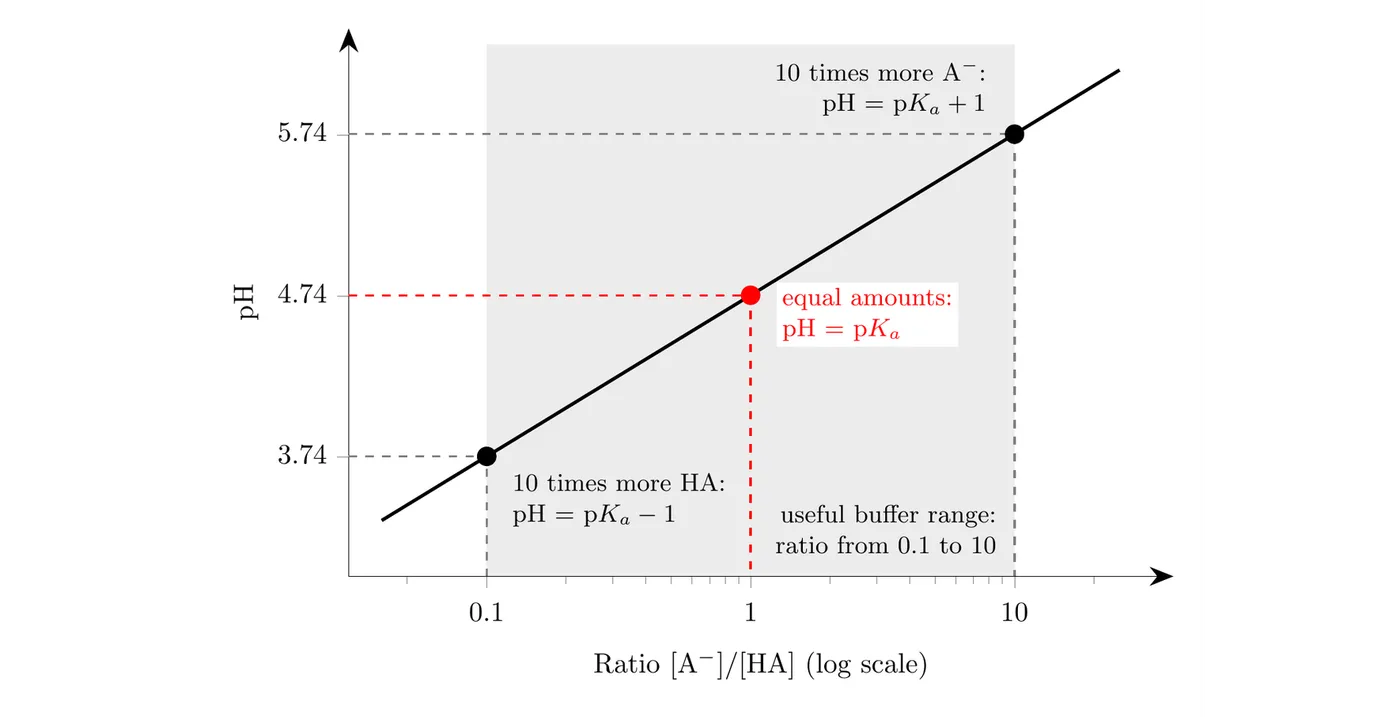
The graph is for an acetic acid buffer (), but every buffer follows the same straight line, shifted up or down to its own p.
A buffer works well when the ratio is between about 0.1 and 10, so its useful range is roughly p. Outside that range, one component is so small that a little added acid or base uses it up.
Example 1: pH of an acetic acid buffer
A buffer contains 0.200 M and 0.300 M . For acetic acid, .
(a) Find the pH. Sodium acetate is a soluble salt, so it supplies 0.300 M ( is a spectator ion).
Answer: pH = 4.92. Quick check: there's more base than acid, so the pH should be a little above the p. It is.
(b) Keeping 0.200 M , what concentration of would give a pH of 5.00? Solve for the ratio first:
Answer: 0.36 M sodium acetate.
Example 2: A buffer made from a weak base
A student dissolves 4.28 g of (molar mass = 53.49 g/mol) in 500.0 mL of 0.250 M . Assume the volume doesn't change. For , . Find the pH.
Step 1: Name the pair. The weak acid is and its conjugate base is . The equation needs the p of the acid, . Since , p + p = 14.00 at 25 °C:
Step 2: Find moles of each.
Step 3: Use the equation with moles. is the base, so it goes on top:
Answer: pH = 9.45, a basic buffer, as you'd expect from ammonia.
Example 3: A buffer made by partly neutralizing a weak acid
A student mixes 50.0 mL of 0.200 M formic acid, (), with 60.0 mL of 0.100 M . Find the pH.
Step 1: Do the reaction first (Topic 8.4). reacts completely with the weak acid. Work in millimoles:
Before (mmol) | (50.0)(0.200) = 10.0 | (60.0)(0.100) = 6.00 | 0 |
Change (mmol) | |||
After (mmol) | 4.0 | 0 | 6.00 |
Step 2: Check what's left. Both the weak acid and its conjugate base remain, so the mixture is a buffer. Use the equation with millimoles (the total volume of 110.0 mL cancels):
Answer: pH = 3.92. If the student had added exactly 50.0 mL of the (5.00 mmol, half of the acid), the ratio would be 1 and the pH would equal the p, 3.74. That's the half-equivalence point.
Choosing a buffer for a target pH
Since a buffer works best when its ratio is near 1, pick a weak acid whose p is as close as possible to the pH you want. The choice of acid sets the rough pH, and the ratio fine-tunes it.
Weak acid | Conjugate base | p | |
(formic acid) | 3.74 | ||
(acetic acid) | 4.74 | ||
7.21 | |||
9.26 | |||
10.33 |
Example 4: Designing a buffer (AP-style)
A student needs a buffer with a pH of 7.00 and can use any pair in the table above.
(a) Which pair should she use? Justify your choice. and . Its p (7.21) is the closest to 7.00, so the ratio she needs is close to 1 and the buffer will have plenty of both components.
(b) What ratio does she need?
You can get the same answer straight from : the ratio equals .
(c) She starts with 1.00 L of 0.100 M . What mass of ( = 141.96 g/mol) should she dissolve in it?
(d) Could she make a good pH 7.00 buffer from acetic acid and sodium acetate instead? Explain. No. She'd need , a ratio of about . That's far outside 0.1 to 10. There would be almost no acetic acid to react with added base, so a small amount of base would use it up and the pH would rise sharply.
Why small additions barely change the pH
When a little strong acid or base goes into a buffer, one buffer component reacts with it and turns into the other (Topic 8.8 shows the reactions). If the buffer holds much more HA and than the amount added, the ratio hardly changes, and the log of the ratio changes even less. So the pH stays close to where it started. Without a buffer, the same acid or base has nothing to react with and changes directly.
For example, add 0.010 mol of HCl to 1.00 L of a buffer with 0.500 mol each of and . The ratio goes from 0.500/0.500 = 1.00 to 0.490/0.510 = 0.961, and , so the pH drops only from 4.74 to 4.72. The same HCl in 1.00 L of pure water drops the pH from 7.00 to 2.00, a change of 5 units. (Topic 8.8's graph shows the same contrast for added base.)
The AP exam won't ask you to calculate the change in pH when an acid or a base is added to a buffer. It can ask you to explain why the change is small, and this ratio argument is the explanation.
Common mistakes
- Flipping the ratio. Base over acid: . Check your answer: more base than acid means the pH is above the p.
- Using for a weak-base buffer. For and , convert to the of first (Example 2).
- Skipping the reaction step. When a strong acid or base is mixed with a weak one, do the stoichiometry first, then use the equation on what's left (Example 3).
- Plugging in concentrations from before mixing. After two solutions are mixed, use moles, which aren't affected by the new total volume.
- Using the equation when there's no buffer. A weak acid alone (no ), the equivalence point (no HA left), or excess strong acid or base all need a different method (Topics 8.3 and 8.4).
- Significant figures in logs. The number of decimal places in a pH or p equals the number of significant figures in the concentration or . A of (two significant figures) gives a p of 4.74 (two decimal places).