

8.5 - Acid-Base Titrations
Overview
Topic 4.6 used a titration to find how much acid or base was in a sample. This topic reads the whole titration curve, the graph of pH as titrant is added. One curve can tell you the analyte's concentration, whether it's strong or weak, the of a weak acid, and how many acidic protons it has.
Reading a titration curve
An acid-base titration runs an acid-base reaction under controlled conditions: titrant from a buret is added to the analyte while a pH probe records the pH. A titration curve plots pH (y-axis) against the volume of titrant added (x-axis). Every curve for an acid titrated with a strong base has the same parts:
- Start (0 mL): the pH of the analyte by itself.
- Before equivalence: the pH changes gradually, because each drop of base is used up by acid still in the flask.
- Near the equivalence point: the pH jumps by several units over just a few drops. The equivalence point is the middle of this steep jump, where the curve is steepest.
- After equivalence: the pH levels off near the pH of the titrant, because nothing is left to react with the extra base.
A base titrated with a strong acid gives the same shape upside down: the pH starts high and falls. In the AP lab on titration curves, you collect curves like these with a pH probe and compare acids and bases of different strengths and starting concentrations.
The equivalence point
At the equivalence point of a titration of a monoprotic acid or base (one that gives or takes a single proton), the moles of titrant added equal the moles of analyte that were in the flask at the start:
This holds for strong and weak acids and bases alike, so the equivalence volume tells you the moles of analyte and, from that, its concentration. That surprises a lot of students: a weak acid needs the same volume of NaOH as a strong acid of the same concentration and volume. NaOH doesn't just react with the few ions a weak acid makes. It pulls protons straight off the acid molecules, and the reaction goes to completion (Topic 8.4). For acetic acid:
Strong acid and weak acid curves
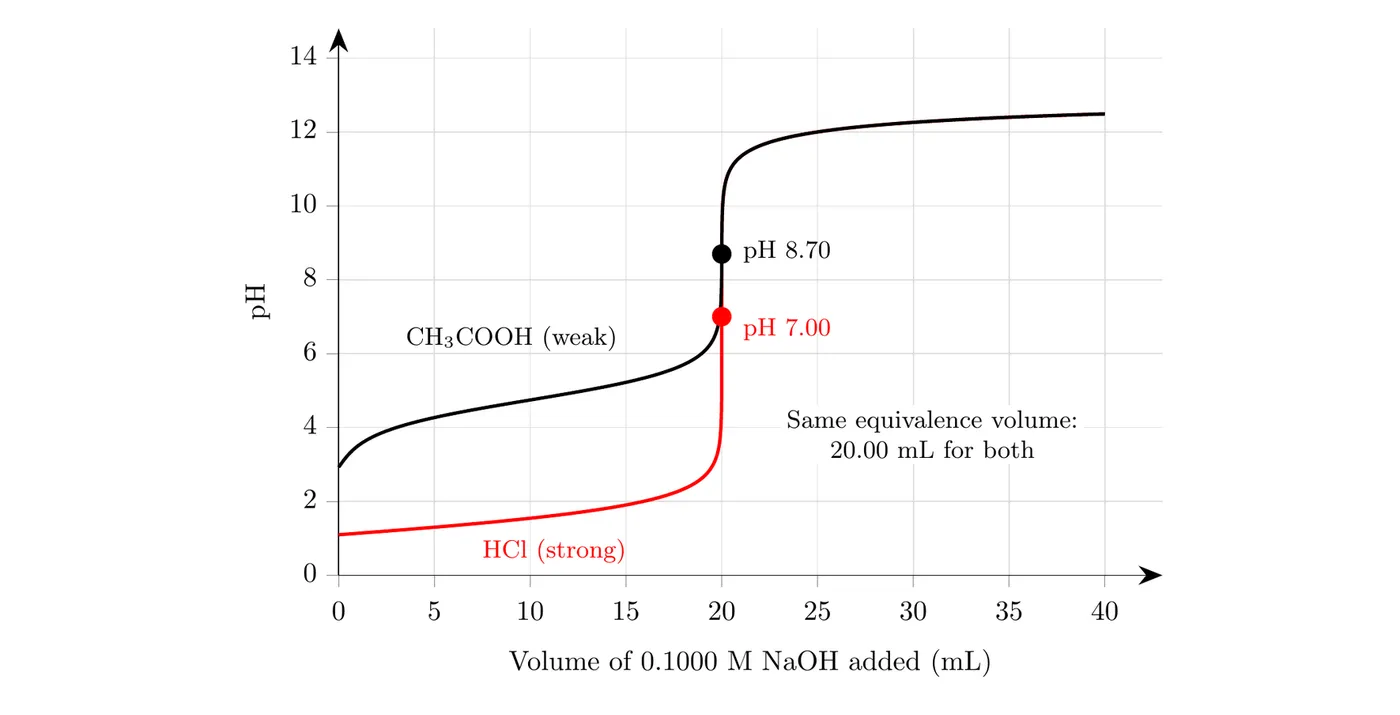
Both curves are for 25.00 mL of 0.0800 M acid titrated with 0.1000 M NaOH. The red curve is HCl. It's the same as the nitric acid curve in Topic 4.6, because every strong acid at the same concentration gives the same curve. The black curve is acetic acid, a weak acid with .
HCl (strong) | (weak) | |
Starting pH | 1.10 | 2.92 (only about 1.5% of the molecules are ionized) |
Before equivalence | Stays low and rises slowly | Rises quickly at first, then flattens into a buffer region |
Equivalence volume | 20.00 mL | 20.00 mL (the same) |
pH at equivalence | 7.00 | 8.70 |
pH from 19.90 to 20.10 mL | 3.65 to 10.35 (a big jump) | 7.04 to 10.35 (a smaller jump) |
Once some NaOH has reacted with the weak acid, the flask holds a lot of both and . That mixture is a buffer (Topic 8.8), so the pH changes slowly over the middle of the curve. This flat stretch is the buffer region. After the equivalence point the two curves overlap, because both are set by the same excess .
The half-equivalence point
For a weak acid, the most useful point on the curve is the half-equivalence point, the volume that is half of the equivalence volume. By then, exactly half of the original HA has been turned into , so the acid and its conjugate base are present in equal amounts:
Put that into the expression and the two concentrations cancel:
So at the half-equivalence point, pH = p. To find the of a weak acid from a titration, find the equivalence volume, divide it by 2, and read the pH at that volume. (This is the Henderson-Hasselbalch equation from Topic 8.9, with a ratio of 1.)
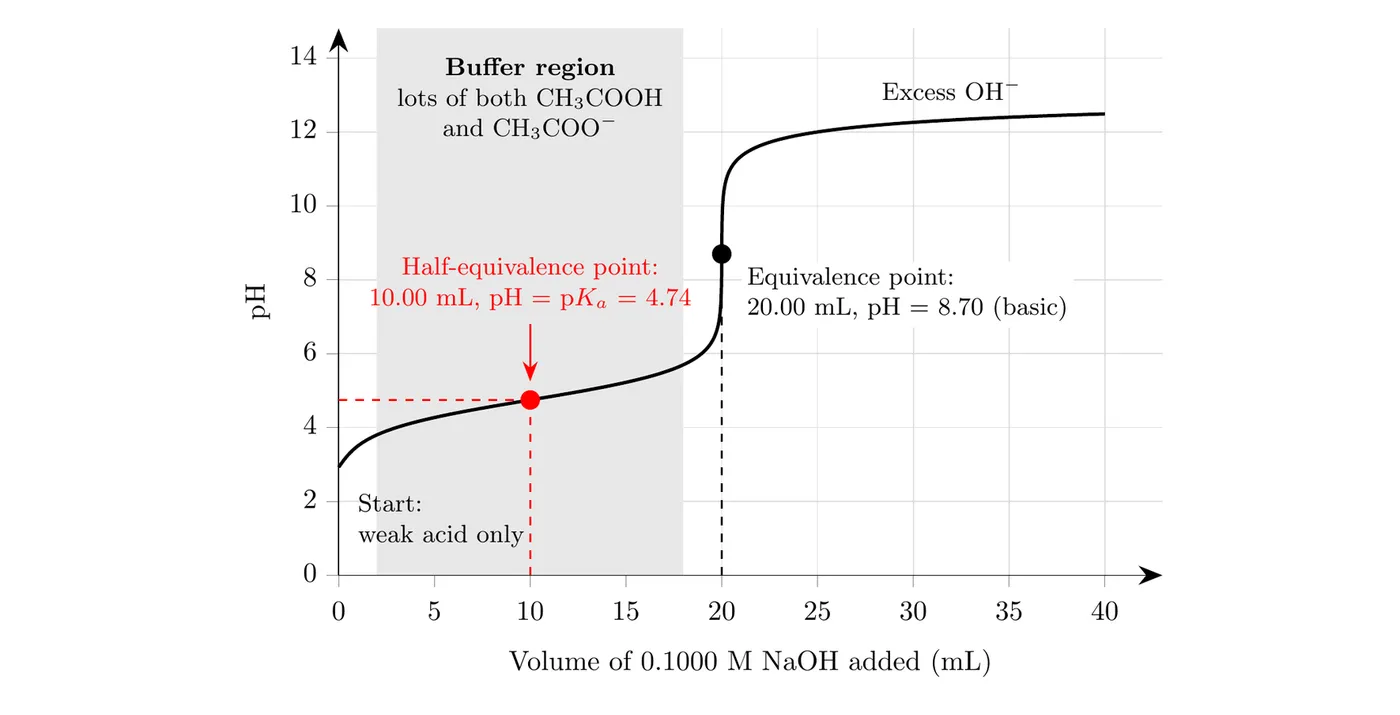
For acetic acid, the equivalence point is at 20.00 mL, so the half-equivalence point is at 10.00 mL, where the pH is 4.74. That's the p of acetic acid, and . The curve is flattest right at the half-equivalence point, which is where a buffer resists pH change best.
What's in the flask at each stage
Here's the same titration, stage by stage. Each stage uses a calculation from Topic 8.3 or 8.4. You always let the NaOH react completely first, then deal with the equilibrium of whatever is left.
NaOH added | Major species (besides and water) | How to find the pH | pH |
0 mL | Weak acid equilibrium with | 2.92 | |
10.00 mL | and , equal amounts | pH = p | 4.74 |
20.00 mL | Weak base equilibrium with | 8.70 | |
30.00 mL | (excess) and | Moles of extra divided by the total volume | 12.26 |
pH at the equivalence point
At the equivalence point the analyte is used up, so the pH depends on the major species left in the flask.
Strong acid with strong base: only water and spectator ions like and are left, so the pH is 7.00 at 25 °C.
Weak acid with strong base: every HA molecule has become , a weak base. It takes protons from water and makes , so the pH is above 7:
Weak base with strong acid: every B has become , a weak acid. It gives protons to water, so the pH is below 7:
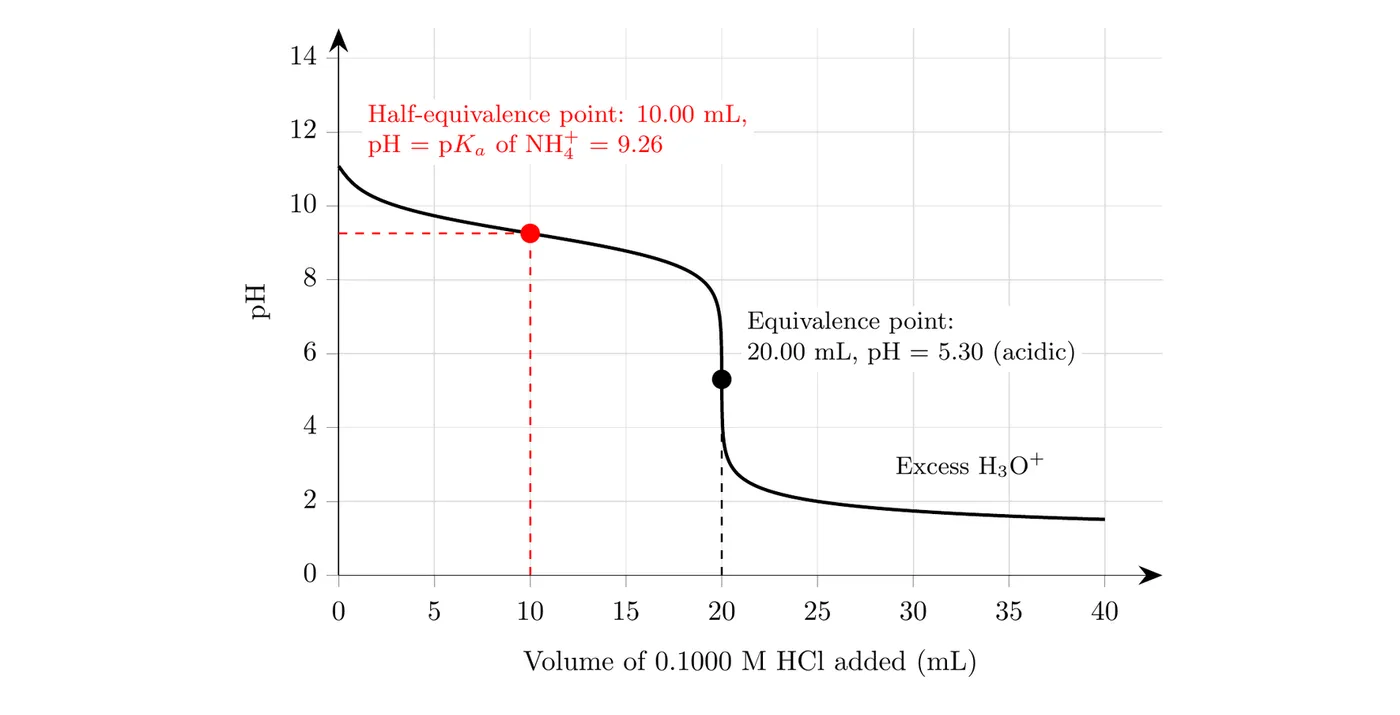
This curve is for 25.00 mL of 0.0800 M titrated with 0.1000 M HCl. It starts basic (pH 11.08) and falls. At the half-equivalence point (10.00 mL), pH = p of the conjugate acid , 9.26, so p for is . At equivalence, the flask holds and , and the pH is 5.30.
Example 1: Identifying an unknown acid (AP-style)
A student dissolves 0.2440 g of an unknown monoprotic solid acid in 50.0 mL of water and titrates it with 0.1000 M NaOH, using a pH probe. The equivalence point is at 19.98 mL, and the pH after 9.99 mL of NaOH is 4.20. The acid is one of these:
Acid | Formula | Molar mass (g/mol) | |
lactic acid | 90.08 | ||
benzoic acid | 122.12 | ||
propanoic acid | 74.08 |
(a) Calculate the molar mass of the acid. (b) Determine . (c) Identify the acid. (d) Is the pH at the equivalence point above, below, or equal to 7? Explain.
(a) At the equivalence point, the moles of acid equal the moles of NaOH:
(b) 9.99 mL is half of 19.98 mL, so it's the half-equivalence point, where pH = p:
(c) Both the molar mass and match benzoic acid, .
(d) Above 7. At the equivalence point, all the benzoic acid has become benzoate, , a weak base that takes protons from water:
To calculate the pH, use and the benzoate concentration in the total volume (50.0 mL + 19.98 mL), as in Topic 8.4, Example 2(b). It comes out to 8.33.
Polyprotic acids
A polyprotic acid has more than one acidic proton and gives them up one at a time. Each step has its own , and each is smaller than the one before, because pulling a proton away from a negative ion is harder than pulling one from a neutral molecule. For a diprotic acid, :
When you titrate with NaOH, the base removes the protons in order. First nearly all the turns into , and only then does turn into . So the curve has one equivalence point (one jump) for each acidic proton, as long as the values are far enough apart.
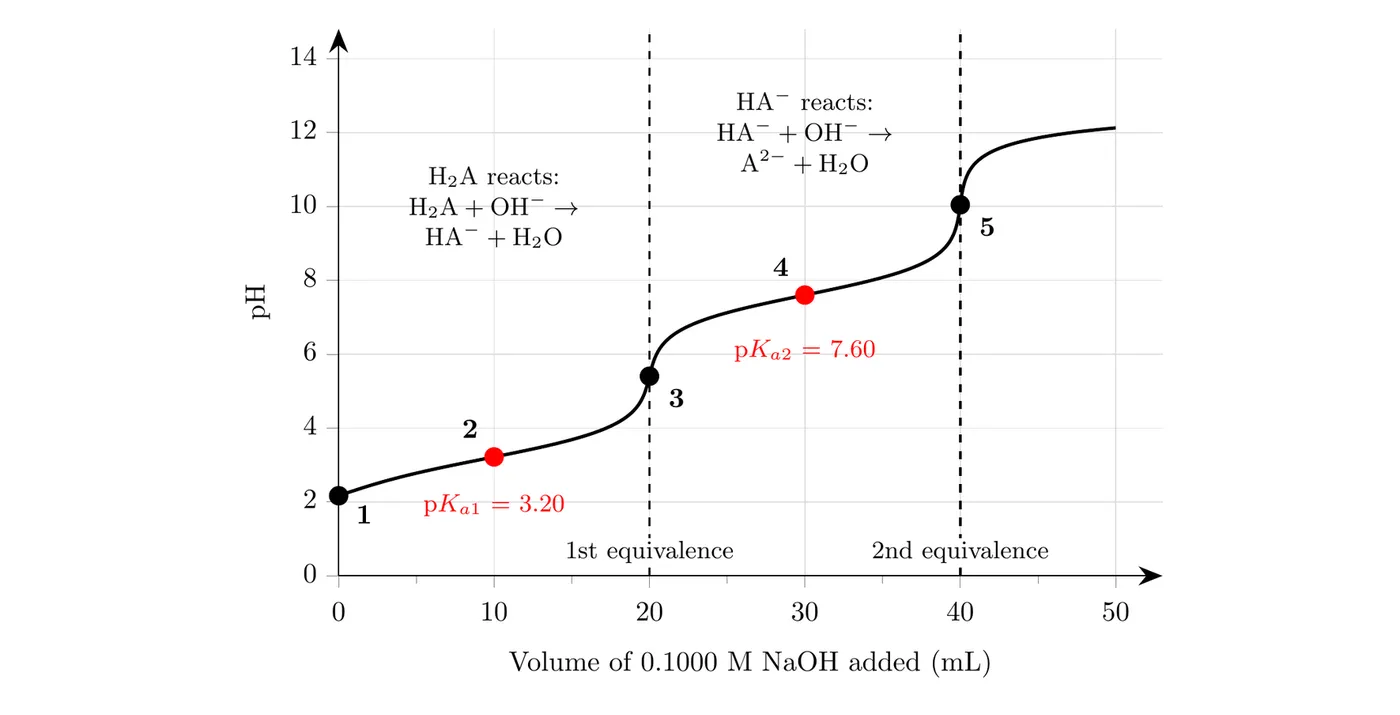
This curve is for 25.00 mL of 0.0800 M , a made-up diprotic acid with p = 3.20 and p = 7.60, titrated with 0.1000 M NaOH.
Point | NaOH added | Major species (besides and water) | What it tells you |
1 | 0 mL | Starting pH of the acid | |
2 | 10.00 mL | and , equal amounts | pH = p |
3 | 20.00 mL | First equivalence point | |
4 | 30.00 mL | and , equal amounts | pH = p |
5 | 40.00 mL | Second equivalence point (basic) |
- Count the jumps to find the number of acidic protons. Two jumps means a diprotic acid.
- The equivalence volumes are evenly spaced. Each proton takes the same moles of , so the second equivalence volume is twice the first. Use the first one to find the moles of acid.
- Each half-equivalence point gives a p. Halfway to the first equivalence point, pH = p. Halfway between the two equivalence points, pH = p.
Watch out for very weak protons. Phosphoric acid, , has three acidic protons, but its titration curve shows only two clear jumps: the third proton (p = 12.38) is too weak to make one.
The AP exam won't ask you to calculate every species' concentration in a polyprotic titration, only which species are present in large or small amounts, as in the table above.
Example 2: Reading a diprotic acid curve (AP-style)
Use the titration curve above. (a) How many acidic protons does have? How can you tell? (b) Calculate the initial concentration of . (c) Determine . (d) After 35.00 mL of NaOH, which is present at higher concentration, or ? Justify your answer.
(a) Two. The curve has two steep jumps (equivalence points), at 20.00 mL and 40.00 mL.
(b) Use the first equivalence point, where one has reacted for each :
(c) Halfway between the two equivalence points, at 30.00 mL, pH = p = 7.60:
(d) . At 35.00 mL the pH is about 8.1, which is above p = 7.60. When the pH is above the p, the base form of that pair is the larger one. (Topic 8.7 explains this rule.)
Common mistakes
- Assuming every equivalence point is at pH 7. Only strong acid with strong base. Weak acids give basic equivalence points, and weak bases give acidic ones.
- Reading p at the equivalence point. pH = p at the half-equivalence point.
- Using the wrong equivalence point for a polyprotic acid. The first equivalence volume matches the moles of acid one to one.
- Forgetting the titrant's volume. At and after the equivalence point, the total volume is the analyte plus the titrant added.