

8.2 - pH and pOH of Strong Acids and Bases
Overview
Strong acids and strong bases are the easy case in Unit 8: they react with water completely, so you can read the ion concentration straight from the label on the bottle. This topic shows how to go from the concentration of a strong acid or base to , , pH, and pOH, using the tools from Topic 8.1.
Strong acids ionize completely
A strong acid gives its proton to water so completely that essentially no acid molecules are left in solution. The six strong acids to memorize:
Strong acid | Name |
HCl | hydrochloric acid |
HBr | hydrobromic acid |
HI | hydroiodic acid |
nitric acid | |
perchloric acid | |
sulfuric acid (first proton only) |
Because the reaction goes to completion, it gets a single arrow:
Every molecule becomes one ion and one ion (the acid's conjugate base). So for a strong monoprotic acid, the hydronium concentration equals the starting concentration of the acid:
The major species in the solution, the particles present in large amounts, are , the conjugate base anion, and water. is present only in a tiny amount, set by .
About : only its first proton is strong. The second one comes from , which is a weak acid, so a sulfuric acid solution has somewhat more than its concentration, but less than double. AP questions that ask for an exact pH usually stick to the monoprotic strong acids.
Once you have , the rest follows from 8.1: pH = , then pOH = 14.00 pH, and . Strong acids more concentrated than 1 M even have negative pH values: 2.0 M HCl has pH = .
Example 1: A strong acid solution
Find , pH, pOH, and in 0.0250 M HBr at 25 °C. What are the major species?
Step 1: HBr is a strong acid, so it ionizes completely.
Step 2: Take the log. Three significant figures give three decimal places.
Step 3: Find pOH and . has two significant figures, so results that come from it get two.
Answer: M, pH = 1.602, pOH = 12.40, and M. The major species are , , and . There are essentially no HBr molecules left.
Notice what dilution does. Since equals the acid concentration, diluting a strong acid tenfold cuts by a factor of 10 and raises the pH by exactly 1 unit.
Strong bases dissociate completely
The strong bases are the group 1 hydroxides (LiOH, NaOH, KOH, RbOH, CsOH) and the group 2 hydroxides (the common ones are , , and ). They're ionic compounds, so the ions already exist in the solid. Dissolving them just separates the ions, a process called dissociation:
The difference that matters is the 2 in front of . Each formula unit of a group 2 hydroxide releases two hydroxide ions:
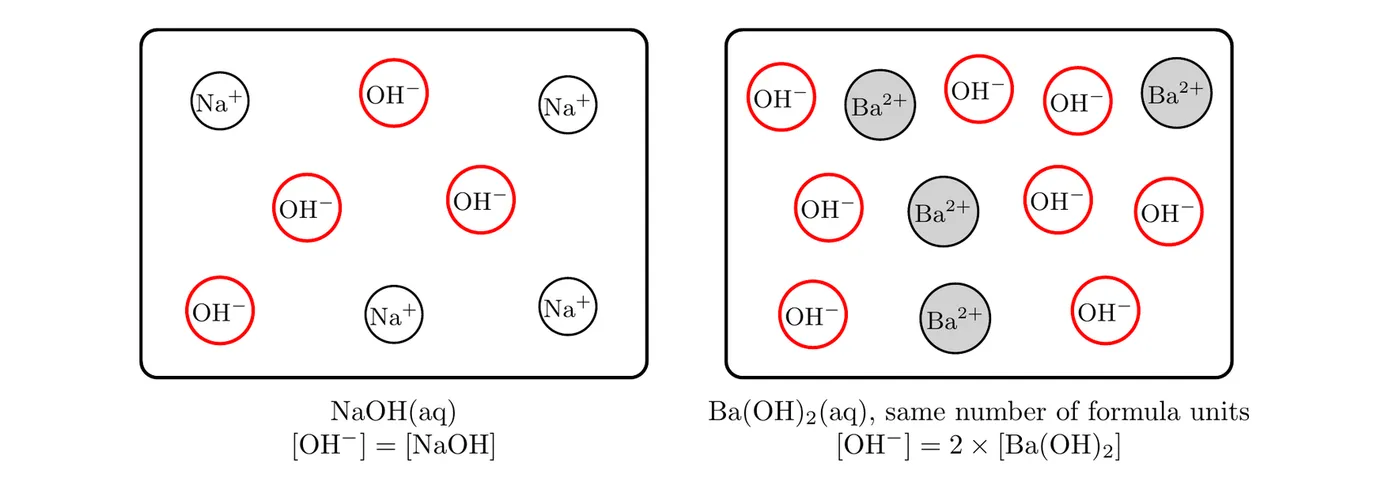
Both boxes started with 4 formula units (water isn't shown). The NaOH box has 4 , but the box has 8. So:
Then find pOH = and pH = 14.00 pOH. doesn't dissolve much, but whatever does dissolve is completely dissociated, so it still counts as a strong base.
Example 2: Barium hydroxide
Find , pOH, pH, and in 0.00750 M at 25 °C.
Step 1: Each gives 2 .
Step 2: Take the log, then use pH + pOH = 14.00.
Step 3: Find from .
Answer: M, pOH = 1.824, pH = 12.18, and M. Forgetting the 2 would give pH 11.88, which is wrong.
Example 3: Starting from a mass (AP-style)
A student dissolves 0.350 g of KOH ( = 56.11 g/mol) in enough water to make 250.0 mL of solution at 25 °C. (a) Calculate the pH. (b) What concentration of would have the same pH? (c) The student dilutes 10.00 mL of the KOH solution to 100.0 mL. Predict the new pH and justify it without a full calculation.
(a) Convert grams to moles, then divide by liters.
(b) Same pH means the same , 0.0250 M. Each gives two , so it takes half as much: M.
(c) Going from 10.00 mL to 100.0 mL is a tenfold dilution, so drops by a factor of 10 to 0.00250 M. A factor of 10 is one log unit, so pOH rises by 1 and pH falls by 1, to 11.40.
Summary of strong acid and base solutions
Solution (concentration ) | Major species | Ion concentration |
Strong monoprotic acid, like | , , | = |
Group 1 hydroxide, like NaOH | , , | = |
Group 2 hydroxide, like | , , | = |
Common mistakes
- Forgetting the 2 for group 2 hydroxides. and give two per formula unit.
- Reporting pOH as pH. For a base you usually find pOH first. Finish with pH = 14.00 pOH.
- Calling HF a strong acid. HF is weak, even though HCl, HBr, and HI are strong.
- Doubling for . Only the first proton ionizes completely.
- Making an acid solution basic. M HCl doesn't have pH 8. That's less acid than water's own M of , so the pH is just under 7 (about 6.98). Adding acid can never make a solution basic.
- Confusing strong with concentrated. "Strong" means it ionizes completely. A very dilute HCl solution is still a strong acid.