

8.8 - Properties of Buffers
Overview
A buffer is a solution that resists changes in pH when a small amount of strong acid or strong base is added. Your blood is buffered, staying between pH 7.35 and 7.45, and so are many medicines, shampoos, and lab solutions. This topic explains what a buffer contains and the reactions that let it hold its pH steady.
What's in a buffer
A buffer contains large concentrations of both members of a conjugate acid-base pair:
- a weak acid and its conjugate base, like and (made by mixing acetic acid with sodium acetate), or
- a weak base and its conjugate acid, like and (made by mixing ammonia with ammonium chloride).
Large means two things: the amounts of the acid and the base are comparable, and both are much bigger than the amount of strong acid or base that will be added.
You can also make a buffer by partly neutralizing a weak acid with a strong base (Topic 8.4). Mixing 0.20 mol of with 0.10 mol of NaOH turns half of the acid into acetate, leaving 0.10 mol of each. That's the buffer region of a weak acid titration curve (Topic 8.5).
Is it a buffer?
Mixture | Buffer? | Why |
and | Yes | A weak acid and its conjugate base |
and | Yes | A weak base and its conjugate acid |
and | Yes | is the acid and is its conjugate base |
HCl and NaCl | No | HCl is a strong acid, and is too weak a base to react with added acid |
alone | No | Plenty of acid, but almost no |
and | No | isn't the conjugate base of ( is) |
How a buffer handles added base
When a strong base is added, the weak acid in the buffer reacts with the :
This reaction goes essentially to completion (its ), so the strong base is used up. In its place you get more , a far weaker base than . That's why the pH rises only a little.
How a buffer handles added acid
When a strong acid is added, the conjugate base in the buffer reacts with the :
This also goes essentially to completion (). The strong acid is used up and replaced by , a weak acid that barely ionizes, so the pH drops only a little.
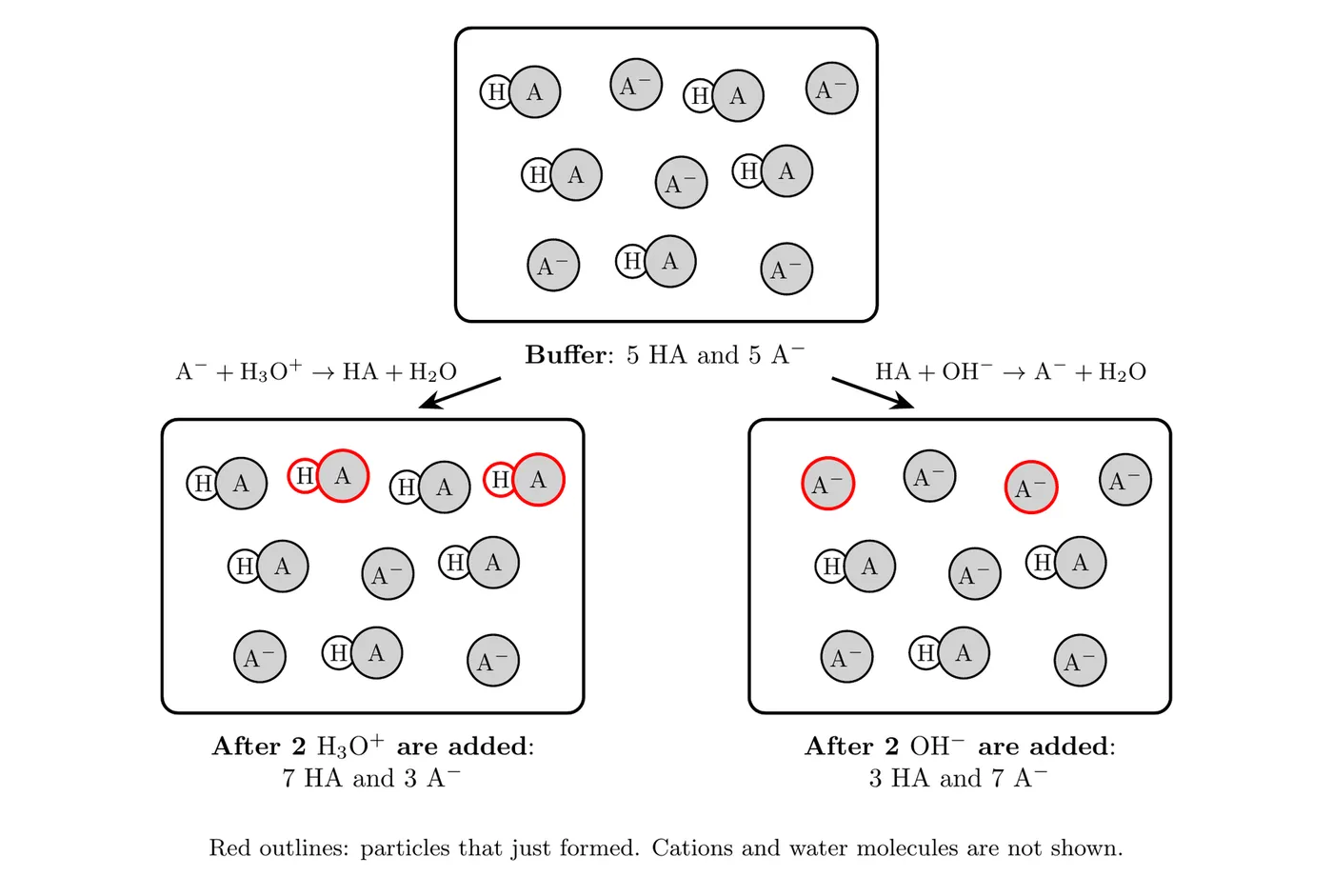
Each added turns one into HA, and each added turns one HA into . The added ions don't stay in solution, and the total number of HA plus stays at 10. One member of the pair is used up and the other is made.
Why the pH barely changes
The pH of a buffer depends on the ratio (Topic 8.7, and Topic 8.9 turns this into the Henderson-Hasselbalch equation). A small amount of added acid or base changes each amount only a little, so the ratio, and the pH, change only a little.
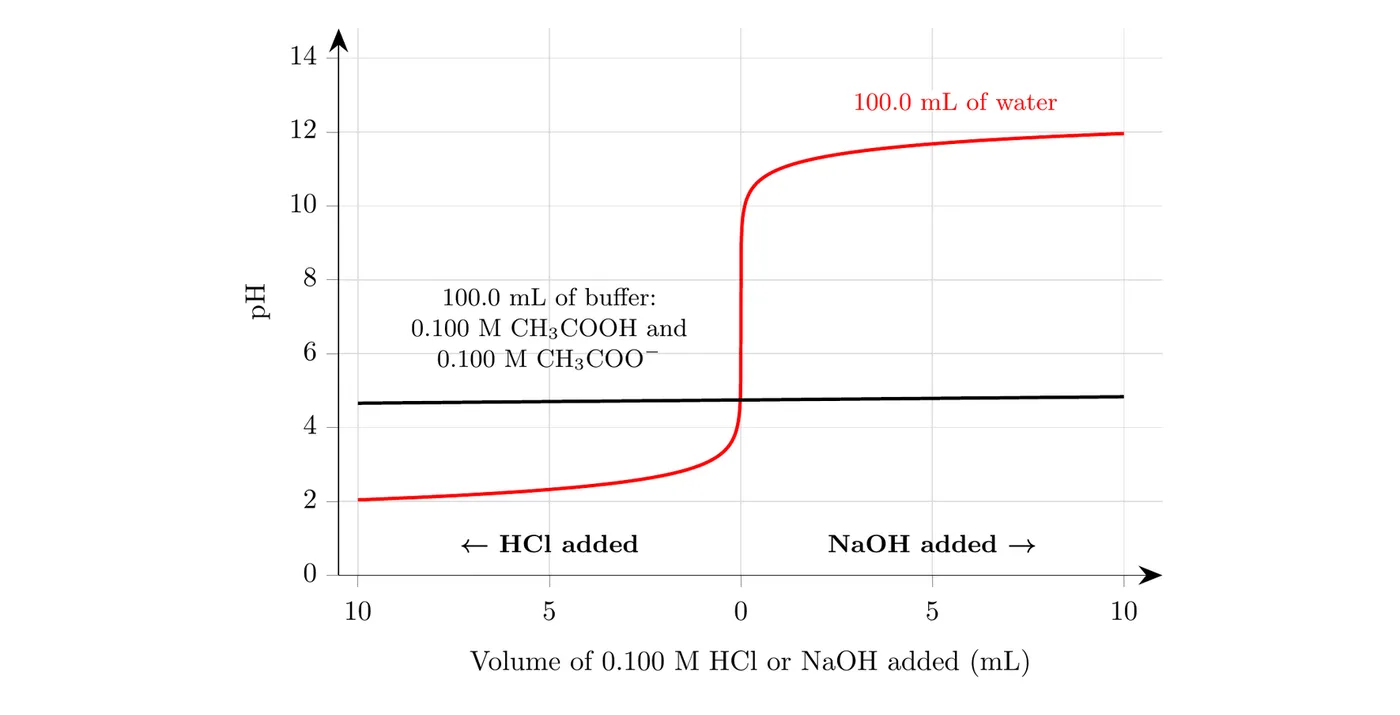
Adding 10.0 mL of 0.100 M NaOH ( mol) to 100.0 mL of pure water raises the pH from 7.00 to 11.96. Adding the same NaOH to 100.0 mL of a buffer that is 0.100 M in both and raises the pH only from 4.74 to 4.83. In the buffer, the amounts of acid and base just shift from 10.0 mmol and 10.0 mmol to 9.0 mmol and 11.0 mmol.
The AP exam won't ask you to calculate the change in pH when an acid or a base is added to a buffer. It can ask you to explain why the change is small, using the reactions above.
A buffer has limits. If you add more strong base than there is weak acid, the weak acid runs out, the extra stays in solution, and the pH shoots up. How much acid or base a buffer can absorb is its buffer capacity (Topic 8.10).
Example 1: Writing buffer reactions
A buffer is made from and . Write the net ionic equation for the reaction that occurs when (a) HCl is added and (b) NaOH is added.
(a) The base in the pair, , reacts with the added :
(b) The acid in the pair, , reacts with the added :
HCl and NaOH are written as and because they're fully ionized. and are spectator ions, so they don't appear.
Example 2: Tracking moles in a buffer
A 1.00 L buffer contains 0.200 mol and 0.150 mol . (a) Find the amount of each after 0.020 mol of solid NaOH is added (assume the volume doesn't change). (b) Does the pH go up or down, and by a lot or a little? (c) What happens if 0.250 mol of NaOH is added instead?
(a) The reacts completely with :
Before | 0.200 mol | 0.020 mol | 0.150 mol |
Change | mol | mol | mol |
After | 0.180 mol | 0 | 0.170 mol |
(b) Up, but only a little. The ratio rises from to , and the solution still has plenty of both, so it's still a buffer. (With Topic 8.9's equation, this works out to a pH change from 4.62 to 4.72.)
(c) Now there's more (0.250 mol) than (0.200 mol). All of the acid is used up and 0.050 mol of is left over, so the solution is no longer a buffer. The pH is set by the excess base: M, so pOH = 1.30 and pH = 12.70.
Buffers in the lab and in the body
In the AP lab on buffering in household products, you test solutions by adding drops of strong acid or base and tracking the pH. A product whose pH stays nearly steady contains a conjugate acid-base pair, often citric acid and citrate or a phosphate pair.
Blood is held near pH 7.4 mainly by the carbonic acid and hydrogen carbonate pair. Extra acid reacts with , and extra base reacts with :
Example 3: Which solution is a buffer? (AP-style)
A student adds 2.0 mL of 0.10 M HCl to a 25.0 mL portion of each solution below, and 2.0 mL of 0.10 M NaOH to a second 25.0 mL portion. The pH readings are:
Solution | Starting pH | After HCl | After NaOH |
A: 0.10 M NaCl | 7.00 | 2.13 | 11.87 |
B: 0.10 M and 0.10 M | 7.21 | 7.14 | 7.28 |
(a) Which solution is a buffer? Justify your answer with the data. (b) Write the net ionic equations for the reactions in solution B when HCl is added and when NaOH is added. (c) Explain why the pH of solution A changed so much. (d) A classmate says solution B's pH barely changed because no reaction happened. Explain what's wrong with that claim.
(a) Solution B. Its pH changed by only 0.07 units in each direction, while solution A's changed by almost 5 units.
(b) With added acid, the base of the pair reacts. With added base, the acid of the pair reacts:
(c) and don't react with or . is the conjugate base of a strong acid, so it's far too weak a base to accept a proton. The added or stays in solution and changes the pH directly.
(d) A reaction did happen: the added was used up by , and the added by , as in part (b). The pH stayed steady because each strong acid or base was replaced by a weak one, and the ratio changed only slightly.
Common mistakes
- Thinking a buffer keeps the pH from changing at all. The pH still changes, just by much less than it would without the buffer.
- Calling a strong acid and its salt a buffer. HCl with NaCl isn't a buffer, because can't react with added acid.
- Pairing the wrong partners. Added acid reacts with the base of the pair, and added base reacts with the acid of the pair.
- Leaving the added ions in solution. While the buffer lasts, the added or is used up. Write single arrows for these reactions, because they go essentially to completion.
- Forgetting that both parts must be present. A weak acid by itself, or its salt by itself, isn't a buffer.