

9.10 - Cell Potential Under Nonstandard Conditions
Overview
Standard cell potentials assume every solution is exactly 1 M. Real batteries almost never are, and their concentrations change as they run. This topic explains how the cell potential responds: the farther a cell is from equilibrium, the bigger its voltage, and at equilibrium the voltage is zero. You'll reason by comparing to , and by reading the Nernst equation qualitatively, not with Le Châtelier's principle.
Cell potential depends on concentration
Away from standard conditions, the cell potential is written (or ), without the degree sign. Its value depends on the concentrations of the dissolved species, and the pressures of any gases, that take part in the reaction.
Think of the cell potential as the driving force toward equilibrium. A cell makes a voltage only because its reaction hasn't reached equilibrium yet. The farther from equilibrium it is, the larger the magnitude (absolute value) of the cell potential.
To measure how far a reaction is from equilibrium, compare the reaction quotient with (Unit 7). has the same form as but uses the concentrations right now. For the iron and nickel cell used on this page:
Solids, including the electrodes, never appear in . That's why the size of an electrode doesn't affect the voltage.
Standard conditions mean Q = 1
At standard conditions every concentration is 1 M, so and the cell potential is . Everything else is measured from that starting point:
- As the cell runs, moves toward , and the magnitude of shrinks.
- When , the reaction is at equilibrium and .
- If the concentrations put farther from than 1 is, the cell is farther from equilibrium than at standard conditions, so the magnitude of is larger than that of .
- If the concentrations put closer to than 1 is, the cell is closer to equilibrium, so the magnitude of is smaller than that of .
For a galvanic cell (, so ), that becomes a simple rule: if , then ; if , then , and stays positive as long as .
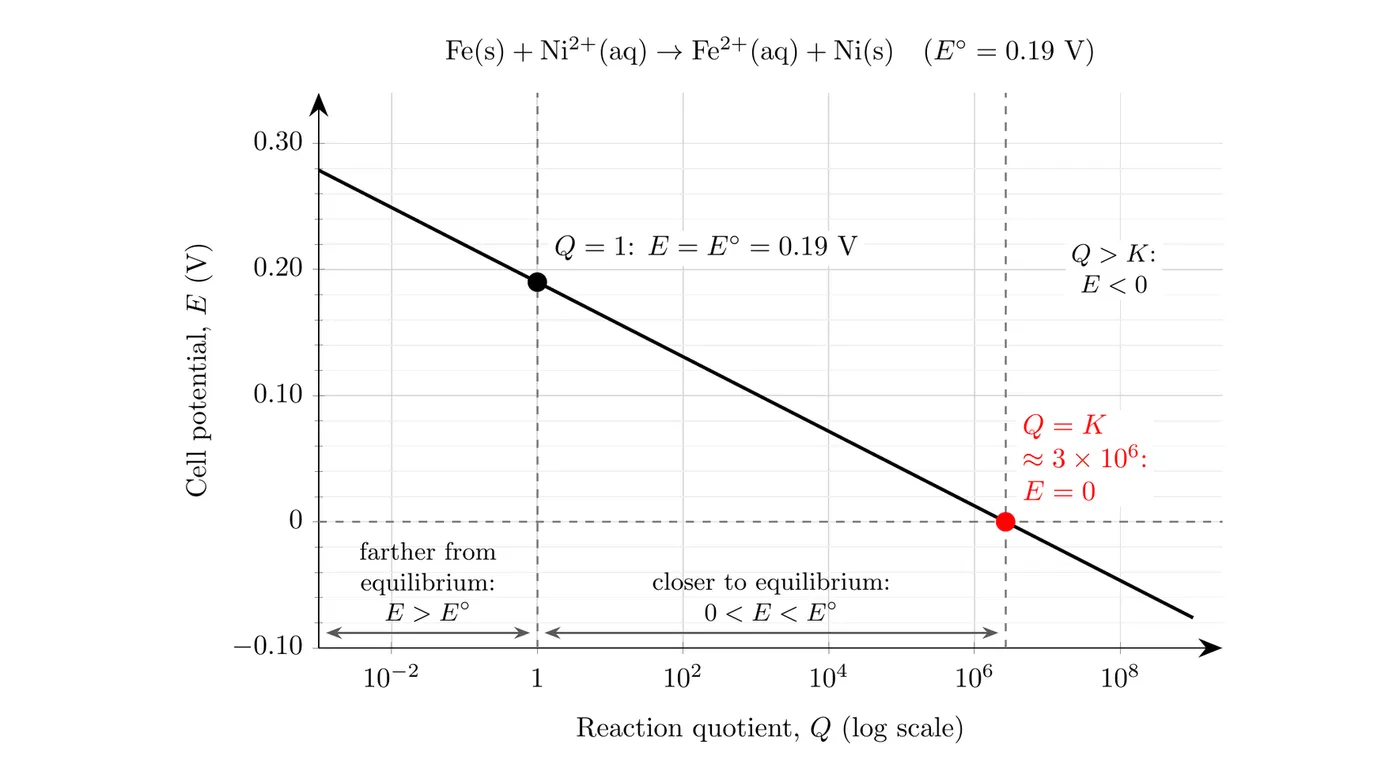
The graph shows the iron and nickel cell, which has V and . Plotted against on a log scale, falls in a straight line. It equals at , reaches zero at , and goes negative past , where the reverse reaction is favored.
In the lab, you can test this by building the same cell at several concentrations and measuring with a voltmeter each time. The points fall close to a line like this one.
Example 1: Reading the graph
For the iron and nickel cell, predict whether is above or below 0.19 V, then estimate from the graph.
(a) M and M. (b) M and M.
(a) . That's less than 1, so is even farther from than at standard conditions. The cell is farther from equilibrium, so . At on the graph, V.
(b) . That's greater than 1 but still far below , so the cell is closer to equilibrium than at standard conditions but not there yet: . At on the graph, V.
Answer: (a) about 0.25 V, higher than . (b) About 0.13 V, lower than but still positive, so the reaction is still favored.
Why a battery dies
As a galvanic cell runs, it uses up reactants and makes products. In the iron and nickel cell, falls and rises, so climbs toward and the voltage drops. When , the reaction is at equilibrium: there's no driving force left, and . That's a dead battery. It hasn't run out of chemicals; it has reached equilibrium.
Why Le Châtelier's principle doesn't apply
Le Châtelier's principle describes how a system at equilibrium responds when it's disturbed. A working electrochemical cell is not at equilibrium (if it were, its voltage would be zero). So on the AP exam, don't explain a voltage change by saying the equilibrium shifts. Use this chain of reasoning instead:
- Say how the change affects : which concentration in went up or down?
- Compare the new with : is the cell now farther from or closer to equilibrium?
- Conclude how the magnitude of changes: larger when farther, smaller when closer.
The Nernst equation, used qualitatively
The AP reference sheet gives the Nernst equation, which shows exactly how depends on :
The AP exam cares about reasoning with this equation more than plugging numbers into it. Since is always positive, everything depends on the sign of :
So is | ||
Less than 1 | Negative | Greater than (subtracting a negative number) |
Equal to 1 | Zero | Equal to |
Greater than 1 | Positive | Less than |
At equilibrium, and , so the equation becomes , the same link between and from Topic 9.9.
It also shows how small the effect usually is. At 25 °C, changing by a factor of 10 changes by only V. Concentrations nudge the voltage by hundredths of a volt; the choice of half-reactions sets most of it.
Example 2: Changing the concentrations in a cell (AP-style)
An iron and nickel galvanic cell starts at standard conditions, with V. For each change, predict whether the measured cell potential increases, decreases, or stays the same, and justify your answer.
(a) Solid is dissolved in the half-cell. (b) The half-cell is diluted with distilled water. (c) The iron electrode is replaced with a larger iron electrode.
(a) Increases. . Raising makes smaller than 1, which is farther from . The cell is farther from equilibrium, so rises above 0.19 V.
(b) Decreases. Diluting lowers , so becomes greater than 1, closer to . The cell is closer to equilibrium, so drops below 0.19 V. The number of ions didn't change, but concentration is what goes into .
(c) Stays the same. Fe(s) is a solid, so it isn't in . A bigger electrode lets the cell run longer, but it doesn't change the voltage.
Concentration cells
A concentration cell has the same half-reaction on both sides; only the concentrations differ. Here, two copper electrodes sit in 0.010 M and 1.0 M :
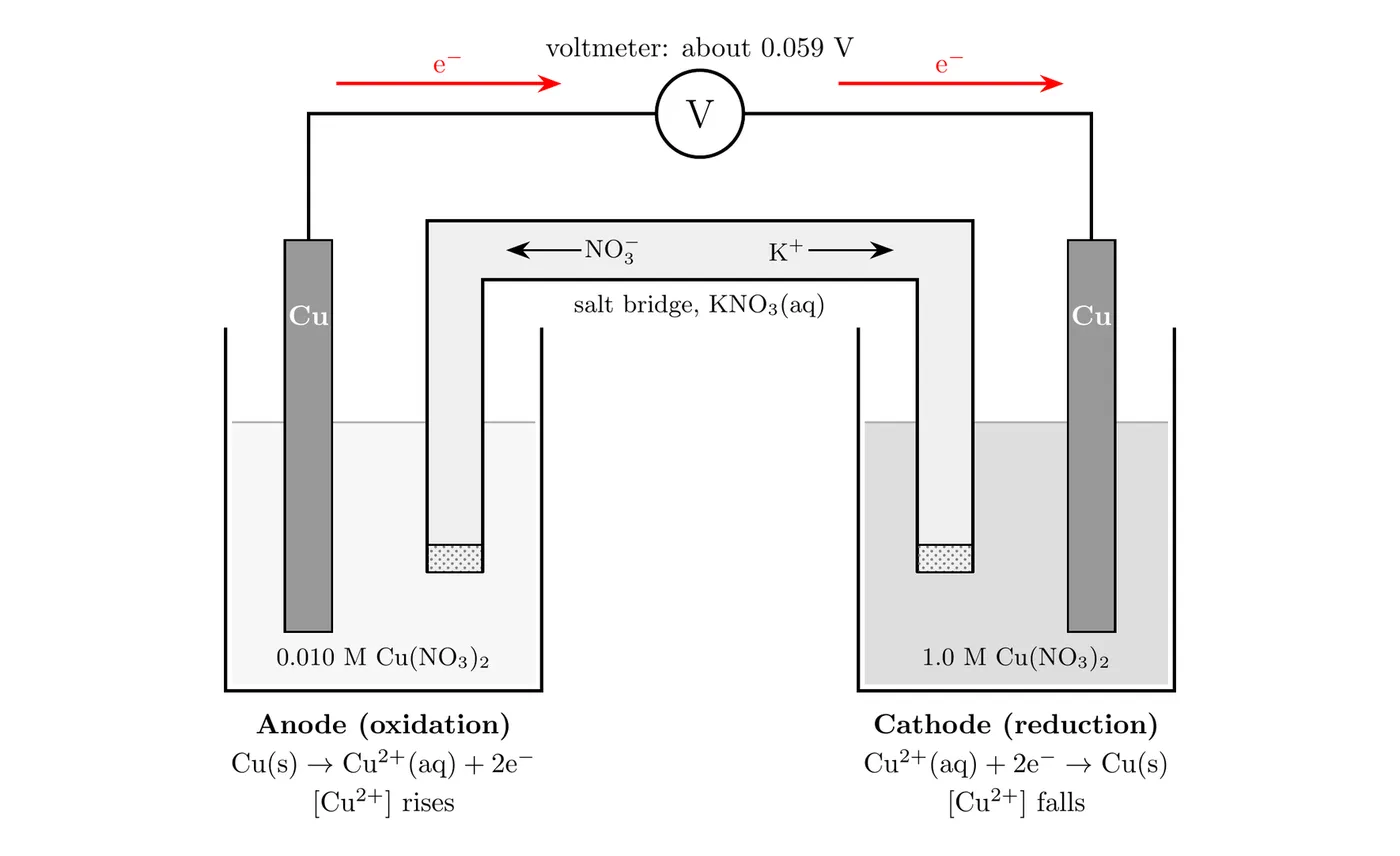
Since both half-reactions are the same, . The cell makes a voltage anyway, because unequal concentrations mean it isn't at equilibrium. Equilibrium is reached when both concentrations are equal ().
To find which way electrons flow, ask what has to happen to reach equilibrium: the concentrations must even out.
- On the dilute side, Cu is oxidized to , which raises that concentration. This electrode is the anode.
- On the concentrated side, is reduced to Cu, which lowers that concentration. This electrode is the cathode.
- Electrons flow through the wire from the dilute side to the concentrated side.
The net change just moves from the concentrated solution to the dilute one:
is less than , so and the process is favored. As the cell runs, the two concentrations approach each other, rises toward 1, and falls toward 0. (For scale, the Nernst equation gives about 0.059 V for this cell at the start.)
Example 3: A silver concentration cell (AP-style)
One half-cell has a silver wire in 0.50 M , and the other has a silver wire in 0.0050 M . The solutions have equal volumes and are joined by a salt bridge.
(a) Identify the anode and the direction of electron flow. (b) What is , and is positive? (c) Describe what happens to each solution and to the voltage as the cell runs.
(a) The 0.0050 M side is the anode: raises its concentration. The 0.50 M side is the cathode: . Electrons flow through the wire from the dilute side to the concentrated side.
(b) V, because the two half-reactions are identical. But applies only when . Here , which is less than , so is positive. (The Nernst equation gives about 0.12 V. That's twice the copper cell's value for the same , because silver transfers one electron instead of two.)
(c) On the dilute side, rises and the silver wire loses mass. On the concentrated side, falls and silver plates onto the wire. rises toward 1, so decreases, reaching 0 when both solutions are about 0.25 M.
Common mistakes
- Saying "the equilibrium shifts" to explain a voltage change. A working cell isn't at equilibrium. Compare to instead.
- Thinking a dead battery is empty. It's at equilibrium: and .
- Putting solids in . Changing the size or mass of an electrode doesn't change .
- Assuming means no voltage. A concentration cell has , but isn't zero until the concentrations are equal.
- Getting a concentration cell backward. Electrons flow from the dilute side (anode) to the concentrated side (cathode).