

9.1 - Introduction to Entropy
Overview
Entropy, , measures how spread out, or dispersed, the matter and energy in a system are. It explains why some processes happen even though they absorb energy, like ice melting on a warm day. This topic is about predicting the sign of an entropy change, , and comparing how big it is for different processes, using what the particles are doing. Topic 9.2 puts numbers on it, and Topic 9.3 combines entropy with enthalpy to decide whether a process is favored.
What entropy measures
Put a drop of food coloring in a glass of water. It spreads through the whole glass on its own, and it never gathers back into a drop. Spreading out wins because there are vastly more ways to arrange the dye particles through the whole glass than ways to keep them in one small spot. Entropy counts that idea: the more ways the particles and their energy can be arranged, the higher the entropy.
- The entropy change is .
- : matter or energy became more dispersed.
- : matter or energy became less dispersed (more confined).
- Entropy is measured in joules per kelvin, J/K, or per mole. Notice it's joules, not kilojoules. That matters in Topic 9.3.
The AP exam looks for two reasons entropy increases: matter disperses, or energy disperses.
Entropy increases when matter disperses
Phase changes
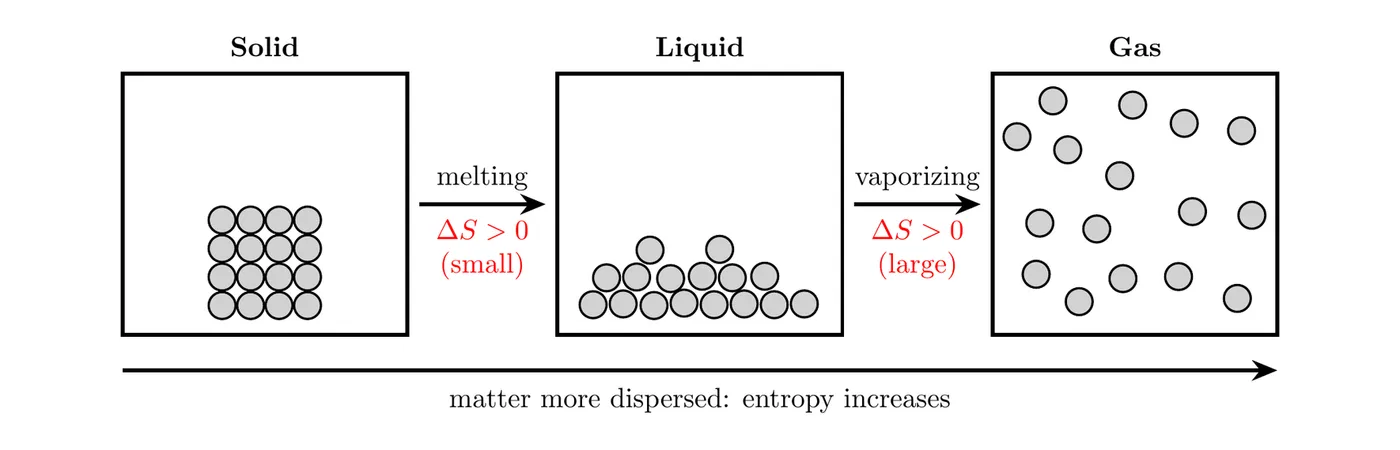
In a solid, particles are locked in place and can only vibrate. In a liquid, they still touch but can slide past each other. In a gas, they are far apart and move freely through the whole container. Each step gives the particles more freedom and more space, so
Melting, vaporization, and sublimation have . The reverse processes (freezing, condensation, deposition) have .
Relative size: the jump from liquid to gas is much bigger than the jump from solid to liquid, because gas particles spread out through a far larger volume. At 25 °C, a mole of water vapor has about 2.7 times the entropy of a mole of liquid water (188.8 vs. 69.9 ).
A gas expanding into a larger volume
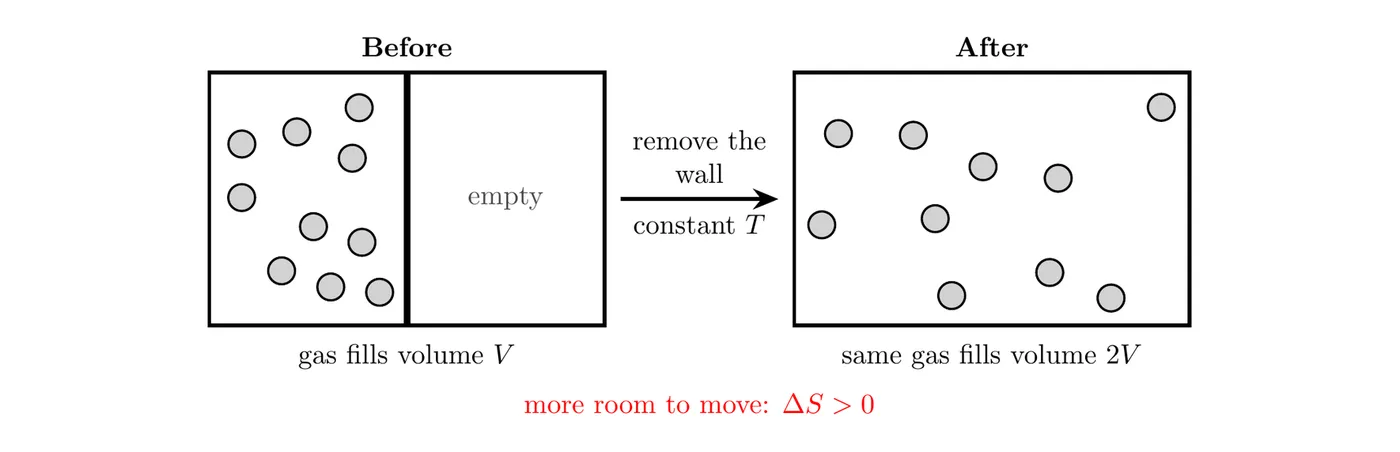
When a gas gets more room at the same temperature, each particle has more places it could be, so the entropy increases. A gas that expands has . A gas that is compressed into a smaller volume has .
Reactions that change the moles of gas
Gases have much more entropy than solids or liquids, so the fastest way to predict the sign of for a reaction is to count moles of gas on each side of the balanced equation:
- More moles of gas in the products: .
- Fewer moles of gas in the products: .
- The same number of moles of gas: is small, and you can't reliably predict its sign without data (Topic 9.2).
Reaction | Moles of gas (reactants → products) | Predicted |
0 → 1 | Positive | |
4 → 2 | Negative | |
2 → 2 | Small; can't tell |
If no gases are involved, use phases: a solid turning into a liquid or a solution usually raises the entropy, but those changes are smaller and less predictable (Topic 9.6 deals with dissolving).
Entropy increases when energy disperses
Kinetic molecular theory (Topic 3.5) says the particles in a sample don't all have the same kinetic energy. They have a distribution of energies. When the temperature goes up, the average kinetic energy rises and the distribution gets broader: the particles' energies are spread over a wider range of values.
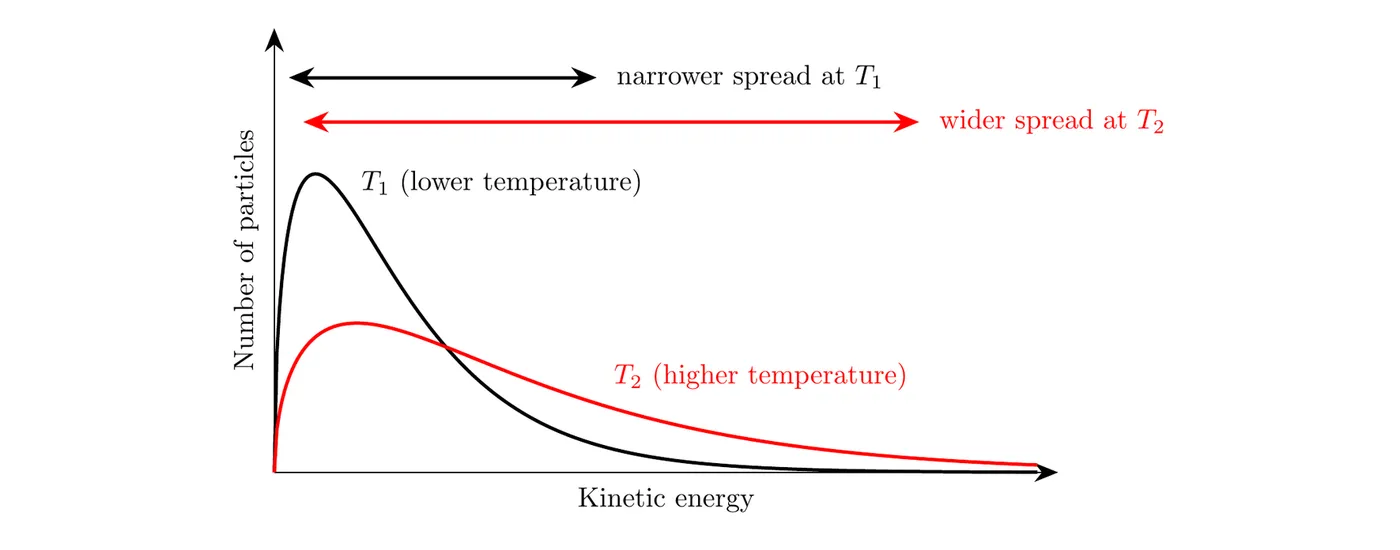
A wider spread means more ways to share the energy among the particles, so the energy is more dispersed and the entropy is higher. So entropy increases as temperature increases, for solids, liquids, and gases alike. Cooling a substance lowers its entropy. This is also why entropy values in tables are always given at a stated temperature, usually 298 K.
Relative size: warming a substance raises its entropy gradually. A phase change, which happens at one temperature, causes a sudden jump (the graph in Topic 9.2 shows both).
Comparing the size of entropy changes
Process | Sign of | Relative size | Reason |
Liquid or solid → gas | + | Large | Particles spread through a much larger volume |
Reaction that increases moles of gas | + | Large | More gas particles moving freely |
Solid → liquid | + | Smaller | Particles gain freedom but stay close together |
Gas expands at constant | + | Moderate | More positions available |
Temperature increases | + | Gradual | Broader distribution of kinetic energy |
Reaction with equal moles of gas | Either | Small | Little change in dispersal |
Every row flips sign if the process runs in reverse.
Example 1: Predicting the sign of ΔS
Predict the sign of for each process and give a reason.
- (sublimation of iodine)
- Positive. A solid becomes a gas, so the particles spread through a much larger volume. This is a large increase.
- Steam condensing on a cold window,
- Negative. Gas particles become a liquid, where they are packed close together.
- (burning propane)
- Negative. Six moles of gas (1 + 5) become three. The water forms as a liquid, so it doesn't count.
- Positive. A solid produces two moles of gas from zero.
- A sealed, rigid tank of argon is heated from 300 K to 400 K.
- Positive. The volume doesn't change, but the higher temperature broadens the distribution of kinetic energies, so the energy is more dispersed.
- Air is pumped into a bike tire, squeezing it into a smaller volume at constant temperature.
- Negative. The same gas particles have less room to move.
Example 2: Supporting a claim with a particle diagram (AP-style)
The diagram shows the contents of a rigid container before and after a reaction between carbon monoxide and oxygen. The temperature is the same in both views.
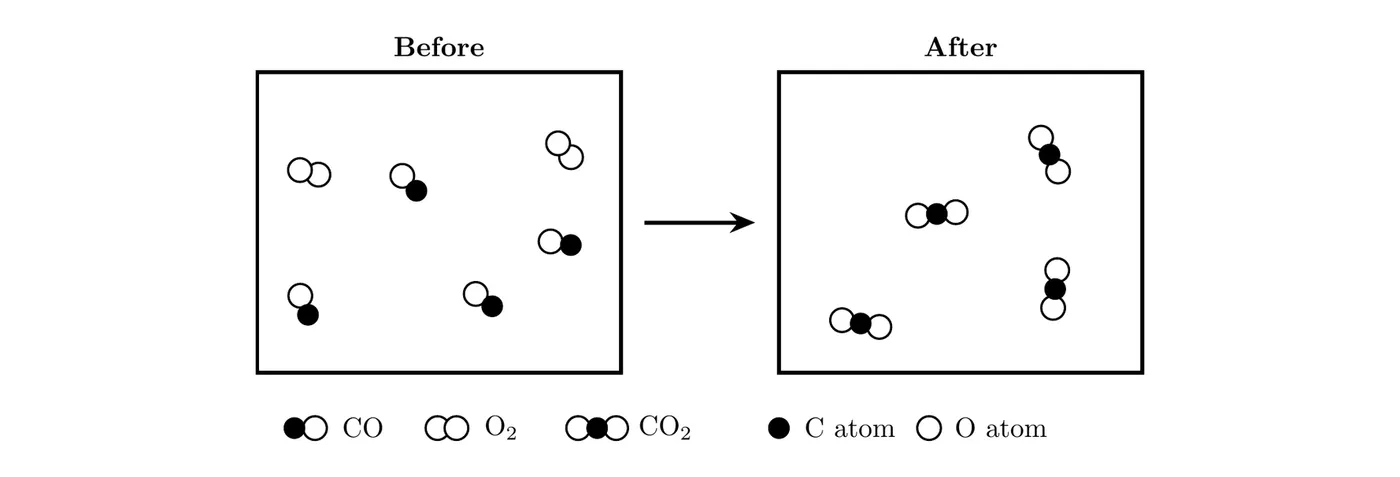
(a) Write the balanced equation for the reaction. (b) A student claims that the entropy of the system decreases. Use the diagram to support or refute the claim. (c) The container is then heated. What happens to the entropy of the gas? Explain.
(a) Before: 4 and 2 molecules. After: 4 molecules. Every atom is accounted for (4 C and 8 O in both views), and the smallest whole-number ratio is 2:1:2:
(b) The claim is supported. The diagram shows 6 gas molecules before and only 4 after. All of them are gases, so the number of independent gas particles drops (3 moles of gas become 2 in the equation). Fewer particles moving freely means fewer ways to arrange the matter, so .
(c) The entropy increases. At a higher temperature, the distribution of kinetic energies among the molecules gets broader, so the energy is more dispersed.
Common mistakes
- Explaining with the word "disorder" alone. Give a specific reason: the particles are freer to move, have more volume, there are more moles of gas, or the energy distribution is broader.
- Counting all moles instead of moles of gas. In , the total moles drop from 3 to 2, but the moles of gas rise from 1 to 2, so .
- Ignoring phase labels. and have very different entropies. Always read the (s), (l), (g), and (aq).
- Thinking means a process will happen. Entropy is only half the story. Water freezes below 0 °C even though . Topic 9.3 shows how enthalpy and entropy combine.
- Forgetting that reversing a process flips the sign of .