

9.7 - Coupled Reactions
Overview
Plenty of useful reactions are thermodynamically unfavored: splitting water into hydrogen and oxygen, turning carbon dioxide into sugar, pulling copper metal out of its ore. They still happen. This topic covers the two ways to make them happen: supply energy from outside, or couple the unfavored reaction to a favored one so the overall is negative.
Driving a reaction with outside energy
A process with won't make much product on its own (). An external source of energy can push it anyway. Under standard conditions, the minimum energy you have to supply is .
Electrical energy
In an electrolytic cell (Topic 9.8), a power supply pushes electrons through a circuit to drive an unfavored redox reaction. The electrolysis of water is one example:
Charging a battery works the same way. When a battery powers your phone, a favored redox reaction pushes electrons through the circuit. The charger forces that reaction to run backward, storing energy that the battery can release later.
Light
In photosynthesis, plants turn carbon dioxide and water into glucose:
is hugely positive. The energy comes from sunlight: chlorophyll absorbs light, and that energy drives a long chain of reactions that ends in glucose. The reverse, breaking glucose down to and water in respiration, is the favored direction.
Example 1: The minimum energy to make hydrogen
Hydrogen fuel can be made by electrolysis of water. What is the minimum energy needed to make 1.00 kg of at 25 °C? For , kJ/mol.
Step 1: Energy per mole of . The reaction above has and makes 2 mol , so each mole of needs 237.1 kJ.
Step 2: Moles of , with g/mol:
Step 3: Multiply:
Answer: at least kJ (about 118 MJ, or 33 kWh). Real electrolyzers need more than this, because some of the electrical energy is always lost as heat.
Coupled reactions
The other strategy is to pair the unfavored reaction with a favored one. When reactions add, their values add, the same way values do in Hess's law (Topic 6.9). So the overall reaction can have even though one of its pieces doesn't.
Coupled reactions share one or more common intermediates: species made by one reaction and used up by the other. When you add the equations, the common intermediates cancel, and what's left is the overall reaction you want. Since values add, the equilibrium constants multiply (Topic 7.6):
ATP in living cells
Cells run on coupled reactions. The favored partner is usually the breakdown of ATP (adenosine triphosphate) into ADP (adenosine diphosphate) and inorganic phosphate, written :
The first step in using glucose for energy attaches a phosphate group to it, making glucose 6-phosphate. On its own, that step is unfavored:
Add the two reactions. and show up on both sides, so they cancel:
(These values are the ones biochemists use, for a standard state at pH 7.)
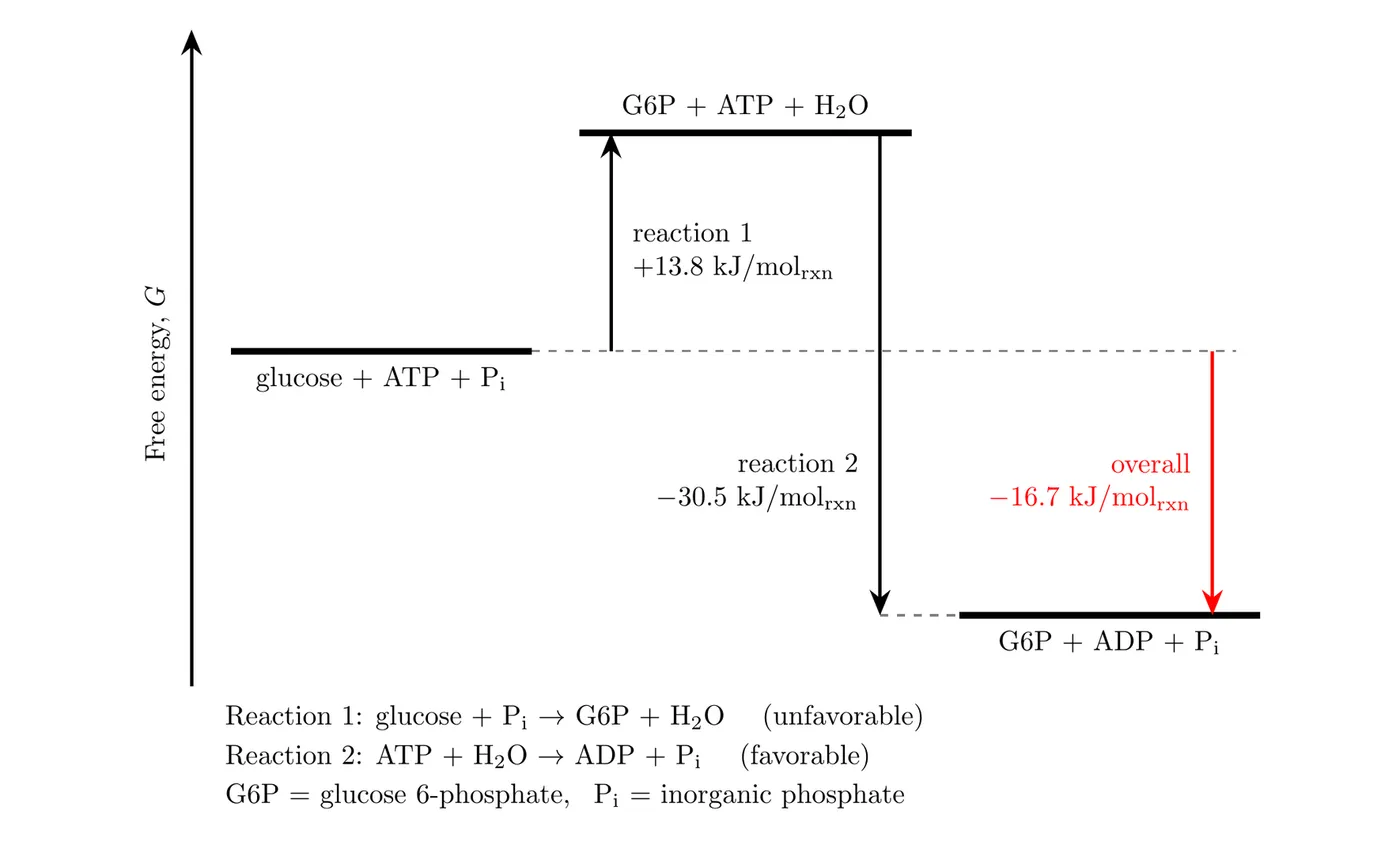
The diagram shows the bookkeeping: up for reaction 1, down for reaction 2, a net drop of . In the cell, an enzyme moves the phosphate group straight from ATP to glucose, so free phosphate never actually forms. Adding the two equations is how you find for that one-step reaction.
The equilibrium constants at 25 °C show what coupling does. On its own, reaction 1 has , so reactants are strongly favored. ATP breakdown has . The coupled reaction has , so products are favored.
Example 2: Copper from its ore
Copper(I) sulfide, , is a common copper ore. Breaking it down is unfavored:
Smelters blow air through the hot ore, which couples that step to the burning of sulfur:
(a) Write the overall reaction and find its . (b) Identify the common intermediate.
(a) Add the two reactions. is made in the first and used in the second, so it cancels:
(b) Sulfur. The overall reaction is strongly favored, which is why heating sulfide ores in air works (and why smelters have to capture the they make).
Example 3: Iron from iron ore (AP-style)
Two reactions at 25 °C:
In a blast furnace, carbon monoxide turns iron(III) oxide into iron:
(a) Show how to combine reactions (1) and (2) to get this reaction, and calculate its . (b) Identify the common intermediate. (c) Calculate at 25 °C. (d) A student says iron can't be made from because reaction (1) is not thermodynamically favored. Explain the flaw in this reasoning.
(a) The target has one , so take of reaction (1). It has three CO, so take of reaction (2). Multiplying a reaction multiplies its by the same number:
(b) is made in the first step and used up in the second, so it cancels. Oxygen is the common intermediate.
(c)
(d) Reaction (1) never has to happen by itself. Coupled with the oxidation of CO, which is strongly favored, the overall reaction has and , so products are favored. (Blast furnaces run hot so the reaction goes at a useful rate, which is a kinetics issue, Topic 9.4.)
Common mistakes
- Saying an unfavored reaction "can't happen." It can, with outside energy or by coupling.
- Adding values without scaling them. Multiply a reaction by a number, and multiply its by the same number. Reverse it, and flip the sign.
- Adding K values. When reactions add, values add but values multiply.
- Leaving the common intermediate in the overall equation. It should cancel.
- Saying energy is stored in ATP's phosphate bond and released when it breaks. Breaking any bond takes energy (Topic 6.7). ATP breakdown is favored because of the whole reaction: the products are lower in free energy than ATP and water.