

9.3 - Gibbs Free Energy and Thermodynamic Favorability
Overview
Some processes release energy and some absorb it. Some increase entropy and some decrease it. To decide whether a process is thermodynamically favored, you need both, and Gibbs free energy, , combines them into one number. The sign of answers the question. The rest of Unit 9 (equilibrium, coupled reactions, and electrochemical cells) builds on this topic.
Standard conditions and ΔG°
is the Gibbs free energy change when every reactant and product is in its standard state:
- pure substances (solids and liquids),
- solutions at 1.0 M concentration,
- gases at a pressure of 1.0 atm (or 1.0 bar).
The degree sign, °, means standard state. Temperature isn't part of the definition, but tables usually list values at 298 K (25 °C). is reported in , per mole of reaction as written.
What "thermodynamically favored" means
Sign of | Meaning |
Thermodynamically favored: products are favored | |
Not favored (the reverse process is favored) |
Older books call a process with spontaneous. The AP exam uses "thermodynamically favored" instead, because "spontaneous" sounds like "sudden" or "without any cause," and neither is true. A favored process can be extremely slow (Topic 9.4), and it may need something to get it started. Use "thermodynamically favored" in your answers. (What means, and how relates to the equilibrium constant, comes in Topic 9.5.)
Calculating ΔG° from free energies of formation
Like enthalpy, free energy can be calculated from tabulated values for each substance, the standard Gibbs free energies of formation, . This equation is on the AP reference sheet:
It works just like from formation enthalpies in Unit 6. Multiply by coefficients, subtract products minus reactants, and remember that for an element in its standard state (unlike ).
Example 1: Burning methane
Calculate at 298 K for the combustion of methane. Use values (in kJ/mol) of for , for , and for .
Step 1: Products. Multiply the water value by 2.
Step 2: Reactants. is an element, so its value is 0.
Step 3: Subtract.
Answer: . It's negative, so the combustion of methane is thermodynamically favored. (A gas stove still needs a spark to light. Topic 9.4 explains why.)
Enthalpy and entropy together
Two tendencies decide whether a process is favored:
- Enthalpy: releasing energy (, exothermic) favors a process.
- Entropy: increasing dispersal () favors a process.
When they agree, the answer is easy. When they compete, you have to consider both. The CED names two everyday cases:
- Water freezing. Freezing is exothermic (the molecules lock into a hydrogen-bonded crystal and release energy, which favors it) but (the molecules lose freedom, which works against it). Below 0 °C enthalpy wins and water freezes. Above 0 °C entropy wins and ice melts.
- Sodium nitrate dissolving. Dissolving is endothermic (the water gets colder, which works against it) but (the ions spread through the solution, which favors it). The salt dissolves readily, so entropy wins. Topic 9.6 works through dissolving in detail.
If you know and at a given temperature, you can calculate directly. This equation is also on the reference sheet:
- is the enthalpy part. A negative value pushes down (more favored).
- is the entropy part. A positive makes this term negative (more favored).
- multiplies , so entropy matters more at high temperature.
Units warning: must be in kelvins. is usually given in , but is in . Divide by 1000 to convert it to kilojoules before you multiply by . This is the most common error on this topic.
As a check, Example 1 gives the same answer this way: for methane combustion, and , so .
Example 2: When does limestone decompose?
For , and (from Topic 9.2). (a) Calculate at 298 K. (b) Above what temperature is the reaction thermodynamically favored?
(a) Step 1: Convert to kilojoules.
Step 2: Substitute.
, so at room temperature the reaction is not favored. That's why limestone buildings don't fall apart into lime and . (The method gives the same .)
(b) Both and are positive, so the reaction becomes favored at high temperature, once is larger than . The switch happens where :
Answer: the reaction is favored above about 1110 K (about 837 °C). Lime kilns run hotter than this, around 900 °C. This assumes and stay about the same as the temperature changes, which the AP exam assumes too.
Example 3: Why water freezes below 0 °C
For , and , or . Is freezing favored at °C (263 K)? At °C (283 K)?
Answer: freezing is favored at 263 K but not at 283 K. Freezing is enthalpy-driven: the negative favors it, and the entropy term works against it. At 0 °C (273.15 K) the two parts cancel, since , so . That's the melting point, where ice and water coexist.
Predicting favorability from the signs
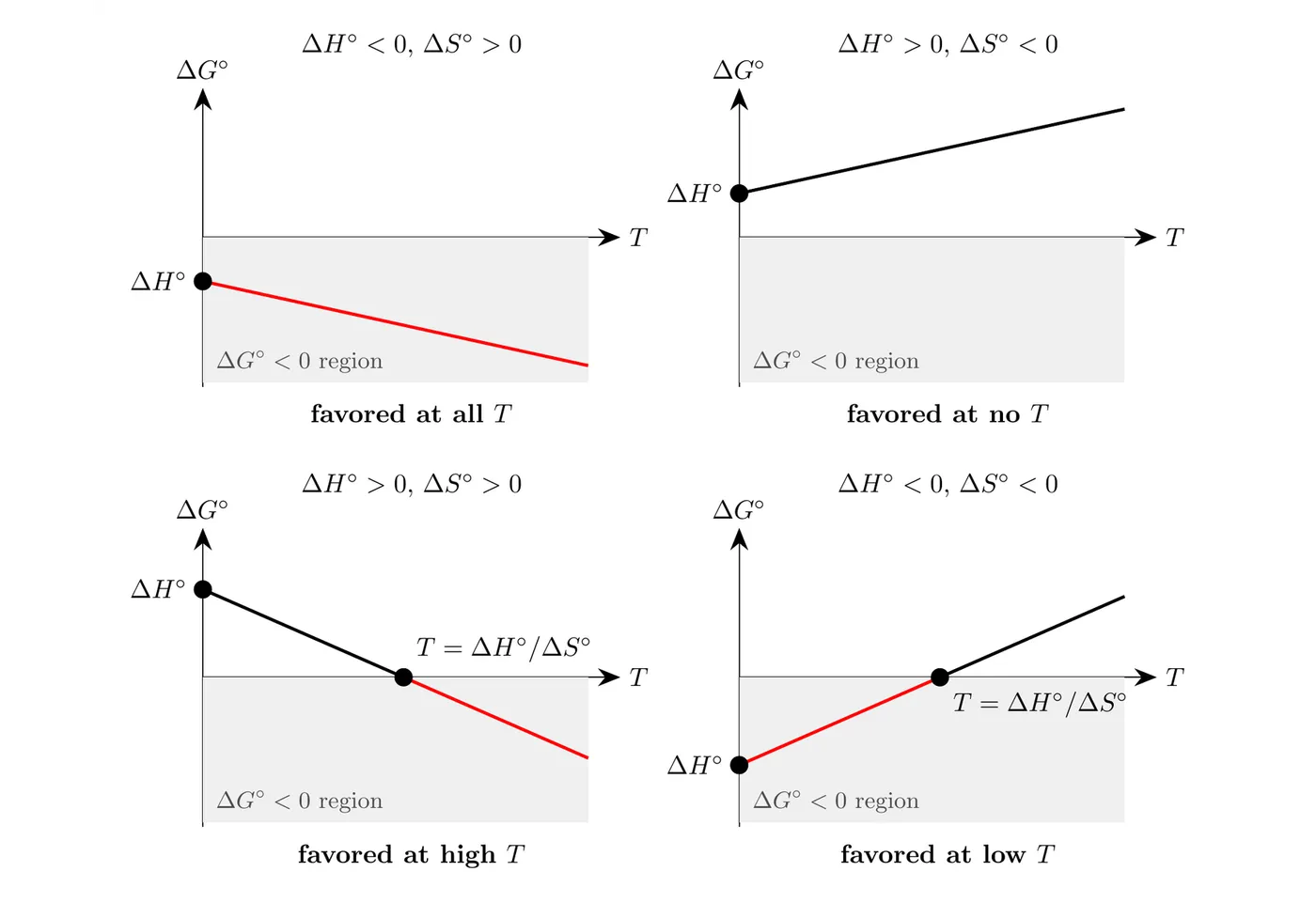
Often you don't need numbers at all. The signs of and tell you when :
Favored () at | Why | ||
All temperatures | Both parts favor the process | ||
No temperature | Both parts work against it | ||
High temperature | Entropy wins once | ||
Low temperature | Enthalpy wins while |
When and , no calculation is needed: the process is favored. When and , no calculation is needed either: it's not favored.
A graph shows why. With and treated as constants, is a straight line: it starts at when , and its slope is . The process is favored wherever the line is below the -axis (red). In the two mixed cases, the line crosses zero at .
Which factor drives the process?
The AP exam often asks whether a favored process is driven by enthalpy, entropy, or both. Use the signs:
Favored process with | Driven by | Examples |
, | Enthalpy (entropy works against it) | Freezing, condensation, making at room temperature |
, | Entropy (enthalpy works against it) | Dissolving , ice melting above 0 °C, limestone above 1110 K |
, | Both | Many combustion reactions that make more gas |
Don't just say "both" because both appear in . If one of them has the unfavorable sign, it is working against the process. Connect the signs to evidence too: if a reaction mixture gets colder, it is endothermic, so if it still happens, entropy must be driving it. If a gas forms from solids or liquids, .
Example 4: Making ammonia (AP-style)
For this reaction, and . (a) Explain the sign of in terms of the particles. (b) Calculate at 298 K and state whether the reaction is thermodynamically favored. (c) Is the reaction driven by enthalpy, entropy, or both? Justify. (d) A student claims that because , the reaction is still thermodynamically favored at 725 K. Do you agree? Justify with a calculation.
(a) Four moles of gas (1 + 3 ) become two moles of gas. With fewer gas particles moving independently, the matter is less dispersed, so .
(b) Convert to , then substitute:
, so the reaction is thermodynamically favored at 298 K.
(c) Enthalpy. favors the reaction. works against it, because the entropy term is positive. The reaction is favored only because the enthalpy part is larger in size at this temperature.
(d) Disagree.
At 725 K, outweighs , so and the reaction is not favored. Since both signs are negative, the reaction is favored only at low temperature, below K (about 191 °C). Yet industrial ammonia plants run near 725 K (about 452 °C), with an iron catalyst and very high pressure, because at low temperatures the reaction is far too slow. Topic 9.4 is about exactly this gap between "favored" and "fast."
Common mistakes
- Mixing J and kJ. Convert from J to kJ (divide by 1000) before using . Being off by a factor of 1000 can flip the sign of your answer.
- Using °C instead of K. is always in kelvins.
- Thinking "favored" means "fast." says nothing about rate.
- Saying "both" drive a reaction when one sign is unfavorable. Check each sign separately.
- Treating elements' as nonzero, or their as zero. It's the other way around.
- Dropping signs when subtracting. Write with parentheses, like .