

9.8 - Galvanic (Voltaic) and Electrolytic Cells
Overview
Put a strip of zinc into a copper(II) nitrate solution, and copper starts coating the zinc while the solution warms up. That's a redox reaction (Topic 4.9) releasing its energy as heat. An electrochemical cell separates the oxidation from the reduction, so the electrons have to travel through a wire, where they can do useful work. This topic covers what each part of a cell does, the difference between galvanic and electrolytic cells, and how to read a cell diagram.
Galvanic and electrolytic cells
- A galvanic cell, also called a voltaic cell, runs a thermodynamically favored redox reaction () and turns chemical energy into electrical energy. A battery is a galvanic cell while it powers something.
- An electrolytic cell uses electrical energy from an outside power supply to force a thermodynamically unfavored reaction () to happen (Topic 9.7). Recharging a battery, electroplating, and splitting water into hydrogen and oxygen are all electrolytic.
In every electrochemical cell, galvanic or electrolytic:
- Oxidation happens at the anode.
- Reduction happens at the cathode.
A memory trick: an ox (anode, oxidation) and red cat (reduction, cathode). Some books also label each electrode as positive or negative; the AP exam won't ask you to.
The parts of a galvanic cell
The classic example is the zinc-copper cell:
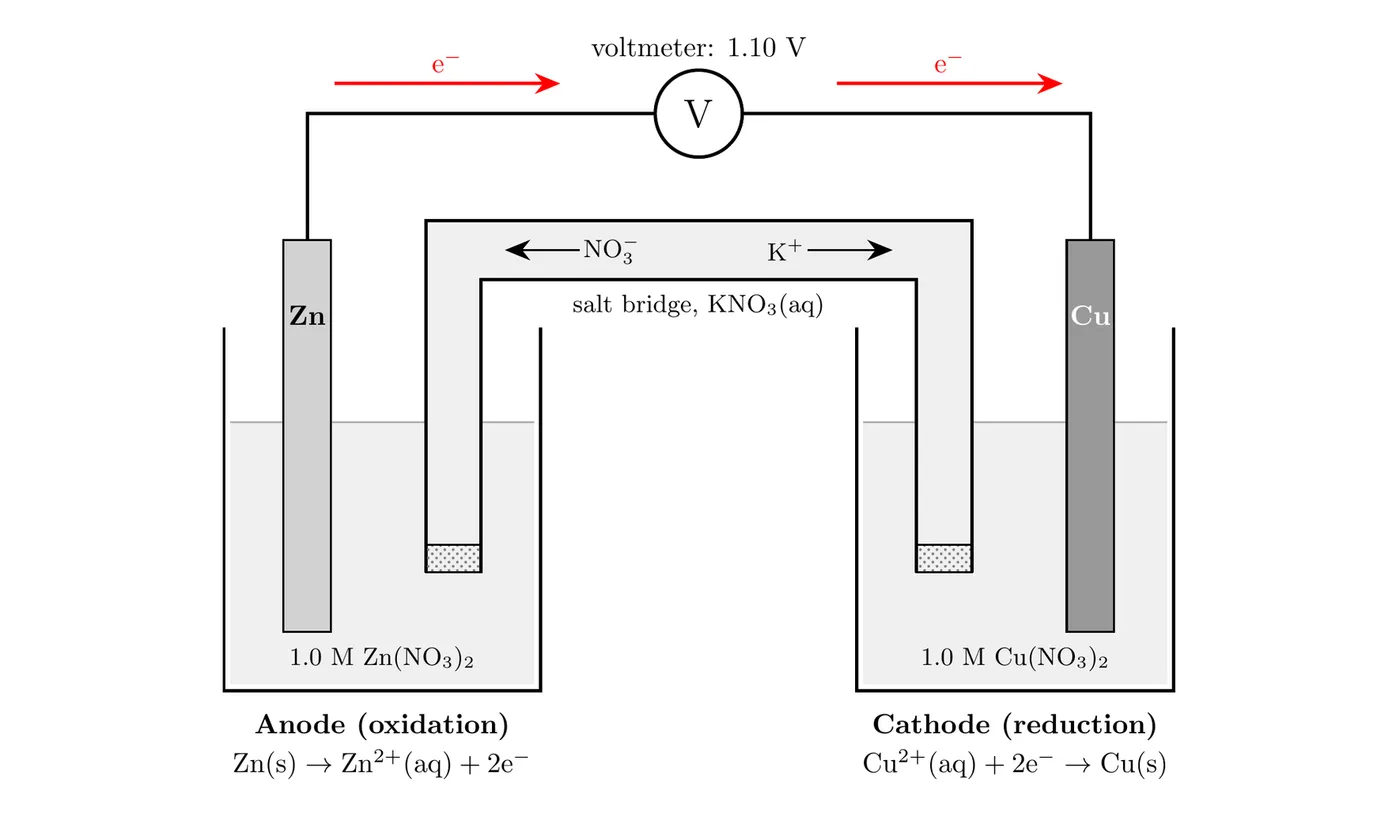
Part | What it does |
Anode (zinc electrode) | Where oxidation happens: . Zinc atoms leave the electrode as ions, and their electrons go into the wire. |
Cathode (copper electrode) | Where reduction happens: . Electrons arrive through the wire, and ions from the solution pick them up and plate onto the electrode as copper metal. |
Solution in each half-cell | Holds the ions for each half-reaction: it supplies at the cathode and takes in the made at the anode. A beaker with its electrode and solution is called a half-cell. |
Wire | Carries electrons from the anode to the cathode. Electrons never travel through the solutions. |
Salt bridge | A tube of a salt solution whose ions don't react, like . Its ions flow into the half-cells to keep each solution electrically neutral, which completes the circuit. |
Voltmeter | Measures the cell potential, the "push" on the electrons, in volts. An ammeter in the same spot would measure the current instead. |
Following the electrons and the ions
Electrons flow through the wire from the anode to the cathode. Inside the cell, ions carry the charge instead:
- As ions form at the anode, that solution starts to build up positive charge. Anions from the salt bridge () flow toward the anode to balance it.
- As ions are used up at the cathode, that solution is left with extra negative charge (the ions that were paired with them). Cations from the salt bridge () flow toward the cathode to balance it.
Without the salt bridge, charge builds up and stops the reaction almost at once: the voltmeter reads zero. If a question asks about current instead of electrons, remember that conventional current is drawn in the opposite direction, from the cathode to the anode in the wire.
What you'd observe
Each thing you can see or measure has a particle-level reason:
Observation | Particle-level reason |
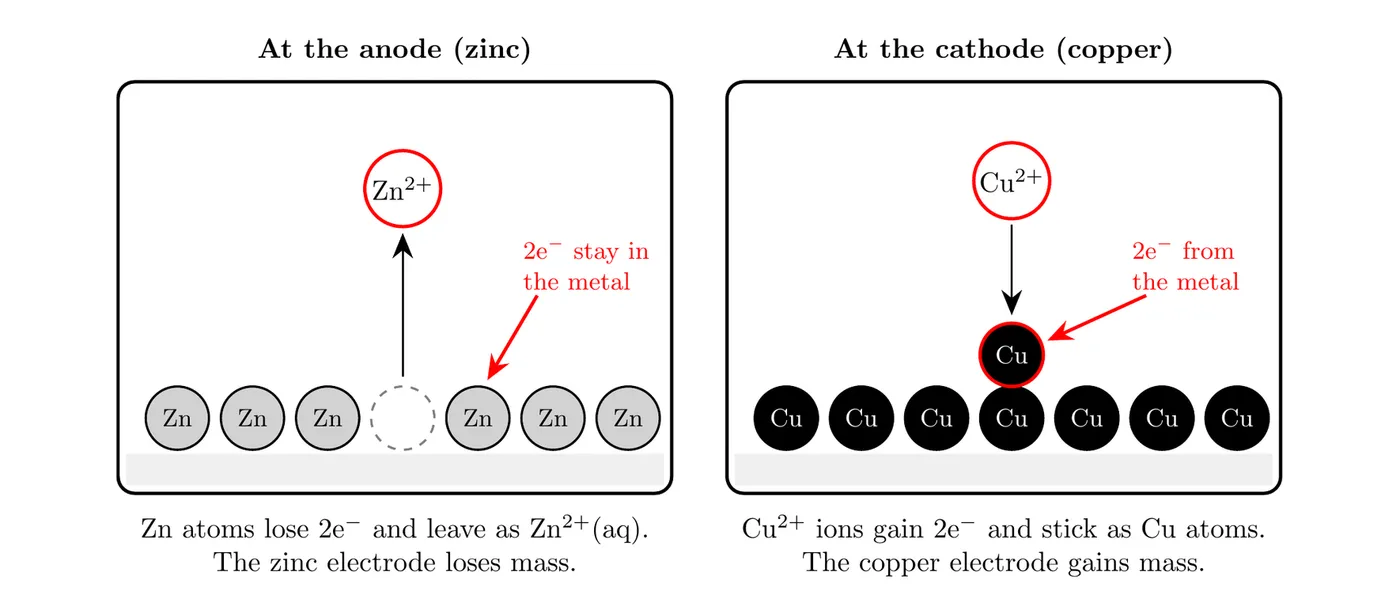
The zinc electrode loses mass | Zn atoms become ions and go into solution |
The copper electrode gains mass | ions become Cu atoms and stick to the electrode |
The blue color of the copper solution fades | drops as the ions are reduced |
rises in the anode half-cell | each Zn atom oxidized adds one ion |
The voltage slowly drops as the cell runs | the reaction moves toward equilibrium (Topic 9.10) |
Inert electrodes and gases. Not every half-reaction has a metal in it. When the reacting species are ions or gases, the cell uses an inert electrode, usually platinum or graphite, which carries electrons but doesn't react. If a half-reaction makes a gas, you'll see bubbles at that electrode. For example, where is the reduction, hydrogen bubbles form on the cathode.
Which electrode is the anode?
In a galvanic cell, the reaction runs in its thermodynamically favored direction. A table of standard reduction potentials tells you which way that is (Topic 9.9 covers these in detail):
- The half-reaction with the more positive runs as written, as a reduction. That electrode is the cathode.
- The other half-reaction runs in reverse, as an oxidation. That electrode is the anode.
For the zinc-copper cell, V for and V for . Copper's is more positive, so copper is the cathode and zinc is the anode. The difference is the cell potential, which is what the voltmeter reads:
A positive means the reaction is thermodynamically favored, which makes it a galvanic cell.
Example 1: A magnesium-zinc cell
A galvanic cell has a magnesium electrode in 1.0 M and a zinc electrode in 1.0 M , joined by a wire and a salt bridge. V for and V for . (a) Identify the anode and cathode, and write each half-reaction. (b) Which way do electrons flow? (c) Which electrode gains mass? (d) Which way do ions in the salt bridge move?
(a) V is more positive than V, so zinc is the cathode and magnesium is the anode.
(b) Through the wire, from the magnesium electrode to the zinc electrode.
(c) The zinc electrode gains mass as ions plate out as zinc metal. The magnesium electrode loses mass.
(d) Toward the zinc half-cell (the cathode), to replace the positive charge lost as is used up. The ions move toward the magnesium half-cell.
( V.) Zinc was the anode next to copper, but next to magnesium it's the cathode. An electrode's role depends on its partner.
Electrolytic cells
Now connect the zinc-copper cell to a power supply that pushes electrons the other way with more than 1.10 V. The reaction runs backward, even though it's unfavored:
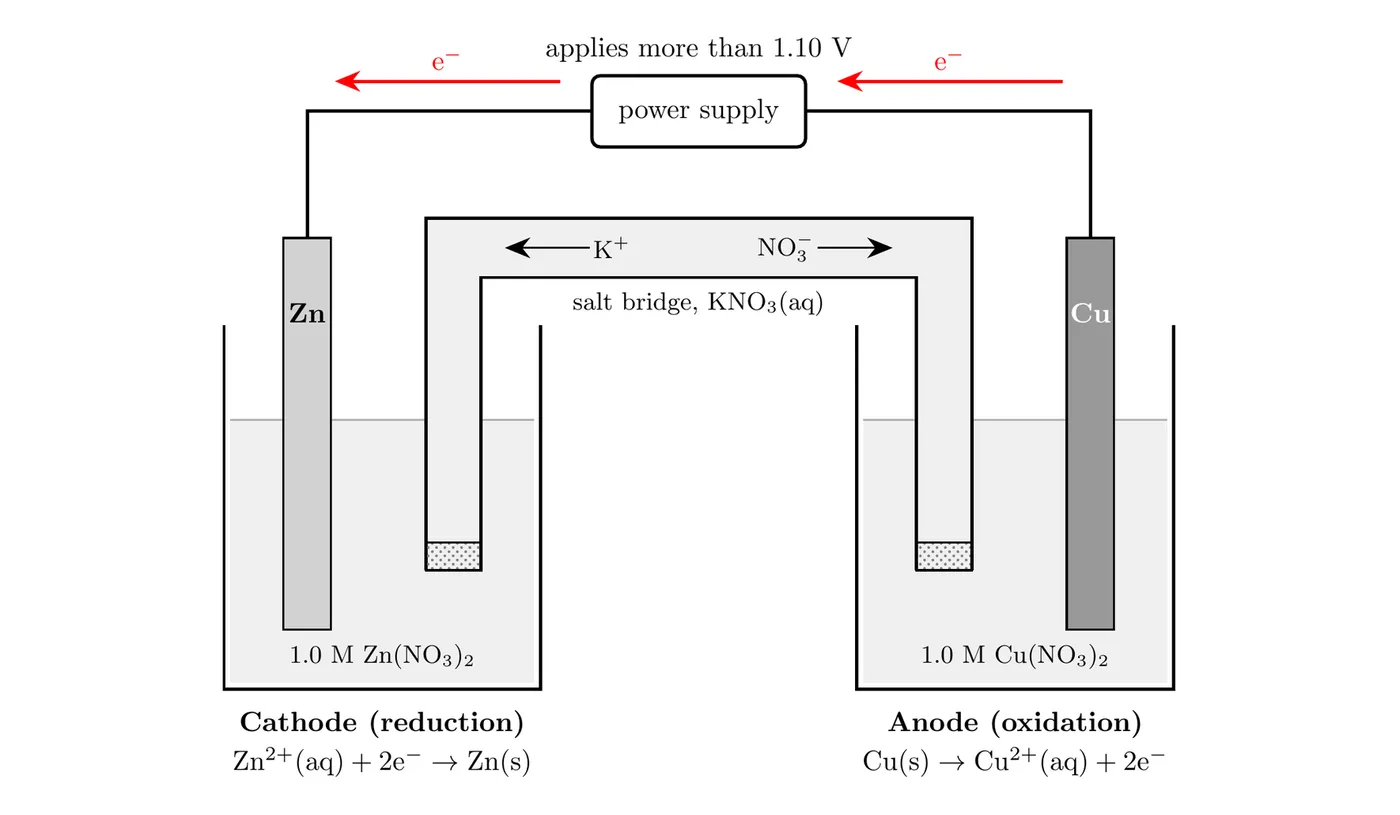
The anode and cathode switch electrodes, but the rule doesn't change: oxidation at the anode, reduction at the cathode. Copper is now oxidized, so the copper electrode is the anode and loses mass. Zinc ions are now reduced, so the zinc electrode is the cathode and gains mass. Electrons still flow from the anode to the cathode in the wire, but now the power supply is pushing them. In the salt bridge, anions still move toward the anode (now the copper half-cell) and cations toward the cathode.
Galvanic (voltaic) cell | Electrolytic cell | |
Reaction | thermodynamically favored () | thermodynamically unfavored () |
Energy change | chemical energy to electrical energy | electrical energy to chemical energy |
In the circuit | a voltmeter, or a device to power | a power supply or battery |
Oxidation | at the anode | at the anode |
Reduction | at the cathode | at the cathode |
Electrons in the wire | anode to cathode, driven by the reaction | anode to cathode, pushed by the power supply |
Examples | a battery powering a phone | charging a battery, electroplating, electrolysis of water |
Example 2: Making sodium metal
Sodium metal is made by passing electricity through molten sodium chloride (melted at about 800 °C) between two inert electrodes. (a) What forms at each electrode? (b) Why does this need a power supply? (c) What would you see at each electrode? (d) Why melt the salt instead of dissolving it in water?
(a) Sodium ions are reduced at the cathode, and chloride ions are oxidized at the anode:
Overall, after doubling the cathode half-reaction so the electrons match:
(b) The reverse reaction, sodium metal burning in chlorine gas, is extremely favored. So breaking NaCl apart has and won't happen on its own. The power supply provides the energy.
(c) Bubbles of yellow-green chlorine gas form at the anode, and liquid sodium metal collects at the cathode.
(d) In water, is much easier to reduce than , so the cathode would make hydrogen gas instead of sodium (Topic 9.11).
Changing the setup
In the AP electrochemistry lab, you build galvanic cells from metals and their salt solutions, measure their voltages, and use a power supply to run an electrolysis. The exam likes to ask how a change in the procedure would change the results. The common ones:
Change | Effect | Why |
Remove the salt bridge | the voltage drops to zero and the reaction stops | ions can't flow, so the circuit is broken and charge can't be balanced |
Use bigger electrodes or more solution | same voltage | the cell potential depends on the reaction and the concentrations, not on amounts; a bigger cell just runs longer |
Swap one metal for a different metal | a different voltage, and the anode and cathode may switch | a different half-reaction has a different |
Put the zinc directly into the solution | no current; the solution warms up | electrons transfer directly, so the energy is released as heat |
Fill the salt bridge with a salt whose ions react with a half-cell solution | a precipitate forms and the cell doesn't work as designed | salt bridge ions must not react with anything in the half-cells (see Example 3) |
Change a concentration | the voltage changes | Topic 9.10 |
Example 3: A copper-silver cell (AP-style)
A student builds the cell below. V for and V for .
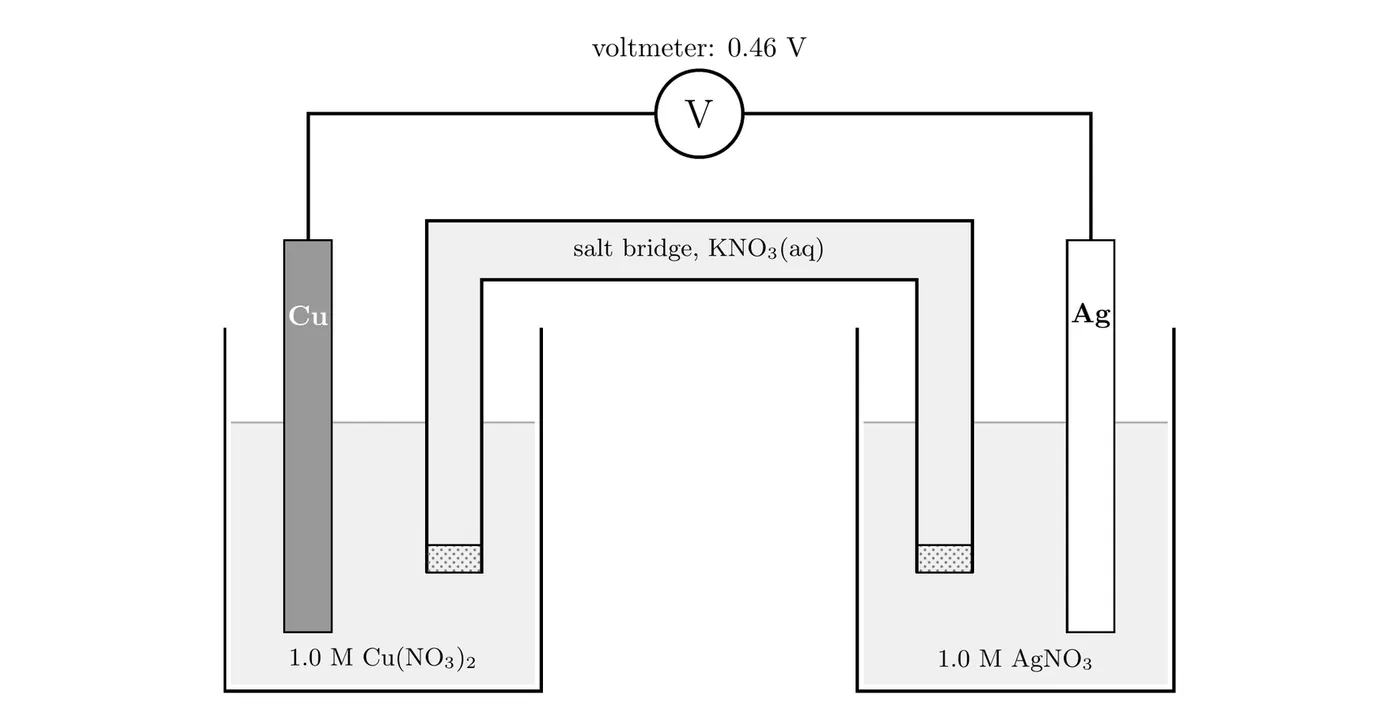
(a) Write the oxidation and reduction half-reactions and the balanced overall reaction. (b) Identify the anode, and state the direction of electron flow in the wire. (c) Describe what happens to the mass of each electrode and to the color of the solution as the cell runs. (d) Which way do ions in the salt bridge move? Justify your answer. (e) The student wants to swap the salt bridge for a salt bridge. Explain why that's a bad idea.
(a) Silver's reduction potential is more positive, so is reduced and Cu is oxidized:
Multiply the reduction by 2 so the electrons match, then add:
Check: V, matching the voltmeter. (Multiplying a half-reaction by 2 doesn't change its .)
(b) Copper is oxidized, so the copper electrode is the anode. Electrons flow through the wire from the copper electrode to the silver electrode. (Copper was the cathode next to zinc.)
(c) The copper electrode loses mass and the silver electrode gains mass. The solution turns a deeper blue as increases.
(d) Toward the copper half-cell, the anode. ions are being added to that solution, so anions have to flow in to keep it neutral.
(e) Chloride ions leaking out of the salt bridge would react with the silver ions:
The precipitate removes from the cathode half-cell (and can clog the bridge), so the cell voltage drops and the cell doesn't run as designed. A salt bridge's ions must not react with anything in the half-cells, which is why is the usual choice.
Common mistakes
- Thinking a metal is always the anode or always the cathode. It depends on the partner: copper is the cathode next to zinc and the anode next to silver.
- Sending electrons through the salt bridge or the solution. Electrons move only through the wire. Ions carry the charge in the solutions and the salt bridge.
- Sending the ions the wrong way. Anions move toward the anode, cations toward the cathode.
- Switching the rules in an electrolytic cell. Oxidation is always at the anode and reduction always at the cathode. What changes is which electrode is which.
- Thinking bigger electrodes give a bigger voltage. Voltage depends on the reaction and the concentrations, not on size.
- Picking the wrong electrode to gain mass. Metal plates out at the cathode, where metal ions are reduced.