

9.11 - Electrolysis and Faraday's Law
Overview
Electrolysis uses an outside power source to drive a redox reaction that wouldn't happen on its own. It's how metals are plated onto objects, how aluminum is made, and how a rechargeable battery recharges. This topic is about counting: the charge that flows through the circuit tells you exactly how many moles of electrons were transferred, and from that, how much metal is deposited or how much gas is made.
Electrolytic cells
In an electrolytic cell, a power source pushes electrons through the circuit to drive a reaction that isn't thermodynamically favored. From Topic 9.9, the source has to supply more voltage than the size of the (negative) cell potential. One thing doesn't change from galvanic cells: oxidation happens at the anode, and reduction happens at the cathode.
Electroplating is a common use. To coat an object with copper, make the object the cathode, use a copper strip as the anode, and put both in copper(II) sulfate solution:
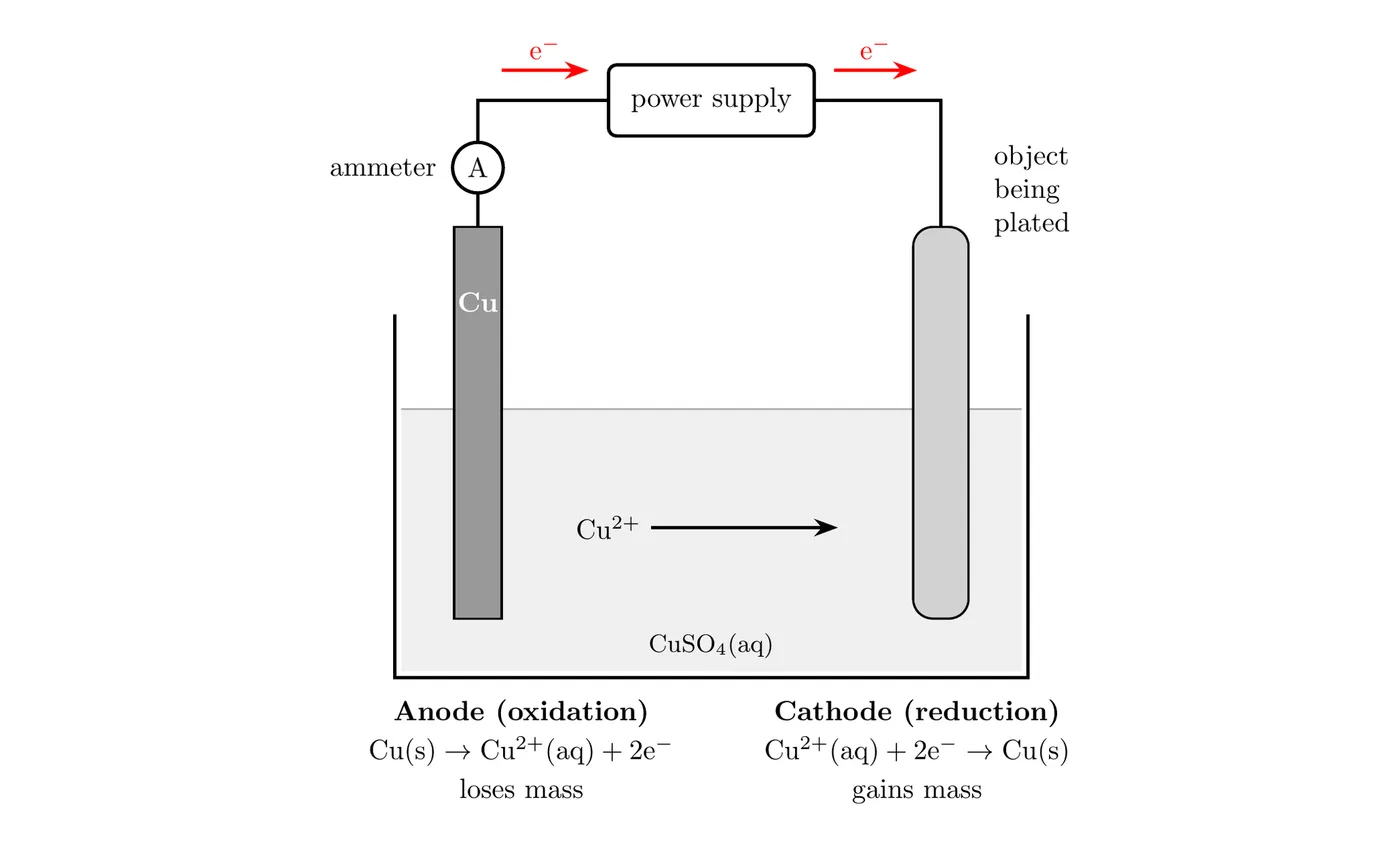
- The power source pulls electrons out of the copper anode, so Cu atoms are oxidized to ions. The anode loses mass.
- The power source pushes those electrons onto the object, where ions are reduced to copper metal. The cathode gains mass.
- The ammeter measures the current. Together with the time, that's all you need to figure out how much copper moved.
Current, charge, and time
Current () is the rate at which charge flows, measured in amperes (A). One ampere is one coulomb of charge per second:
Here is the charge in coulombs (C) and is the time in seconds. Rearranged, . Always convert minutes or hours to seconds first.
To connect charge to chemistry, you need the charge on one mole of electrons, the Faraday constant:
(That's the charge on one electron, C, times Avogadro's number.) Dividing a charge by turns coulombs into moles of electrons, the same way dividing a mass by molar mass turns grams into moles.
Faraday's law
Faraday's law says the amount of substance oxidized or reduced at an electrode is directly proportional to the charge that passes through the cell. Double the current or double the time, and you double the mass deposited.
The half-reaction connects electrons to substance. Its coefficients give the mole ratio, and for a metal ion, the number of electrons needed equals the charge on the ion:
Half-reaction | Moles of electrons per mole of product |
1 mol per mol Ag | |
2 mol per mol Cu | |
(in a molten salt) | 3 mol per mol Al |
2 mol per mol | |
4 mol per mol |
So the same charge deposits twice as many moles of silver as copper, and three times as many as aluminum.
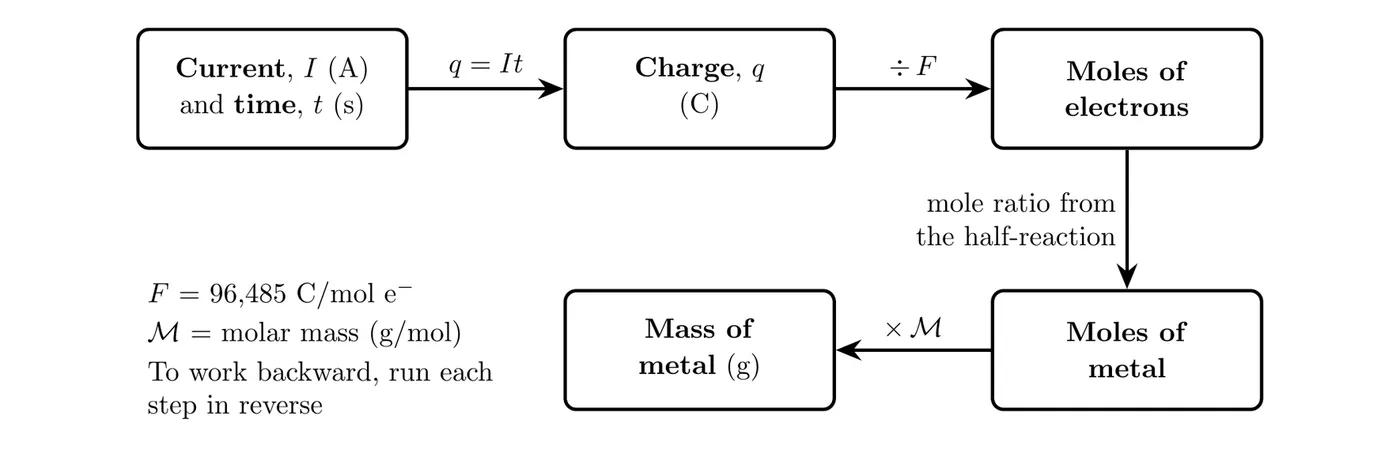
With Faraday's law you can find any one of these from the others: the number of electrons transferred, the mass deposited on or removed from an electrode, the current, the time, or the charge on an ion. Every problem follows the same road map:
Example 1: Mass of copper plated
A current of 1.50 A runs through the copper plating cell above for 45.0 min. What mass of copper is deposited on the object?
Step 1: Charge. Convert the time: s.
Step 2: Moles of electrons.
Step 3: Moles of copper. From , 2 mol of electrons make 1 mol of Cu:
Step 4: Mass.
Answer: 1.33 g of copper plates onto the object (three significant figures, from 1.50 A and 45.0 min). The copper anode loses the same mass.
Example 2: Current needed for silver plating
A jeweler wants to plate 0.750 g of silver onto a ring in 15.0 min, using a solution of ions. What constant current is needed?
This time, run the road map backward.
Since uses 1 electron per atom, that's also mol of electrons.
Answer: a steady current of 0.745 A.
Example 3: Finding the charge on an ion
A solution contains an unknown chromium salt. A current of 0.800 A for 20.0 min deposits 0.172 g of chromium metal on the cathode. What is the charge on the chromium ions?
Step 1: Moles of electrons.
Step 2: Moles of chromium.
Step 3: Ratio.
Answer: Each chromium ion gained 3 electrons to become a neutral atom, so the ion is , and the half-reaction is .
Gases from electrolysis
Electrolysis doesn't always deposit a metal. In water, the electrode reactions can make gases. When a solution of a salt like is electrolyzed, water reacts at both electrodes. is much harder to reduce than water ( V for compared with V for water), and sulfate is harder to oxidize than water. The salt is there only so the solution conducts.
The and end up neutralizing each other, so the overall reaction is . Each takes 4 electrons but each takes only 2, so the same charge makes twice as many moles of as .
Example 4: Collecting hydrogen gas
With a current of 0.500 A, how long does it take to collect 75.0 mL of dry at 1.00 atm and 25 °C (298 K)? What volume of forms at the anode in that time, at the same temperature and pressure?
Step 1: Moles of from :
Step 2: Moles of electrons. 2 per : .
Step 3: Charge and time.
Step 4: Oxygen. The same mol of electrons makes one-fourth as many moles of , which is half the moles of . At the same temperature and pressure, half the moles means half the volume.
Answer: s (about 19.7 min), and 37.5 mL of .
Electrolysis in the lab
In the AP lab, you use an outside power source to run an electrolysis, then use Faraday's law to compare what you measured with what you calculate. You measure the current (ammeter, kept steady), the time (in seconds), and the mass of each electrode before and after, on an analytical balance. Each error pushes the result one way:
What went wrong | Measured mass gain | Calculated ( divided by mol ) |
The cathode was still wet when weighed | Too high | Too low |
Some plated metal flaked off during rinsing | Too low | Too high |
Some current made at the cathode instead of metal | Too low | Too high |
The real current was higher than the recorded value | Too high | Too low |
Example 5: Measuring the Faraday constant (AP-style)
A student plates copper onto a copper cathode from solution, using a steady current of 0.400 A for 30.0 min. The cathode's mass is 24.135 g before and 24.364 g after (rinsed and dried).
(a) Calculate the charge that passed. (b) Use the mass of copper deposited to calculate an experimental value of the Faraday constant. (c) Calculate the percent error compared with the accepted value, and identify one error that could explain the result.
(a)
(b) The cathode gained g of Cu.
(c)
The experimental value is too high, which means the moles of electrons calculated from the copper were too low. In other words, too little copper was weighed: Faraday's law predicts 0.237 g, but the cathode gained only 0.229 g. A likely cause is copper flaking off the cathode during rinsing, or some current making instead of copper. A wet cathode can't explain it, because extra water would make the result too low.
Common mistakes
- Using minutes in . Time must be in seconds.
- Skipping the mole ratio. Moles of electrons equal moles of metal only for +1 ions like . For , divide by 2; for , by 3.
- Multiplying by when you should divide. Check the units: C divided by C/mol gives mol .
- Mixing up which electrode gains mass. The cathode (reduction) gains mass as metal ions are reduced onto it. The anode loses mass when its metal is oxidized.
- Thinking oxidation moves to the cathode in an electrolytic cell. In every electrochemical cell, oxidation is at the anode and reduction is at the cathode.
- Expecting equal volumes of and . Water electrolysis makes 2 mol of for every 1 mol of .
BackNext