

9.4 - Thermodynamic and Kinetic Control
Overview
tells you whether a reaction is thermodynamically favored. It tells you nothing about how fast the reaction goes. Many favored reactions are so slow that nothing seems to happen, and those are said to be under kinetic control. On the AP exam you'll explain these cases with activation energy, and you'll need to recognize that a reaction that isn't moving is not necessarily at equilibrium.
Two different questions
Thermodynamics | Kinetics | |
Question it answers | Which direction is favored? | How fast does it go? |
Key quantities | , , | Rate, rate constant, activation energy |
Depends on | Only the starting and ending states | The pathway (mechanism), temperature, concentrations, catalysts |
Changed by a catalyst? | No | Yes, a catalyst lowers |
Knowing one tells you nothing about the other. A reaction can be strongly favored and extremely slow, or barely favored and very fast.
Favored reactions that don't happen
Many processes that are thermodynamically favored don't occur to any measurable extent, or occur extremely slowly. Some familiar ones:
- Fuels in air. Natural gas, wood, and paper all react with oxygen with a large negative ( for methane, from Topic 9.3). Yet a gas stove doesn't light itself, and a book on a shelf doesn't burst into flames.
- Hydrogen and oxygen. A mixture of the two gases can sit unchanged for years, then explode with a spark.
- Hydrogen peroxide. A bottle of it breaks down into water and oxygen very slowly. Put it on a cut, and an enzyme in your blood (a catalyst) makes it fizz right away.
- Diamond. Diamond is less stable than graphite at room conditions, but diamonds last for millions of years (Example 1).
Why: a high activation energy
A reaction happens only when particles collide with enough energy to reach the transition state, at least the activation energy (Unit 5). If is large compared to the kinetic energies particles have at room temperature, almost no collisions succeed, and the rate is too small to measure.
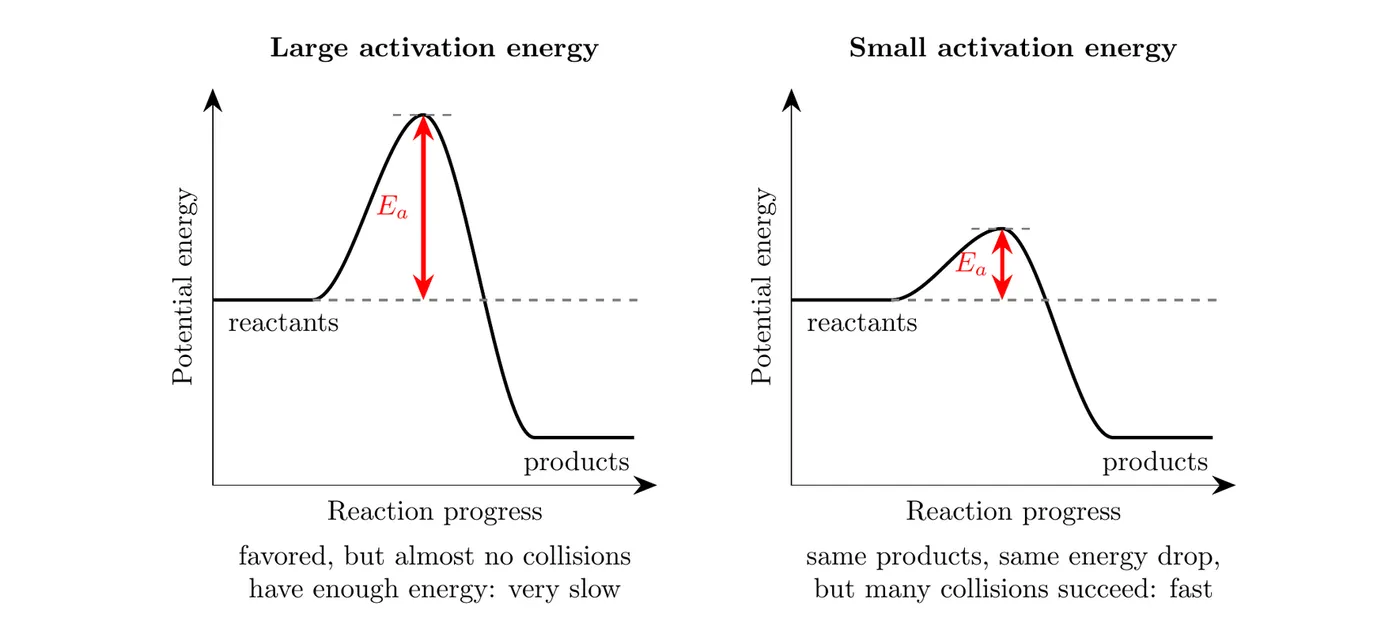
The two reactions above start and end at the same energies, so the drop from reactants to products is the same. The only difference is the height of the barrier, and how far downhill the products sit doesn't help the reactants climb it.
A process that is thermodynamically favored but doesn't proceed at a measurable rate is under kinetic control. A high activation energy is the most common reason. Ways to get such a reaction going all target the barrier, and none of them changes :
- Raise the temperature. More collisions have energy above .
- Add a catalyst. It provides a new pathway with a lower .
- Start it with a spark or flame. For an exothermic reaction like combustion, the spark gets some molecules over the barrier. The energy those first molecules release heats their neighbors, and the reaction keeps itself going.
No change doesn't mean equilibrium
A reaction that isn't proceeding at a noticeable rate can look as if it's at equilibrium, since nothing seems to change. But the two situations are very different:
At equilibrium | Under kinetic control | |
Forward and reverse rates | Equal (both reactions keep happening) | Both close to zero |
Composition | Matches the equilibrium constant | Far from equilibrium |
If you add a catalyst | Nothing changes | The reaction takes off |
The catalyst test is the key piece of evidence. A catalyst speeds up the forward and reverse reactions equally, so it can't shift a true equilibrium. If adding a catalyst (or a spark) makes the system change a lot, it wasn't at equilibrium. It was under kinetic control.
The CED's rule of thumb: if a process is known to be thermodynamically favored, yet it doesn't occur at a measurable rate, it's reasonable to conclude that the process is under kinetic control.
Writing the argument
A full-credit explanation has four parts:
- Favored: (from a calculation or from the signs of and ).
- Observation: no measurable reaction at these conditions.
- Reason: the activation energy is high, so very few collisions have enough energy to react.
- Conclusion: the process is under kinetic control, not at equilibrium.
Example 1: Are diamonds forever?
for diamond is kJ/mol at 298 K, and graphite is the standard state of carbon. (a) Is the conversion of diamond to graphite thermodynamically favored? (b) Explain why diamonds don't turn into graphite. (c) Is a diamond at equilibrium with graphite?
(a) Graphite is an element in its standard state, so its is 0.
, so the conversion is thermodynamically favored.
(b) To rearrange into graphite, carbon atoms would have to break the strong covalent bonds of diamond's 3-D network. The activation energy is enormous, so at room temperature essentially no atoms make it over the barrier, and the rate is far too small to measure. The conversion is under kinetic control.
(c) No. Nothing is changing, but not because forward and reverse rates are equal. Both rates are close to zero, and if the barrier could be crossed, diamond would keep turning into graphite.
Example 2: A flask of hydrogen and oxygen (AP-style)
A sealed flask holds and in a 2:1 mole ratio at 25 °C. The pressure stays constant for several weeks. When a small amount of powdered platinum is added, droplets of water form on the walls within seconds and the pressure drops sharply. ( for is kJ/mol.)
(a) Calculate and state whether the reaction is thermodynamically favored. (b) Explain why no reaction was observed for several weeks. (c) A student claims the flask was at equilibrium during those weeks because the pressure didn't change. Evaluate the claim. (d) What does the platinum do?
(a) Both reactants are elements in their standard states, so their values are 0.
, so the reaction is thermodynamically favored.
(b) The reaction has a high activation energy. At 25 °C, almost no collisions between and molecules have enough energy to reach the transition state, so the rate is too slow to measure. The reaction is under kinetic control.
(c) The claim is wrong. If the flask were at equilibrium, adding a catalyst couldn't change its composition, because a catalyst speeds up the forward and reverse reactions equally. Instead, the mixture reacted as soon as the platinum was added, so it was far from equilibrium the whole time. It just couldn't get over the activation energy barrier.
(d) Platinum is a catalyst. Its surface gives the reaction a pathway with a much lower activation energy, so many more collisions succeed and the rate becomes fast. It doesn't change , which is still , and it isn't used up.
Common mistakes
- Thinking means the reaction happens quickly or right away. Favorability and rate are separate questions.
- Thinking a very negative means a small . The size of the drop in energy says nothing about the height of the barrier.
- Calling a stuck reaction "at equilibrium." At equilibrium, both directions are happening at equal rates. Under kinetic control, neither is happening at a measurable rate.
- Saying a catalyst makes a reaction more favored. A catalyst lowers and speeds up the reaction. It doesn't change , , or the equilibrium constant.
- Saying the spark "makes the reaction exothermic." The spark only gets the first molecules over the barrier. The energy released comes from the reaction itself.