

9.9 - Cell Potential and Free Energy
Overview
Every electrochemical cell runs on a redox reaction, and the cell's voltage tells you whether that reaction is thermodynamically favored. In this topic you'll calculate a standard cell potential from a table of half-reactions, then connect it to Gibbs free energy with and to the equilibrium constant . One sign rule ties it all together: a positive goes with a negative and a favored reaction.
Favored and unfavored cells
Electrochemistry is the study of redox reactions in electrochemical cells. In a cell, the oxidation and the reduction happen in separate places, so electrons travel through a wire from one to the other. The cell potential (), measured in volts (V), is the push behind that electron flow. Its sign tells you which way the reaction goes on its own:
- Positive cell potential: the reaction is thermodynamically favored. It runs on its own and pushes electrons through the wire. This is a galvanic (voltaic) cell, like a battery.
- Negative cell potential: the reaction is thermodynamically unfavored. It won't run on its own. To make it happen, an outside power source has to apply a voltage larger than the size of the cell potential. This is an electrolytic cell (Topics 9.8 and 9.11).
Reversing a reaction flips the sign of its cell potential, so a reaction with a negative cell potential is favored in the reverse direction.
Standard reduction potentials
What a reduction potential is
You can't measure the voltage of a single half-reaction, because every cell needs both an oxidation and a reduction. Instead, each half-reaction is measured against a reference, the standard hydrogen electrode, , which is assigned exactly 0.00 V. The voltage of a half-reaction compared with this reference is its standard reduction potential, .
Standard means 1 M for every dissolved species and 1 atm for every gas, usually at 25 °C. Tables list every half-reaction as a reduction (electrons on the left). On the AP exam, any values you need are given in the question. These are the ones used on this page:
Half-reaction (reduction) | (V) |
The more positive is, the more strongly that half-reaction tends to happen as written. So , at the top, is the easiest ion to reduce, and aluminum and zinc, at the bottom, are the easiest metals to oxidize.
Calculating the standard cell potential
In a galvanic cell, the half-reaction with the higher runs as written, as the reduction at the cathode. The other one runs in reverse, as the oxidation at the anode. Then:
Both values in this equation are reduction potentials, straight from the table. The subtraction takes care of running the anode half-reaction in reverse. Choosing the higher value as the cathode always gives a positive , which is what a galvanic cell needs.
Never multiply by a coefficient. To balance electrons you often multiply a half-reaction by 2 or 3, but stays the same. A potential is energy per unit of charge (1 V = 1 J/C). Like temperature or density, it doesn't depend on how much stuff you have, so it's an intensive property.
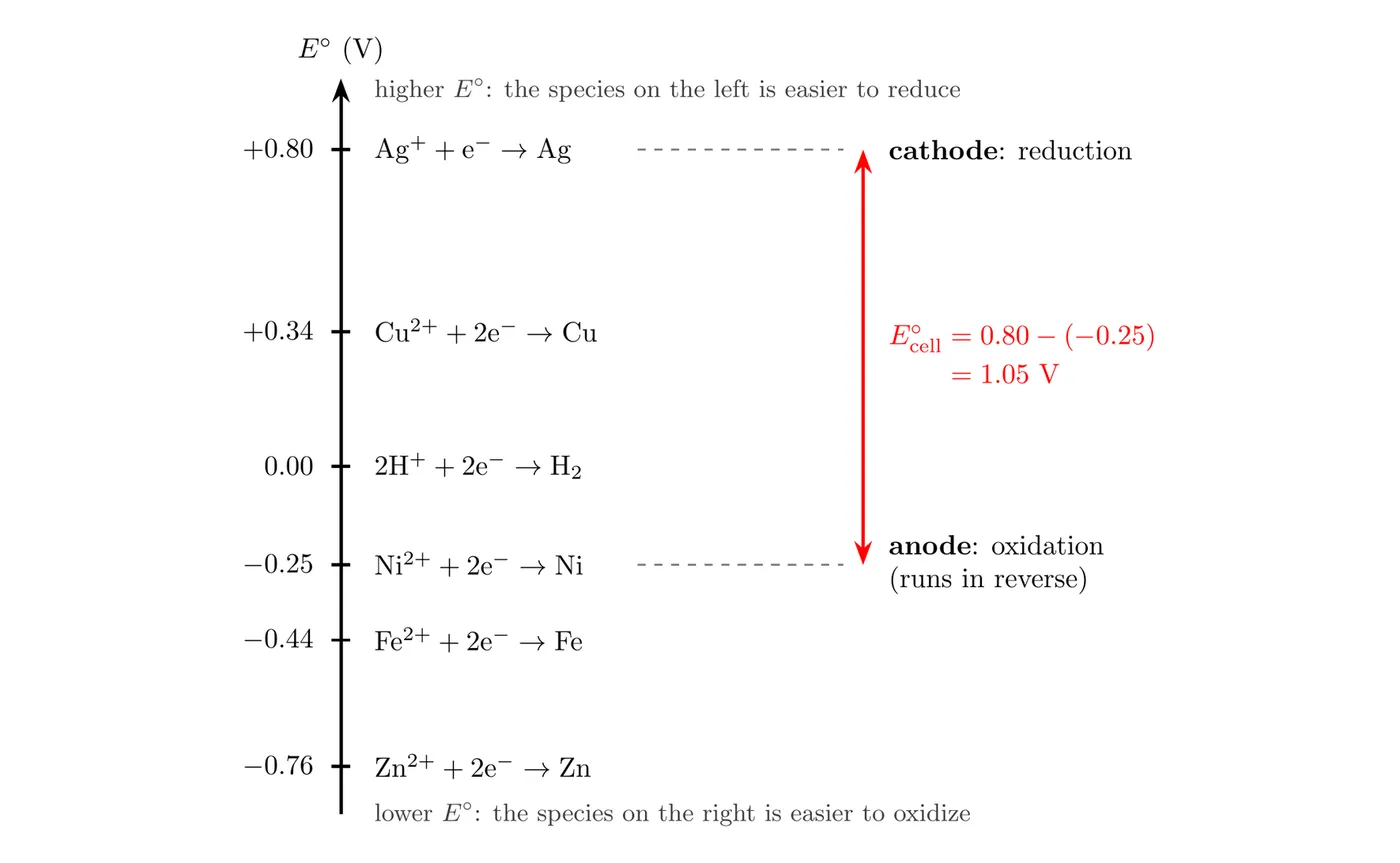
On this ladder, the cell potential is the vertical distance between the two half-reactions: the farther apart they sit, the bigger the voltage.
Example 1: Standard potential of a nickel and silver cell
A galvanic cell is built from a nickel electrode in 1 M and a silver electrode in 1 M . Write the overall reaction and find .
Step 1: Pick the cathode. Silver's reduction potential ( V) is higher than nickel's ( V), so is reduced at the cathode, and nickel metal is oxidized at the anode:
Step 2: Balance the electrons. Each Ni atom loses 2 electrons and each ion gains 1, so multiply the silver half-reaction by 2 and add. Silver's stays V.
Step 3: Find the cell potential.
Answer: V. The positive value means the reaction is thermodynamically favored, so this cell can power a device. As it runs, the nickel electrode loses mass and silver metal builds up on the silver electrode.
Cell potential and Gibbs free energy
Topic 9.3 used to decide whether a reaction is thermodynamically favored. The cell potential tells you the same thing, and this equation from the AP reference sheet links the two:
- is the standard Gibbs free energy change, in . Divide by 1000 for .
- is the number of moles of electrons transferred per mole of reaction, as balanced. These are the electrons that canceled when you added the half-reactions.
- is the Faraday constant, , the charge on one mole of electrons.
- is the standard cell potential, in volts. Since 1 V = 1 J/C, multiplying coulombs by volts leaves joules.
The minus sign is the main idea. is proportional to the negative of the cell potential, so the two always have opposite signs. A cell with a positive has a negative (favored), and a cell with a negative has a positive (unfavored).
Example 2: Free energy change for the nickel and silver cell
Calculate for the reaction in Example 1.
Step 1: Find . In the balanced equation, one Ni atom gives 2 electrons to two ions. So 2 mol of electrons are transferred per mole of reaction: .
Step 2: Substitute.
Answer: . It's negative, matching the positive , so the reaction is thermodynamically favored. The answer has three significant figures because 1.05 V does; is an exact count.
What if you double the equation? Then . The cell potential is still V, but doubles to , because free energy is extensive: twice the reaction, twice the energy.
Example 3: Which metal dissolves in acid? (AP-style)
A student drops a piece of zinc into 1 M HCl and a piece of copper into another beaker of 1 M HCl. Hydrogen bubbles form on the zinc, but nothing happens to the copper.
(a) Calculate for each reaction. (b) Calculate for the copper reaction, and explain the observations. (c) The copper reaction can be forced to happen in an electrolytic cell. Under standard conditions, what voltage must the outside power source supply?
(a) In both reactions, is reduced (cathode) and the metal is oxidized (anode):
(b) For copper, :
The zinc reaction has a positive (and a negative ), so it's thermodynamically favored: zinc dissolves as bubbles off. The copper reaction has a negative and a positive , so it isn't favored, and copper doesn't react with 1 M HCl.
(c) The power source has to overcome a cell potential of V, so it must supply more than 0.34 V.
Connecting cell potential, free energy, and K
Topic 9.5 linked free energy to the equilibrium constant with . Combine that with , and all three quantities describe the same thing: how far a reaction goes toward products.
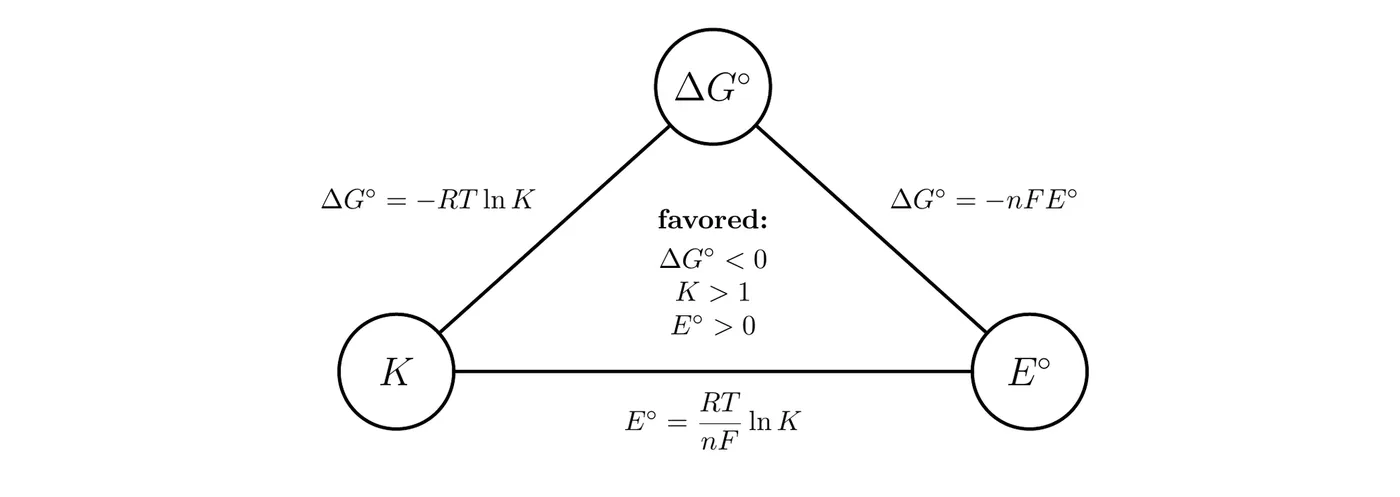
Setting the two expressions for equal links and directly. (You can also go in two steps with the reference sheet equations, as Example 4 does.)
What it means | |||
Positive | Negative | Greater than 1 | Favored; products favored at equilibrium |
Zero | Zero | Equal to 1 | Neither direction favored |
Negative | Positive | Less than 1 | Unfavored; reactants favored at equilibrium |
Because depends on exponentially, even a few tenths of a volt means a huge .
Example 4: Equilibrium constant from a cell potential (AP-style)
A copper wire placed in silver nitrate solution slowly gets covered in silver crystals, and the solution turns blue as forms:
(a) Calculate and at 25 °C. (b) Calculate . (c) Explain what the value of says about the reaction.
(a) is reduced (cathode), Cu is oxidized (anode), and :
(b) Rearrange . Keep in joules to match the units of , and carry an extra digit until the end:
An exponent magnifies any rounding in , so one significant figure is all can honestly carry here.
(c) is enormous, so at equilibrium almost all of the has been converted to products. For practical purposes, the reaction goes to completion.
Compare a pair of half-reactions that sit close together in the table:
Here , , and , so large amounts of both reactants and products are present at equilibrium. A cell potential of 0.46 V means a reaction that runs to completion; 0.03 V means a real mixture.
Common mistakes
- Multiplying by a coefficient. never changes when you scale a half-reaction. does, through .
- Flipping the anode's sign and then subtracting too. That reverses it twice. Use with both values straight from the table.
- Using the wrong . is the number of electrons transferred in the balanced overall equation, not the charge on one ion. In Example 1, even though each gains only one electron.
- Mixing up joules and kilojoules. and give joules. Use joules when you put into , and convert to kJ only at the end.
- Reading a negative as "no reaction at all." It means the reverse reaction is favored, or that an outside power source is needed to drive the forward one.