

9.2 - Absolute Entropy and Entropy Change
Overview
Topic 9.1 predicted the sign of an entropy change. This topic calculates it. Every substance has a measured absolute entropy, and the entropy change for a reaction is the total entropy of the products minus the total entropy of the reactants. If you have used enthalpies of formation in Unit 6, the method will feel familiar, with one important difference about elements.
Absolute entropy
Enthalpy has no natural zero, so tables only list changes (like ). Entropy is different: a perfect crystal at 0 K has zero entropy, because there is only one way to arrange its particles and their energy (this is the third law of thermodynamics). Since entropy has a true zero, chemists can measure the total entropy a substance has gained by the time it reaches room temperature. That total is its absolute entropy.
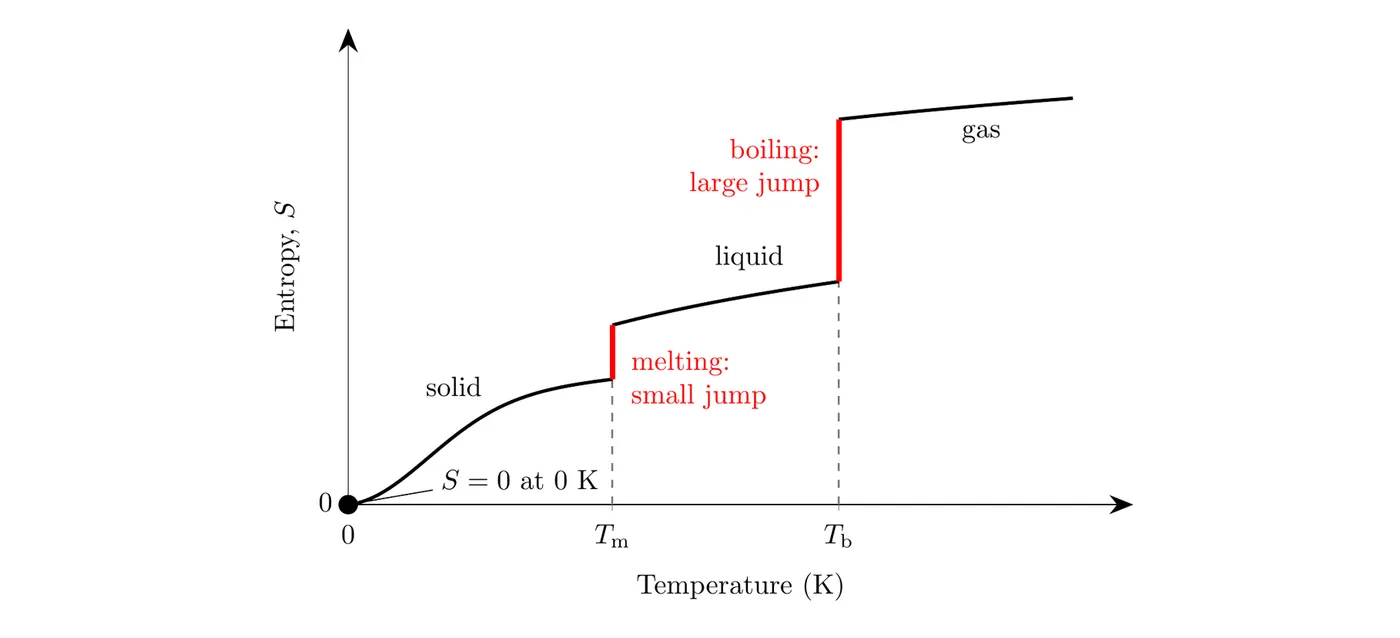
The graph pulls together both ideas from Topic 9.1. Entropy rises gradually as the temperature increases, and it jumps at each phase change, with a much bigger jump at boiling than at melting.
- The standard molar entropy, , is the absolute entropy of one mole of a substance in its standard state (pure solid or liquid, gas at 1 atm, or solution at 1 M), usually listed at 298 K. Its units are .
- Elements are not zero. Unlike , which is zero for an element in its standard state, every element has a positive . For example, for is 205.1 .
- Every pure substance has . (A few aqueous ions are listed with negative values because ion entropies are measured relative to , but the AP exam won't ask you to explain that.)
Patterns in standard molar entropies
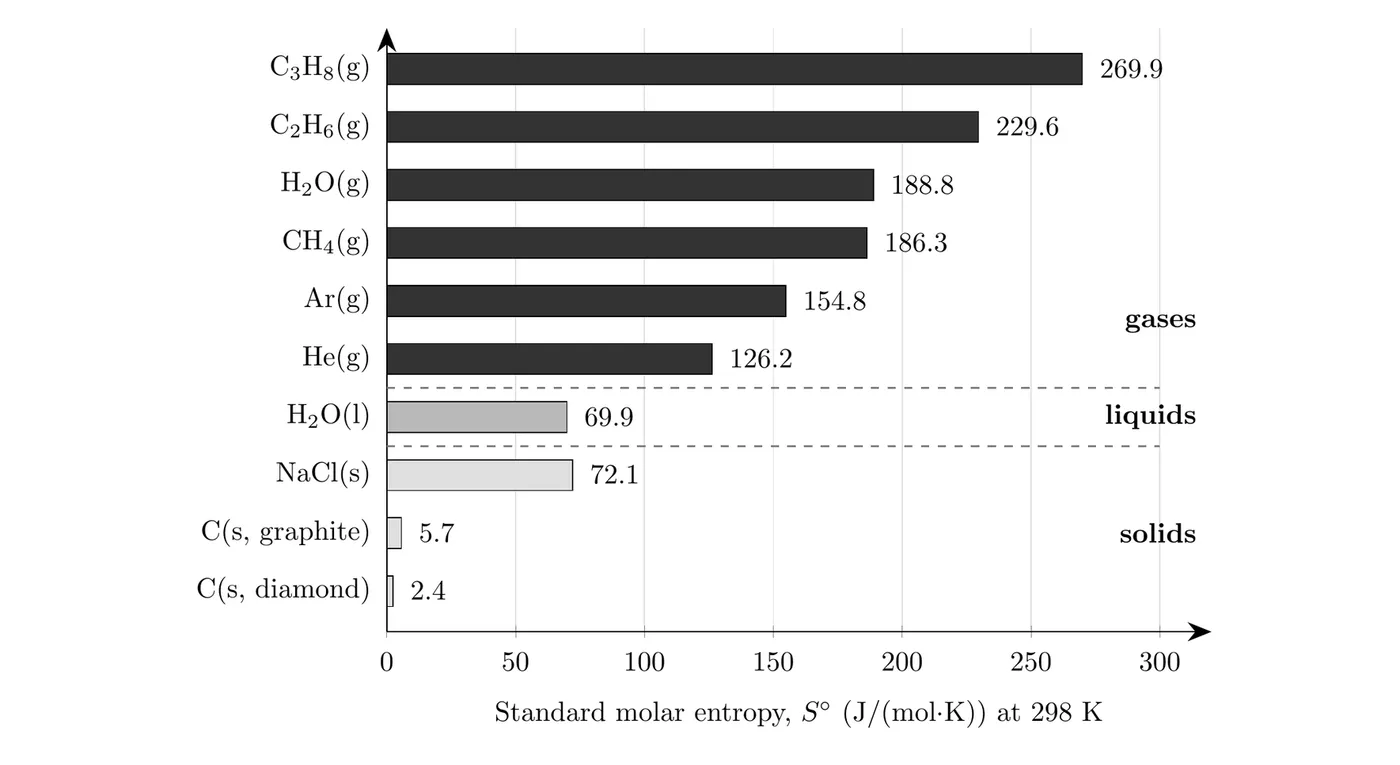
- Phase: gases are far higher than liquids and solids. is 188.8, but is only 69.9 .
- Molecular size and complexity: in the same phase, molecules with more atoms have more ways to rotate and vibrate, so their entropy is higher: (186.3) < (229.6) < (269.9).
- Rigid solids: diamond (2.4) has the lowest value on the chart. Its atoms are locked into a 3-D network of strong covalent bonds and barely vibrate. Graphite (5.7) has layers that can vibrate more freely.
- Mass: among similar particles, heavier ones have somewhat higher entropy, like He (126.2) and Ar (154.8).
Calculating the entropy change for a reaction
The standard entropy change for a reaction comes from the absolute entropies of everything involved. This equation is on the AP reference sheet:
- Write the balanced equation with phases.
- Look up for every species, elements included.
- Multiply each by its coefficient in the equation.
- Subtract: products minus reactants.
- Check the sign against a Topic 9.1 prediction. If they disagree, look for an error.
The answer is per mole of reaction as written, so its units are . If you double the equation, doubles. If you reverse it, the sign flips.
The simplest case is a phase change. For at 298 K, , a large positive value, as expected for vaporization.
Precision: the table values are given to 0.1, so when you add and subtract them, keep one decimal place in the answer.
Values used on this page, at 298 K, rounded from a standard thermodynamic table (other tables can differ slightly):
Substance | () | Substance | () |
191.6 | 92.9 | ||
130.7 | 39.8 | ||
192.5 | 213.7 | ||
205.1 | 197.7 |
Example 1: Making ammonia
Calculate for the synthesis of ammonia.
Step 1: Add up the products. There are 2 mol of .
Step 2: Add up the reactants. Nitrogen and hydrogen are elements, but their entropies are not zero.
Step 3: Subtract.
Answer: . The sign matches the prediction from Topic 9.1: 4 moles of gas become 2 moles of gas, so the matter becomes less dispersed.
Example 2: Heating limestone
Calculate for the decomposition of calcium carbonate, the reaction used to make lime.
Answer: . A solid makes a gas (0 moles of gas become 1), so a large positive value makes sense. Topic 9.3 uses this value to find the temperature where the reaction becomes favored.
Example 3: Working backward to a missing entropy (AP-style)
For the reaction below, .
(a) Justify the sign of without calculating. (b) Given values of 197.7 for and 205.1 for , calculate for . (c) What is for the reverse reaction?
(a) Three moles of gas (2 + 1 ) become two moles of gas, so there are fewer gas particles moving freely and the entropy decreases. (This is the reaction in the particle diagram of Topic 9.1, Example 2.)
(b) Set up the equation with for :
for is 213.7 . Don't forget to divide by the coefficient 2 at the end.
(c) Reversing the reaction flips the sign: .
Common mistakes
- Setting for elements. That rule is for and , not for absolute entropy.
- Forgetting the coefficients. Multiply each by its coefficient before adding.
- Subtracting in the wrong order. It's products minus reactants.
- Using the wrong phase. (69.9) and (188.8) are very different.
- Mixing joules and kilojoules later. comes out in joules per kelvin, while is in kilojoules. Convert before combining them in Topic 9.3.