

9.5 - Free Energy and Equilibrium
Overview
Topic 9.3 used to decide whether a process is thermodynamically favored. This topic ties that same number to the equilibrium constant from Unit 7. A negative goes with (products favored at equilibrium), and a positive goes with (reactants favored). One equation, , takes you from either one to the other, and a quick comparison with lets you estimate without a calculator.
What "thermodynamically favored" means at equilibrium
describes a reaction under standard conditions: gases at 1 atm, solutes at 1 M, and pure solids and liquids (Topic 9.3). Under those conditions every term in the reaction quotient equals 1, so . Now compare that with , the way you did in Topic 7.3:
- If , then . Starting from standard conditions, the reaction runs forward and makes more products before it reaches equilibrium. Products are favored. This is what means.
- If , then . The reaction runs in reverse, and reactants are favored at equilibrium. This is what means.
- If , the standard mixture is already at equilibrium, and .
So thermodynamically favored () means products are favored at equilibrium () under standard conditions. It doesn't mean the reaction goes to completion, and it says nothing about speed (Topic 9.4). A reaction with still makes some products; it just reaches equilibrium with mostly reactants.
At equilibrium | ||
Negative () | Greater than 1 | Products favored |
Zero | Equal to 1 | Neither side favored |
Positive () | Less than 1 | Reactants favored |
The equation linking ΔG° and K
This equation is on the AP reference sheet:
Solving for (divide both sides by , then raise to each side) gives the other form:
- is the gas constant, . Its energy unit is joules, so has to be in , not kJ. Forgetting to convert is the most common mistake on this topic.
- is the temperature in kelvins. At 25 °C, K.
- is the same equilibrium constant you wrote in Topic 7.3, with gas pressures in atm and solute concentrations in M. It has no units. For a reaction of gases, this makes it .
- belongs to the equation as written, just like . Double the coefficients and doubles while is squared. Reverse the reaction and changes sign while becomes (Topic 7.6). The exponential form makes both rules agree.
Because depends exponentially on , a small change in makes a big change in . Keep extra digits in the exponent until the end, and report to about two significant figures.
Example 1: Finding K from ΔG°
Colorless dinitrogen tetroxide breaks apart into brown nitrogen dioxide:
For , kJ/mol, and for , kJ/mol. Find and at 25 °C. Which side is favored?
Step 1: from free energies of formation (Topic 9.3):
Step 2: Convert to joules () and substitute:
Answer: . is positive, so and is favored. But is small, less than twice , so isn't far from 1: both gases are present in real amounts at equilibrium. That's why a sealed tube of these gases at room temperature is light brown, not colorless and not dark brown. (This uses pressures in atm, so it's . The that Unit 7 uses for this reaction is a different constant: it uses concentrations, and it's for a higher temperature.)
Estimating K without a calculator
The AP exam often asks you to reason about instead of calculating it. The trick is to compare with . At 298 K,
- near zero (a few kJ/mol, about the size of ): the exponent is small, so is close to 1. Reactants and products are both present in significant amounts at equilibrium.
- much larger than (tens of kJ/mol or more, positive): is much less than 1. Reactants are strongly favored.
- much more negative than : is much greater than 1. Products are strongly favored.
A handy rule at 25 °C: every 5.7 kJ/mol of changes by a factor of 10, because kJ/mol. So gives , and gives .
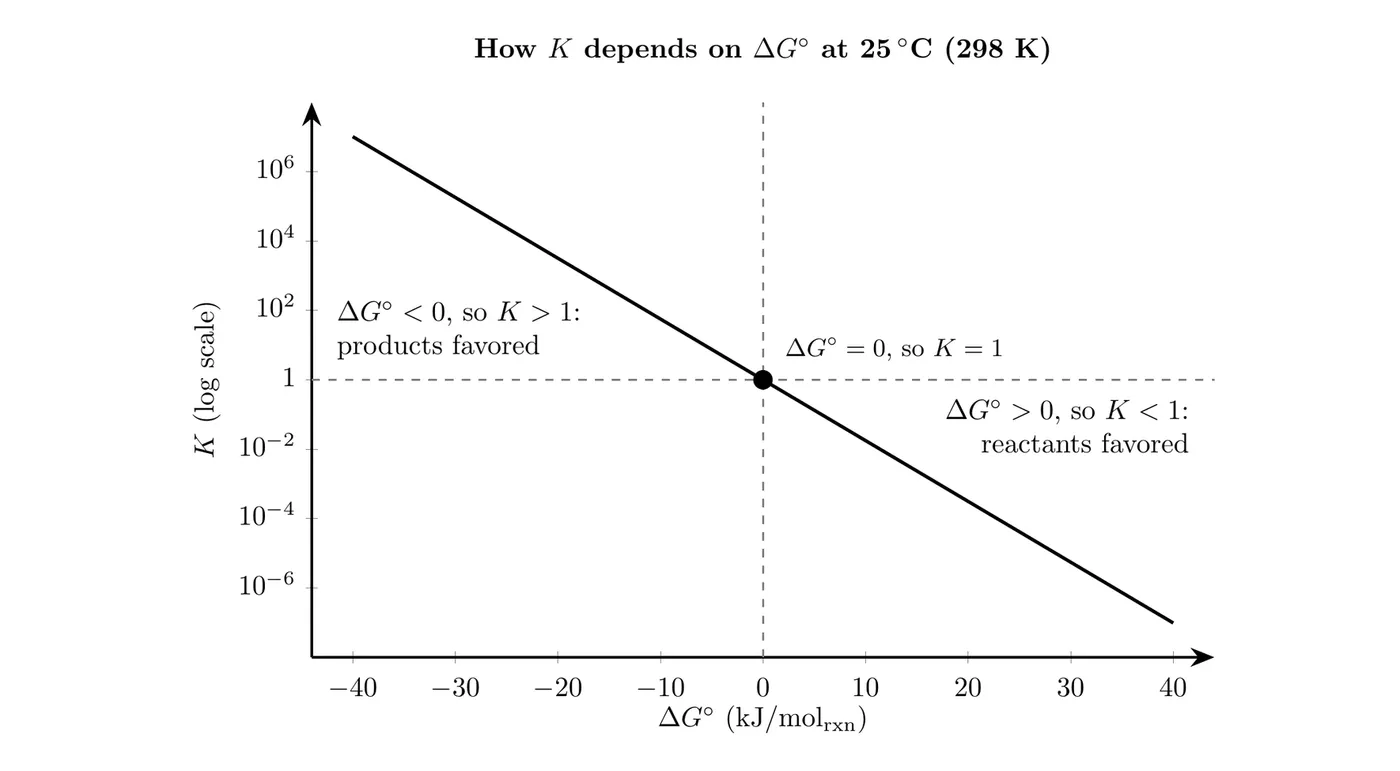
On a log scale the relationship is a straight line through , . Notice how fast changes: going from to takes from 1 to about .
Example 2: Estimating K (no calculator)
At 25 °C, three reactions have these values of . Estimate for each, and say which side is favored. (a) (b) (c)
- (a) , and is positive, so . Reactants are strongly favored.
- (b) 2 kJ/mol is smaller than (2.5 kJ/mol), so is close to 1, a little above 1 because is negative. (A calculator gives .) Products are only slightly favored.
- (c) , and is negative, so . Products are so strongly favored that the reaction essentially goes to completion.
Example 3: ΔG° from K
Acetic acid, the acid in vinegar, has at 25 °C:
Find for this ionization and explain what its sign means.
Answer: . It's positive, so ionization is not thermodynamically favored: at equilibrium, almost all of the acetic acid is still un-ionized molecules. That's what "weak acid" means (Topic 8.3). Any less than 1 goes with a positive .
Temperature, ΔG°, and K
Temperature shows up twice. itself changes with temperature, since (Topic 9.3), and also sits in the exponent. For AP problems, assume and stay about the same as the temperature changes. Then:
- Calculate at the new temperature from .
- Use the new and the new in .
Whether goes up or down with temperature depends on the sign of , just as Le Châtelier's principle predicts (Topic 7.9): increases with temperature for an endothermic reaction and decreases for an exothermic one. Substituting shows why:
Only the first term depends on . (You don't need this form on the exam; it just explains the rule.)
Example 4: Limestone in a lime kiln (AP-style)
Lime () is made by heating limestone ():
and . Topic 9.3 found at 298 K and showed that changes sign near 1110 K. (a) Calculate at 298 K. (b) Calculate and at 1200 K, assuming and don't change. (c) Write the expression for , and use it to explain why limestone is stable at room temperature but breaks down in a kiln.
(a) Convert to joules and substitute:
(b) First at 1200 K, with in kJ:
(c) and are pure solids, so they're left out of (Topic 7.3):
At 298 K, the equilibrium pressure of above limestone is about atm. Essentially nothing decomposes, which is why limestone buildings last for centuries. At 1200 K, , so keeps forming until its pressure reaches about 4 atm. A kiln is open to the air, where the pressure is far below that, so stays less than and the limestone keeps breaking down.
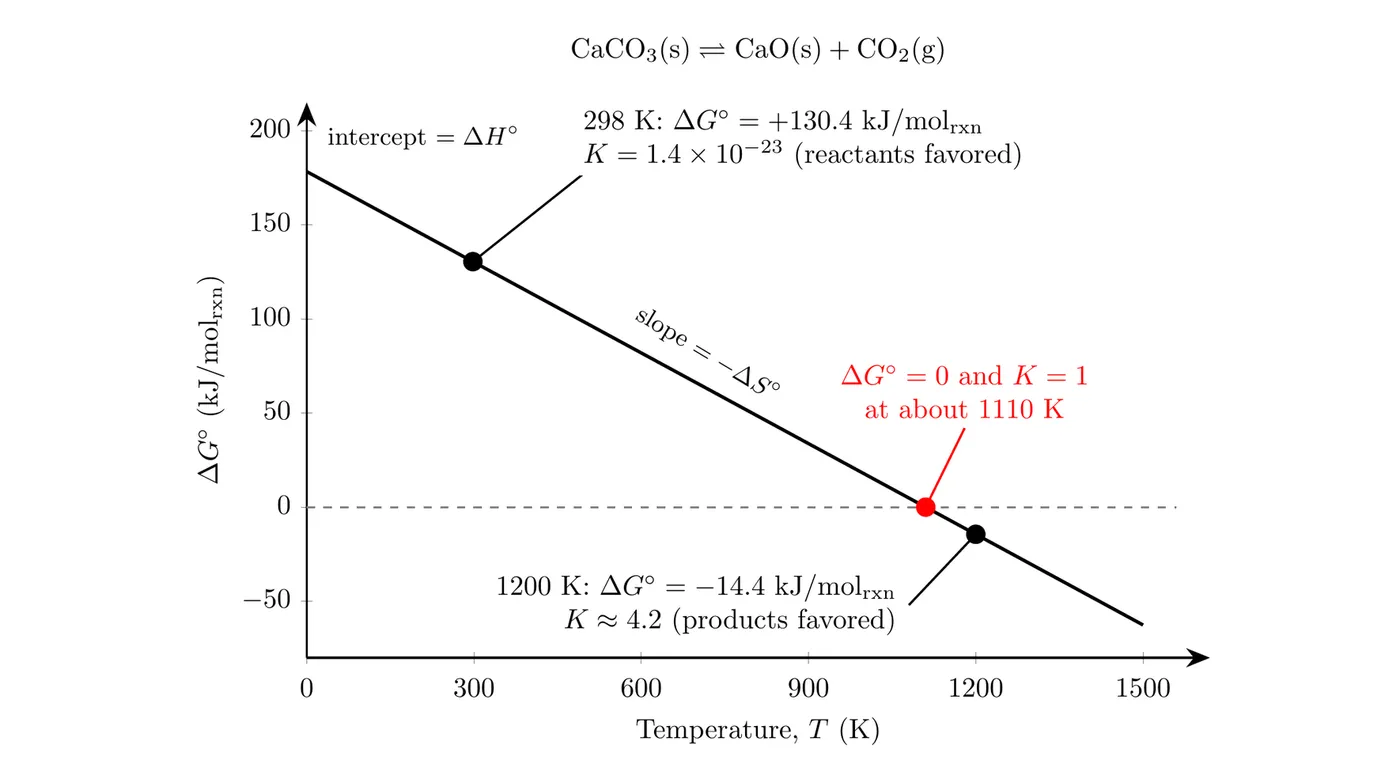
The graph puts the example together. falls in a straight line as rises (its slope is and its intercept is ) and crosses zero, where , at about 1110 K (837 °C). The reaction is endothermic, so grows with temperature, from to about 4.
Common mistakes
- Mixing kJ and J. , so convert to joules before you divide by . Otherwise the exponent is off by a factor of 1000.
- Using °C. must be in kelvins.
- Dropping the negative sign in . Quick check: must give a negative .
- Reading as "no reaction." It means . Some products still form.
- Reading as "fast." tells you where equilibrium lies, not how quickly the reaction gets there (Topic 9.4).
- Saying always increases with temperature. It increases only for endothermic reactions.