

9.6 - Free Energy of Dissolution
Overview
Why does table salt dissolve in water while chalk () barely does? Dissolving is a process like any other, so it has a , a , and a . This topic breaks dissolving into three particle-level changes, estimates the sign of and for each, and shows why the total is hard to predict: large contributions mostly cancel.
Dissolving is an equilibrium
When an ionic solid dissolves, its ions separate and spread through the water:
The equilibrium constant for dissolving is the solubility product, (Topic 7.11), so everything from Topic 9.5 applies. If , then and the salt is very soluble. If , then and the salt has low solubility. The more positive is, the smaller is. For NaCl, , which gives , the value quoted in Topic 7.11.
Three things happen when a salt dissolves
The free energy change for dissolving reflects three factors. For each one, you can estimate the sign of and from what the particles are doing.
1. Breaking apart the solid
The attractions that hold the solid together have to be overcome: ion-ion attractions in an ionic solid, or intermolecular forces in a molecular solid. That takes energy, so . It's large for ionic solids, and largest for small, highly charged ions, which attract each other most strongly (Coulomb's law). The particles also go from fixed positions in a lattice to moving freely through the whole solution, so .
2. Reorganizing the solvent
Water molecules have to move apart to make room, which breaks some hydrogen bonds between them (). Then they line up around each dissolved particle in a hydration shell: the oxygen ends (partial negative) face cations, and the hydrogen ends (partial positive) face anions (Topic 3.10). Water molecules locked in a shell can't move or turn as freely as they could in pure water, so this reorganization lowers the entropy (). The effect is biggest for small or highly charged ions, like , , , and , which hold their shells tightly.
3. Attractions between the dissolved particles and the solvent
New ion-dipole attractions form between the ions and water (for a molecular solute, hydrogen bonds or dipole attractions). Forming attractions releases energy, so . Like the attractions in the solid, these are strongest for small, highly charged ions. They're also what holds the hydration shell in place, so they go along with the entropy loss in factor 2.
Factor | What the particles do | ||
1. Breaking apart the solid | ions leave their fixed positions and spread out | (energy in) | (more freedom) |
2. Reorganizing the solvent | water molecules move apart, then line up in hydration shells | (some hydrogen bonds broken) | (water held in place) |
3. Solute-solvent attractions | ion-dipole attractions form | (energy out) | goes with the ordering in factor 2 |
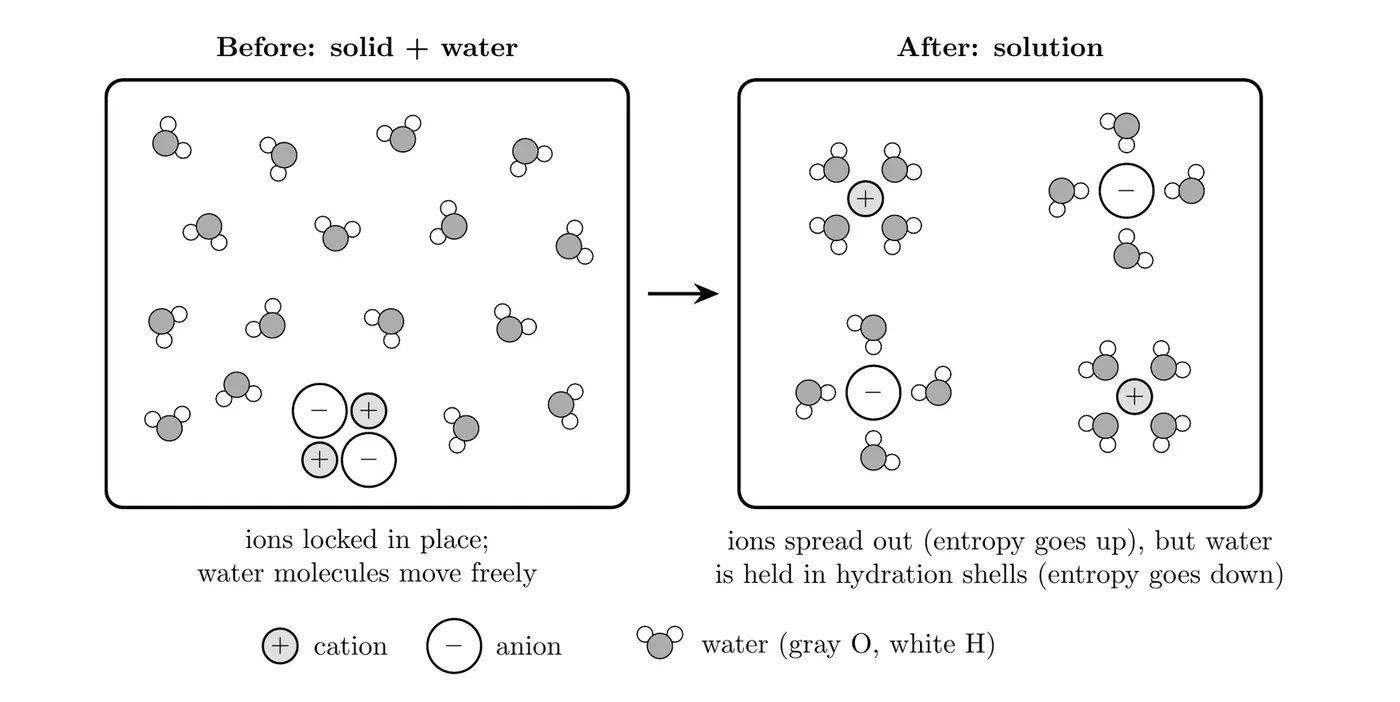
In this particle model, the two entropy effects pull in opposite directions. The ions gain freedom, but the water molecules around them lose it. For ions with a charge of 1 and a fairly large size, like and , the freed ions win and . For small or highly charged ions, the ordering of water can win, and .
Why the total is hard to predict
Each factor can be large, and their signs are opposite, so the total is a small difference between big numbers. Here is the enthalpy side for sodium chloride, drawn to scale:
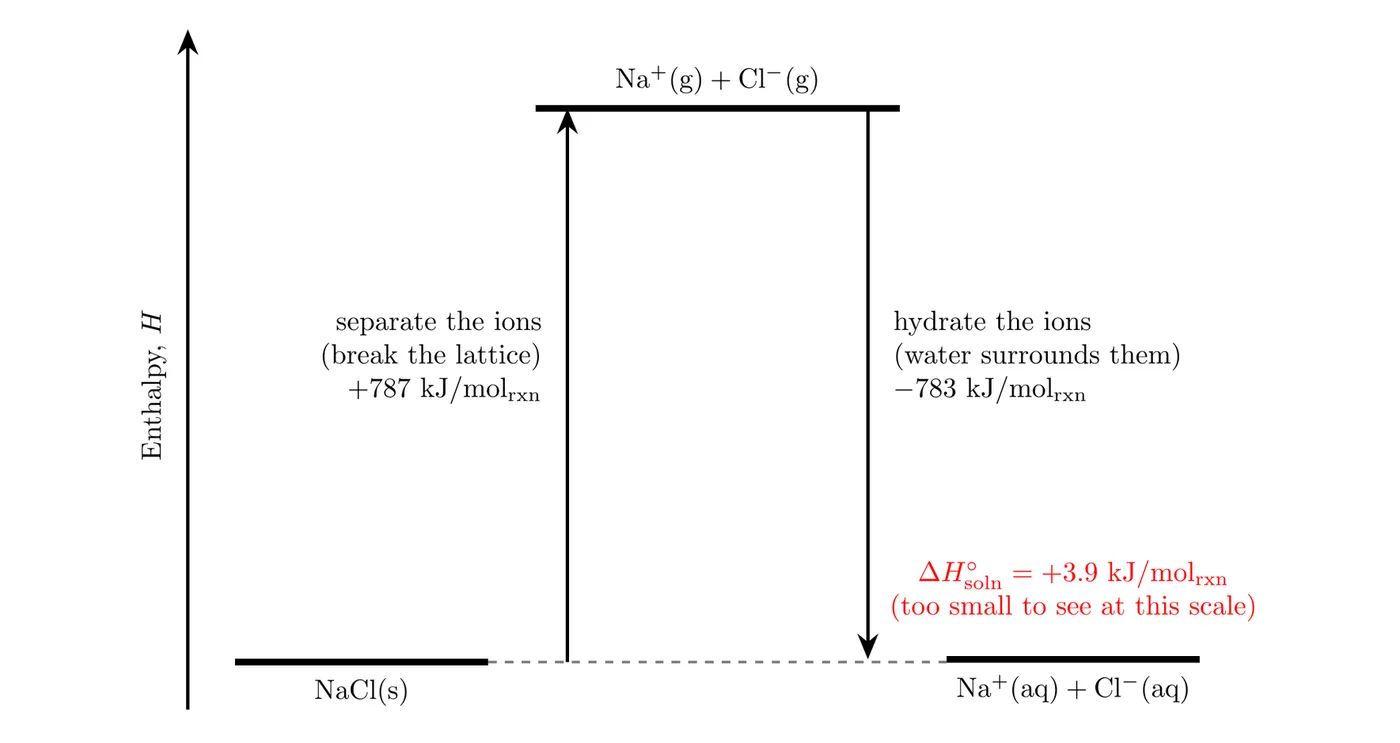
Pulling one mole of NaCl apart into separate gaseous ions takes about 787 kJ. Surrounding those ions with water (factors 2 and 3 together) releases about 783 kJ. The net is only , less than 1% of either step. A small error in either big number would flip the sign of the answer. Entropy works the same way. That's why you can estimate the sign and rough size of each factor, but the total has to come from measured data.
Enthalpy vs. entropy in real salts
The table gives values for six salts at 25 °C, rounded from standard thermodynamic tables. is calculated as at 298 K, and each comes from , so it can differ a little from a measured value (Topic 7.11 lists for AgCl).
Salt | () | () | () | In water |
dissolves well; the solution gets colder | ||||
dissolves well; the temperature barely changes | ||||
dissolves well; the solution gets hot | ||||
slightly soluble () | ||||
insoluble () | ||||
insoluble () |
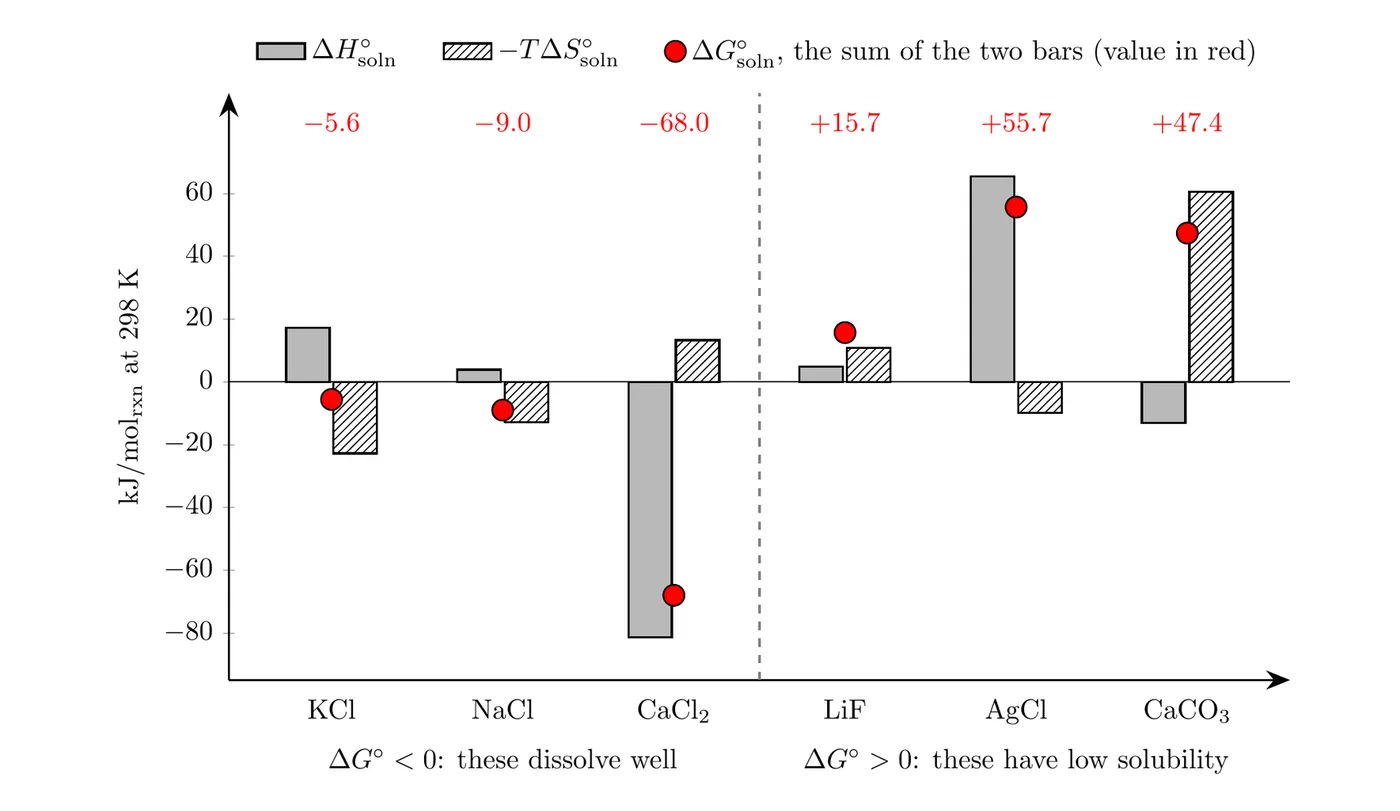
Each red dot is the sum of the two bars next to it, since . What the graph shows:
- KCl dissolves even though dissolving is endothermic, because the entropy term is bigger. This is entropy-driven, and the solution gets colder. The cold-pack salt from Topic 6.1, , works the same way: its is , but is larger at room temperature.
- has a negative , but dissolving is so exothermic that is strongly negative anyway. This is enthalpy-driven, and the solution gets hot (it's used in hot packs).
- AgCl gains entropy when it dissolves, but the enthalpy cost is much larger, so .
- LiF and have negative : their small or doubly charged ions order so much water that entropy works against dissolving. Calcium carbonate is the striking case. Dissolving it releases heat, yet it's insoluble.
The takeaway: neither nor alone tells you whether a salt dissolves. A salt can dissolve while absorbing heat (KCl), and a salt can stay put even though dissolving would release heat ().
Temperature matters too. From Topic 9.5, grows with temperature when the process is endothermic, so KCl is more soluble in hot water than in cold. Dissolving is exothermic, and it really is less soluble in hot water.
Example 1: An entropy-driven salt
Use the table for KCl. (a) Calculate at 25 °C. (b) Which term drives the dissolving? (c) Explain the sign of at the particle level.
(a) Convert to kJ ():
(b) The enthalpy term () works against dissolving. The entropy term () favors it and is larger. Entropy drives it.
(c) and leave the ordered crystal and spread through the whole solution, a big entropy gain. Both ions have a charge of only 1 and fairly large radii, so they hold their hydration shells loosely, and the entropy lost by ordering water is smaller. The net is positive.
Example 2: Calcium carbonate (AP-style)
Calcium carbonate dissolves only slightly:
and .
(a) A student claims that because dissolving is exothermic, must be soluble. Use to evaluate the claim. (b) Calculate at 25 °C. (c) Explain, in terms of particles, why is negative for but positive for KCl.
(a)
, so the claim is wrong. The favorable enthalpy change is outweighed by the large, unfavorable entropy term ().
(b)
That's close to measured values for calcium carbonate (a few times ), so it's insoluble.
(c) and each carry a charge of 2. Their strong ion-dipole attractions lock many water molecules into tight hydration shells, and the entropy those molecules lose is larger than the entropy the ions gain by leaving the solid. and carry charges of only 1, so their shells are looser, and the freed ions win.
Common mistakes
- Assuming an endothermic process can't happen on its own. KCl and dissolve while absorbing heat because the entropy term wins.
- Assuming dissolving always increases entropy. The ions spread out, but water ordered in hydration shells can make negative (LiF, ).
- Predicting solubility from one factor. The factors nearly cancel, so you need the total and (or ).
- Mixing up which steps release energy. Breaking apart the solid and pushing water molecules apart absorb energy. Forming solute-water attractions releases it.
- Forgetting to convert to kJ before using .