

5.1 - Using the Mean Value Theorem
Formal Definition
If:
- is continuous on the closed interval
- is differentiable on the open interval
Then:
There exists at least one point in such that:
In words: the instantaneous rate of change (the derivative) at some point equals the average rate of change over the interval.
Visual Understanding
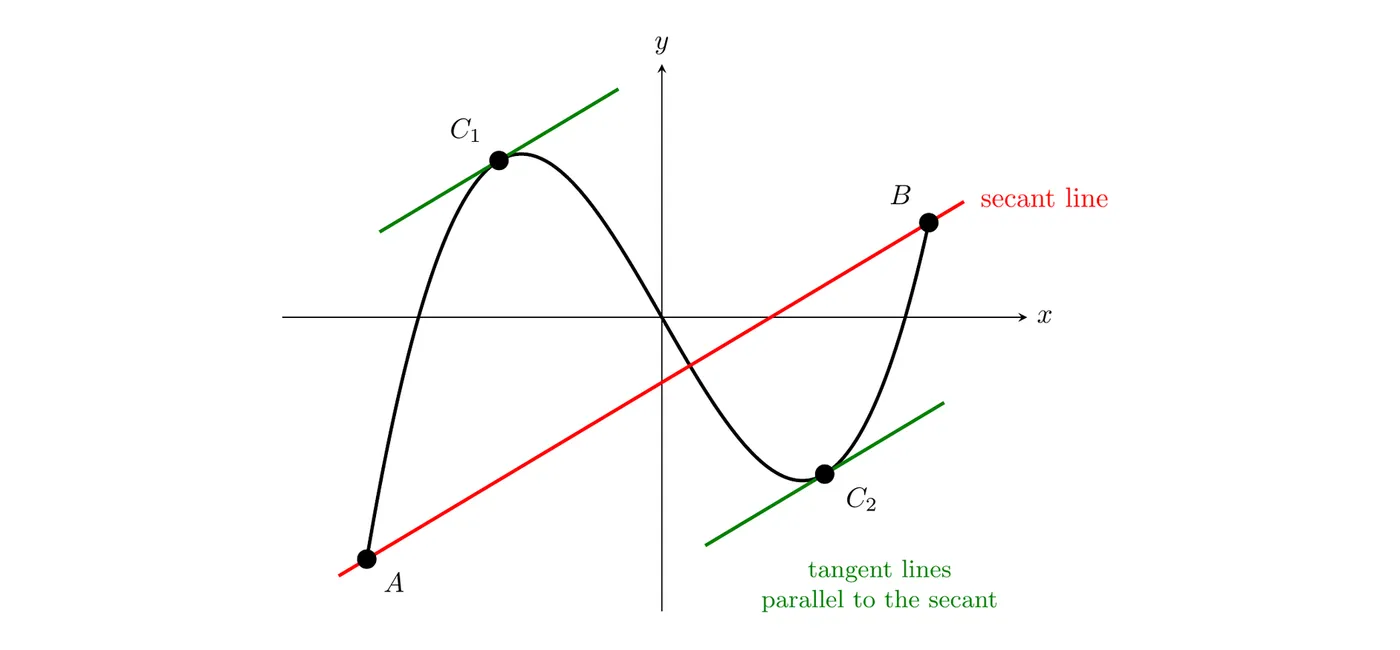
In this diagram:
- The secant line from A to B has a slope equal to the average rate of change
- At points C₁ and C₂, the tangent lines are parallel to the secant line
- That means
Important note: the Mean Value Theorem guarantees at least one such point exists. There might be more than one, as shown here, or exactly one.
Example 1: Finding the MVT Point
Given: on the interval . Find all values of that satisfy the Mean Value Theorem.
Step 1: Calculate the average rate of change
Find :
Find :
Average rate of change:
Step 2: Find where the instantaneous rate equals the average rate
Set it equal to the average rate:
Conclusion: at , which is inside the interval , the instantaneous rate of change equals the average rate of change of .
When the Conditions Fail
The Mean Value Theorem only promises a point when both conditions hold. If the graph has a corner, a cusp, or a break inside the interval, there might be no tangent line parallel to the secant line at all.
Example: Does the Mean Value Theorem apply to on ?
Try it anyway. The average rate of change is:
The derivative is . Set it equal to the average rate:
But is an endpoint, not a point inside . On the derivative is negative, so it can’t equal there either. No value of works.
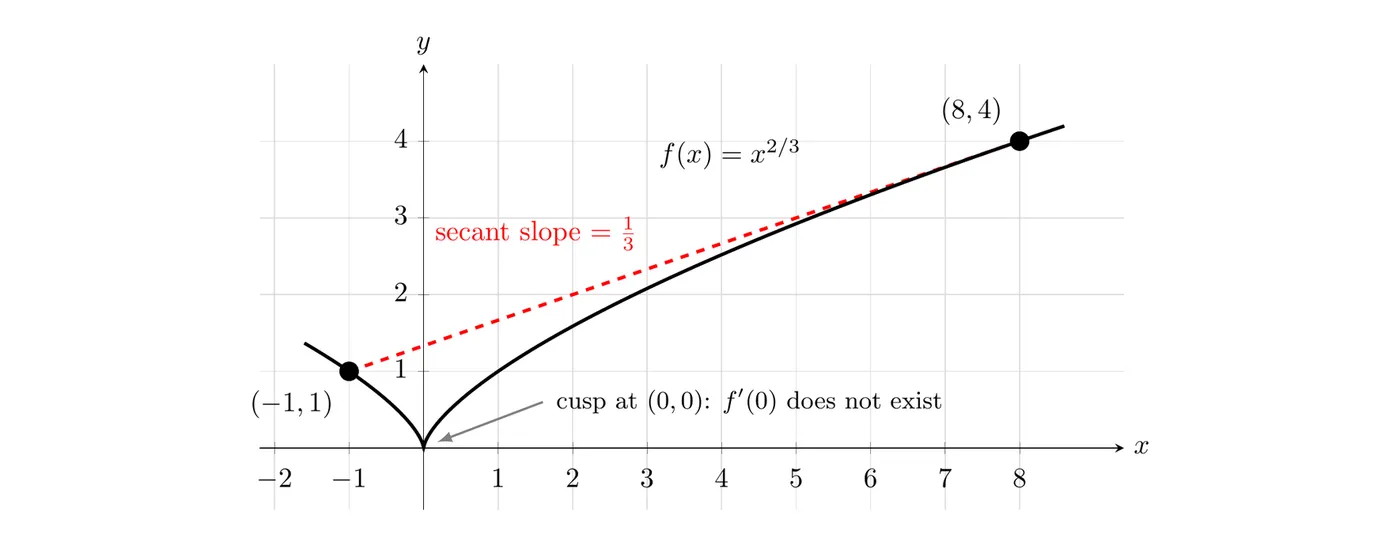
Why it fails: is continuous on , but doesn’t exist because the graph has a cusp at the origin. So isn’t differentiable on , and the theorem doesn’t apply.
Justification to write: “The Mean Value Theorem does not apply because is not differentiable at , which is in the interval .” When a condition fails, name the condition and the point where it fails.
A failed condition means the theorem makes no promise. It doesn’t mean a point can never exist. Some functions that break a condition still happen to have one.
Mean Value Theorem vs. Intermediate Value Theorem
These two get confused a lot. Here’s how to tell them apart.
Mean Value Theorem (MVT)
About: rates of change, meaning slopes and derivatives
Statement: if you draw a secant line between two points on a continuous, differentiable function, there’s at least one point where the tangent line is parallel to that secant line.
Requires:
- Continuity on
- Differentiability on
Guarantees: a point where
Intermediate Value Theorem (IVT)
About: function values, meaning -values
Statement: if a function is continuous on an interval, it takes on every value between and .
Requires:
- Continuity on
Guarantees: for any value between and , there’s a point where
Quick Comparison
Feature | MVT | IVT |
Focus | Slopes and rates | Function values |
Requires | Differentiable | Continuous |
Compares | Derivative to average rate | Function value to target |
Finds | Where slope equals average | Where function equals target |
Example 2: Hot Air Balloon (IVT and MVT)
A hot air balloon’s height in feet is given by , where is time in minutes. The function is twice differentiable.
(min) | 0 | 5 | 10 | 15 | 20 | 25 | 30 |
(ft) | 0 | 40 | 55 | 70 | 65 | 75 | 80 |
Part A: Is there a time between 5 and 15 minutes when the balloon is at 50 feet?
This one needs the Intermediate Value Theorem, since it’s asking about a specific height value.
Check conditions: is continuous on , since twice differentiable implies continuous.
Identify endpoints: and
Apply IVT: since is continuous on and , the Intermediate Value Theorem guarantees there’s a value in such that .
Justification to write: “According to the Intermediate Value Theorem, since is continuous on and is between and , there must exist a time in the interval where feet.”
Part B: Is there a time between 20 and 30 minutes when the velocity is 1.5 ft/min?
This one needs the Mean Value Theorem, since it’s asking about a rate of change.
Check conditions: is differentiable on , since it’s twice differentiable.
Calculate the average velocity:
Apply MVT: since is differentiable on and the average rate of change is 1.5 ft/min, the Mean Value Theorem guarantees there’s a value in such that ft/min.
Justification to write: “According to the Mean Value Theorem, since is differentiable on and the average velocity is ft/min, there must exist a time in the interval where the instantaneous velocity ft/min.”
Example 3: Application with Temperature
The temperature in degrees Fahrenheit of a room over a 6-hour period is modeled by a differentiable function. At hour, , and at hours, .
Question: must there be a time in the interval when the temperature is increasing at exactly 2°F per hour?
Calculate the average rate of temperature change:
Apply MVT: since is differentiable, by the Mean Value Theorem there has to be a time in where:
Answer: yes. The Mean Value Theorem guarantees at least one time when the instantaneous rate of temperature increase is exactly 2°F per hour.
Writing Proper Justifications
When you use MVT or IVT on exams, follow this structure.
For IVT
- State the condition: “ is continuous on ”
- Show the endpoint values: “ and ”
- Apply the theorem: “By the Intermediate Value Theorem, there exists in such that ”
For MVT
- State the condition: “ is differentiable on ”
- Calculate the average rate: “”
- Apply the theorem: “By the Mean Value Theorem, there exists in such that ”
Common Mistakes
- ❌ Confusing MVT and IVT. MVT is about rates and slopes, IVT is about function values
- ❌ Forgetting to state the conditions. You have to explicitly say “continuous” for IVT or “differentiable” for MVT
- ❌ Using closed vs. open intervals incorrectly. Continuity is needed on (closed), differentiability on (open)
- ❌ Not showing the calculation. You have to show the average rate calculation for MVT, or the endpoint values for IVT
- ❌ Incomplete justification. You have to reference the theorem by name and show all the required conditions
When to Use Which Theorem
Use IVT when:
- You’re asked if a function reaches a specific value
- The question uses phrases like “equals,” “reaches,” “is at height,” or “passes through”
- Only continuity is mentioned
Use MVT when:
- You’re asked about rates of change, velocity, speed, or slopes
- The question uses phrases like “rate of change equals,” “velocity is,” or “increasing at”
- Differentiability is mentioned
Key Takeaways
- Mean Value Theorem: the instantaneous rate equals the average rate at some point
- MVT formula:
- Conditions for MVT: continuous on , differentiable on
- Geometric meaning: a tangent line parallel to the secant line exists
- IVT vs. MVT: IVT is about values, MVT is about rates
- At least one point. MVT guarantees at least one exists, and there could be more
- Proper justification required. State the conditions, show your work, reference the theorem
- Real-world applications: speed cameras, toll booths, any average vs. instantaneous rate scenario
- Twice differentiable implies both differentiable AND continuous
- Complete justifications. AP exams require stating conditions and showing calculations