

5.4 - Using the First Derivative Test to Determine Relative (Local) Extrema
Understanding the First Derivative Test
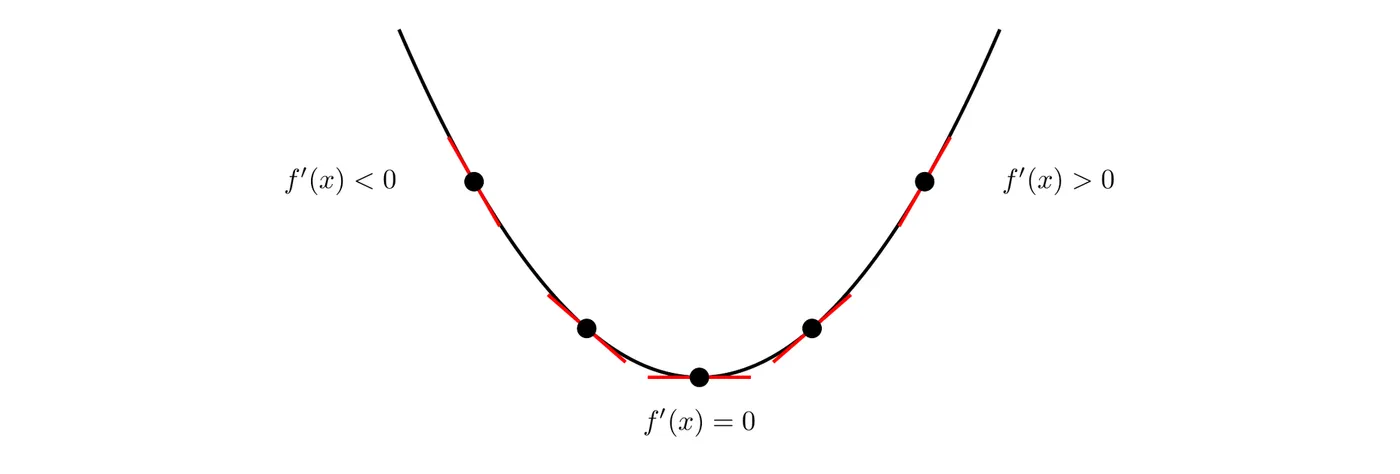
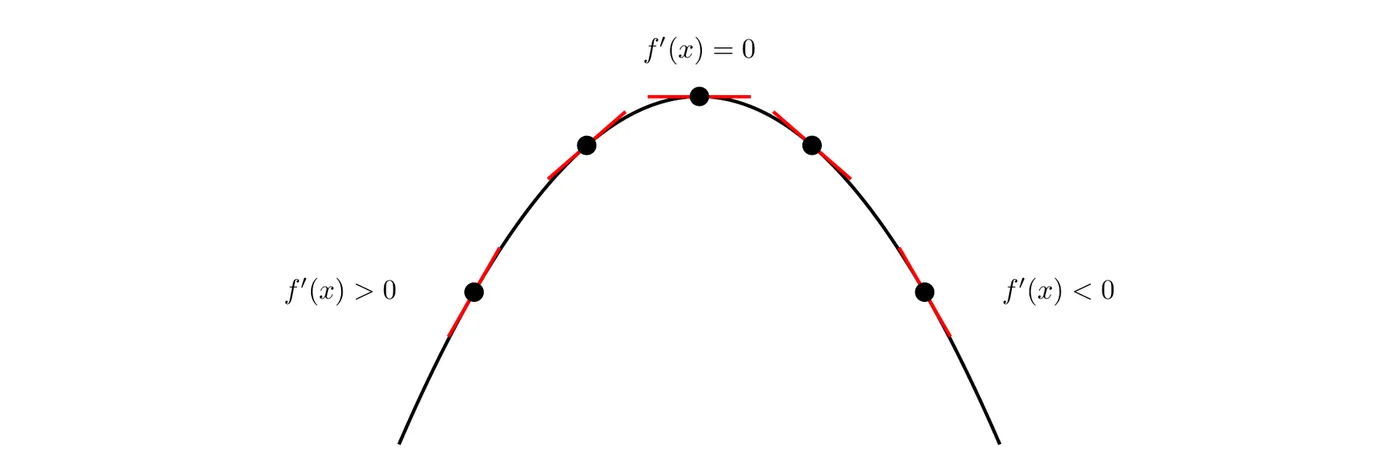
The first derivative test uses the sign of around a critical point to figure out whether it’s a local max or a local min.
For a minimum: goes negative 0 positive
For a maximum: goes positive 0 negative
Formal Justification Statements
Let and be critical numbers.
Minimum: There is a minimum value at because changes sign from negative to positive.
Maximum: There is a maximum value at because changes sign from positive to negative.
Neither: There is no maximum or minimum at a critical point where does not change sign.
For example, has . So is a critical point, but on both sides of it. The function keeps increasing through , so there’s no relative extremum there.
The Procedure
- Find
- Find all critical points (where or doesn’t exist)
- Make a sign chart with intervals between the critical points
- Test the sign of in each interval
- Look at the sign changes to classify each critical point
- Write justification statements
Example 1
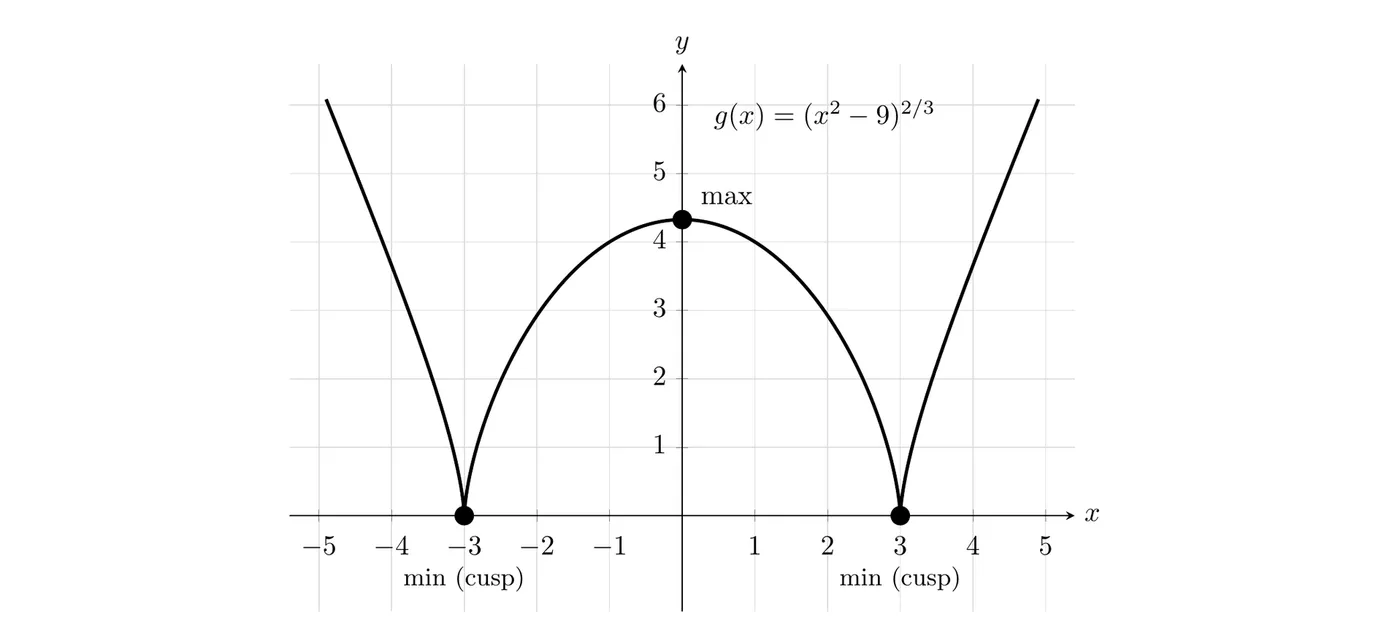
Given .
Step 1: Find the derivative. Chain rule:
Step 2: Find critical points.
when the numerator is zero:
is undefined when the denominator is zero:
Critical points:
Step 3: Sign chart.
Interval | |||||||
Sign of | Undef | Undef |
Step 4: Test points.
- :
- :
- :
- :
Step 5: Classify.
Minimum at and because changes sign from negative to positive.
Maximum at because changes sign from positive to negative.
Example 2: Domain Restrictions
Given , where .
Find the derivative with the quotient rule:
Potential critical points:
From : or
From undefined:
Check the domain. is not in the domain of , it’s a vertical asymptote. So is NOT a critical point and cannot be a max or min. You still put it in the sign chart though, since the behavior can change there.
Sign testing. Since is always positive, you only need to look at the numerator :
- :
- :
- :
Sign chart:
Interval | |||||||
Sign of | Undef (not a CP) |
Classification:
Maximum at because changes sign from positive to negative.
Minimum at because changes sign from negative to positive.
Again, creates a vertical asymptote but it’s not a critical point since it’s not in the domain.
Maximum/Minimum VALUE vs. LOCATION
This distinction matters a lot on exams.
“Where is the maximum?” asks for the x-coordinate:
“What is the maximum value?” asks for the y-coordinate:
So if has a maximum at :
- Location of the maximum:
- Maximum value: , which you get by plugging 3 into the original function
Both of these often show up as multiple choice options, so read the question.
Key Takeaways
- The first derivative test looks at sign changes of at critical points
- Minimum: changes from to
- Maximum: changes from to
- Justification is required: say “ changes sign from ___ to ___”
- The sign chart organizes your info but is not justification by itself
- Points not in the domain cannot be critical points or extrema
- Still include domain restrictions in your sign chart to get the intervals right
- “Where” asks for the -value, “what value” asks for the -value