This lesson takes concepts you already know (increasing/decreasing, concavity, extrema) and applies them to implicitly defined curves. The one big difference: you have to substitute both the x and y values when evaluating derivatives.
Determining If a Curve Is Increasing or Decreasing
Check the sign of dxdy at the point.
If dxdy>0, the curve is increasing
If dxdy<0, the curve is decreasing
Example 1
Determine whether 3x3+3=ln(4y2) is increasing or decreasing at (−1,21).
Step 1: differentiate implicitly with respect to x
9x2+0=4y21⋅8y⋅dxdy
Step 2: simplify
9x2=4y28y⋅dxdy⇒9x2=y2⋅dxdy
Step 3: evaluate at (−1,21)
9(−1)2=212⋅dxdy⇒9=4⋅dxdy⇒dxdy=49
Step 4: conclude
The curve is increasing at (−1,21) because:
(dxdy)(−1,21)=49>0
Notation for Derivatives at a Point
When evaluating derivatives at specific points in implicit differentiation, use subscript notation:
(dxdy)(x0,y0)
That just means the derivative evaluated at the point (x0,y0).
Determining Concavity
Check the sign of dx2d2y at the point.
If dx2d2y>0, the curve is concave up
If dx2d2y<0, the curve is concave down
Example 2
Determine the concavity of x2=ey at (−2,ln4).
Step 1: first derivative
2x=ey⋅dxdy⇒dxdy=ey2x
Step 2: second derivative. Use the quotient rule on ey2x:
dx2d2y=(ey)22⋅ey−2x⋅ey⋅dxdy
Factor out ey:
dx2d2y=e2yey(2−2x⋅dxdy)=ey2−2x⋅dxdy
Step 3: evaluate at (−2,ln4). First get dxdy there:
dxdy=eln42(−2)=4−4=−1
Now the second derivative:
dx2d2y=eln42−2(−2)(−1)=42−4=−21
Step 4: conclude
The curve is concave down at (−2,ln4) because:
(dx2d2y)(−2,ln4)=−21<0
Important: when finding the second derivative, you have to substitute the expression for dxdy from the first derivative before evaluating at the point.
Finding Extrema: The Second Derivative Test
To classify a point as a max, min, or neither:
Step 1: verify it’s a critical point. Check whether (dxdy)(a,b)=0 or does not exist.
Not a critical point → answer is neither
Is a critical point → go to Step 2
Step 2: apply the second derivative test. Evaluate dx2d2y at the point.
dx2d2y>0 → minimum (concave up)
dx2d2y<0 → maximum (concave down)
dx2d2y=0 → inconclusive
Example 3
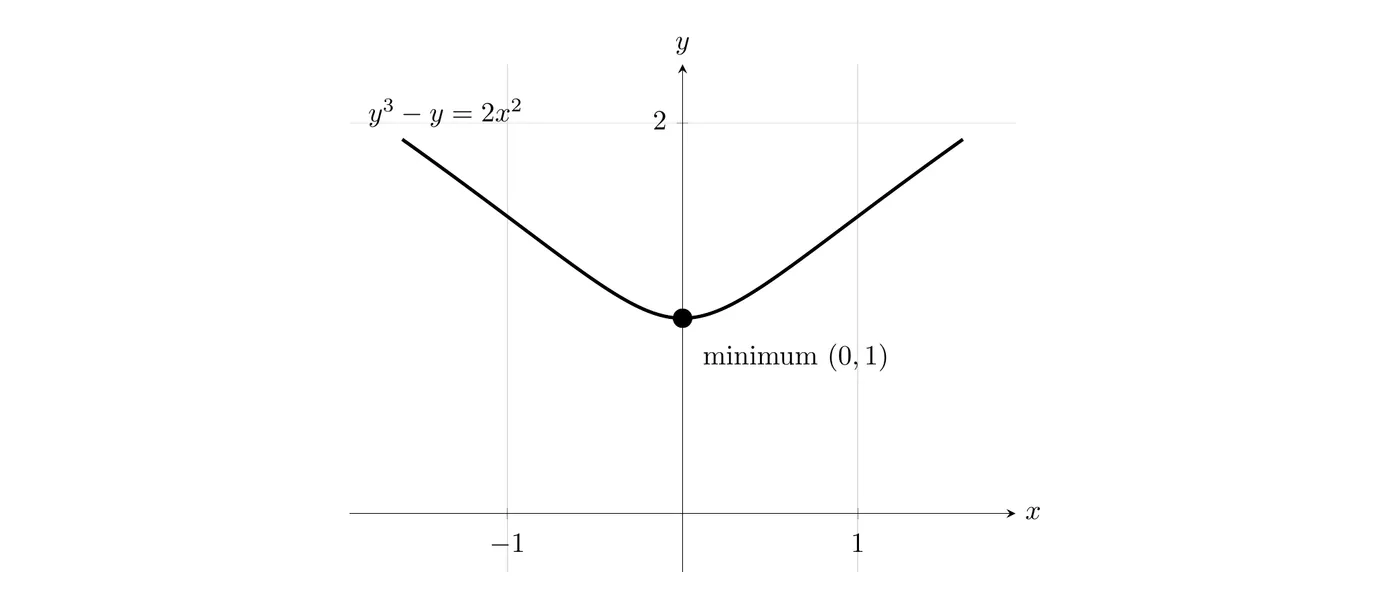
Does y3−y=2x2 have a maximum, minimum, or neither at (0,1)?
Step 1: first derivative
3y2⋅dxdy−dxdy=4x
Factor:
dxdy(3y2−1)=4x⇒dxdy=3y2−14x
Verify it’s a critical point at (0,1):
(dxdy)(0,1)=3(1)2−14(0)=20=0✓
The first derivative is zero, so it’s a critical point. On to Step 2.
Step 2: second derivative. Quotient rule on 3y2−14x:
dx2d2y=(3y2−1)24(3y2−1)−4x⋅6y⋅dxdy
Evaluate at (0,1), where dxdy=0:
dx2d2y=(3−1)24(3−1)−4(0)(6)(1)(0)=48−0=2
Step 3: conclude
The curve has a minimum at (0,1) because:
(dxdy)(0,1)=0
(dx2d2y)(0,1)=2>0
The positive second derivative means the curve is concave up at the critical point, which makes it a minimum.
Finding Critical Points of an Implicit Relation
In Example 3 the point was given. When it isn’t, you have to find the critical points yourself. A critical point of an implicit relation is a point on the curve where dxdy=0 or dxdy does not exist. Since dxdy usually has both x and y in it, you need full points (x,y), not just x-values.
Where dxdy=0: set the numerator equal to zero, then substitute that into the original equation to find the actual points on the curve. The tangent line is horizontal there.
Where dxdy doesn’t exist: set the denominator equal to zero, then substitute that into the original equation too. The tangent line is usually vertical there.
Example 4
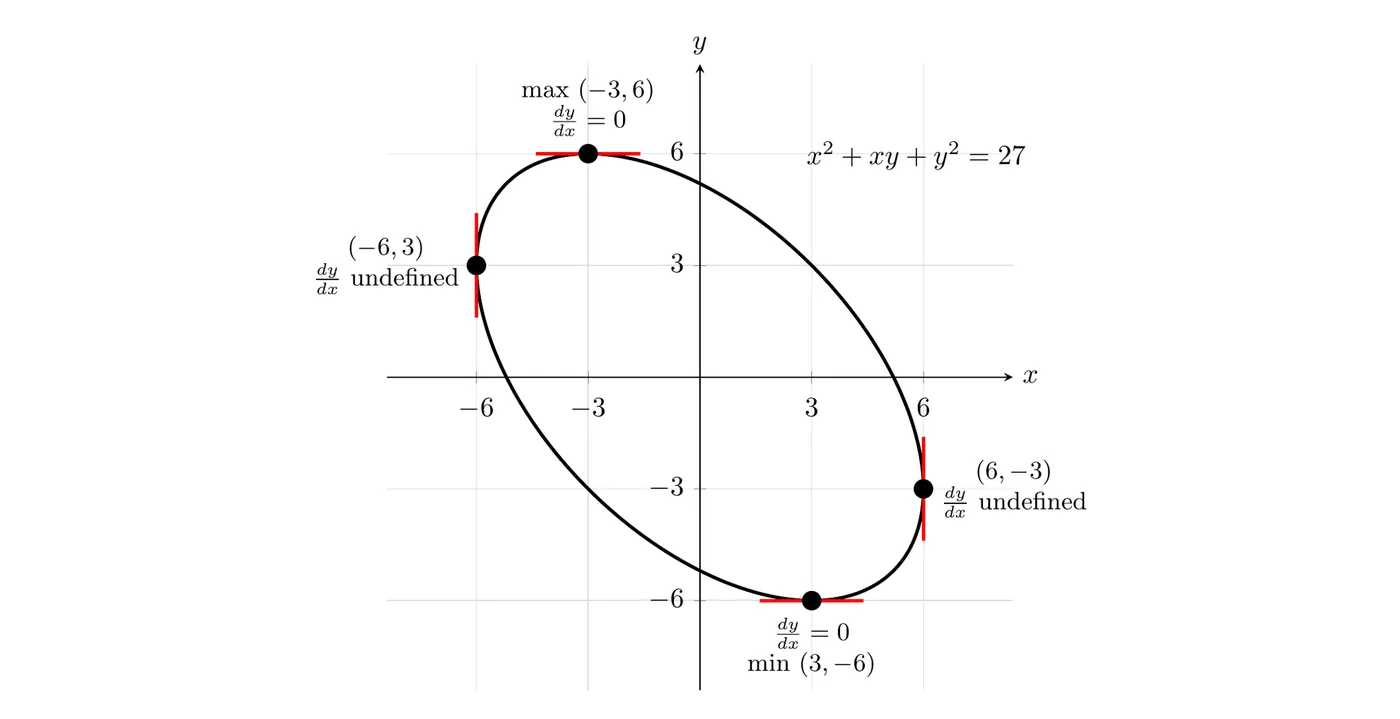
Find all critical points of x2+xy+y2=27. Then classify the ones where dxdy=0.
Step 1: differentiate implicitly with respect to x
The numerator is zero when 2x+y=0, so y=−2x. Substitute into the original equation:
x2+x(−2x)+(−2x)2=27⇒3x2=27⇒x=±3
Since y=−2x, the points are (3,−6) and (−3,6). The denominator x+2y is −9 and 9 there, not zero, so dxdy=0 at both.
Step 3: find where dxdy doesn’t exist
The denominator is zero when x+2y=0, so x=−2y. Substitute:
(−2y)2+(−2y)y+y2=27⇒3y2=27⇒y=±3
Since x=−2y, the points are (−6,3) and (6,−3). The numerator isn’t zero there, so dxdy doesn’t exist, and the tangent lines are vertical.
Step 4: second derivative. Use the quotient rule on dxdy=−x+2y2x+y:
dx2d2y=−(x+2y)2(2+dxdy)(x+2y)−(2x+y)(1+2dxdy)
This second derivative is a relation in x, y, and dxdy, which is normal with implicit differentiation. At both horizontal-tangent points, dxdy=0 and 2x+y=0, so it simplifies to:
dx2d2y=−(x+2y)22(x+2y)−0=−x+2y2
Step 5: conclude
At (3,−6): (dx2d2y)(3,−6)=−−92=92>0, so the curve has a minimum there.
At (−3,6): (dx2d2y)(−3,6)=−92<0, so the curve has a maximum there.
The curve is a tilted ellipse. All four points are critical points: (3,−6) and (−3,6) have horizontal tangents (the lowest and highest points), and (−6,3) and (6,−3) have vertical tangents (the farthest left and right).
Why the Second Derivative Test Works Here
The logic is identical to explicit functions:
First Derivative
Second Derivative
Shape
Result
dxdy=0
dx2d2y>0
Concave up ∪
Minimum
dxdy=0
dx2d2y<0
Concave down ∩
Maximum
dxdy=0
dx2d2y=0
Indeterminate
Inconclusive
Note: the first derivative test is a pain with implicit relations, because testing values on either side of a critical point means you’d need both the x and y coordinates of nearby points, which isn’t practical. The second derivative test only needs one point.
Summary of Justification Statements
Increasing: the curve is increasing at (a,b) because (dxdy)(a,b)>0
Decreasing: the curve is decreasing at (a,b) because (dxdy)(a,b)<0
Concave up: the curve is concave up at (a,b) because (dx2d2y)(a,b)>0
Concave down: the curve is concave down at (a,b) because (dx2d2y)(a,b)<0
Minimum: there’s a minimum at (a,b) because (dxdy)(a,b)=0 and (dx2d2y)(a,b)>0
Maximum: there’s a maximum at (a,b) because (dxdy)(a,b)=0 and (dx2d2y)(a,b)<0
Neither: neither a max nor a min at (a,b) because (dxdy)(a,b)=0, so it isn’t a critical point
Problem-Solving Strategy
Differentiate implicitly with respect to x
Simplify the expression for dxdy (solve for it if you’ll need the second derivative)
Substitute the point(x0,y0), and remember you need both coordinates
Evaluate the numerical result
Interpret the sign (positive, negative, or zero)
Write the conclusion with justification
Key Takeaways
Nothing new conceptually: same ideas as before, just applied to implicit curves
Both coordinates needed: substitute both x and y when evaluating
Subscript notation:(dxdy)(a,b) means the derivative evaluated at (a,b)
Finding critical points: set the numerator of dxdy equal to zero (horizontal tangents) or the denominator equal to zero (vertical tangents), then substitute back into the original equation to get the points
Increasing:dxdy>0 at the point
Decreasing:dxdy<0 at the point
Concave up:dx2d2y>0 at the point
Concave down:dx2d2y<0 at the point
Second derivative: substitute the dxdy expression before evaluating
Extrema require two checks: first derivative equals 0, then check the sign of the second derivative
Use the second derivative test: the first derivative test is impractical for implicit relations
Always justify: state the derivative value and its sign as your reason