

5.7 - Using the Second Derivative Test to Determine Extrema
Understanding the Test
The second derivative test uses the value of at a critical point to classify it as a max or min.
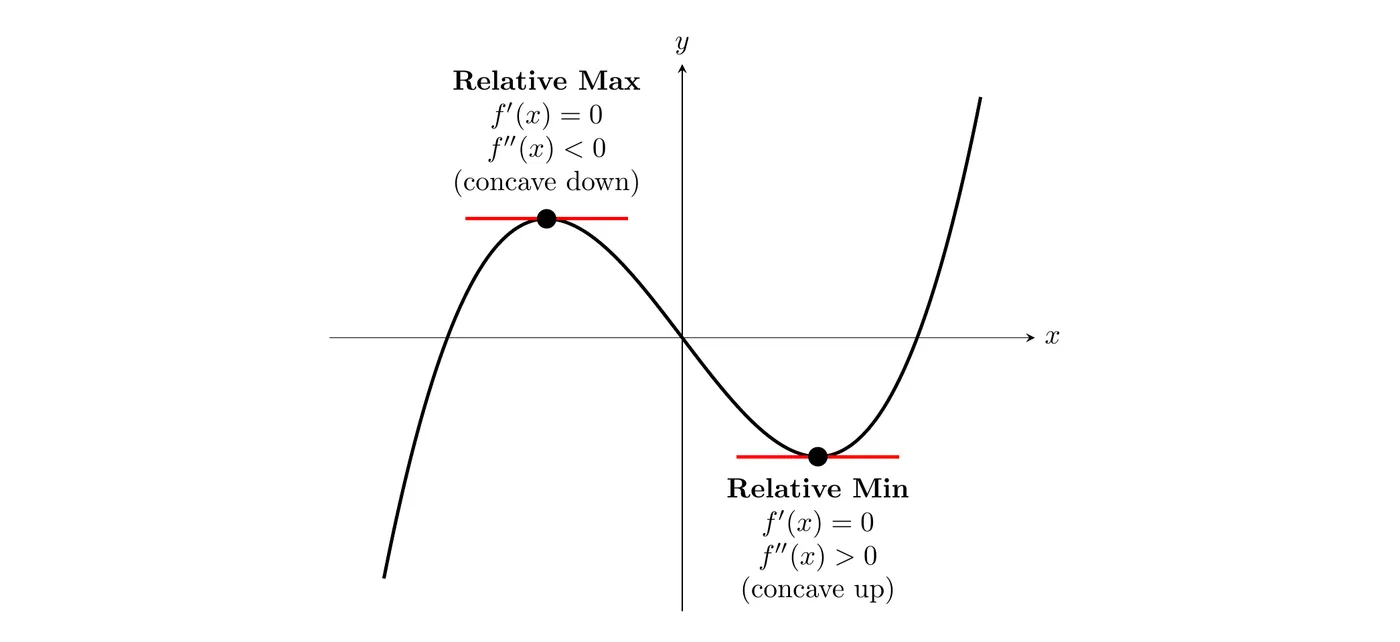
At a maximum: (horizontal tangent) and (concave down)
At a minimum: (horizontal tangent) and (concave up)
The Test
Suppose and exists.
Important: the second derivative test only works when . It does not apply at critical points where the derivative doesn’t exist.
Why it works: concave down with a horizontal tangent means the function curves downward away from that point, so it’s a max. Concave up with a horizontal tangent means it curves upward, so it’s a min.
The Procedure
- Find and solve to get critical points
- Find
- Evaluate at each critical point where
- Classify:
- means relative maximum
- means relative minimum
- means the test is inconclusive, use the first derivative test instead
Example 1
Find and classify all relative extrema of .
Step 1: Critical points.
Step 2: Second derivative.
Step 3: Evaluate.
Step 4: Classify.
Relative maximum at because and .
Relative minimum at because and .
Relative minimum at because and .
Justification format: always state both conditions, that the first derivative is zero AND that the second derivative is positive or negative.
Example 2
Find and classify all relative extrema of on .
Step 1: Critical points.
Step 2: Second derivative.
Step 3: Evaluate.
Step 4: Classify.
Relative maximum at because and .
Relative minimum at because and .
Example 3: Product with an Exponential
Find and classify all extrema of .
Step 1: First derivative (product rule).
Factor out :
Set it to zero. Since is never zero:
Step 2: Second derivative (product rule again).
Step 3: Evaluate at .
Step 4: Classify.
Relative maximum at because and .
And since is the only critical point, this is actually an absolute maximum.
Absolute Extrema with One Critical Point
Special case: if a function is continuous on an interval and has only one critical point there, and that point is a relative extremum, then it has to be an absolute extremum on that interval, not just a relative one.
The reasoning: if there’s only one critical point and it’s a maximum, there are no other peaks anywhere, so it’s the highest point on the whole function. Same logic for a minimum.
Continuity matters here. For example, has only one critical point, a relative minimum at . But isn’t continuous at , and just to the left of it drops toward , so is not the absolute minimum.
So if has only one critical point at :
- If and , then is an absolute maximum
- If and , then is an absolute minimum
When the Second Derivative Test Fails
If , the test is inconclusive and you have to fall back on the first derivative test.
Example: for :
- , so there’s a critical point at
- , so the test fails
- Use the first derivative test instead: changes from negative to positive, so there’s a minimum at
Key Takeaways
- Second derivative test: if and it’s a relative max; if it’s a relative min
- The first derivative must equal zero, not just fail to exist
- Concave down at a horizontal tangent means maximum
- Concave up at a horizontal tangent means minimum
- Justification needs both parts: AND the sign of
- Continuous on an interval with only one critical point there, and it’s an extremum? Then it’s an absolute extremum on that interval
- The test fails when , so use the first derivative test
- Often easier than the first derivative test, since you only evaluate at the critical points instead of testing whole intervals