

5.6 - Determining Concavity of Functions over Their Domains
Understanding Concavity
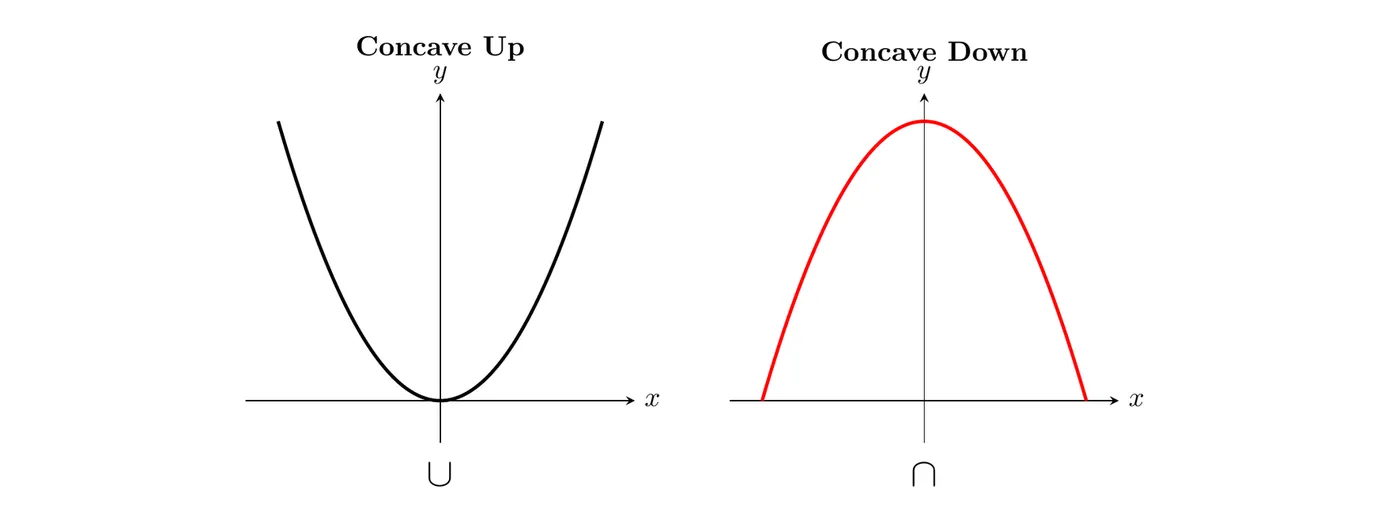
Concavity describes which way a curve bends.
Concave up: opens upward like a cup that holds water,
Concave down: opens downward like an upside-down cup,
No concavity: a straight line has none
Concavity and the First Derivative
When a function is concave up, the slope (the first derivative) is increasing.
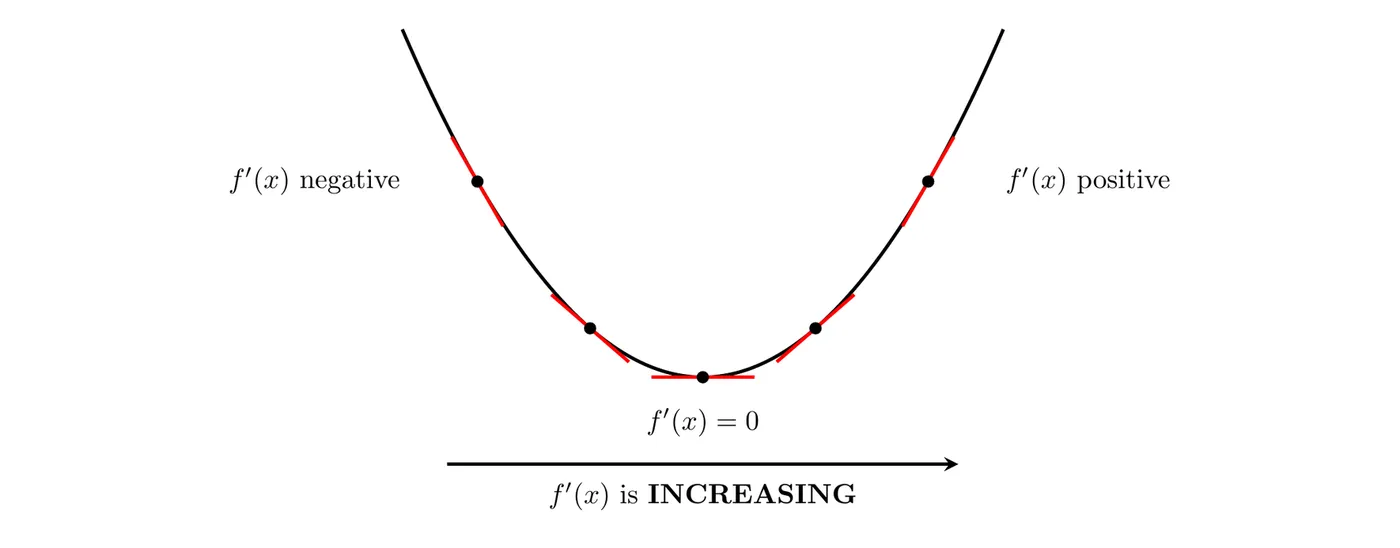
Moving left to right, the slope goes negative zero positive. The derivative values are increasing.
When a function is concave down, the slope is decreasing.
The Second Derivative Test for Concavity
If increasing means , and , then:
Mnemonic: positive second derivative is a happy face (concave up). Negative second derivative is a sad face (concave down).
Finding Intervals of Concavity
- Find
- Solve and find where doesn’t exist
- Make a sign chart
- Test the sign of in each interval
- Interpret: positive means concave up, negative means concave down
Example 1
Find the intervals of concavity for .
Step 1: First derivative.
Step 2: Second derivative.
Step 3: Solve .
Step 4: Sign chart.
Interval | |||||
Sign of |
Test points:
- :
- :
- :
Step 5: Conclusions.
Concave up on because .
Concave down on because .
Points of Inflection
A point of inflection happens at where:
- is continuous at
- The concavity changes (which means changes sign)
The key idea: a point of inflection is where the graph changes concavity.
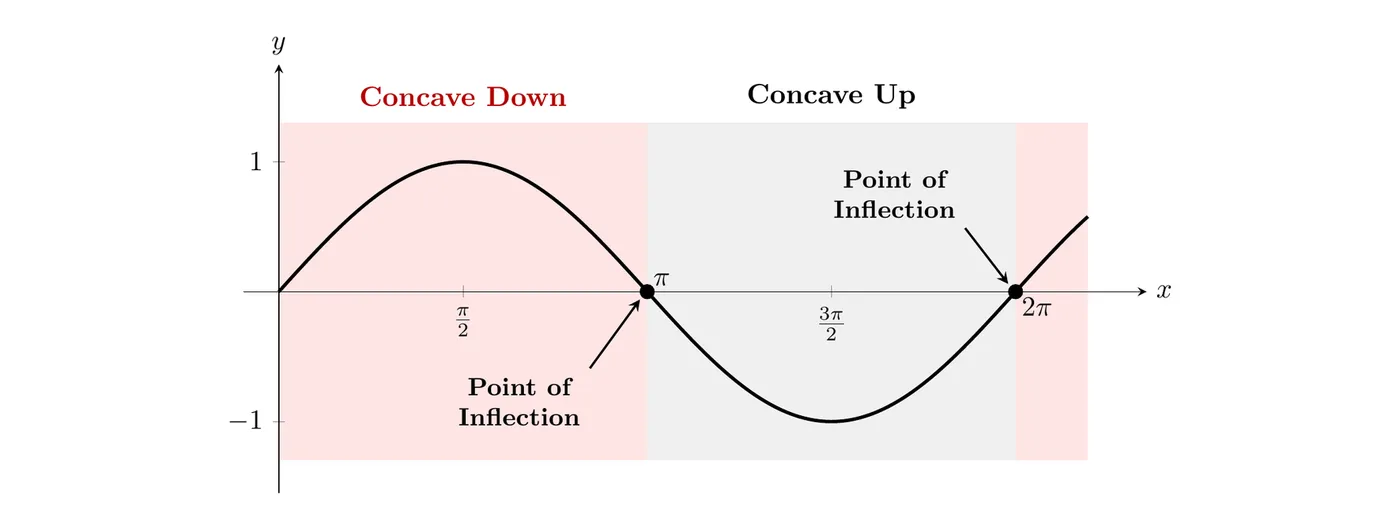
Back to Example 1
Points of inflection at and because changes sign there.
- At : changes from to
- At : changes from to
Justification: points of inflection exist because changes sign.
Common Mistakes
Wrong: “If , then is a point of inflection.”
Right: “ is a candidate for a point of inflection. You have to verify the sign change.”
Wrong: “If doesn’t exist, there can’t be a point of inflection.”
Right: “Even if doesn’t exist, there can still be a point of inflection as long as concavity changes.”
Point of Inflection Where Doesn’t Exist
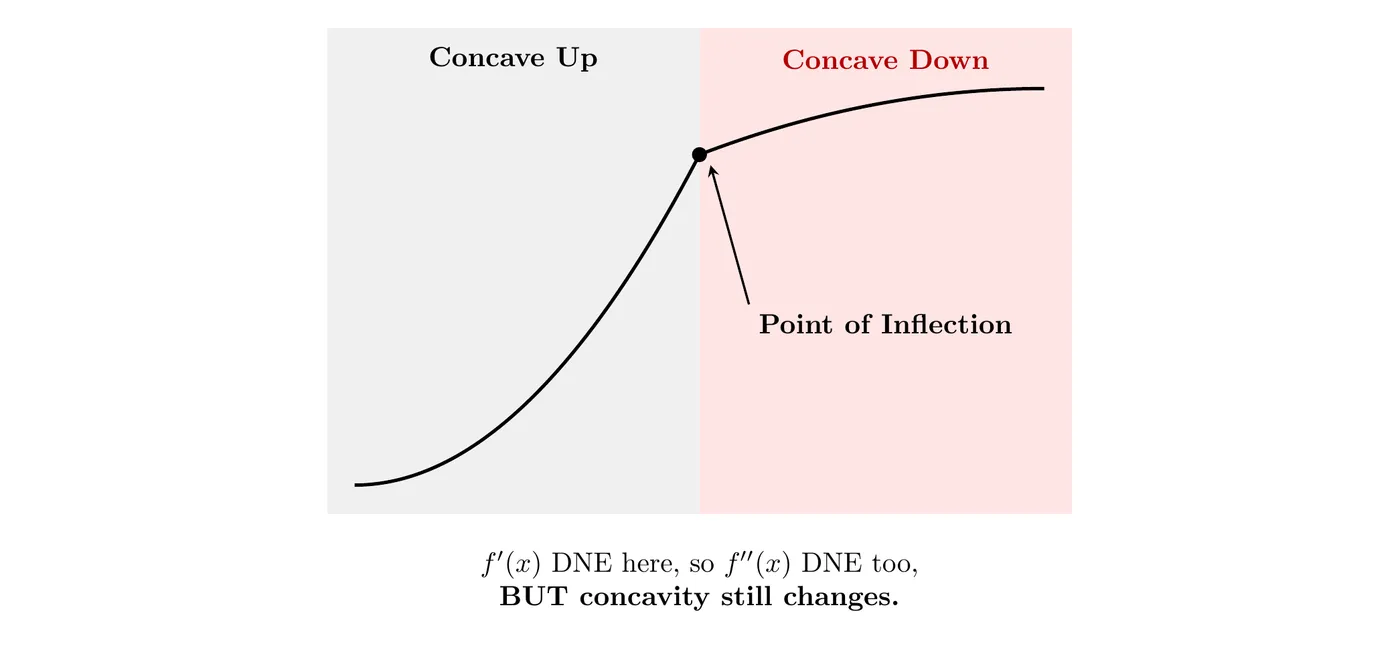
All you need for a point of inflection:
- must be continuous at
- Concavity must change
The second derivative doesn’t have to exist.
Reading from the Graph of
Given the graph of :
Concave up where is increasing (the slope of is positive)
Concave down where is decreasing (the slope of is negative)
Example 2
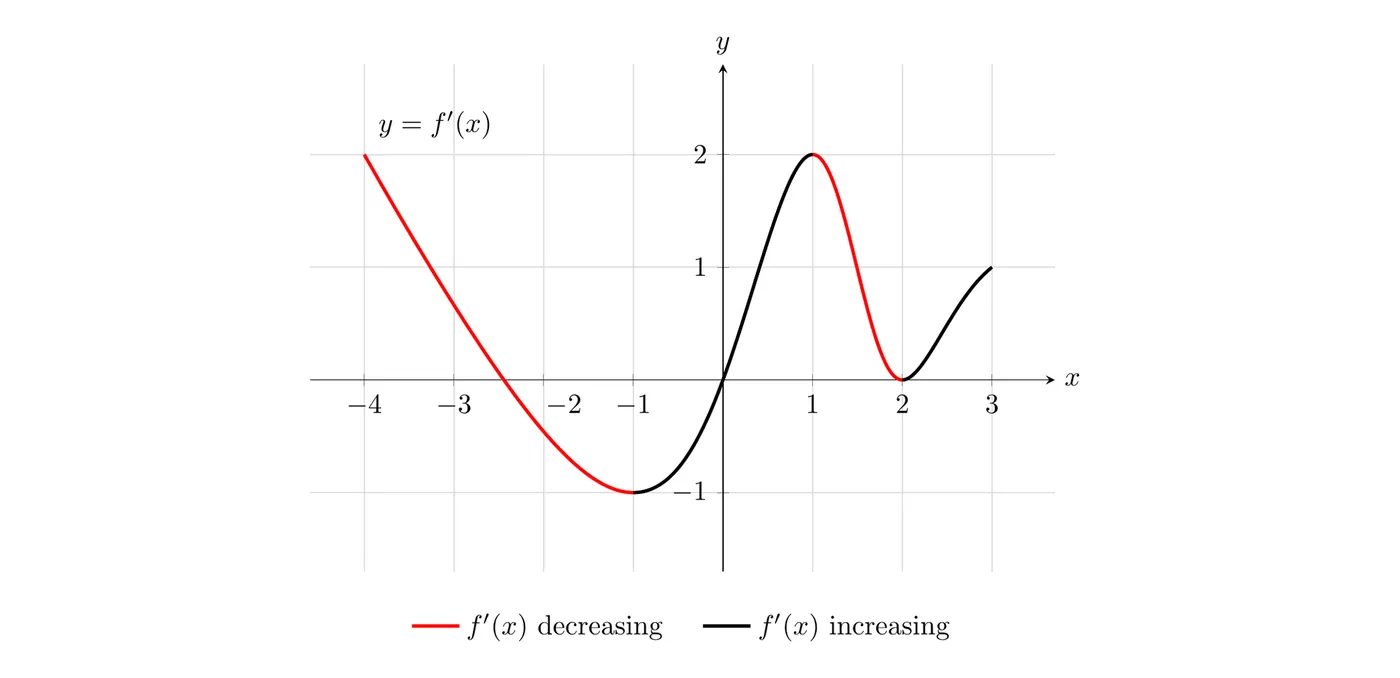
Where is decreasing? On and .
Where is increasing? On and .
Conclusions about :
Concave down on because is decreasing.
Concave up on because is increasing.
Points of inflection at because concavity changes there.
Reading from the Graph of
Given the graph of the second derivative:
Concave up where (above the x-axis)
Concave down where (below the x-axis)
Points of inflection where crosses the x-axis (changes sign)
Example 3
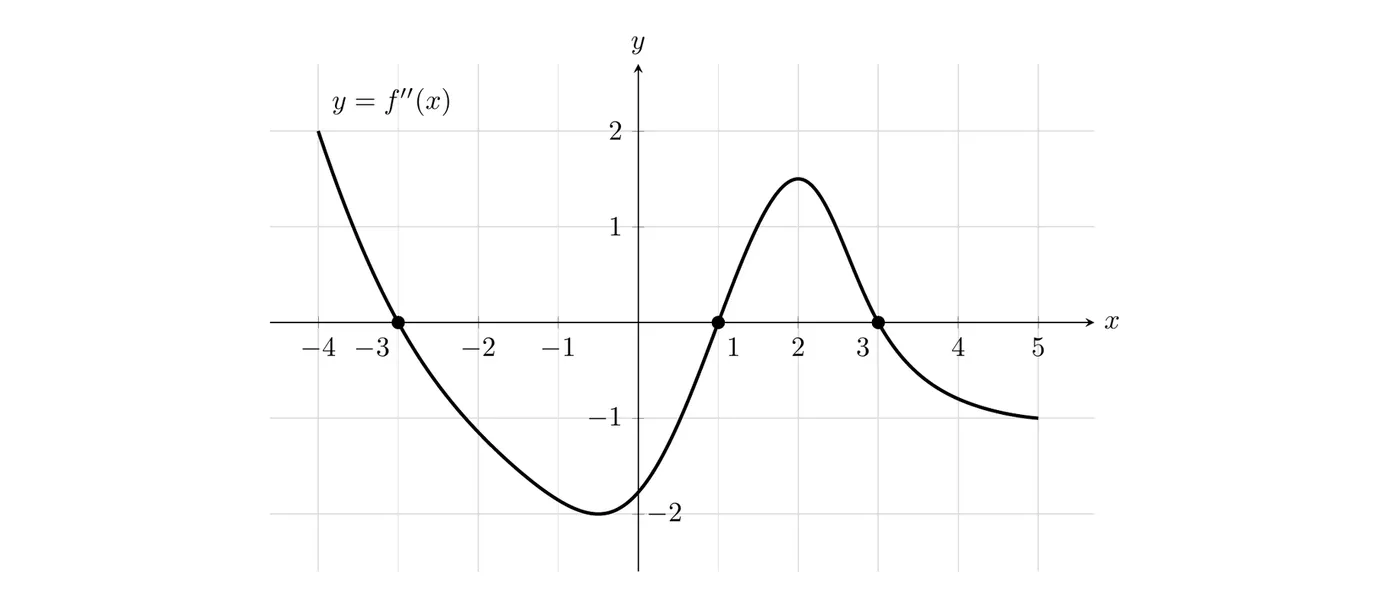
Where is ? Above the axis:
Where is ? Below the axis:
Concave up on
Concave down on
Points of inflection at where crosses the x-axis
Application: Tangent Line Estimates
Concavity tells you whether a tangent line approximation is an overestimate or an underestimate.
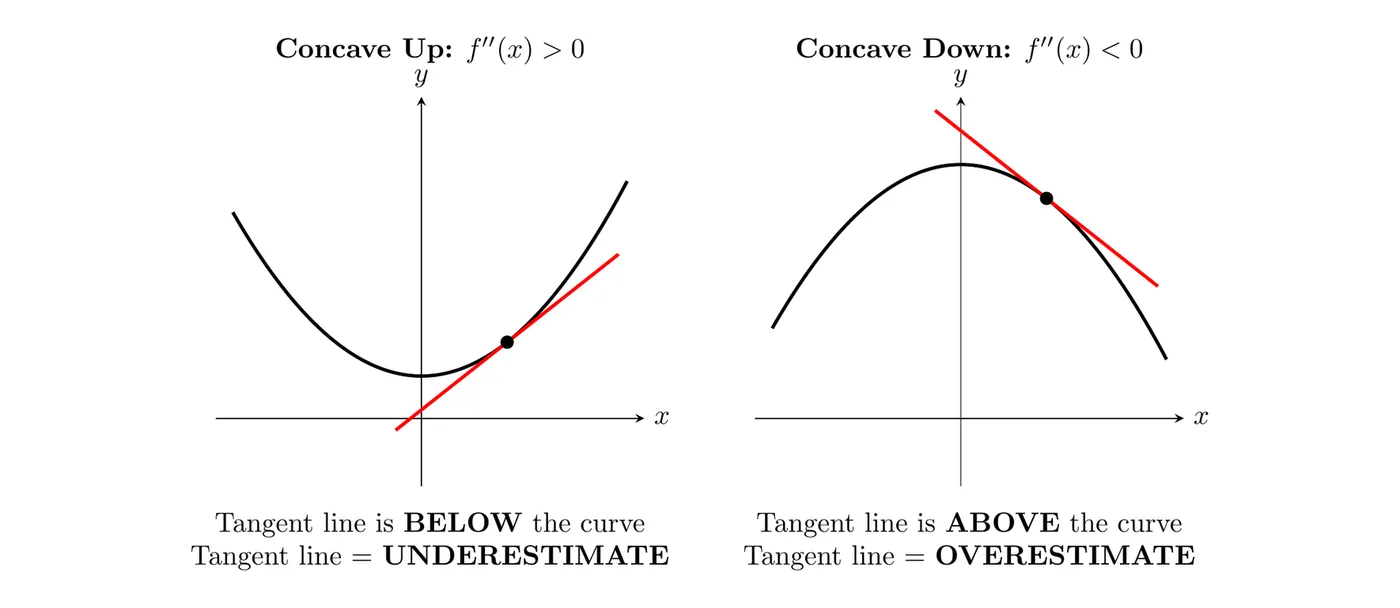
- If (concave up), the tangent line lies below the curve, so it’s an underestimate
- If (concave down), the tangent line lies above the curve, so it’s an overestimate
Example 4
Does the tangent line to at lie above or below the curve?
First derivative (product rule):
Second derivative:
Evaluate at :
Since , the function is concave down at , so the tangent line there lies above the curve. It’s an overestimate.
Side note: at , , so that’s a candidate for a point of inflection, not a place where you can call the tangent line an over or underestimate.
Key Takeaways
- Concave up: (happy face )
- Concave down: (sad face )
- Concave up is the same as saying is increasing
- Concave down is the same as saying is decreasing
- A point of inflection happens where concavity changes, meaning changes sign
- does NOT guarantee a point of inflection, you have to verify the sign change
- A point of inflection can exist even if is undefined
- From the graph of : look at where increases or decreases
- From the graph of : look at where it’s above or below the x-axis
- Tangent line estimates: concave up means underestimate, concave down means overestimate