

5.2 - Extreme Value Theorem, Global Versus Local Extrema, and Critical Points
The Extreme Value Theorem
If a function is continuous on a closed interval , then has to have both:
- At least one absolute maximum
- At least one absolute minimum
This seems obvious, but it’s a fundamental guarantee. Every continuous function on a closed interval reaches both a highest and a lowest point.
Special case: for a horizontal line segment, every point is both an absolute maximum and an absolute minimum at the same time, since all the -values are equal.
Both conditions matter. If either one is missing, there’s no guarantee:
- Not a closed interval: on the open interval has no absolute maximum or minimum. Its values get closer and closer to and but never reach them, because the endpoints aren’t included.
- Not continuous: on has no absolute maximum or minimum. It isn’t continuous at (a vertical asymptote), where it shoots up to on one side and down to on the other.
A function that breaks a condition can still have extrema. The graph under Identifying Extrema on a Graph below has a jump at , and it still has an absolute max and an absolute min. The theorem just doesn’t promise them.
Justification to write: “Since is continuous on the closed interval , the Extreme Value Theorem guarantees that has an absolute maximum and an absolute minimum on .”
Terminology: Two Ways to Say the Same Thing
Different textbooks and teachers use different words for the same ideas.
Common Term 1 | Common Term 2 | Meaning |
Global extrema | Absolute extrema | Highest or lowest point on the entire domain |
Local extrema | Relative extrema | Highest or lowest point in a neighborhood |
Extrema, the plural of extremum, means maximum or minimum points.
These notes use the “absolute” and “relative” terminology.
Absolute vs. Relative Extrema
Absolute Maximum/Minimum
The highest or lowest point on the entire function, or on the given interval.
Absolute maximum: for all in the domain
Absolute minimum: for all in the domain
Relative Maximum/Minimum
A point that is higher or lower than all the nearby points.
Relative maximum: for all in some open interval around
Relative minimum: for all in some open interval around
Test for relative extrema: construct a small open interval around the point. If the point is higher (or lower) than every other point in that interval, it’s a relative max (or min).
Identifying Extrema on a Graph
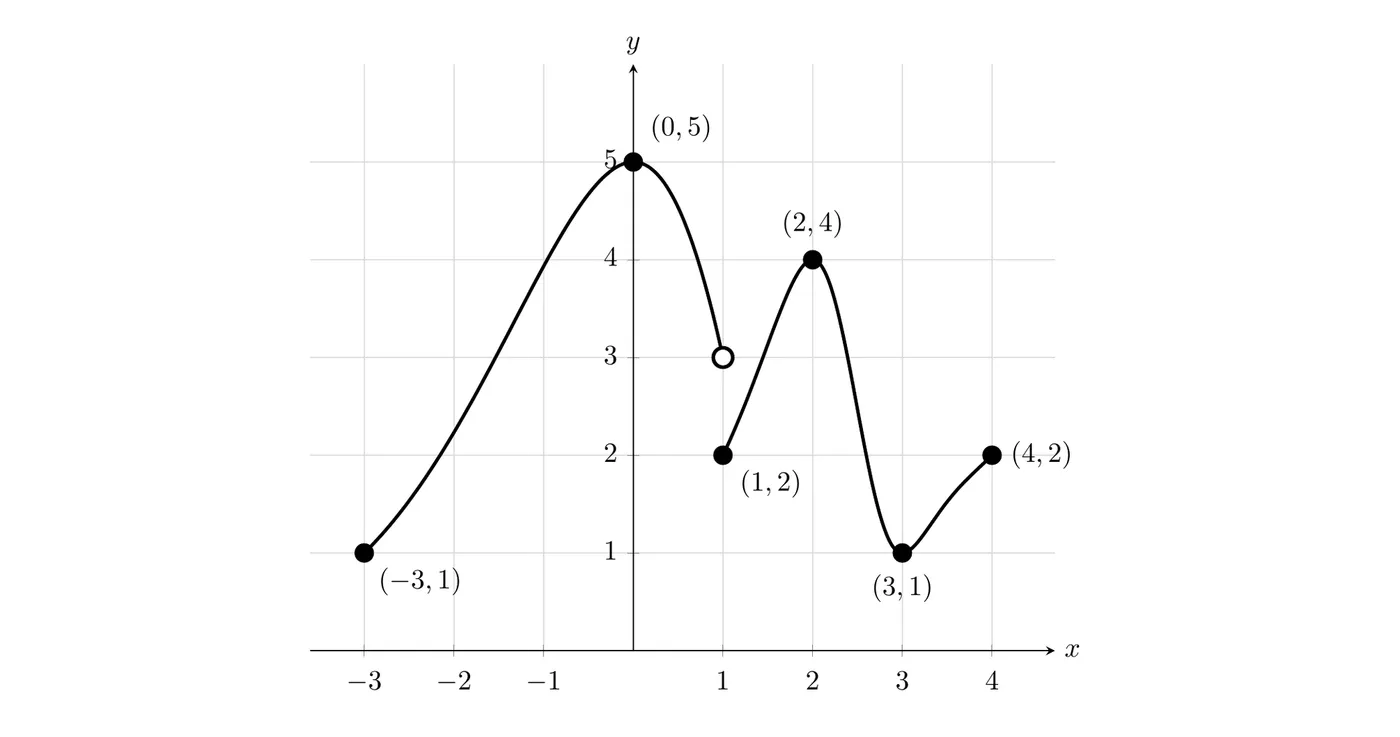
Analysis of the extrema:
At : absolute minimum of 1, since it’s the lowest -value on the whole graph
At : absolute maximum of 5, since it’s the highest -value on the whole graph
At : relative minimum of 2. Construct an open interval around , and the point is lower than the points to its left and right, so it’s a relative minimum
At : relative maximum of 4, since it’s higher than the nearby points, a peak
At : relative minimum of 1, since it’s lower than the nearby points, a valley. It also ties x = -3 for the lowest y-value on the whole graph, so it’s an absolute minimum too
At : controversial, see the endpoint discussion below
The Endpoint Controversy
The question: can an endpoint be a relative extremum if it isn’t absolute?
Consider the endpoint at in the graph above, where .
Argument FOR it being a relative maximum:
- It’s higher than all the points in its domain to the left
- It’s “relatively” higher than the nearby points that actually exist
Argument AGAINST it being a relative maximum:
- An open interval around extends to the right, where no points exist
- “Relative” should mean relative to points on both sides
- You can’t compare to points that don’t exist
Bottom line: mathematicians debate this, and different textbooks take different stances.
For this course:
- Absolute extrema at endpoints are always valid
- Relative extrema at endpoints: check with your instructor
- AP exams avoid asking about this controversial case
Practice: Identifying Extrema
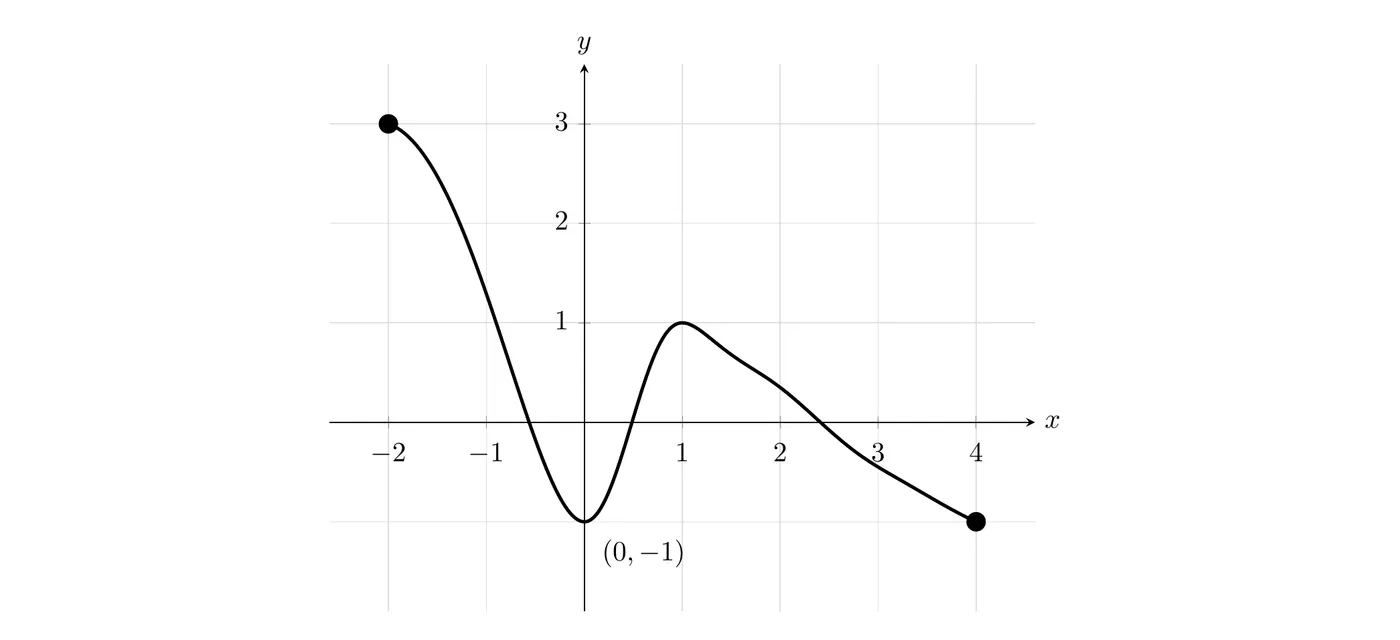
Extrema identification:
Absolute maximum of 3 at , since it’s the highest -value on the graph
Relative minimum of at , since it’s lower than the surrounding points, a valley. It also ties for the lowest -value on the whole graph, so it’s an absolute minimum too
Relative maximum of 1 at , since it’s higher than the surrounding points, a peak
At : absolute minimum of , tied with for the lowest -value on the graph. It’s also a relative minimum, if endpoints count as relative extrema
Critical Points: Definition and Importance
Critical point: a point in the domain of where:
Why critical points matter: they’re candidates for local extrema, meaning maxima or minima.
Important distinction:
- Critical point ≠ guaranteed extremum
- Critical point = possible extremum
Every relative extremum (away from the endpoints) happens at a critical point, but not every critical point is a relative extremum. You have to test critical points to see if they’re actually extrema.
Example: has , so and is a critical point. But on both sides of , so keeps increasing right through it. The graph levels off for an instant at the origin without making a peak or a valley, so is a critical point that is not an extremum.
Why Critical Points Matter: The Derivative Connection
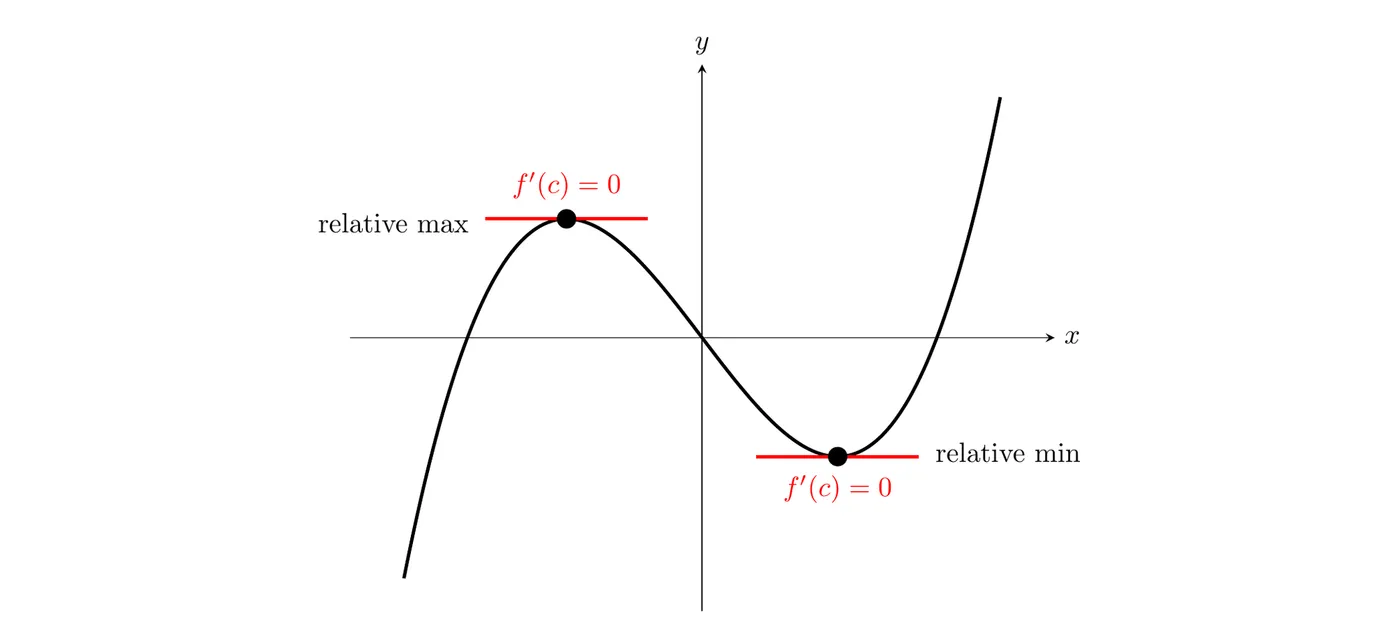
At every relative extremum, either or does not exist. The two most common shapes:
At a smooth peak or valley: , which is a horizontal tangent line
At a sharp corner: does not exist
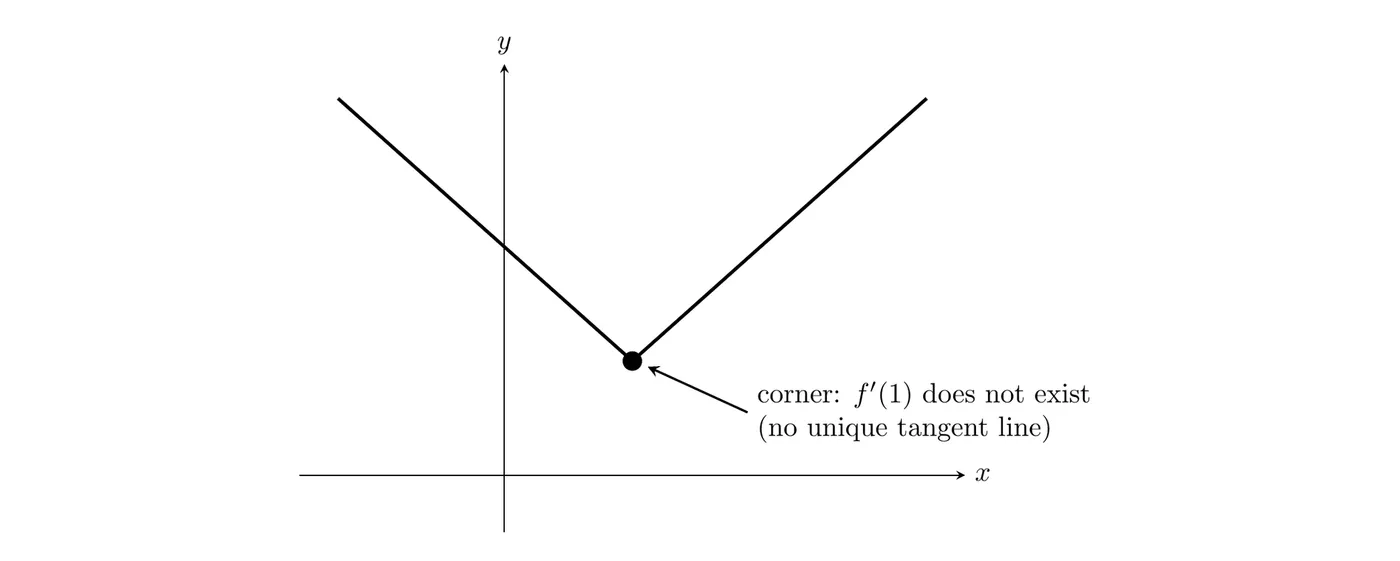
Observation: both types of points, where and where doesn’t exist, are critical points.
Finding Critical Points: The Process
Step 1: Find . Take the derivative of the function.
Step 2: Solve . Find all the -values where the derivative equals zero.
Step 3: Find where does not exist. Identify the -values where the derivative is undefined.
Step 4: Check the domain. This is critical. Only include -values that are in the domain of the original function . If doesn’t exist at some point, that point can’t be a critical point, even if is undefined there.
Example 1: Polynomial Function
Find all critical points of .
Step 1: Find the derivative
Step 2: Solve
Step 3: Where does not exist?
is a polynomial, so it exists for all real numbers. No issues here.
Step 4: Check the domain
Both and are in the domain of .
Critical points:
These are candidates for relative extrema.
Example 2: Rational Function with Radicals
Find all critical points of .
Step 1: Rewrite for easier differentiation
Step 2: Find the derivative using the chain rule
Rewrite as a fraction:
Step 3: Solve
A fraction equals zero only when the numerator equals zero, so:
Step 4: Where does not exist?
The derivative is undefined when the denominator equals zero:
Step 5: Check the domain of the original function
For to exist, we need , which means .
Critical check: and make the original function undefined, so they are NOT in the domain of .
Even though doesn’t exist, those are not critical points, because the original function doesn’t exist there.
Critical point:
Only is a critical point, since and exists.
Example 3: Trig Function
Find all critical points of on .
Step 1: Find the derivative
Step 2: Solve
Using the identity :
Case 1: , so on
Case 2: , so , giving on
Step 3: Where does not exist?
is continuous everywhere, since it’s a combination of sine and cosine.
Critical points on :
Summary: Critical Points Checklist
- Find
- Solve
- Find where does not exist
- Verify all the points are in the domain of
- Remember: critical points are candidates, not guarantees, for extrema
Key Takeaways
- Extreme Value Theorem: continuous functions on closed intervals have an absolute max and an absolute min
- Absolute extrema: highest or lowest on the entire domain
- Relative extrema: highest or lowest in a neighborhood
- Critical points occur where or does not exist
- Critical points are candidates. Not all critical points are extrema
- Domain matters. If doesn’t exist, then can’t be a critical point
- Endpoint controversy: whether endpoints can be relative extrema is debated, but absolute extrema at endpoints are always valid
- Every relative extremum occurs at a critical point (absolute extrema can also be at endpoints), which is why finding critical points is essential