

5.10 - Introduction to Optimization Problems
What Is Optimization?
Optimize means to make the best or most effective use of a situation or resource. In calculus, that means finding:
- Maximum values (largest, most, greatest)
- Minimum values (smallest, least, shortest)
These show up constantly in business, engineering, economics, and physics.
The Optimization Process
This lesson covers the first three steps.
Step 1: Draw a picture (if it applies). Sketch the situation to see the known and unknown quantities.
Step 2: Write an equation to optimize. Figure out what quantity you need to max or min, then write an equation for it.
Step 3: Express it in terms of one variable. Use constraint equations to eliminate extra variables. You need one variable before you can take the derivative.
Steps 4 and 5 (taking derivatives and solving) come in the next lesson. This one is all setup.
Example 1: Product of Two Numbers
Problem: Find two positive numbers whose sum is 24 and whose product is as large as possible.
What to optimize: the product, and we want it as large as possible, so a maximum.
Step 1: No picture needed here.
Step 2: Let the two numbers be and .
Step 3: The constraint is that the sum is 24.
Substitute:
Result: the equation to optimize is , and it’s in one variable.
Next lesson, we’d find , set it equal to zero, and solve.
Example 2: Distance to a Curve
Problem: What point on the graph is closest to the point ?
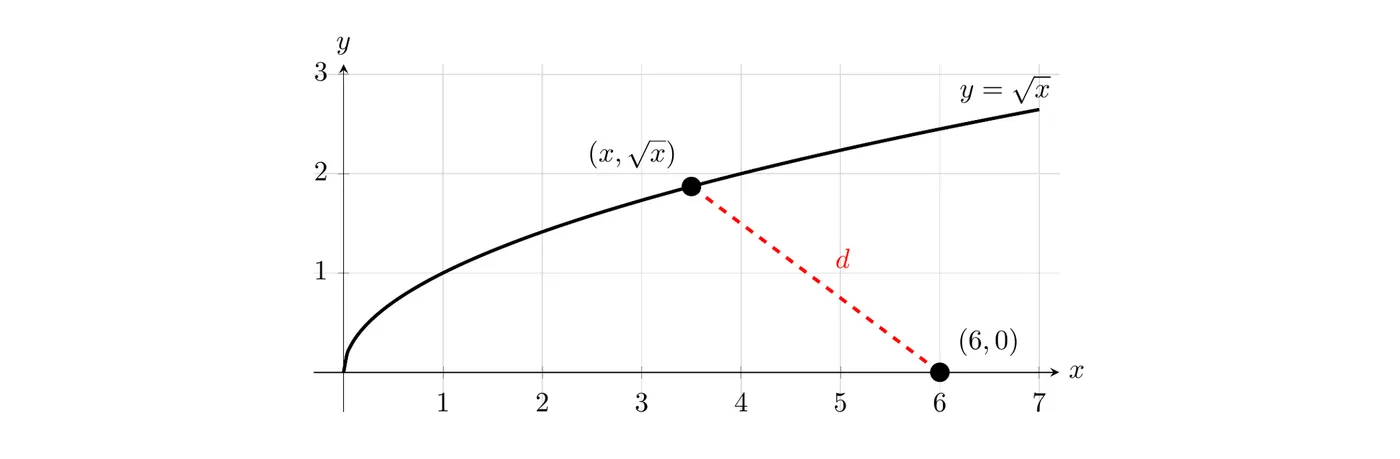
What to optimize: distance, and we want it smallest, so a minimum.
Step 2: Use the distance formula.
The two points are on the curve and .
Step 3:
That’s already one variable. The curve equation gave us the y-coordinate in terms of for free.
Result:
Handy trick: it’s often easier to minimize instead of , since that kills the square root and they have the same critical points.
Example 3: Box with Maximum Volume
Problem: A rectangular piece of cardboard measuring 20 inches by 32 inches has squares cut from each corner. The sides fold up to make an open-top box. What size squares maximize the volume?
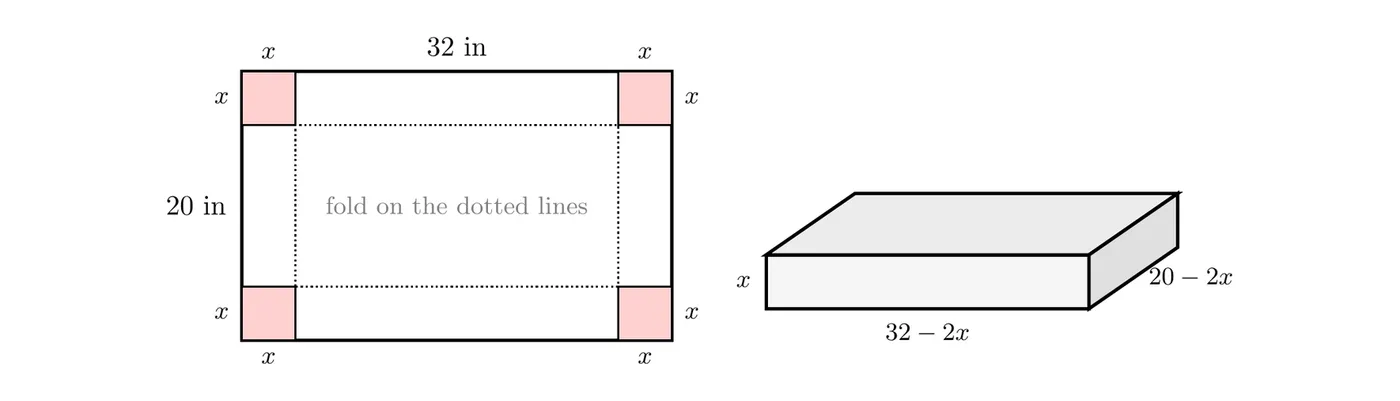
What to optimize: volume, and we want it largest, so a maximum.
Step 2:
Step 3: After cutting squares of side from each corner:
- Length of the base: (you lose a square from each end)
- Width of the base:
- Height of the box: (once folded up)
Expand:
Result: , one variable.
Domain: since you’re cutting squares from corners, (half of the shorter side).
Example 4: Minimizing Wire Length
Problem: Two vertical poles stand 40 feet apart. One is 20 feet tall, the other is 15 feet tall. A wire runs from the top of each pole to a single stake on the ground between them. Where do you put the stake to use the least wire?
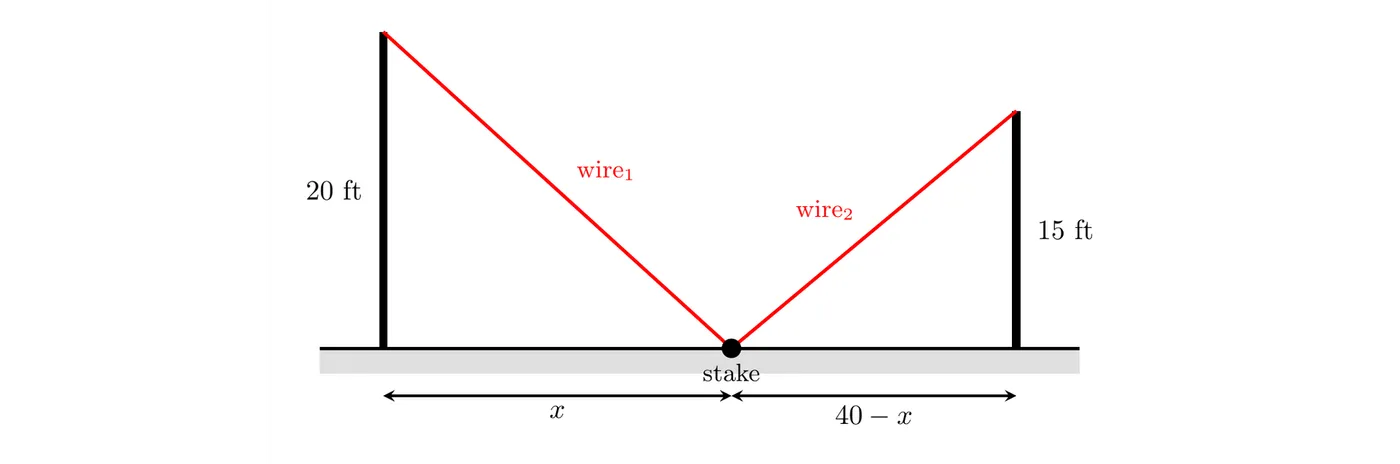
What to optimize: total wire length, and we want the least, so a minimum.
Step 2:
Step 3: Let be the distance from the left pole to the stake, so is the distance from the stake to the right pole. Pythagorean theorem on each right triangle:
Result: , one variable.
Domain:
Key Strategy: Using Constraints
When you have two variables but need one:
- Find the constraint equation, usually given in the problem
- Solve the constraint for one variable in terms of the other
- Substitute into the optimization equation
Pattern: optimize subject to .
- From the constraint:
- Substitute:
- Now it’s in one variable
Common Optimization Setups
Scenario | What to Optimize | Common Formula |
Area problems | Area | or |
Volume problems | Volume | or |
Distance problems | Distance | |
Cost problems | Cost | |
Revenue problems | Revenue | |
Profit problems | Profit |
Setup Checklist
Before you take the derivative, make sure you’ve:
- Identified what quantity to maximize or minimize
- Drawn a picture if applicable (especially for geometry problems)
- Labeled known quantities with numbers
- Labeled unknown quantities with variables
- Written the primary equation (the thing you’re optimizing)
- Identified and used the constraint equation
- Reduced everything to one variable only
- Simplified the equation (optional but it helps)
Key Takeaways
- Optimization means finding maximum or minimum values
- Keywords to watch for: largest, smallest, most, least, greatest, shortest, maximum, minimum
- Three setup steps: draw a picture, write the equation, convert to one variable
- The primary equation is the quantity you want to optimize (area, volume, distance, cost, etc.)
- The constraint equation is extra info that relates the variables
- Use constraints to eliminate extra variables through substitution
- You must have one variable before taking the derivative
- The Pythagorean theorem is useful for distance and geometry problems
- Domain matters, so think about physical constraints (lengths can’t be negative, etc.)
- This lesson is setup only, solving comes next