

5.11 - Solving Optimization Problems
The Complete Process
This lesson picks up at Steps 4 and 5, building on the setup from last lesson.
Step 4: Take the derivative and set it equal to zero to find critical points.
Step 5: Determine max or min using the candidates test (evaluate at critical points and endpoints) or the first derivative test.
The Full Five Steps
- Draw a picture (if applicable)
- Write the equation to optimize
- Express it in one variable
- Take the derivative, set it to zero, solve
- Test the critical points and endpoints
Example 1: Distance to a Curve
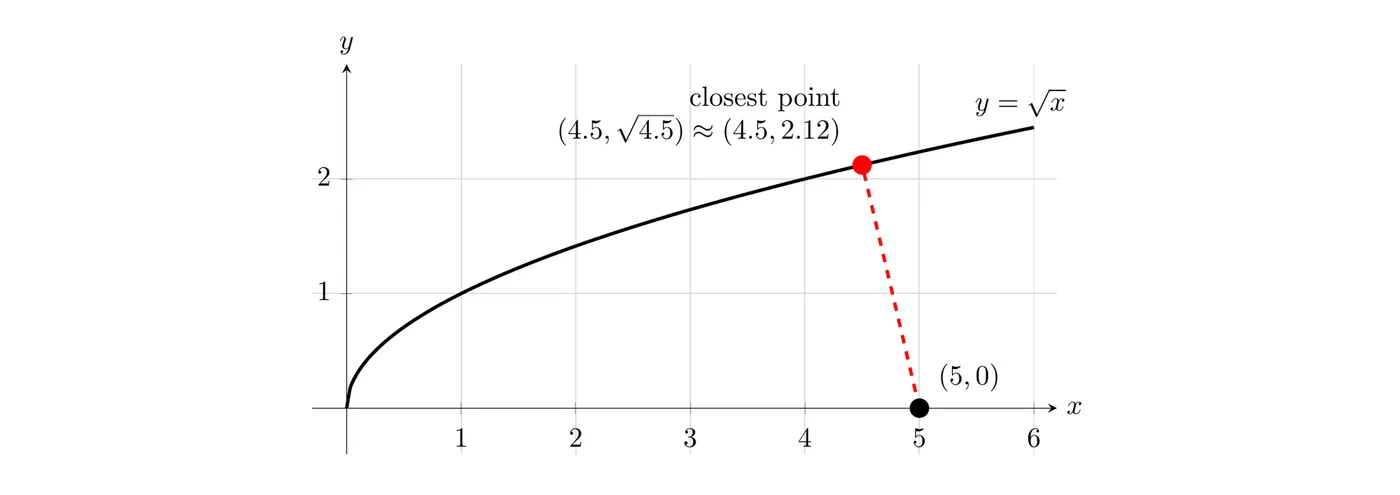
Problem: What point on the graph is closest to the point ?
Set it up the same way as Example 2 in 5.10, but with the point :
Step 4: Take the derivative with the chain rule.
Set equal to zero. A fraction equals zero only when the numerator equals zero:
Check that it’s a minimum. The denominator of is always positive, so the sign of matches the sign of : negative for and positive for . So changes from decreasing to increasing at , which makes it a minimum. Since is continuous for and this is its only critical point, it’s the absolute minimum (5.7).
Step 5: Find the point. The y-coordinate is .
Answer: the point , roughly , is the closest point to .
Example 2: Wire Between Towers (Calculator Method)
Problem: Two vertical poles stand 30 feet apart. One is 28 feet tall, the other is 12 feet tall. A wire runs from the top of each pole to a single stake on the ground between them. Where should the stake go to use the least wire?
Set it up the same way as Example 4 in 5.10 (with new heights and distance), measuring from the 12-foot pole:
Step 4: Take the derivative.
This is nasty to solve algebraically, so use the calculator.
Using the TI-84 to Solve
Enter the derivative:
- Press
Y=
- Enter the derivative equation (use
ALPHA+F1for the fraction template)
- Set the window:
WINDOWwith and (that’s the domain)
- Press
GRAPH
Find the zero:
- Press
2NDthenCALC(above TRACE)
- Choose
2:zero
- Move the cursor left of the crossing and press
ENTERfor the left bound (or just type a number like1)
- Move right of the crossing and press
ENTERfor the right bound (or type25)
- Press
ENTERfor the guess
Result:
Answer: the stake goes 9 feet from the 12-foot tower, which is 21 feet from the 28-foot tower.
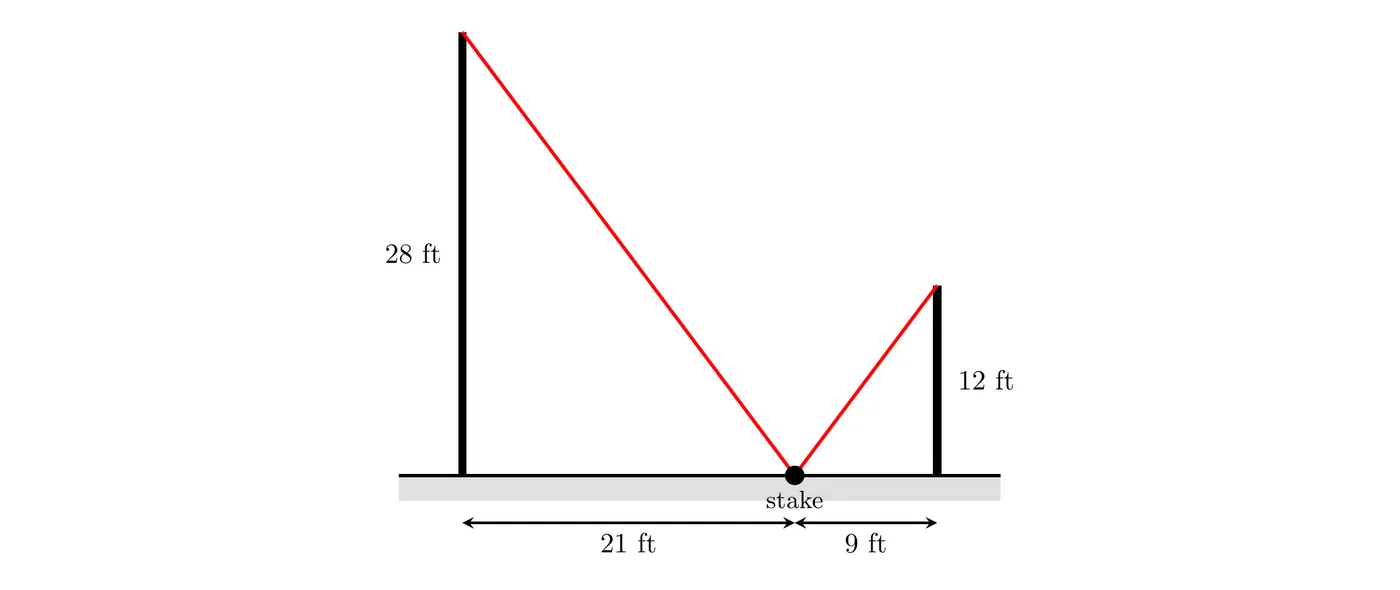
Check that it’s a minimum. On the calculator graph of , the curve crosses the -axis from below to above at , so changes from decreasing to increasing there. That makes the minimum. The shortest possible wire is:
Example 3: Particle Motion with Endpoints
Problem: A particle moves along the x-axis with position function
on the interval .
Part A: When is the particle farthest to the right?
Step 1: Velocity.
Step 2: Critical points.
Critical points: and
Step 3: Evaluate position at all candidates (endpoints and critical points ):
Calculation | ||
Using the calculator table:
- Enter into
Y1
- Press
2NDthenTBLSET, set “Indpnt: Ask”
- Press
2NDthenTABLE
- Enter
3,4,6,9
- Read the values from the Y1 column
Answer: the particle is farthest to the right at seconds, at position .
Part B: What is the particle’s maximum speed?
Remember, speed is , the absolute value of velocity.
Step 1: Acceleration.
Step 2: Critical points of velocity.
Step 3: Evaluate velocity at the candidates (endpoints and critical point ):
Calculation | ||
Step 4: Max speed.
Speeds: , ,
Answer: the maximum speed is units per second, at .
Note that even though is negative, the speed there is only 3. The max speed happens at , where the velocity is positive and biggest in magnitude.
Example 4: Box with Maximum Volume
Problem: Finish the cardboard box from 5.10 (Example 3). Squares of side inches are cut from the corners of a 20 inch by 32 inch sheet. What size squares give the box with the largest volume, and what is that volume?
From the setup in 5.10:
Step 4: Take the derivative.
Setting gives or . Only is in the domain, since you can’t cut a 13.3-inch square from each corner of a 20-inch side.
Step 5: Test the candidates. The endpoints and don’t make real boxes, but they’re still worth checking. The volume is at both, since the box would have no height or no width.
Calculation | ||
Answer: Cut 4-inch squares from each corner. The box is 24 inches long, 12 inches wide, and 4 inches tall, and its maximum volume is cubic inches.
Notice the question asked for two things. “What size squares” asks for the input, inches. “What is that volume” asks for the output, cubic inches.
The Candidates Test
On a closed interval :
- Find all critical points in the interval (where or doesn’t exist)
- Evaluate at all critical points AND both endpoints
- The largest value is the absolute max
- The smallest value is the absolute min
Why include endpoints? Because the max or min might sit right at the boundary instead of at a critical point.
Calculator Techniques
Method 1: Graphing and Finding Zeros
For derivatives that are ugly to solve by hand:
- Enter the derivative in
Y=
- Set a sensible window using the domain constraints
- Graph it
- Use
2ND→CALC→2:zeroto find where the derivative crosses the x-axis
Method 2: Table of Values
To evaluate a function at several points quickly:
- Enter the function in
Y=
2ND→TBLSET, set “Indpnt: Ask”
2ND→TABLE
- Type each value and read the outputs
Tip: press
ALPHA + F1 to get a fraction template (numerator over denominator) instead of fighting with parentheses and division.Interpreting Max and Min Values in Context
In a word problem, a maximum or minimum always means something specific. Your final answer should say what it means in a full sentence, with units.
Function | Its maximum means | Its minimum means |
Position | Farthest right (or highest) | Farthest left (or lowest) |
Speed | Moving fastest | Moving slowest |
Distance to a point | Farthest away | Closest |
Volume or area | Biggest box or region | Smallest box or region |
Cost | Most expensive | Cheapest |
Profit | Largest profit | Smallest profit (or biggest loss) |
Input vs. output: the input tells you when or where the max or min happens (a time, a cut size, a stake location). The output is the max or min value itself (a position, a volume, a wire length). In Example 3, the particle is farthest right at seconds, and its position at that time is . Read the question to see which one it wants.
Common Pitfalls
- Forgetting endpoints. Always test them.
- Ignoring domain restrictions. Some values aren’t physically meaningful, like negative lengths.
- Confusing speed and velocity. Speed is the absolute value of velocity. Negative velocity doesn’t mean slow.
- Not answering the actual question. The problem might ask “when” (time), “where” (position), or “what value” (the max or min itself). Read carefully.
Solving Checklist
- Take the derivative of the optimization equation
- Set the derivative equal to zero
- Solve for critical points (use a calculator if needed)
- Identify domain and interval restrictions
- Evaluate at ALL candidates (critical points plus endpoints)
- Compare the values to find the max or min
- Answer the specific question asked (when? where? what value?)
- Include appropriate units
Key Takeaways
- Step 4: take the derivative, set it to zero, solve for critical points
- Step 5: use the candidates test with critical points AND endpoints
- A fraction equals zero only when the numerator is zero (the denominator can’t be zero)
- For messy algebra, use the calculator to find the zeros of the derivative
- Calculator zeros: graph the derivative, then
2ND→CALC→2:zero
- The table method evaluates a function at multiple points fast
- Always test endpoints on a closed interval
- Speed is , so take absolute values
- Read the question to figure out if it wants a time, a position, or the max/min value itself
- Domain matters, use physical constraints to set your window and bounds
- Compare all candidates: largest is the max, smallest is the min