

7.10 - Reaction Quotient and Le Châtelier's Principle
Overview
Le Châtelier's principle tells you which way a system shifts. The reaction quotient, Q, tells you why. Every stress either changes Q while K stays the same, or changes K while Q stays the same for a moment. Either way, Q and K no longer match, and the system shifts until they do. This topic lets you back up any Le Châtelier prediction with a calculation.
Q, K, and the direction of a reaction
Recall from Topic 7.7: Q has the same form as K, but it uses the concentrations (or partial pressures) right now. If , there are too few products, so the net reaction runs forward (the system shifts right). If , there are too many, so it runs in reverse (shifts left). If , the system is at equilibrium.
A stress pushes Q away from K
At equilibrium, Q = K. A stress makes Q differ from K, which takes the system out of equilibrium. The system responds the only way it can: the forward or reverse reaction runs faster for a while, changing the concentrations until Q matches K again. That's the new equilibrium state.
Stresses fall into two groups:
- Stresses that change Q only: adding or removing a species, changing the volume of a gas mixture, and diluting a solution. K stays the same.
- A stress that changes K: temperature. At the instant you heat or cool the system, the concentrations haven't changed yet, so Q is the same. But K is now different.
In both cases, the concentrations or partial pressures redistribute until Q and K are equal again.
Stresses that change Q
Adding or removing a species
Adding a reactant makes the denominator of Q bigger, so Q drops below K and the system shifts right. Adding a product makes the numerator bigger, so Q rises above K and the system shifts left. Removing a species does the opposite.
Example 1: Adding hydrogen
At 430 °C, for
An equilibrium mixture has = 0.0200 M, = 0.00500 M, and = 0.0737 M. Hydrogen is injected until = 0.0400 M. (a) Calculate Q right after the addition and predict the shift. (b) The new equilibrium has = 0.0379 M, = 0.00294 M, and = 0.0778 M. Show that this mixture is at equilibrium.
(a) Right after the addition, only has changed:
, so the system shifts right and makes more . Doubling cut Q exactly in half, because appears to the first power in the denominator.
(b) Substitute the new concentrations:
Q equals K again, so this is the new equilibrium. The changes fit the 1 : 1 : 2 ratio: dropped by 0.0021 M, dropped by 0.00206 M, and rose by 0.0041 M, twice as much (within rounding).
Changing the volume of a gas mixture
Halving the volume doubles every gas concentration and every partial pressure at once. Whether that changes Q depends on the moles of gas on each side. For , right after the volume is halved:
The numerator has the higher power (2 mol of gas versus 1), so doubling everything doubles Q. Now Q > K, and the system shifts left, toward fewer moles of gas. That's the Topic 7.9 rule, now with a reason. For , the powers match (2 on top, 1 + 1 on the bottom), the factors of 2 cancel, Q doesn't change, and there's no shift.
Example 2: Compressing and
At a certain temperature, for . An equilibrium mixture has = 0.0400 M and = 0.120 M. The volume is suddenly halved. (a) Calculate Q right after and predict the shift. (b) The new equilibrium has = 0.103 M and = 0.193 M. Show that Q = K, and compare with its value before the volume change.
(a) Each concentration doubles, to 0.0800 M and 0.240 M:
, so the system shifts left, toward .
(b)
That's equal to within rounding (the concentrations are rounded to 3 significant figures). went from 0.120 M (before) to 0.240 M (right after the squeeze) to 0.193 M (new equilibrium). It ends up between the two, which is why the gas in Topic 7.9's syringe darkens, lightens a little, and stays darker than it started.
Diluting a solution
Diluting a solution to twice its volume halves every dissolved concentration. For , right after the dilution:
Q > K, so the system shifts left, toward the side with more dissolved particles. Whenever the two sides have different numbers of dissolved particles, dilution changes Q.
Temperature changes K
Temperature is the one stress that changes K. Which way K moves depends on the sign of :
Forward reaction | Raise the temperature | Lower the temperature |
Endothermic () | K increases | K decreases |
Exothermic () | K decreases | K increases |
Right after a temperature change at constant volume, the concentrations haven't had time to change, so Q is the same as before. But it no longer equals the new K:
- Endothermic reaction, heated: K goes up, so Q < K and the system shifts right.
- Exothermic reaction, heated: K goes down, so Q > K and the system shifts left.
That matches what Le Châtelier's principle says when you treat heat as a reactant or product. It also works backward: if K values at two temperatures show K growing as the temperature rises, the forward reaction is endothermic. Unit 9 explains why K depends on temperature, through .
Stress | What changes at that instant | Result |
Add a reactant | Q decreases (K is the same) | Q < K, shifts right |
Add a product | Q increases (K is the same) | Q > K, shifts left |
Halve the volume of a gas mixture | Q changes unless the moles of gas are equal on both sides | Shifts toward fewer moles of gas |
Dilute a solution | Q changes unless the dissolved particles are equal on both sides | Shifts toward more dissolved particles |
Heat an endothermic reaction | K increases (Q is the same) | Q < K, shifts right |
Heat an exothermic reaction | K decreases (Q is the same) | Q > K, shifts left |
Add a catalyst | Neither Q nor K | No shift |
Example 3: Reading a concentration-time graph (AP-style)
The graph shows and in a sealed flask. The mixture starts at equilibrium with . At times , , and , one of three stresses is applied: is added, the volume is halved, or the temperature is raised.
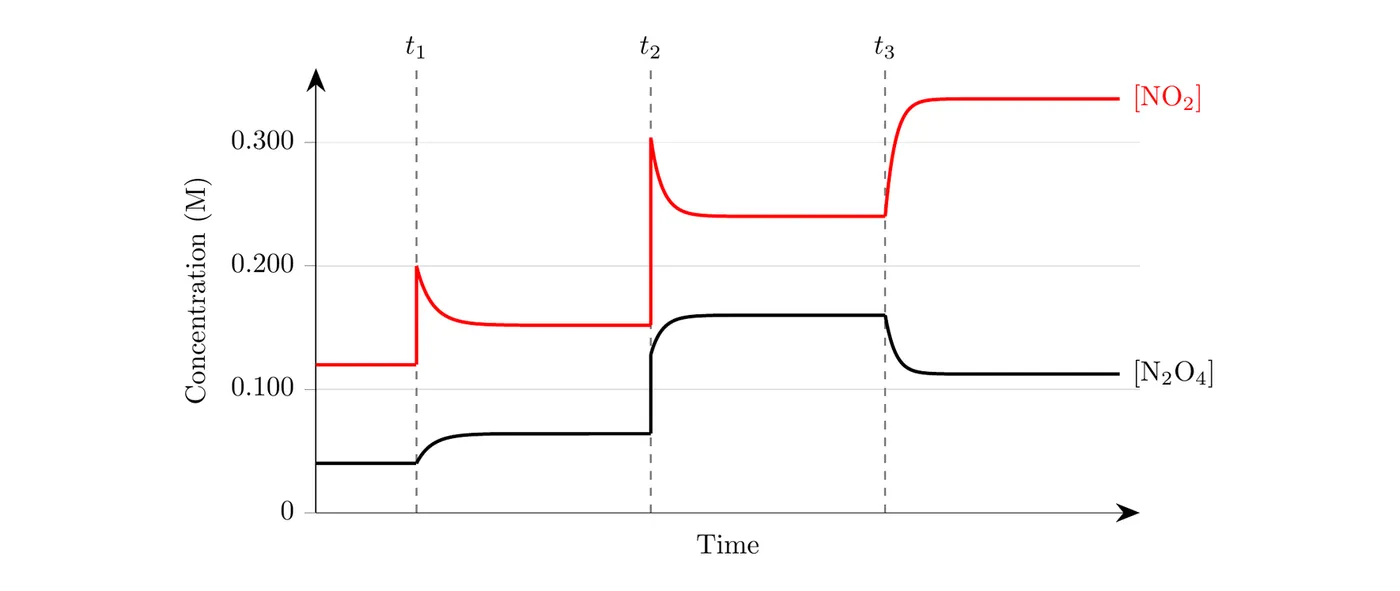
(a) Match each time to its stress, and justify each choice with the graph. (b) Calculate Q right after , and use it to explain the changes after . (c) After , the mixture settles at = 0.112 M and = 0.335 M. Calculate K at the new temperature and decide whether the forward reaction is endothermic or exothermic.
(a)
- , added: only jumps. doesn't change at that instant.
- , volume halved: both concentrations jump at the same instant, and each one doubles (0.0641 M to 0.128 M, and 0.152 M to 0.304 M).
- , temperature raised: neither concentration jumps. Both start curving smoothly at , because only K changed.
(b) Right after , = 0.0400 M and = 0.200 M:
, so the system shifts left: falls and rises until Q is back to 0.360. That happens at 0.0641 M and 0.152 M, and .
(c)
K went up from 0.360 to 1.00 when the temperature was raised. K increases with temperature only for an endothermic reaction, so the forward reaction is endothermic. The graph agrees: heating shifted the system right, toward , the endothermic direction.
Common mistakes
- Saying that adding a reactant changes K. It changes Q. Only temperature changes K.
- Using the old concentrations in Q. Use the values right after the stress, before the system shifts.
- Changing only one concentration when the volume changes. A volume change scales every gas concentration by the same factor.
- Drawing a jump at a temperature change. At constant volume, concentrations change gradually after heating. Only K jumps.
- Reading Q > K as "shift right." Q > K means there's too much product, so the reverse reaction wins and the system shifts left.